Malaysia Flexible Workspace: 590-Day Crucible
On 18 March 2020, every coworking space in Malaysia was ordered to close without a reopening date. The Movement Control Order ran, in various waves, for 590 days. The operators who emerged from it are now building one of Asia-Pacific's fastest-growing flexible workspace markets. This is what survived.
590天之后:马来西亚灵活办公的生存版图
The 590 days that sorted the field
On 18 March 2020, the Malaysian government sent a single WhatsApp broadcast to the nation: effective midnight, non-essential businesses were to close. For coworking operators, there was nothing to debate. Their entire value proposition — people showing up to shared space — was illegal.
The closure lasted, in various forms, for 590 days.
By April 2022, when Malaysia completed its endemic transition and removed workplace capacity limits, the flexible workspace sector had been transformed. Weaker operators had closed. Survivors had discovered what they were actually building. By 2024, Kuala Lumpur ranked among Asia-Pacific’s fastest-growing cities for flexible workspace demand — drawing the attention of international real estate investors who had dismissed the market only four years earlier.
This is the story of a sector that should not have survived — and what its survival actually means.
From serviced offices to a founding wave
The operators who survived 590 days of lockdowns are now building one of Asia's fastest-growing flex workspace markets.
Malaysia’s flexible workspace story begins in 1998, in Johor Bahru, when a company called MEN iNN WORK opened what may be the country’s first serviced office complex. The concept was simple: furnished offices, shared reception, virtual addresses for companies that needed a professional presence without a full lease. MEN iNN WORK has operated without interruption ever since, through the Asian Financial Crisis aftermath, the Global Financial Crisis, and three waves of MCO lockdown.
Five years later, vOffice entered Malaysia with a virtual office model developed in Melbourne by Indonesian entrepreneurs who had met during the 1997 Asian crisis. Both vOffice and MEN iNN WORK understood something the later generation of coworking founders would independently rediscover: in a market where commercial leases demand long commitments and company formation requires a registered address, flexibility is not a lifestyle amenity. It is a business infrastructure necessity.
The coworking concept — shared space designed for community, not just cost efficiency — arrived in Malaysia in 2010 when Paper + Toast opened at Bukit Bintang. Pat Teoh conceived the idea; Wan Imran Wan Abdul Rahaman ran the operations. The space hosted over 600 startups over its history, introducing Kuala Lumpur to the proposition that an office could function as social infrastructure. Three years later, Daniel Yap opened Nook on a Bangsar hilltop as an anti-thesis to conventional offices — a café-like space that became, incidentally, the first physical merchant in Malaysia to accept Bitcoin.
These were pioneering years, but not yet a sector.
The sector arrived in 2017. Colony, Common Ground, WORQ, INFINITY8, and Co-labs all launched within months of one another. MDEC formalized the ecosystem with the Malaysia Digital Hub program, certifying qualifying coworking spaces as digital hubs with tax incentives and a technology entrepreneur visa pathway. Knight Frank recorded 36 percent supply growth in Kuala Lumpur’s flexible workspace market by 2018. By 2019, WeWork opened what was then Southeast Asia’s largest coworking space at Equatorial Plaza in KL — five floors, nearly 1,900 member capacity. The global coworking brand’s arrival was confirmation: the market had reached critical mass.
Then the MCO arrived.
Five markets, five different reasons
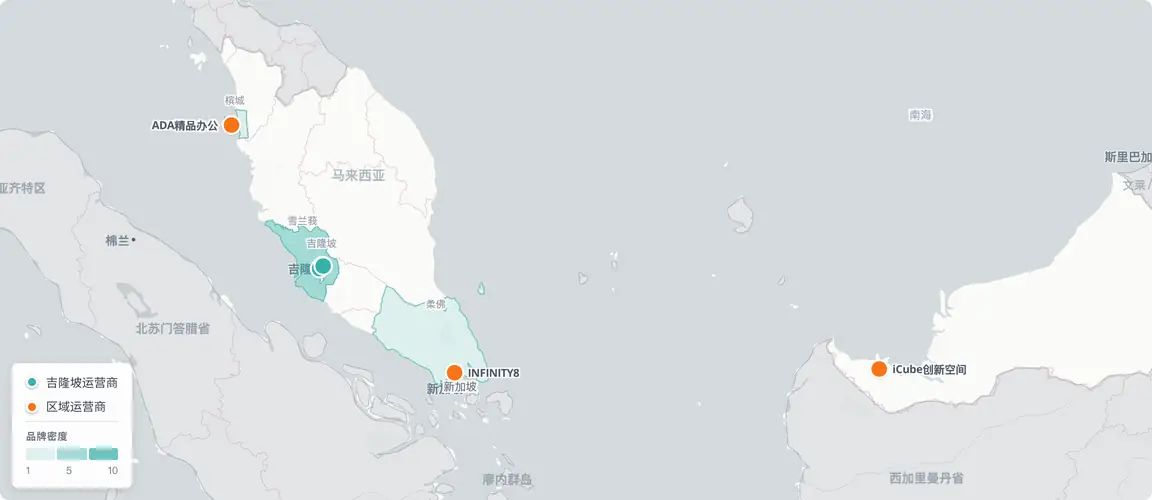
Malaysia’s flexible workspace sector is not a single market. It is five distinct markets, each with its own demand drivers, its own founding stories, and its own reasons why flexible workspace makes structural sense.
The Klang Valley anchors the sector. Malaysia’s largest concentration of multinational and domestic corporate headquarters sits here, surrounded by a dense ecosystem of professional service firms, startups, and digital economy businesses that cannot be served by a traditional commercial lease. The city’s unusual surplus of vacant office space — once a liability landlords managed by avoiding coworking operators — has become an asset, as those same landlords increasingly court flexible workspace brands as fill-rate partners, creating a pipeline of incoming supply on favorable terms.
Penang carries a different character. The industrial base in Bayan Lepas — global electronics and semiconductor manufacturers — generates steady demand from engineers, supply chain managers, and professional services firms embedded in the manufacturing ecosystem. Georgetown adds a second layer: heritage shophouses within the UNESCO World Heritage buffer zone have proven well-suited to coworking conversion in ways that purpose-built commercial towers cannot replicate. ADA Serviced Office, which began in 2008 from a single 200-square-foot shophouse, has spent nearly two decades building what its founder describes as a “simple luxury” standard — the island’s most durable professional workspace brand.
Johor Bahru is structurally unlike any other market in the country. More than 300,000 Malaysians cross the Causeway to Singapore for work each day, and when the JB-Singapore Rapid Transit System Link opens — a six-minute crossing targeted for late 2026 — the commute economics shift fundamentally. Office rents in JB run substantially below Singapore equivalents. For Singapore-based businesses needing operational space, or Malaysian professionals returning from Singapore employment, the arbitrage is hard to ignore. The Johor-Singapore Special Economic Zone, signed in January 2024 and spanning more than 3,500 square kilometers across nine flagship zones, deepens this logic further — the most significant cross-border economic project in the region in decades.
Sarawak operates on its own terms. The Sarawak Digital Economy Corporation manages nine Digital Innovation Hubs across the state and runs its digital economy strategy largely independent of federal programs, including an MOU with Tech Barcelona. The result is a workspace market shaped more by government strategic intent than by organic startup demand. iCube Innovation in Kuching, run by Patrick Liew and his son Melvin Liew, holds MDEC MSC Incubator status and originated the global Free Coworking Day initiative, now observed in more than 20 cities worldwide.
Cyberjaya completes the picture as Malaysia’s purpose-built technology city. The Malaysia Digital Hub certification program — which grants qualifying coworking spaces the right to offer member companies tax incentives and the Malaysia Tech Entrepreneur Programme visa — runs primarily through Cyberjaya-based operators. For international technology companies entering the Malaysian market, an MDEC-certified space offers a regulatory on-ramp that a standard commercial lease cannot provide.
Why you haven’t heard of this
Malaysia’s flexible workspace sector has a visibility problem that has nothing to do with quality. It has everything to do with geography, language, and the long shadow of a larger market sitting across a 1.05 kilometre strait.
Singapore’s workspace market is mature, internationally profiled, and priced accordingly. When global real estate consultancies write about Southeast Asian flexible workspace, Singapore anchors the analysis. Kuala Lumpur, two hours north by high-speed rail and three hours by road, appears as a footnote — if at all. Yet Malaysia’s workspace penetration rate as a share of total office stock sits well below the Asian average. The gap between where Malaysia is and where markets typically settle at maturity represents genuine commercial runway.
This invisibility is reinforced by how workspace data gets collected. The Instant Group, CBRE, and JLL generate regional reports that aggregate APAC markets — but the detailed intelligence on which operators are growing, which founders are building something durable, and which brands have survived genuine crisis comes from local sources: The Edge Malaysia, Vulcan Post, BFM 89.9, EdgeProp. These sources publish primarily in English, but their distribution ends at the Malaysian border. An international investor conducting market research through English-language financial media will find KL’s workspace sector chronically underrepresented.
The sector’s invisibility is compounded by the nature of what flexible workspace sells. A logistics hub or a manufacturing cluster produces statistics that travel: export volumes, production figures, trade flows. A coworking space produces occupancy rates, membership counts, and member companies that generate their own statistics elsewhere. The workspace sector’s output is invisible precisely because its output is the work of others.
The intelligence gap sits in that space between what exists and what is documented. The sector is real. The founders are documented. The crisis test was administered in public, and the results are published.
The decisions that cost something
The MCO’s first wave arrived on 18 March 2020. For Colony’s (founded in 2017) co-founder Timothy Tiah, the warning signs had been visible a month earlier. Events revenue — which represented roughly one-third of Colony’s total income — had already collapsed in February as corporate clients began cancelling. Group profits fell more than 60 percent from January to February before the lockdown was even declared.
Tiah implemented what he called the Red Alert protocol — a traffic-light cost management system designed to preserve both the business and its culture. He and his wife and co-founder Audrey Ooi took 50 percent pay cuts. His general manager took 25 percent. Staff costs were reduced by 20 percent. But Tiah made one decision that seemed counterintuitive to anyone focused purely on surviving: he protected Colony’s hospitality budgets. The travel adaptors at member desks. The after-work dinners. The service details that defined what Colony was. His reasoning was specific: cutting quality at the moment members needed confidence most would create an irrecoverable reputational spiral.
Colony’s KL Sentral location was permanently closed. Star Boulevard, built for RM5 million as an events-focused flagship, never recovered and closed in 2025. The personal cost was documented publicly and precisely: Tiah was diagnosed with Mixed Anxiety Depressive Disorder in 2020. He disclosed his diagnosis proactively to investors and shareholders, expecting them to lose confidence. They did not. He has since spoken openly about mental health in business contexts — making him one of the few Malaysian founders to have done so.
By 2022, Colony reported 74 percent revenue growth and 265 percent EBITDA growth. Jerry, the automated budget sub-brand Tiah created during the pandemic — private offices only, PIN-code entry, no reception staff, pricing at a fraction of Colony’s premium tier — achieved 619 percent revenue growth the same year.
At WORQ (also founded in 2017), co-founder Stephanie Ping was facing a different version of the same crisis. Business inquiries dropped 50 to 60 percent in March 2020. The question was not whether revenue would fall — it would — but whether the membership base would survive. Ping deployed roughly half a million ringgit in member relief programs across multiple waves: digital marketing support, business continuity consulting, deferred payments, and direct assistance to member companies whose own revenues had collapsed.
In September 2020, with Malaysia in the depths of the pandemic’s most uncertain phase, Ping raised RM10 million from seven follow-on investors. The investment came during the pandemic’s worst months, not after them. Her reasoning, and theirs: a workspace operator who could maintain profitability through consecutive lockdowns while giving away close to half a million ringgit in member support had demonstrated something that couldn’t be faked. WORQ’s membership paradoxically grew 15 percent during the MCO period, as corporations downsizing traditional offices redirected their teams to flexible alternatives.
By mid-2022, WORQ was at 90 percent occupancy with waiting lists. In 2025, WORQ Well — a wellness-oriented workspace in Bangsar — became the first coworking space in Malaysia to receive WELL Coworking certification. It achieved full occupancy on its first day of operation.
Lee Sheah Liang had built INFINITY8 from 1,400 square feet and four coworkers in a Johor Bahru shophouse. The JB location was both the business’s strength and its vulnerability: roughly 40 percent of INFINITY8’s clients were Singaporean. When Malaysia closed its borders on 18 March 2020, that client base effectively ceased to exist.
In December 2021 — during the most severe phase of Malaysia’s lockdown regime, while the sector was contracting — Lee expanded INFINITY8 into Kuala Lumpur. The decision to grow when every market signal argued for caution was deliberate. His reasoning: the operators who survived the lockdown most intact would inherit the market’s recovery, and entering KL at a moment of suppressed competition was the lowest-cost entry point he would ever see.
INFINITY8 received the PropertyGuru Best Coworking Space in Asia and Malaysia award in 2022. The dual-brand strategy Lee developed during the pandemic — premium INFINITY8 for enterprise clients, budget-positioned KONGSI WORK for SMEs and students — now spans fourteen locations across Johor Bahru, Kuala Lumpur, and Penang.
Juhn Teo and Erman Akinci had built Common Ground into Malaysia’s largest domestic coworking operator, with fourteen locations across the country and early international expansions into the Philippines and Thailand. When the MCO hit, the business model that had driven their expansion — relatively high-density, community-oriented shared workspace — was exactly what the lockdown prohibited.
The decision they made was structural. In August 2022, as Malaysia completed its endemic transition, Common Ground merged with Hong Kong’s The Hive and Australia’s The Cluster to form The Flexi Group — a pan-Asian entity spanning 45 locations across nine countries. The merger did not resolve every challenge: a planned Nasdaq listing via SPAC was terminated in February 2024 before completing. But the organization remains the largest regionally-anchored flexible workspace operator in Asia, with $71.5M USD in total funding and a Malaysian founding story at its core.
Rashvin Pal Singh runs Mereka Space, a 12,000 square foot makerspace at Publika in Kuala Lumpur. When the MCO shuttered all non-essential businesses, Mereka’s fabrication labs — wood workshops, electronics benches, 3D printers, metal equipment — went dark.
On 1 April 2020, with Malaysia facing a critical shortage of personal protective equipment, Pal Singh and his co-founder Juliana Adam decided to repurpose everything. They announced a public fundraising campaign and began producing face shields from the machines that normally built furniture and electronics prototypes. The public contributed RM140,000. Mereka produced more than 20,000 face shields, delivering them to 75 organizations across Malaysia.
Mereka Space is not a conventional coworking operation. Its model — part makerspace, part social enterprise, part creative industry incubator — does not map neatly onto the sector’s mainstream. But its COVID pivot demonstrated something that the founders of Colony, WORQ, INFINITY8, and Common Ground demonstrated in different ways: the flexible workspace operators who survived the MCO did so not by reducing what they offered but by finding what they were actually built to do.
Not every survival story required reinvention. ADA Serviced Office in Penang, which Louis Soo founded in 2008 from a 200 square foot shophouse, represents the sector’s quiet endurance. Eighteen years after opening, ADA operates across multiple Penang locations with ISO 9001 certification and a service model that has outlasted three economic shocks. Soo has not sought national visibility. The business has not needed it.
The multicultural advantage
Malaysia’s coworking sector operates in a business environment unlike any other in Southeast Asia. Three communities — Malay, Chinese, and Indian — each with distinct commercial traditions, financing networks, and business cultures, share a market where English is the primary business language and where government policy actively tries to bridge these communities through entrepreneurship programs.
The 2017 founding cohort reflects this complexity. Timothy Tiah and Lee Sheah Liang are Chinese-Malaysian entrepreneurs. Stephanie Ping returned after her Stanford education to build in KL rather than stay in the US — a choice that shaped WORQ’s founding ethos. Rashvin Pal Singh brings an impact-oriented model rooted in the Indian-Malaysian social enterprise tradition.
The MDEC Malaysia Digital Hub certification program creates a formal gateway for this multicultural enterprise activity: qualifying coworking spaces can offer member companies access to the Malaysia Tech Entrepreneur Programme visa, which has been used by entrepreneurs from more than 60 countries to base their operations in Malaysia. The tax incentives extend to all qualifying companies regardless of ethnic background or national origin.
Halal-friendly workspace infrastructure — prayer rooms, Muslim-friendly dining — appears across multiple operators as a cultural default rather than an add-on, giving Malaysian brands a fluency that international entrants must build deliberately.
The resulting market is, by Southeast Asian standards, unusually legible to international operators and tenants. English functions as the business medium. The contractual environment is familiar to common-law-trained lawyers. The workforce navigates English, Malay, and often Mandarin without friction.
Two structural changes, documented in parallel
Two structural changes are reshaping Malaysia’s flexible workspace market at the same time.
The first is the Johor-Singapore Special Economic Zone, signed in January 2024. The JS-SEZ covers more than 3,500 square kilometers and includes nine flagship development zones across Johor state. The JB-Singapore RTS Link, a six-minute crossing, is under construction to collapse the effective distance between the two cities. INFINITY8 already reports that approximately 40 percent of its Johor Bahru client base is Singaporean — a proportion recorded before the RTS Link has even opened.
The second is the announcement by IWG — the global flexible workspace group that operates Regus, Spaces, HQ, and Signature brands — of a target to expand from its current 45 Malaysia centers to 160. IWG’s expansion decisions are driven by the company’s own quantitative market analysis; a 3.5x center-count target from the world’s largest flexible workspace operator is itself a documented data point about the market’s measured penetration gap and demand.
For domestic operators, IWG’s expansion brings international brand recognition to a market that flexible workspace buyers outside Malaysia have largely ignored. Local operators bring a different set of assets to that same enterprise-tenant conversation: cultural fluency, local relationships, and a crisis record — the 590 MCO days — that an international entrant does not carry.
The enterprise segment is the sector’s most significant structural evolution. Malaysia’s flexible workspace operators have been building capabilities that function as workspace infrastructure rather than desk rental alone. WORQ has sold pre-committed enterprise space to major corporate clients, locating deliberately near transit hubs to serve corporate mobility programs. INFINITY8 has added employer-of-record services, HR outsourcing, and payroll administration as integrated offerings. Co-labs, backed by Paramount Corporation, is pursuing 300,000 square feet of managed workspace for corporate tenants. These are not coworking businesses expanding into adjacent services. They are workspace infrastructure providers whose origins happened to be in coworking.
A desk rental business scales with headcount. A workspace infrastructure company scales with enterprise contract value — a structural difference documented across WORQ, INFINITY8, and Co-labs’ 2024–2025 service expansions.
What survives 590 days of lockdown
Malaysia’s flexible workspace sector offers something unusual for anyone trying to understand the market: a complete natural experiment. Every operator in the sector faced the same exogenous shock — 590 days of intermittent legal prohibition on their core business — at the same time. The differences in how they survived, what they chose to protect, and what they built on the other side reveal the organizations’ actual characters with unusual clarity.
Malaysian flexible workspace grew after the pandemic — Kuala Lumpur reached 78 percent flex-demand growth by 2024. Within that growth, the record separates two groups: operators who built institutional capabilities — crisis documentation, enterprise relationships, quality standards maintained under the 2020 Red Alert protocols — from operators whose growth tracked the market’s broader recovery.
The MCO record provides something due diligence normally cannot generate directly: a public, dated account of what operators actually did when the pressure was at its maximum, across every operator in the sector, at the same time.
For the operators themselves, the period produced something unexpected. Founders who had built their businesses in favorable conditions discovered, during 590 days of intermittent lockdown, what they were actually building. The workspace sector that emerged in 2022 was not a resumption of the 2019 trajectory. It was a different sector, operated by founders who knew exactly what they were capable of — and what they were not.
That lesson is not specific to coworking. Colony protected its hospitality budgets while cutting founder pay by half. WORQ gave away half a million ringgit in member relief and raised capital during the pandemic’s worst months. INFINITY8 expanded into Kuala Lumpur in December 2021, when every market signal argued against it. None of the three organizations returned to their 2019 position — each occupies a different one, built during 590 days that every competitor in the sector lived through at the same time, in public.
跳至主要内容