 跳至主要内容
Hyderabad Ethnic-Wear: The Bazaar Ratings Miss
A Hyderabad trading house has operated continuously since 1881 — six generations, a family that fled the city in 1953 and rebuilt from nothing — and carries not one disclosed financial figure in the public record. The sector's only rated apex chain has revenue data down to the quarter.
海得拉巴:五个片区,一个获评级品牌
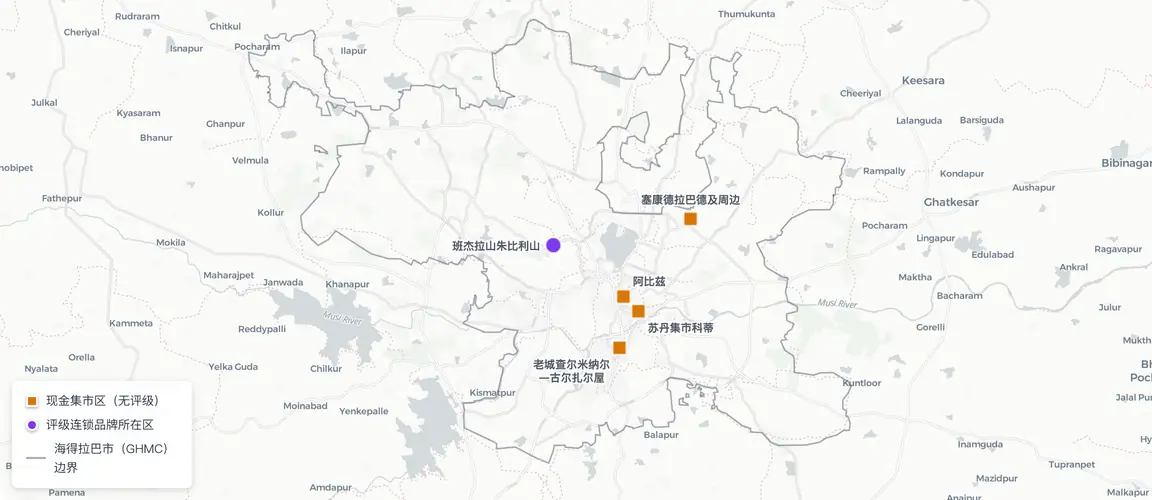
One rated ledger, three undocumented centuries
On 27 February 2025, CARE Ratings quietly withdrew its rating on Anutex Shopping Mall LLP and flagged the issuer “Not Cooperating.” Two years earlier, the same agency had recorded a 15% revenue jump — Rs 82.46 crore to Rs 95.55 crore — for a three-generation Hyderabad family chain running 7-8 large-format stores across the Secunderabad catchment. Then the paper trail simply stopped. Whatever Anutex has done since, no institutional record shows it.
Neeru’s, a few kilometers away in Hyderabad’s premium retail district, tells the opposite story: rated by Acuité Ratings & Research, filed at Rs 231.43 crore for FY2024, up from Rs 191.74 crore the year before, with a Q1 FY2025 figure already on record. Same city, same general scale of operation, and a visibility gap that has nothing to do with either business’s actual size.
This is not a story about one company outperforming another. It is a story about what makes a company visible at all.
What survived the purges — and stayed invisible anyway
Our business usually picks up after 5 p.m when people break their fast. Yet during a shutdown, more than 40 per cent business is affected.
Hyderabad’s ethnic-wear and saree retail sector did not spring up recently. Its oldest houses predate Indian independence by decades. Singhania’s traces to 1881, when Seth Nandlal Singhania’s family moved from pearls into textiles under the Nizam, eventually becoming a court textile distributor — a lineage that would later be interrupted, and then deliberately continued, across a rupture most Indian retail dynasties never had to survive. Anutex, founded in 1970 by P Ramakrishna Rao, is now three generations deep and runs 7-8 large-format stores across the Secunderabad catchment, a scale that in almost any other Indian city would have produced a regional trade-press profile by now. Meena Bazar Hyderabad opened in 1971 under Doulatram Jethwani, the same year Basant Kaur and her son Harish Kumar began the tailoring-and-embroidery operation that would become Neeru’s — two businesses starting in the same city, the same year, on trajectories that would diverge completely in how visible each one became.
None of these four houses is young. None of them is small by the standards of Indian family retail — Anutex alone operates enough floor space to anchor a suburban shopping district, and Singhania’s has outlasted the political system it was born under. And until a credit-rating agency chose to rate Neeru’s debt, none of them appeared in any institutional record that an outside investor, distributor, or acquirer would think to search. Not a trade database, not a franchise directory, not the kind of desk-research report an analyst would produce before recommending a market entry.
That is the sector’s actual structure, and it has almost nothing to do with company size. It has to do with a specific, narrow mechanism: whether a business’s owners ever chose to seek external credit rated by an agency whose findings become public.
Five zones, one visible district
Hyderabad’s ethnic-wear trade is not scattered across the city at random — it clusters in five identifiable commercial zones, each with its own character, and the distribution itself tells the sector’s story before a single balance sheet enters the picture.
The Old City, radiating out from Charminar and Gulzar House, carries the largest share by far: some 20,000 traders working showrooms and roadside stalls along a two-kilometer stretch from Nayapul junction to the Charminar bus stand, a density of commerce that has functioned continuously through Ramzan seasons, lockdowns, and political upheavals the rest of the city barely registers. This is the heartland of embroidered sarees, khada dupatta, sherwani, bridal wear, and lac bangles — Deccani-Muslim retail tradition at genuine commercial scale, and almost none of it belongs to a rated, institutionally-documented entity.
Sultan Bazar and Koti, a Residency-era saree mile with more than a hundred textile shops, functions as the city’s mid-market corridor — silk and cotton sarees, dress materials, affordable ethnic wear sold at volume rather than margin. Abids, the legacy retail spine linking Koti to the premium north, is where Meena Bazar Hyderabad sits — itself a business whose own identity gets tangled in searches for two other Meena Bazaars entirely.
Secunderabad and its suburbs — Malkajgiri, AS Rao Nagar, Kukatpally, Uppal — form a different kind of cluster: family-chain catchment territory, built around wedding and festival wear sold to a broad mass-market audience rather than a tourist or luxury one. This is Anutex’s home ground, and its scale here is real even if its current financial disclosure is not.
Only Banjara Hills and Jubilee Hills — the smallest of the five zones by trade share — carry the sector’s premium, destination-retail character: luxury store theatre, designer sarees, high-end bridal lehengas. It is also, not coincidentally, the one district where the sector’s only credit-rated chain chose to build its flagship. Neeru’s Emporio opened here in 2012, and Singhania’s — six generations removed from its 1881 origin — operates here too, one documented brand and one undocumented one sharing the same premium address.
Why the bazaar doesn’t show up on a database
Institutional discovery tools — the databases that surface acquisition targets, distribution partners, and franchise candidates — are built to scan mandatory public filings and voluntary credit disclosures. In India’s listed and venture-backed retail sector, that produces a reasonably complete picture. In India’s founder-owned, debt-financed family retail sector, it produces almost nothing, because rating an unlisted company’s debt is optional, and most family houses in this category never do it.
Neeru’s became visible because it sought a credit rating — Acuité’s RR-20240819 filing, dated August 2024, is now the single most cited document about the entire sector, cited more than any trade-press feature or government register. Anutex sought one too, and CARE Ratings recorded a 15% year-on-year improvement to Rs 95.55 crore in FY2023. But by early 2025, CARE had withdrawn the rating and flagged the issuer “Not Cooperating” — a label that says nothing about whether Anutex is still performing, only that it stopped participating in the process that would have kept it visible.
Singhania’s never entered that process at all. Neither, in its current form, did Meena Bazar Hyderabad — whose own financial history is complicated further by a naming overlap. A related entity, New Meena Bazar International Private Limited, reported Rs 146.99 crore in FY2017 before being absorbed around Vedant Fashions’ 2017 acquisition of the separately-named Mebaz brand. That figure belongs to an entity connected to, but distinct from, the still-operating Meena Bazar Hyderabad business — a confusion compounded by the existence of an entirely unrelated Meena Bazaar in Delhi. Three names, three ownership histories, one shared surname across two of them, and a public record that resolves almost none of it cleanly.
This is what an intelligence gap looks like when it isn’t about hidden geography or a language barrier alone — it’s a gap created by the specific mechanics of voluntary disclosure. A business can be a century old, multi-generational, and structurally sound, and still be functionally invisible to anyone relying on standard due-diligence tools.
It compounds because the vernacular press, which does cover this sector richly, covers it as place rather than as institution. Telugu and Urdu outlets report the Old City bazaar corridor in detail — trader counts, Ramzan-season shopping surges, the rhythm of a two-kilometer commercial stretch that has outlasted every retail format innovation of the last fifty years. What they almost never do is profile an individual family business as a company with a history, a balance sheet, and a named successor. Place journalism and company journalism are different genres, and Hyderabad’s ethnic-wear economy has abundant coverage in the first and almost none in the second — in any language, including English. The result is a sector that is simultaneously well-documented as geography and almost entirely undocumented as commerce.
Who’s still standing
Neeru’s is the sector’s clearest case of crisis surviving into documented recovery. Founder-chairman Harish Kumar died in June 2019, and Avnish Kumar succeeded him as Chairman and Managing Director — a transition that, in most sectors this opaque, would have happened without leaving a trace on the public record at all. Within a year, COVID-19 store shutdowns brought the business to zero sales — Avnish Kumar has described it plainly: “Many of our stores were shut down, and we had zero sales. I never imagined days like that would come. But somehow, we found the strength to get through it, keep the business afloat and move forward.”
The decision he faced was not abstract: retrench toward the stores that could still open, or commit capital toward an omnichannel rebuild while the core business was still bleeding. He chose the second path, and the recovery that followed is now on the public record in a way almost nothing else in this sector is: Rs 231.43 crore in FY2024, up from Rs 191.74 crore the year prior, an operating margin of 12.71%, a network of roughly 45 showrooms, and a 2012 flagship — Neeru’s Emporio, a 30,000 square foot store in Jubilee Hills — that set the template for premium retail theatre in the district years before the crisis arrived.
Anutex, by contrast, shows what happens when the same kind of scale exists without the same continuity of disclosure. Three generations deep under the Rao family, 7-8 large-format stores across Secunderabad, and a documented 15% revenue improvement — from Rs 82.46 crore in FY2022 to Rs 95.55 crore in FY2023 — and then the rating simply stops. CARE Ratings’ own release does not say the business failed; it says the issuer stopped cooperating with the rating process, which is a different fact entirely, and one that a database scanning for “distressed” or “delisted” flags would badly misread. Whatever Anutex has done since early 2025 is not on any public record Brandmine could locate — not because the business went quiet, but because the one channel that had made it visible went quiet first.
Singhania’s carries the sector’s deepest history and its thinnest paper trail. The 1881 founding under Seth Nandlal Singhania predates most Indian retail dynasties by a century, rooted in a pearl-and-textile trade that served the Nizam’s court directly. The 1953 Jagir Abolition — the dismantling of the Nizam-era jagirdari estate system that the family’s trade depended on — forced them from the city; the fact that they returned, rebuilt, and eventually formalized a modern retail operation in 2002 is a survival story spanning nearly half a century between rupture and recovery, with no financial figures attached to any part of it. Sixth-generation head Sailesh Singhania has since diversified into designer fashion, showing at Lakme Fashion Week on three occasions — a visible creative record layered directly over an invisible commercial one, as if the family decided which parts of the business the public gets to see.
Meena Bazar Hyderabad occupies the strangest position of the four: real, operating, and founded the same year as Neeru’s, but permanently entangled — in searchable records, in casual conversation, in anyone’s first attempt to research this sector — with two other businesses that share its name or its founding family’s name but not its current ownership or operations. Doulatram Jethwani’s Hyderabad house is distinct from the unrelated Meena Bazaar in Delhi, and distinct again from Mebaz, a separate Jethwani-linked business sold to Vedant Fashions in 2017. A related entity, New Meena Bazar International Private Limited, reported Rs 146.99 crore for FY2017 — but that figure describes the entity absorbed into the Mebaz sale, not the Meena Bazar Hyderabad business that continues trading in Abids today. Three names, two founding families sharing a surname, and a public record that resolves almost none of it without direct verification.
Beyond the balance sheet
None of this is a story about businesses that failed to build something real. Ethnic wear and sarees are not a peripheral category in Hyderabad — they run through wedding economies, festival cycles, and daily dress in a way few retail categories do, and the city’s Old City bazaar corridor has functioned as a commercial and cultural institution for generations, independent of whether any single retailer inside it ever files a public number.
The Ramzan shopping surge alone is enough to illustrate the scale of what standard business intelligence misses. Every year, the two-kilometer stretch from Nayapul to Charminar absorbs a spike in foot traffic that outlets like The Siasat Daily have covered for decades, reporting more than 20,000 traders working the corridor across showrooms and roadside stalls. That kind of seasonal intensity, repeated annually for generations, is precisely the texture that never survives translation into a database field. It is cultural infrastructure first and commercial infrastructure second, and the two are inseparable in the Old City in a way institutional intelligence tools are not built to represent.
The families behind these four houses built businesses that outlasted the Nizam-era transition, the 1953 estate reforms, and — in Neeru’s case — a founder’s death arriving within a year of a pandemic that emptied every showroom in the city. Continuity across a century is not a footnote to a financial story. In a sector this old, it may be the more reliable signal — a signal that has nothing to do with whether an agency chose to rate the debt behind it.
Why this matters now
Neeru’s succession is not a historical curiosity — it is a live, documented case of exactly the transition institutional buyers look for and rarely find on the record. A founder’s death in 2019, an immediate crisis in 2020, and a recovery that reached the public filing system by 2024: that is a five-year arc with dates, figures, and a named successor, sitting in a sector where almost nothing else is dated or figured at all. Meanwhile, a new pressure is building at the sector’s edge — 2025 US tariffs now threaten roughly Rs 42 crore a year of Telangana handloom textile exports, a supply-layer disruption that will eventually work its way into retail margins across every house in this cohort, rated or not.
The businesses that will define this sector’s next decade are not necessarily the ones building fastest. They may be the ones that choose, for the first time, to become visible — and the ones that never do will not have failed. They will simply have stayed exactly as they’ve always been: real, operating, and off the record. A rating agency captured five years of one Hyderabad chain’s history because that chain asked it to. Three peer houses of equal or greater age never made that choice, and nothing about their absence from the public record says anything about whether they are still standing.
研究涵盖英语、TE、乌尔都语,共33 篇来源。