 Перейти к основному содержанию
TEGIN
Three times in 24 years the market tried to close TEGIN down — 2008's US collapse, 2020's cancelled show, 2022's sanctions. Each time, a commercial Mongolian-cashmere line no one talks about paid for the uncommercial 'intellectual fashion' line no one can copy to stay uncompromised.
Кашемир из Монголии, овчина из Стамбула, пошив в Москве
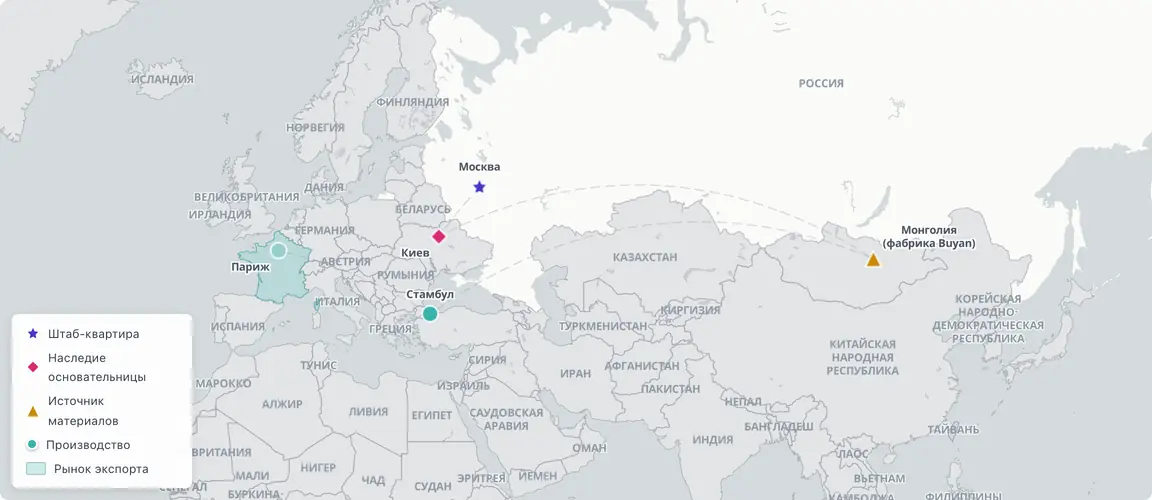
Three shocks, one cashmere line, one house still standing
Three times in twenty-four years, the market has tried to close TEGIN down. In 2008 it was the US expansion collapsing into the financial crisis; in 2020, a cancelled runway show; in 2022, sanctions that cut fabric stocks to roughly a season and erased the house’s European buyers. Each time, the same commercial line paid for the house to keep its uncommercial core intact.
Strategic Hook
TEGIN calls itself “intellectual fashion” — a deliberate stand against the ironic, streetwear-inflected image some Russian design has carried abroad. “A thing without a concept is nothing,” founder Svetlana Tegin told Posta-Magazine in 2018, “that’s why my fashion is called ‘intellectual.’” The house’s visual signature — draped, multi-layered silhouettes, a recurring Mongolian motif drawn from her long fascination with the Gobi — has never chased volume. What has let a conceptual house survive twenty-four years of Russian market turbulence is not the concept itself but its financial shadow: Tegin Cashmere, a separate, deliberately commercial line launched the same year as the runway collection, sourced directly from Mongolia and sold as knitwear rather than as art. The pattern that recurs at every crisis point in the house’s history is the same — the cashmere line absorbs the shock so the conceptual line does not have to compromise.
Origin & Catalyst
TEGIN opened in Moscow in 2001, launching two lines simultaneously rather than one. The Tegin Collection carried the house’s seasonal, runway-facing identity; Tegin Cashmere, sourced from the start through direct relationships in Mongolia, gave it a category with almost no domestic competitor — the house built a two-decade sourcing relationship with Buyan Cashmere before “sustainable sourcing” became a marketing category anyone else bothered to occupy. The split was not incidental. Svetlana Tegin has described the startup capital coming from her husband selling his family’s art collection — a decision made once, at the outset, that then required a structure durable enough not to need repeating. Pairing a commercial knitwear line with a conceptual runway line from the first year gave the house exactly that: a way to keep making difficult, uncommercial clothes without needing a second capital event every time the market turned. The atelier moved to the Vinzavod contemporary-art centre around 2008 — a fashion house choosing a converted wine factory turned gallery complex over a retail district, signalling from its address alone that the runway line’s audience was never meant to be a mass one.
Crisis & Transformation
The structural bet TEGIN made in 2001 was tested three times, and each time the response looked the same. The first shock arrived in 2008: a New York showroom venture, part of an attempt at US expansion, ran directly into the global financial crisis. The house wound the venture down and refocused on the domestic market rather than pushing forward into a collapsing export environment — a retreat, but not a closure. Tegin Cashmere, generating steady revenue from a category that did not depend on export runway momentum, gave the house room to pull back from one front without abandoning the business.
The second shock came in March 2020, when COVID forced the cancellation of a planned show at the Museum of Moscow. Rather than absorb the loss, the house redirected the show’s creative energy into a film, “Кастинг” (“Casting”) — a lost runway slot converted into a different medium instead of simply deferred. It was possible because the commercial line was still generating cash while the experiment played out.
The third and most severe shock followed February 2022. Sanctions and the collapse of import channels threatened to cut the house’s imported-fabric stocks to roughly one more season, and European buyers — a channel cultivated for over a decade through Paris showrooms and trade fairs — largely disappeared. “During the pandemic I hoped,” Svetlana Tegin told The Blueprint in 2022, “we’d return to exhibitions in Europe and America… Now it’s already clear that this won’t happen.” The house skipped Moscow Fashion Week that season rather than stage a diminished version of itself. What did not stop was the Mongolian cashmere supply chain, sourced outside the sanctioned Western fabric channels — the one input the house had spent two decades building direct relationships around kept flowing when everything imported from Europe did not. The commercial engine held while the conceptual line retrenched, exactly as it had in 2008 and 2020.
Across all three shocks, TEGIN never diluted the runway line to chase volume, and it never let the commercial line drift into being the house’s public identity. The crises did not resolve into growth — TEGIN is not a bigger company today than it might otherwise have been — but they did not resolve into closure either, which for a conceptual house running against the market’s preference for scale is its own kind of outcome.
Business Model Evolution
The two-line structure set in 2001 has since grown into five. Tegin Kids, added in 2007, extended the commercial logic into childrenswear. Tegin Atelier, opened in 2018 at Vinzavod, added a made-to-measure bridal and occasion-wear offering — a third revenue stream that, like the cashmere line, does not depend on runway visibility to sell. Tegin’s Angel, launched in 2022 with students from the Stroganov Academy, added hand-finished accessories. Each addition has followed the same principle as the original 2001 split: a line that can generate revenue on its own terms, distinct from the conceptual collection’s critical reception.
Cultural and institutional work has become a parallel channel, particularly since 2022 narrowed the commercial-export path. The 2021 collaboration with the Pushkin State Museum of Fine Arts — a “Degas Ballerina” dress-toy alongside costume work for a “Vertinsky” theatrical series — put the house’s design inside a museum collection, a validation no runway show confers. That relationship has continued: costumes for the 2024 ballet “Две Анны” (“Two Annas”) and a seat on the World Fashion Shorts festival’s expert council turned one museum commission into a recurring channel of festival, stage and screen work — commissions that pay and confer prestige at once, arriving as export retail grew harder to sustain.
Future Trajectory
Twenty-four years in, TEGIN occupies a position most brands its age have either abandoned or grown out of: still small, still founder-led, still making the conceptual argument it opened with in 2001. The house has not scaled into a national retail chain, and it has not folded into a larger group — it remains financed and controlled by the family that founded it, with no external investor across two and a half decades. Its export relationships, once anchored in Paris showrooms and buyers as far as South Korea and Japan, have narrowed since 2022 to whatever the sanctions environment allows. What has not narrowed is the cultural work — theatre, ballet, festival costume commissions — which now looks less like a side project and more like the house’s second commercial leg alongside the cashmere line. Whether that leg can carry the house through a fourth shock is untested. What the record shows is that the structure built in 2001 has already absorbed three.
Исследовано 20 источников на русском и английском языках.