 Skip to main content


Zanzibar: Who Actually Owned the Cloves
In 1828 an Omani ruler confiscated a rival's clove orchard. Within four decades it made Zanzibar the world's clove garden — but the sultan never controlled the money. Indian financiers held the customs farm and the real claim on the islands' output. A hurricane, a treaty, a war under forty minutes and a decree later, the owner had nothing left.
Zanzibar: Where the Clove Economy's Claims Converged
Trade timeline
Sultan Seyyid Said took a rival’s spice trees. In 1828, visiting the humid island his family had ruled at a distance for two decades, the Omani ruler imprisoned an Arab planter named Saleh bin Haramil al-Abray and confiscated the only clove orchards then growing on Zanzibar. The official reason was a breach of an anti-slave-trading treaty. In practice, the accounts say, Saleh was a political rival and the trees were valuable.
What the sultan never confiscated, and never controlled, was the money.
The trees that were never really his
A spear is held at each of my eyes; with which shall I choose to be pierced?
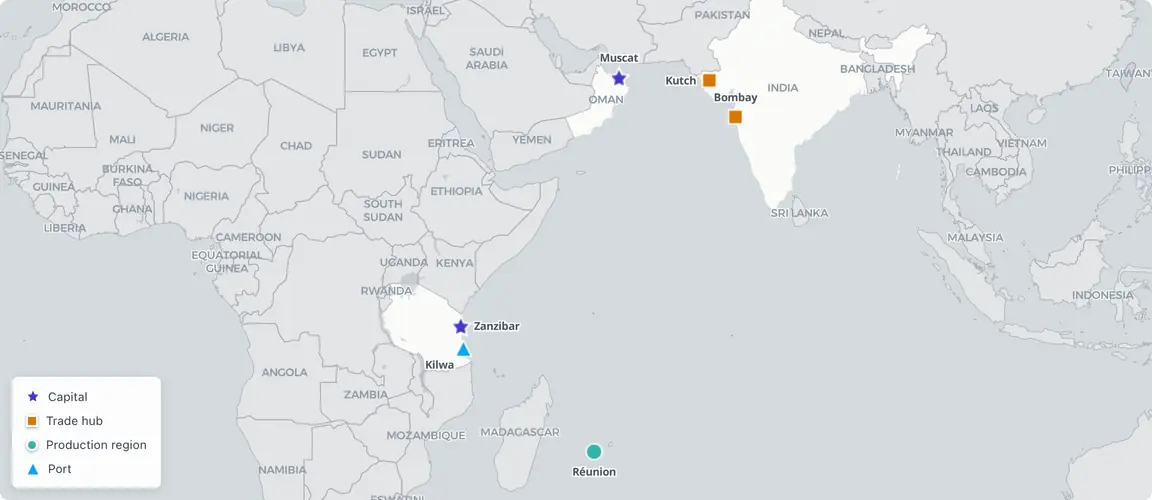
Within four decades, forced expansion by the sultan’s decree turned those confiscated saplings into the foundation of the world’s dominant clove economy — the sultanate is said to have controlled somewhere between three-quarters and nine-tenths of global supply, depending on whose account is believed. Zanzibar became a trading capital of the western Indian Ocean. The clove trees Said seized in 1828 were not native to Zanzibar, and they were not even Zanzibar’s discovery. They had arrived by a circuitous, thoroughly French route. Between 1766 and 1772, the French intendant Pierre Poivre ran an intelligence operation against the Dutch East India Company’s jealously guarded spice monopoly, smuggling clove seedlings out of the Maluku Islands to French plantations on Île de France and Bourbon — today’s Mauritius and Réunion. The trees took. From Bourbon, probably in the early 1800s, cuttings made their way to Saleh — the Omani planter with French commercial ties who planted the first clove trees on Zanzibari soil at Mtoni around 1810.
Saleh was not a nobody. He had built genuine commercial relationships that reached across the Indian Ocean trading world, and he had made a calculated bet on a crop nobody else on the island was growing. For nearly two decades, that bet was his. Then Said visited in 1828, on his first trip to the island his dynasty claimed to rule, and decided the orchard belonged to someone else — him. The popular story, repeated in countless retellings, holds that Said personally introduced cloves to Zanzibar. He did not. He confiscated them. The distinction matters, because it establishes the pattern that would define the entire economy built on top of it: value created by someone outside the ruling structure, absorbed into it by decree, and then presented as the sultanate’s own achievement.
Said followed the confiscation with compulsion. A proclamation — dated by Omani state media to 1842 — ordered subjects across Zanzibar and Pemba to plant cloves or face punishment. Within a generation, an entire archipelago’s agricultural output had been redirected by the sultan’s command toward a crop that arrived, stolen, from somewhere else, on land taken from the person who had actually grown it. Zanzibar’s near-monopoly on the world clove trade was manufactured, not discovered — built entirely from inputs the sultanate had neither bred nor legitimately acquired.
Whoever collects the money owns the business
If the trees were borrowed, the money was worse — it was never the sultan’s at all. The contract to collect Zanzibar’s customs revenue went to the highest bidder among a handful of competing Indian firms, and by 1819 it belonged to the Sewji family. On Gateway House’s account, it was Jairam Sewji who became customs farmer of Zanzibar that year; other accounts credit his father, Sewji Topan, a court figure in his own right, and the two histories do not agree on which man held the post first. This was not a minor concession, whichever Sewji it was. Customs on Zanzibar’s booming trade — cloves, ivory, slaves, and the general commerce of the western Indian Ocean’s busiest port — was the sultanate’s primary income, and it did not flow to the sultan first. It flowed to an Indian financier first, who paid the sultanate an agreed annual sum for the right to collect and keep everything above it.
Jairam Sewji expanded the family’s hold on the sultanate’s revenue, adding the customs farm of the Mrima coast — the mainland strip opposite Zanzibar — from 1837. The arrangement was, by its nature, competitive and lucrative enough that it changed hands under real financial pressure decades later. In 1876, a rival Indian financier named Tharia Topan outbid the Sewji family, offering 450,000 Maria Theresa thalers a year for the contract — an annual sum paid purely for the right to collect the sultanate’s own taxes. Four years later, the Sewji family bid the position back, this time for 500,000 thalers a year. These were not investments in Zanzibar’s economy. They were payments for the right to sit between the sultanate and its own income.
British observers at the time noticed the deeper pattern underneath the customs contract. Vice-Consul Holmwood reported that Arab caravan traders — the men who financed and organised the mainland expeditions that supplied both ivory and enslaved labour to the coast — frequently operated with capital borrowed from Indian merchants based in Kutch or Bombay. The apparent owners of Zanzibar’s commercial economy, in other words, were themselves debtors. In 1860, records show Jairam Sewji as the single largest slaveholder on the islands, with 460 people held in bondage.
This is the structural fact that the sultanate’s ownership never disturbed. Arab planters held the land. They held, nominally, the labour. What they did not hold was the balance sheet. Indian financiers — protected as British subjects under treaties Zanzibar itself had signed — held the customs contract, held the caravan credit, and held the claims on output that mattered when the accounts were actually settled. Zanzibar’s clove economy looked, from the outside, like an Omani sultan’s private empire. From the inside, whoever collected the customs revenue held a more durable claim on the islands’ wealth than the man wearing the crown.
Fourteen months, one treaty and a war of under forty minutes
For more than fifty years this arrangement held, because it was profitable for everyone with a stake in maintaining it. Then, within twenty-five years, every external input the model depended on was removed — not gradually, but in a sequence so tight that the sultanate had no time to substitute for what it lost.
On 15 April 1872, a hurricane tore through the islands. Contemporary eyewitness accounts collected by cyclone researchers describe it destroying every one of the sultan’s boats in Zanzibar harbour, flattening the Catholic Mission Hospital at Bagamoyo on the mainland, and wrecking roughly two-thirds of the coconut and clove crop on Zanzibar itself. One historian’s account describes it uprooting almost all the clove trees on the main island. Cultivation’s centre of gravity shifted permanently to the smaller island of Pemba. The storm did not care whose trees they were. It simply removed the physical asset the entire economy rested on.
Sir Bartle Frere arrived in Zanzibar harbour on 12 January 1873 with a treaty already drafted, presenting its terms to Said’s son, Sultan Barghash. Barghash’s response, as related by the historian Saada Omar Wahab, who reports that he told the British consul, has survived as one of the era’s starkest statements of a ruler with no real leverage left: “A spear is held at each of my eyes; with which shall I choose to be pierced?” Frere departed without a signature. It was the acting consul, John Kirk, who secured Barghash’s agreement that June — fourteen months after the hurricane — under the explicit threat of a naval blockade. The treaty closed the Zanzibar slave market and banned the export of enslaved people from the mainland. It did not, contrary to how the episode is often remembered, end slavery itself; that would take a further quarter century. But it removed, at a stroke, a trade that had been running for generations and that the customs farm had been quietly profiting from — Zanzibar’s slave trade contributed something like 18% of the sultanate’s total customs revenue in the late 1860s, a figure that makes plain how central the traffic was to the financial architecture Indian customs farmers had built.
Sovereignty went next, in under an hour. After the death of the pro-British Sultan Hamad bin Thuwaini in August 1896, his cousin Khalid bin Barghash occupied the palace without securing British assent — a procedural sin, in a sultanate whose succession had effectively required London’s blessing since the 1890 declaration of a formal protectorate. Royal Navy ships opened fire at 09:02 on 27 August. The flag came down by roughly 09:40. Britannica records the engagement as lasting no more than forty minutes, “the shortest war in recorded history”; other accounts put it at thirty-eight, depending on how the opening and surrender moments are timed. Around five hundred of Khalid’s defenders were killed or wounded. One British sailor was hurt. The brevity is the detail everyone remembers. The precondition is the one that matters: a sultanate whose customs were farmed to British-protected subjects, whose succession required British approval, and which had been a formal protectorate for six years, had no independent capacity to resist anything London decided to do. Within eight months, the newly installed and British-backed Sultan Hamoud signed the decree that finally abolished the legal status of slavery on the islands — 5 April 1897, with concubines left out of the decree until a further one in 1909. Between 1897 and 1901, roughly thirteen thousand people gained freedom through the court-application process the decree established.
A hurricane. A treaty. A war measured in minutes. A decree. Four blows in twenty-five years, and each one landed on an input the sultanate itself had never controlled — weather it could not forecast, a trade whose closure Britain could dictate under threat of blockade, a navy it could not match, and a legal order written in London before it was signed in Zanzibar.
What was never borrowed
By 1964, the arrangement’s final act arrived. On 12 January, an insurrection led by John Okello overthrew the sultanate outright. The death toll remains genuinely contested — the British High Commissioner at the time reported a floor of 1,000 dead and possibly considerably more; the American diplomat Donald Petterson later estimated around 5,000; the historian Anthony Clayton put the figure at 8,000; Okello himself claimed 7,994 Arabs and 1,417 Africans killed; The New Arab reports some accounts running as high as 20,000. No single figure commands agreement. What is not contested is what followed: union with Tanganyika followed in April, and a Revolutionary Government that nationalised every clove plantation on the islands, breaking up estates that Arab families and Indian financiers alike had held for more than a century and distributing three-acre plots to landless Africans between 1965 and 1974.
The plantations, the customs farm, the caravan credit networks — all of it, gone or transformed beyond recognition within a century and a half of being built. What survived was different in kind from everything that had been seized, taxed, financed, or fought over. The merchant relationships that had connected Zanzibar to Bombay, to the Gulf, to the wider Indian Ocean world did not vanish with the plantations; they had never depended on any single crop or any single financier’s contract to exist. The Swahili urban culture that had grown up around Stone Town’s narrow streets, absorbing Arab, Indian, Persian and African influences into something genuinely its own, did not require a sultan’s decree to persist. And Stone Town itself — the actual stone city, its carved doors and coral-rag buildings — simply stood, through hurricane, treaty, war, revolution and neglect, until UNESCO inscribed it as a World Heritage Site in 2000, citing its cultural fusion and centuries of Indian Ocean exchange.
What Zanzibar’s wealth model got backwards was not its ambition — capturing a valuable crop, financing its expansion, and building a trading capital around it was, on its own terms, a genuinely sophisticated achievement. What it got backwards was believing that borrowed inputs, however well-managed, constitute an asset you actually own. The seedlings were smuggled out of a Dutch colony by French agents. The labour came from a mainland trade a foreign navy could interdict. The capital belonged to financiers who were, by treaty, someone else’s protected subjects. Even the sultan’s own succession required a foreign power’s blessing. Every one of those claims sat on top of the visible economy, structurally invisible until the moment each one was withdrawn — and when four of them were withdrawn within twenty-five years, nothing inside the model could substitute for what had been removed, because nothing inside the model had ever actually belonged to it.
The uncomfortable part, as the historical record makes clear, is that contemporaries understood this perfectly well while it was happening. British consular memoranda, missionary reports, and Barghash’s own remark about the spears at his eyes all show a ruling structure that recognised its own dependency in real time. It tolerated that dependency because the arrangement paid — handsomely, for decades. Today, Zanzibar’s economy runs on a different externally set price: leisure travel, chiefly from Europe, which delivered a record 917,167 international arrivals in 2025, up sharply from the year before. Clove exports, by contrast, have collapsed — volumes down from 3,900 tonnes to 1,200 tonnes in the twelve months to September 2025, a 76% fall in export value that the state trading corporation attributes to new producers crowding the world market the islands once dominated. Zanzibar has, in effect, swapped one input it does not control for another. The founder lesson is not a caution against dependency in the abstract — every business depends on inputs it does not fully own. It is a discipline: identify precisely which of your margins rest on something another party can legally, physically, or morally switch off, and price the cost of that removal before someone else decides to test it.
Researched 42 sources in English, French, Arabic, Swahili.