 Skip to main content
The Wave Isn't One Wave
Tens of thousands of founder-owned brands are approaching succession at once, synchronized by the market openings that created them. But treat that as one wave and you will mistime every market you touch — because the wave breaks six different ways, and the shape of the break tells you more than its size ever will.
One wave, mistimed
In August 2016, Jacques von Polier put the choice to his partner in blunt terms: “Very quickly we realized this was going to take a lot of work, and were faced with a choice: go all-in, or close the factory.” Six years into rebuilding a derelict Soviet watch factory outside St. Petersburg, David Henderson-Stewart was almost out of runway. A last-minute investor — never publicly named — kept Raketa alive. The year ended with the company’s first profitable result: a fraction of what it earns today.
That single choice is what the founder transition wave looks like up close — one person, one factory floor, one year that could have gone either way. Whitepaper No. 1 established the aggregate behind it: tens of thousands of founder-owned consumer brands across emerging markets, built by a generation who came of age when their home markets first opened to private enterprise, now old enough — collectively — that control has to move. Framed as an aggregate, it reads as a single event. It isn’t. A market where one generation entered together and is now uniformly overdue behaves nothing like a market where two generations entered decades apart and are aging on separate clocks. The wave doesn’t have a size. It has a shape — six of them — and the shape is what tells you whether you’re looking at a Raketa or something stranger.
Six shapes
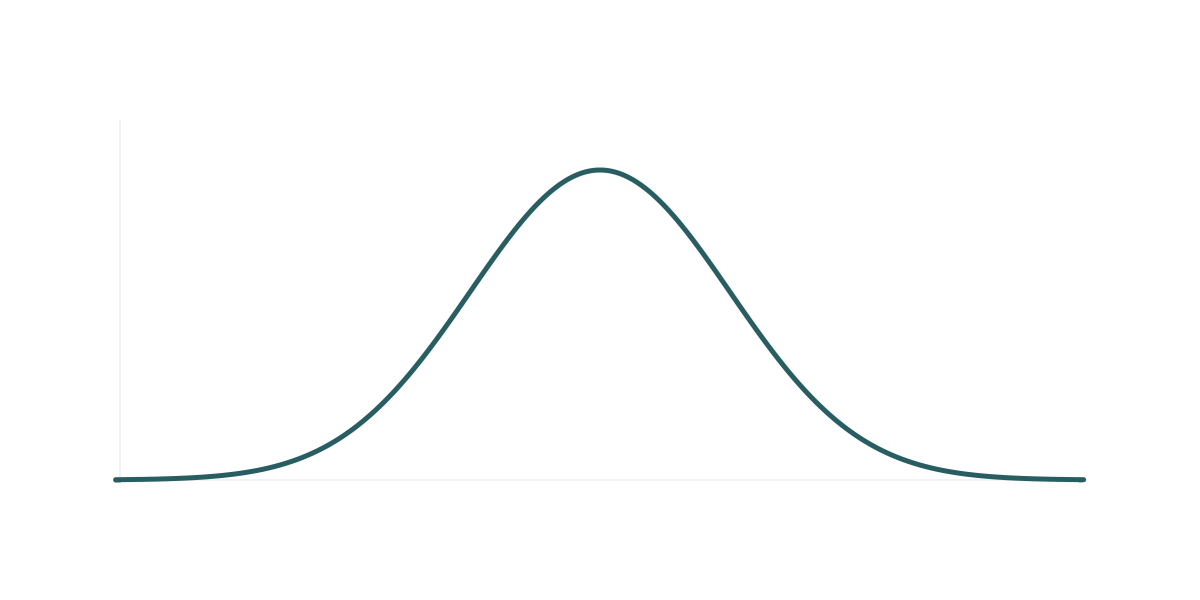
A standard wave is the majority pattern — one generation, one opening, aging and transitioning together on roughly one schedule. Most markets Brandmine tracks ride this shape.
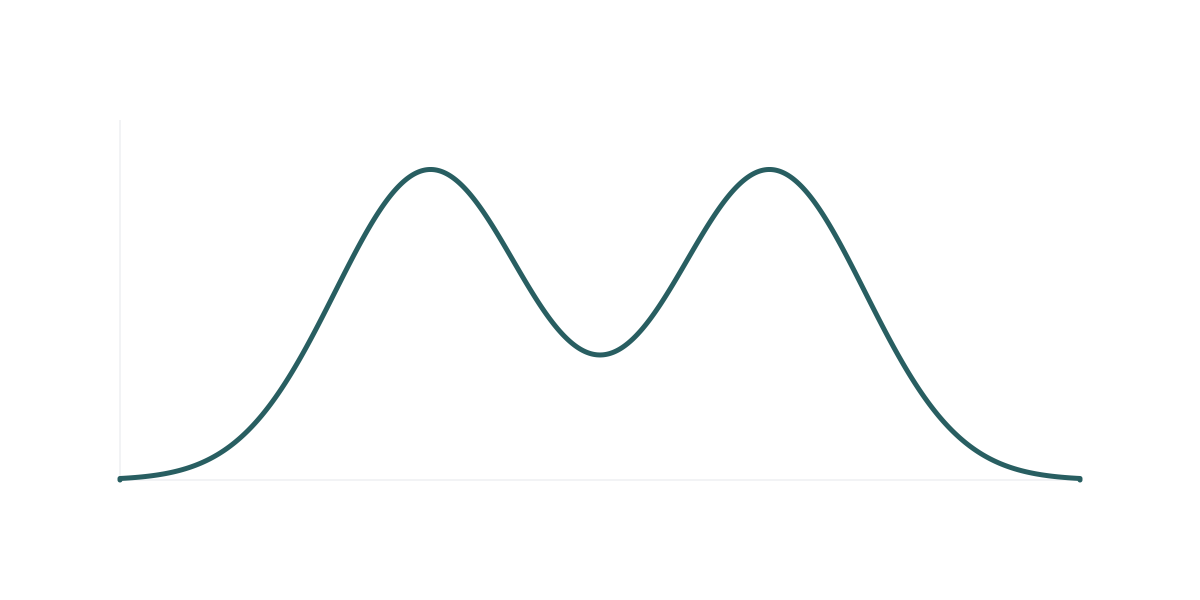
A double wave stacks two standard waves with distance between them: a second liberalizing event, often decades later, creates a second founding cohort aging on its own clock. Two succession conversations, a generation apart.
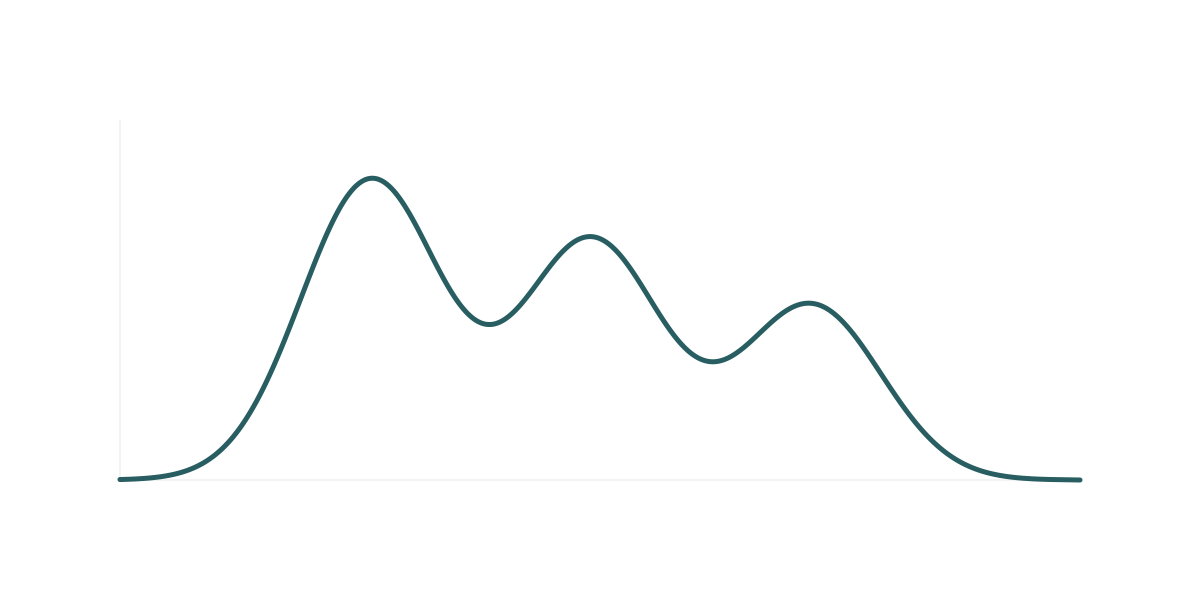
A layered wave is messier — three or more founding events whose cohorts don't resolve in sequence but partially overlap, converging on the same investors and the same succession infrastructure at once.
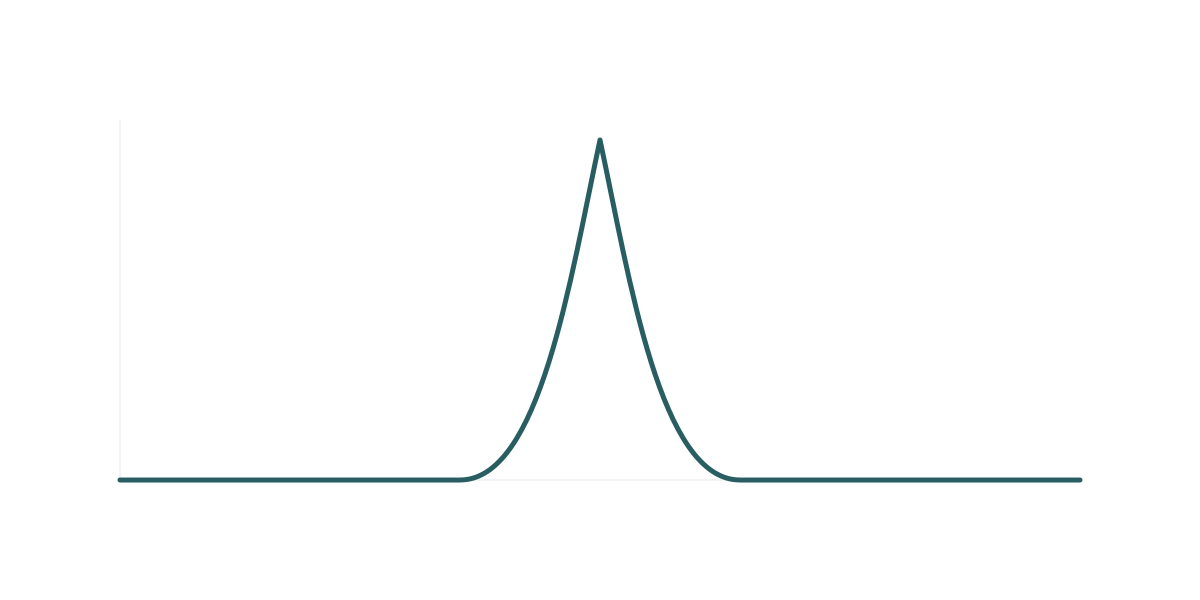
A compressed wave happens when one founding event squeezes an entire generation into a narrow window, concentrating succession risk into a single tight period rather than spreading it across years.
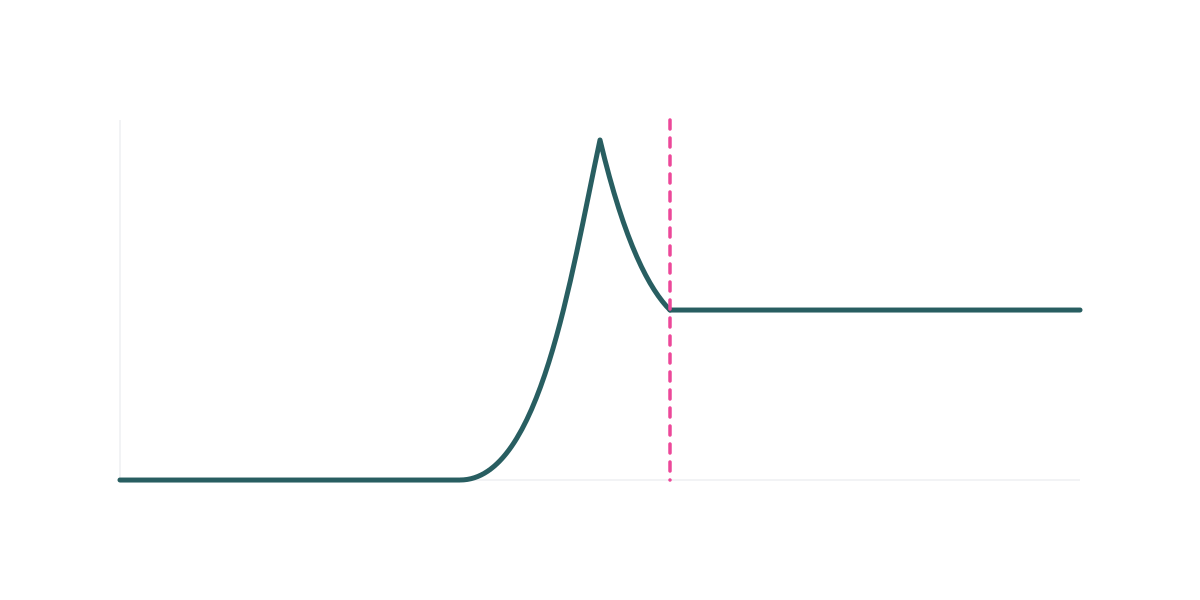
A compressed-disrupted wave is a compressed wave that took a second hit — a later shock that didn't reset the succession clock but suspended it, leaving founders in limbo.
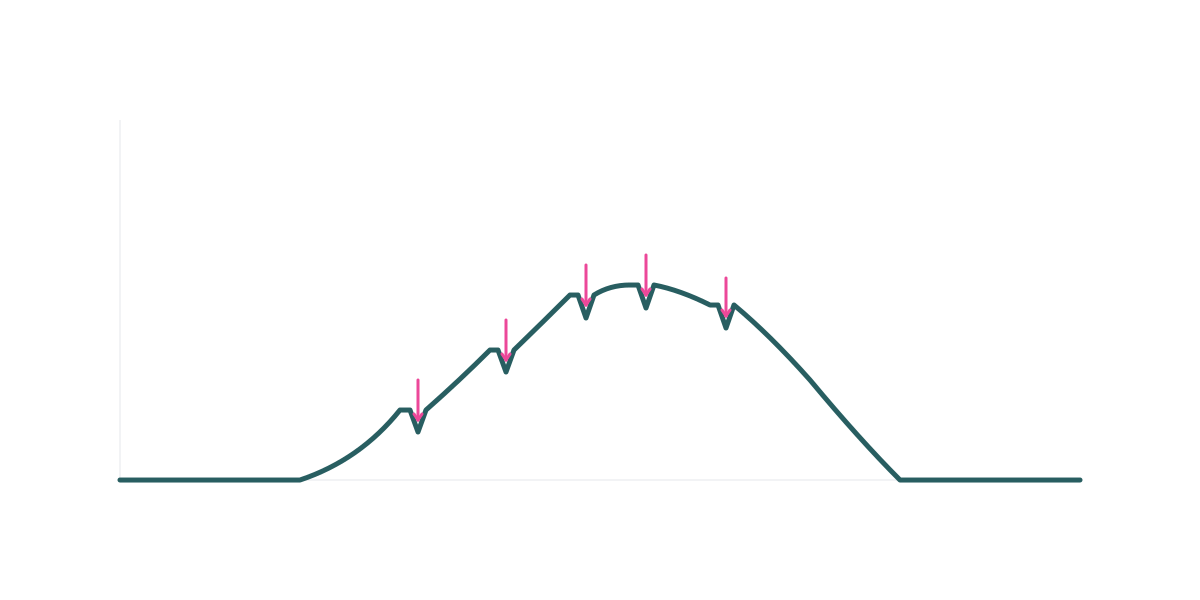
And a five-crisis compressed wave is the extreme case: a compressed cohort that absorbed repeated macro shocks across one career, each deferring the succession question the last had already deferred.
Russia
Russia is the five-crisis case, and this is what the 2016 choice above looks like once you name the shape it belongs to. Two years earlier, the factory had launched Raketa’s first new in-house automatic movement in thirty years — the technical proof-of-concept was established, the commercial proof was not, and August 2016 was the moment that gap became existential. One generation entered the market in 1991, when Soviet central planning gave way to private enterprise almost overnight, and it never got a clean multi-decade run to build and hand over a business. It absorbed the 1998 rouble collapse and default, 2008’s global crisis, 2014’s sanctions regime, a pandemic, and the 2022 sanctions wave that followed — five distinct shocks inside one career, each a reason to defer the succession conversation rather than have it. There is no second generation coming up behind most of this cohort to absorb the shock. What makes five-crisis compressed the extreme case isn’t that the founders are older — it’s that every reasonable moment to plan for succession was also, simultaneously, a crisis that made planning impossible.
China and India
India’s version of a double wave has a name attached to it. When Dharampal Gulati died in December 2020 at 97, he left behind a spice company built from a cart he pushed through the streets of post-Partition Delhi after arriving with nothing from Sialkot — he had refused every acquisition offer for decades. His son Rajeev assumed the chairmanship; the transition was orderly, because MDH was one of the rare cases where the founder had decades to prepare. Most of India’s post-1991 founder cohort has no equivalent story — the 1991 liberalization that dismantled the License Raj created a single compressed founding cohort now squarely in the succession danger zone, with a second wave from the early-2000s retail boom just beginning to approach its own window a generation behind.
China runs the same double-clock pattern on a different timeline. A first cohort formed between 1978 and 1992 under Deng Xiaoping’s reforms, now deep into a succession window most never planned for. A second, larger cohort formed after 1992’s Southern Tour — the 下海 (“plunging into business”) generation who left secure state jobs to found consumer businesses — now just entering its own window behind them. In both countries, the mistake is treating two clocks as one.
Indonesia and Argentina
Indonesia’s older layer formed under the New Order’s industrialization decades ago; a younger layer formed during the Reformasi era after 1998, when Rabbani — Bandung’s hijab producer, founded in 1994 by Amry Gunawan and Nia Kurnia on the eve of the Asian Financial Crisis — survived the rupiah collapse because its customer base was the Muslim lower-middle class whose identity consumption held even under financial shock. The two layers are now converging on the same succession infrastructure, and a certification regime with a hard clock is compressing the timeline further for whoever comes next.
Argentina’s older layer formed during the 1990s convertibility era, when a fixed exchange rate briefly made long-term brand investment rational; its younger layer was tempered very differently. When Argentina’s economy collapsed in 2001, a widowed mother in the Buenos Aires neighborhood of Liniers began making alfajores to survive. Her sons, the Alcaraz brothers, built what she started into Cachafaz, now one of the country’s premium alfajor brands and Havanna’s principal rival — and a generation stress-tested in a way the convertibility-era founders never had to be. In both countries, two distinct cohorts, shaped by different conditions, are now arriving at the same moment together.
Bangladesh and Mongolia
Bangladesh’s compressed wave has a name attached to it. Syed Manzur Elahi bought a tannery in 1975 and built it into Apex Group, the country’s largest leather goods and footwear company. When he died, there was no public succession plan announced in advance — but his son, Syed Nasim Manzur, had already served as managing director for decades and took over formally without disruption. It is the cleanest succession in the sector, and one of the only documented ones: most of the founders who built Bangladesh’s export economy after the country’s 1990s garment boom are aging without an equivalent record.
Mongolia’s compressed wave has no name attached yet, only a date and a shape. The country’s private sector didn’t form over a decade like most — it formed in roughly two to three years after the 1990 democratic revolution, when Nomin began as a five-person cooperative and the first wave of founder-owned enterprises appeared almost simultaneously. That compressed founding cohort then absorbed hyperinflation, two banking collapses, catastrophic winters that devastated the cashmere supply chain, a commodity crash, and a pandemic — one generation, one narrow founding window, and a run of shocks with no space between them to plan an exit.
Myanmar
Myanmar’s compressed-disrupted wave is anchored by a single visible case. Dr. Sai Sam Htun built Loi Hein Company into the market leader across three beverage categories during the country’s 1990s partial opening. He is 80 years old, with no identified heir — the anchor case for a cluster of similarly built, similarly undocumented businesses that share his profile: founder relationships and personal licensing access standing in for the governance structures a transition would require. The partial opening of the 1990s never resolved into an orderly handover window for founders like him. It was suspended by a shock years later that scattered the institutions a succession would have needed, leaving him in limbo rather than moving him toward a resolution.
The majority case
Most markets Brandmine tracks don’t look like any of that. They ride a standard wave — one generation, one opening, no compounding disruption, aging and transitioning together on a schedule that, while urgent, is at least legible. That’s precisely why the exceptions matter. Shape is the first filter on where succession pressure actually concentrates, and where it doesn’t. A market riding a standard wave rewards patience and a well-timed approach. A market riding a five-crisis compressed wave, or two layered cohorts converging on the same year, rewards neither — it rewards knowing the shape before you walk in.
Where the shape becomes signal
A shape is a starting point, not a finished answer. Knowing that a market is compressed, layered, or riding a double wave tells an investor what kind of succession pressure to expect. It does not say which specific brand, in which specific sector, is closest to a transition decision right now. For that — the per-market shape and timing mapped across Brandmine’s full research corpus — see Brandmine’s sector intelligence products. Start with Whitepaper No. 1 — the aggregate this piece complicates; the shape tells you where to look first.