 Skip to main content
Thailand's Sauce Dynasties: The Hidden Century
Their products travel to 70+ countries; their names travel to none. Five Thai families have built the global condiment sector across a century — institutional culture conservative, balance sheets cash-rich, succession synchronised, and almost entirely undocumented in English.
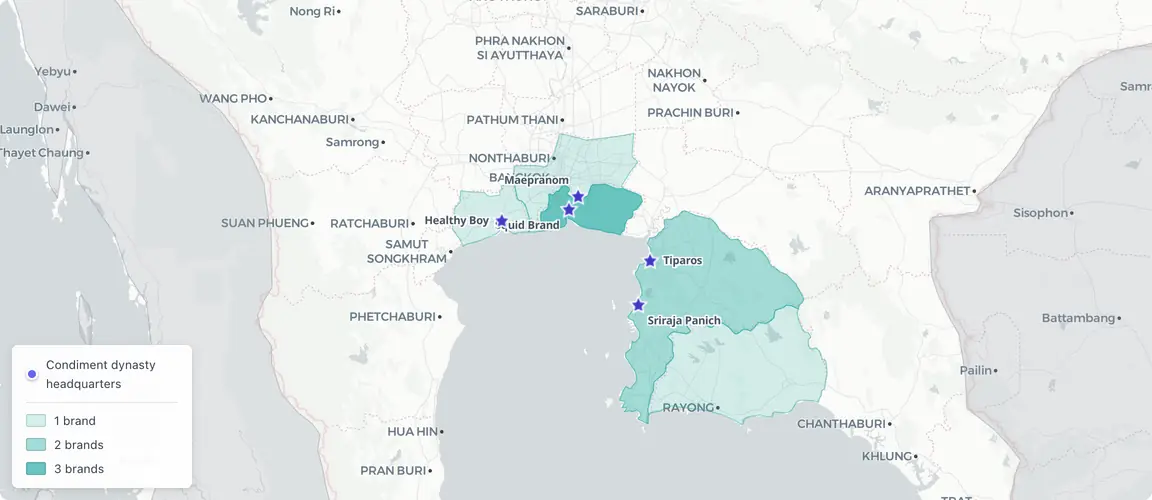
Thailand's sauce dynasties: the Gulf Coast arc
Condiments that outlasted everything
In 1910, a Chiuchow fishmonger named Laichiang Sae Tang began bottling fish sauce in a Chonburi shophouse. He had unsold small fish at the end of each market day, a Chinese family tradition of preserving them with salt, and the Gulf of Thailand anchovy fishery a few minutes from his door. Nine years later he registered the company that became Tiparos — Thailand’s first commercial fish sauce producer. It still operates from the same Gulf-coast town. Most American chefs who buy Thai fish sauce by the case do not know it exists.
Five families, founded between 1919 and 1959, built the sector that supplies the flavours global restaurant kitchens depend on — fish sauce, soy sauce, chili paste, sriracha. The largest reports nearly ฿4.4B THB (~$137M USD) in annual revenue. Three of the four largest are followed by zero English-language analysts. The publicly listed one is followed by exactly one.
How a fishmonger built an industry
The cohort that built Thai condiments did not start with capital. It started with two unrelated facts of geography that became the same fact once a Chinese merchant tradition arrived in coastal Siam.
The first fact was the Gulf of Thailand anchovy. The waters off Chonburi, Samut Prakan, and Samut Sakhon held a small fish — pla katak — that fermented well, in volume, in heat. Thai households had preserved it for generations as nam pla. The product was indigenous; the industry was not.
The second fact was the Chiuchow merchant. Between 1910 and 1947, the families that built Thailand’s largest condiment houses arrived from Chaozhou in southern China — Teochew dialect speakers, members of a merchant caste that had moved across Southeast Asia for centuries. They brought commercial discipline, multi-generational business culture, and a Chinese fermentation grammar — soy sauce, oyster sauce, garlic-chili paste — that complemented rather than replaced the Thai one. Laichiang Sae Tang’s 1910 Chonburi shophouse and the 1947 founding of Yan Wal Yun in Bangkok’s Sathon district are not coincidences with similar dates. They are the same migration arriving twice.
What followed across four decades was a single founding pattern, repeated. Tang Sang Hah in Chonburi, 1919. The first Si Racha chili-garlic-vinegar sauce, 1932 — commercialised by Thanom Chakkapak as Sriraja Panich in 1935. Squid Brand in Samut Prakan, 1944. Yan Wal Yun and what would become Healthy Boy in Bangkok, 1947. Thaitheparos in Samut Prakan, 1954. Maepranom and Thailand’s first bottled chili paste in Samut Prakan, 1959.
By the time the second world war ended, three families had registered. By the time the Vietnam War began, six. Most still hold majority control more than half a century later. Heinz’s 1987–2007 minority stake in Win Chance Foods — taken back by founder Metha Kornsantiwong in a 2007 reverse acquisition — is the rare and instructive exception. The sector’s institutional culture is patriarchal, oral-tradition-heavy, and historically allergic to outside equity.
The names of those founders rarely appear in English. Laichiang Sae Tang is referenced in a Thailand Foundation profile, in two Wikipedia entries, and almost nowhere else. Wichian Tangsombatvisit, founder of Yan Wal Yun, appears on his company website as “Mr. Vichien” — a transliteration variant — and the year 1947 is not always attached to him. Tien Nithipitigan, founder of Squid Brand, is acknowledged on the company site but has no English-language profile anywhere. The patriarchs live in family memory and in Thai-language trade press. They are mostly absent from the intelligence layer international capital reads.
Everything within reach of an anchovy boat
Thailand is a country of 66 million people across 513,000 square kilometres. Its condiment industry occupies a coastal strip about 100 kilometres long.
The geography is precise. Five of the named dynasties operate from a Gulf-of-Thailand arc that runs from Samut Sakhon in the west — where Healthy Boy’s Tha Chin plant has produced soy sauce since 1980 — through Samut Prakan immediately south of Bangkok, where Squid Brand, Maepranom, and Thaitheparos all maintain their primary factories, and east into Chonburi, where Tiparos operates three factories and Si Racha district is the literal birthplace of sriracha sauce. Add Rayong, an hour further east, where Flying Goose’s parent Exotic Food has built the cohort’s newest large-scale operation. The entire industrial footprint of Thai condiments sits inside a coastal arc most readers could drive in two hours.
Outside this arc, industrial-scale sauce production is essentially absent. Bangkok holds heritage urban brands — Chua Ha Seng in Yaowarat for nam prik pao, Mae-Ruay’s Koh-Kae for snack-condiments. Nakhon Pathom hosts Maesri’s curry-paste operation. Isan’s OTOP graduates exist but at an order-of-magnitude smaller scale. The interior, the north, the Andaman coast, the deep south: not part of the industrial condiment story.
The concentration is not accidental. It is the direct geographic expression of the founding sequence. Chiuchow merchants settled where the anchovies landed. The anchovies landed in the Gulf of Thailand. Bangkok was close enough to ship product; Samut Sakhon’s seafood processing infrastructure was already the largest in the country; Chonburi’s deep-water access made early industrial fermentation viable. Every subsequent founding clustered within a half-day overland trip of an existing operation. The sector industrial map looks the way it does because the families that built it lived within a hundred kilometres of each other for three generations.
This is the geographic argument the sector makes without saying it: Thai condiments are not “made all over Thailand.” They are made within sight of one body of water, by descendants of one merchant tradition, using one raw material.
What the databases miss
Search for Thailand in any institutional food-sector database — Euromonitor, Mintel, IWSR for spirits-adjacent categories — and you will find aggregate trade data, customs figures, and broad category sizing. You will find that Thailand exports approximately ฿44B THB in sauces and condiments annually. You will not find that Squid Brand alone reaches 70+ countries with ISO 9001:2015 and HACCP certifications across two factories, or that its Deputy Managing Director Thitiya Nithipitigan articulated a Gen 3 premiumisation strategy publicly at THAIFEX Anuga Asia 2023. You will not find Yan Wal Yun’s claimed ~82% Thai soy sauce share, or that Vasupon Tangsombatvisit, the founding family’s fourth-generation new-business lead, is on record at Prachachat Turakij explaining the family’s product-format strategy.
These are not boutique operators. Yan Wal Yun’s ~฿4.36B THB in 2023 revenue is on the scale of mid-sized European condiment specialists. Thaitheparos PCL’s ฿3.56B THB in FY2024 audited revenue — and its parallel ฿744M THB in earnings — would qualify it for substantive sell-side coverage anywhere in the world. One English-language sell-side analyst covers it.
The invisibility is structural and linguistic. Of the cohort’s five largest brands, four are privately held limited companies registered in Thai (บริษัท … จำกัด) with audited filings available only via the Department of Business Development and accessed primarily through Thai-language portals like creden.co. Their founder interviews appear in Prachachat Turakij, Read the Cloud, Bangkok Post, Longtunman, and BrandCase — none indexed by the analyst services international consumer-goods investors use. The Thaitheparos PCL annual report exists in English and is largely unread.
There is a second layer. The founder caste itself does not self-promote. Maepranom’s founder Pranom Daengsupha did not give a single interview about her company until the 2015 lawsuit between her and her elder daughter Siriporn became a front-page Bangkok Post story. Win Chance Foods’ Metha Kornsantiwong remains chairman of a company that has produced 5 billion sachets and 500 million bottles cumulatively for Heinz, Burger King, 7-Eleven, and Tesco Lotus — and the English-language profile of him fits inside a paragraph.
The result is a sector that, viewed from outside, looks like generic OEM supply. Viewed from inside, it is six families operating multi-factory businesses with multi-decade export histories and multi-generational governance — all undocumented in the language institutional capital reads.
The five who are still standing
The cohort’s resilience is not theoretical. It is documented at brand level, with named decisions made under specific pressure.
Thitiya Nithipitigan, Deputy Managing Director of Thai Fishsauce Factory and a third-generation member of the Nithipitigan family that founded Squid Brand in 1944, made the decision that defined the cohort’s response to the 2022 Gulf-of-Thailand anchovy shortage. As marine fish capture across Thai waters fell from a 2003–12 average of 2.05 million tonnes to roughly 1.56 million by 2014, and as the U.S. began layering trade pressure on Thai exporters, she refused to pass cost increases to existing buyers. Squid Brand drew on 18-month fermentation inventories and pivoted into a premium SKU strategy — vegan kombu-and-shiitake, kids, silver-age, truffle, mala-chilli, Himalayan-salt. By 2025 the platform was 11 SKUs deep. The brand held its pricing discipline through a cohort-wide cost shock that hit open-market exposed producers in Rayong much harder.
Varanya Winyarat, Gen 3 Deputy MD of Thaitheparos PCL, took a different fight to a different audience. Sriraja Panich — the original sriracha sauce, commercialised in 1935 by Thanom Chakkapak in Si Racha district, acquired by Thaitheparos in 1984 — lost the global category to David Tran’s California-built Huy Fong Foods rooster-label sauce over forty years. In 2019 Winyarat took the original-sauce argument to NPR’s The Salt and made it explicit: Sriraja Panich, made in the place that gave sriracha its name, was being commercially out-positioned in the United States by a product that did not exist when the original was already a household name in Thailand. The provenance story became public. The U.S. mainstream channel did not open. As of FY2024, Sriraja Panich’s U.S. revenue is still routed through Asian-supermarket distribution. The battle is ongoing, documented, and so far unwon.
Metha Kornsantiwong’s story is the cohort’s reverse-acquisition arc. He founded Win Chance Foods in 1985 and, two years later, took H.J. Heinz Co. USA as a minority partner — making his company Heinz Win Chance Limited. For twenty years the company co-packed for Heinz, Burger King, 7-Eleven, and a dozen other multinationals while Kornsantiwong learned the discipline of running a foreign-owned operation. In 2007, Heinz sold its shares back. Kornsantiwong spent four years building Thasia as the family’s own brand from inside an operation still bound by co-packing contracts. Thasia launched in 2011; Thasia Foods Co. opened in 2016 as the family’s retail arm. The Kornsantiwong family now owns 100% of a company that produces, per its own filings, 500 million bottles a year. Heinz APAC remains a co-packing client.
Pranom Daengsupha — founder of Maepranom, the family that bottled Thailand’s first chili paste in glass jars in 1959 — faced a different crisis. In 2015, she filed a public lawsuit against her elder daughter Siriporn Daengsupha over company control. The case reached the front page of Bangkok Post. Prime Minister’s Office Minister Panadda Diskul personally mediated. The family reconciled rather than splitting the company; Pongsapat Sukumanchan now represents Gen 3 in PR and management. Maepranom held its approximately 40% share of the chili-paste segment through the dispute and emerged on the other side at ~฿1.83B THB in 2023 revenue. The family did not split, the brand did not weaken, the segment leadership did not transfer.
Yan Wal Yun’s response to the 2011 Central Plains floods is the cohort’s clearest infrastructure arc. Thailand’s worst flooding in seventy years inundated 65+ provinces and damaged approximately 930 factories across 28 provinces; Samut Sakhon, where Yan Wal Yun’s Tha Chin plant has produced since 1980, was exposed. The Tangsombatvisit family responded with a 2012–2016 capex cycle of plant elevation and perimeter walls, and a Gen 4 product strategy under Vasupon Tangsombatvisit that produced 2024’s squeezable-bottle chili paste innovation and a soy-sauce candy launch nobody had attempted before. The brand held its ~82% domestic soy sauce share against private-label pressure and export imitation throughout.
Five families, five different stresses, five sustained outcomes. None of them is on the Euromonitor company list.
Sino-Thai by inheritance, Thai by choice
What looks from outside like a fully Thai industry is, in identity terms, a Sino-Thai one — and the families have made a deliberate choice about which face shows in which market.
Yan Wal Yun’s Chinese name, 仁和園, appears in heritage materials but not on consumer packaging in Thailand. Tang Sang Hah’s Chinese identity, 唐双合, sits in the same archival layer. Squid Brand has recently reintroduced Thai script alongside its competitors’ English labelling — a deliberate statement about where the brand comes from. The pattern across the cohort is consistent: lead with Thai identity for the domestic mass market and for halal-certified Gulf and Indonesian exports; selectively reveal Chinese heritage when courting ethnic-Chinese diaspora retailers in California, Vancouver, Sydney, and Singapore.
This is not assimilation; it is platforming. The Chinese inheritance is institutional culture — multi-generational governance, marriage-mediated succession, conservative balance sheets, oral-tradition knowledge transfer. The Thai expression is everything visible to customers. The institutional implication for outside capital is specific: conservative balance sheets mean few of these companies will need to sell; marriage-mediated succession means equity stays within the founding family network even when individual heirs lack operational interest; oral-tradition knowledge transfer means there is no documented governance manual to acquire — institutional memory is in the patriarch’s office, and it does not transfer without him.
The transfer already underway
For the next thirty-six to forty-eight months, that institutional memory is in active transfer.
Six brands are visibly in Gen 2-to-3 or Gen 3-to-4 handovers. Thitiya Nithipitigan at Squid Brand is third-generation, on the operational record, publicly articulating premiumisation strategy. Vasupon Tangsombatvisit at Yan Wal Yun is fourth-generation, leading new-business development at a company with a current MD (Somwang Tangsombatvisit) of the previous generation still in role. Varanya Winyarat at Thaitheparos is Gen 3, the family’s English-language press spokesperson, working alongside Bancha and Thanawat Winyarat as deputy MDs under MD Parinya Winyarat. Rattapong Wattanaporn took the Pantainorasingh MD chair from his grandfather’s generation and now exports to 48+ countries. Chitti Pongpairoj is Gen 3 at Tiparos, with two of his five children now in the business. Mae-Ruay’s Koh-Kae snack brand completed its own four-heir transition in 2008 — and grew revenue five-fold over the next decade as proof of what the cohort can do when succession works.
What the next three to four years will determine is whether each family institutionalises governance — boards, audit committees, third-party CFO, sometimes a minority outside shareholder — or locks equity into a fourth-generation structure that effectively forecloses outside capital. The two listed comparables (Thaitheparos on SET, Exotic Food on MAI) provide a price discovery mechanism. The private cohort does not. Today’s Gen 3 deputies are MBA-trained, multilingual, active on LinkedIn, and present at trade shows — a counter-party generation institutional capital can actually find a conversation with. Their patriarchs were not.
Three audiences have documented ties to the sector already. Singapore and Hong Kong family offices with Asian-food-supply mandates have the closest geographic proximity. Japanese trading houses — Mitsubishi, Itochu, Marubeni — already distribute Thai sauces and have decades of relationship infrastructure. Middle Eastern halal-food investors, courted by Yan Wal Yun’s halal certification and the cohort’s strong Indonesia and Gulf footprints, are the third natural buyer set.
The record sits in plain view
None of the intelligence here requires proprietary research infrastructure to access. Department of Business Development filings disclose every Thai company’s registered capital, revenue, and shareholding — accessible to any analyst with a few hundred baht and a creden.co subscription. The SET and MAI annual reports are public. Prachachat Turakij interviews are free to read; Read the Cloud’s long-form Thai founder profiles cost nothing. Bangkok Post and Khaosod English publish in two languages. The Thailand Foundation’s Chiuchow-merchant history exists.
It has not been assembled. Not in English. Not in any single product an institutional buyer can use to act.
Tiparos — 106 years of continuous operation since its 1919 registration, three factories, ~฿2.89B THB in revenue when the most recent figure was filed — does not appear in any sector intelligence product international consumer-goods investors actually use. Squid Brand’s 70-country export footprint, its 18-month fermentation discipline, and the premiumisation pivot under a named Gen 3 deputy sit in Khaosod English and Foodnavigator-Asia and almost nowhere else. Yan Wal Yun’s claim to ~82% of the Thai soy sauce category is the kind of single fact that becomes a sector thesis when you assemble it next to four others on the same page.
These dynasties have been building, exporting, surviving, and transforming for a century in one of the world’s most copied food categories. The intelligence existed, scattered across Thai-language registries and trade media and one NPR feature. It has not been assembled anywhere — until now.
Five families, six brands, one coastline — a century of record that was never translated, not a story that was never told.
Researched 36 sources in English, Thai.