 Skip to main content
Thailand Restaurants: The Succession Wave
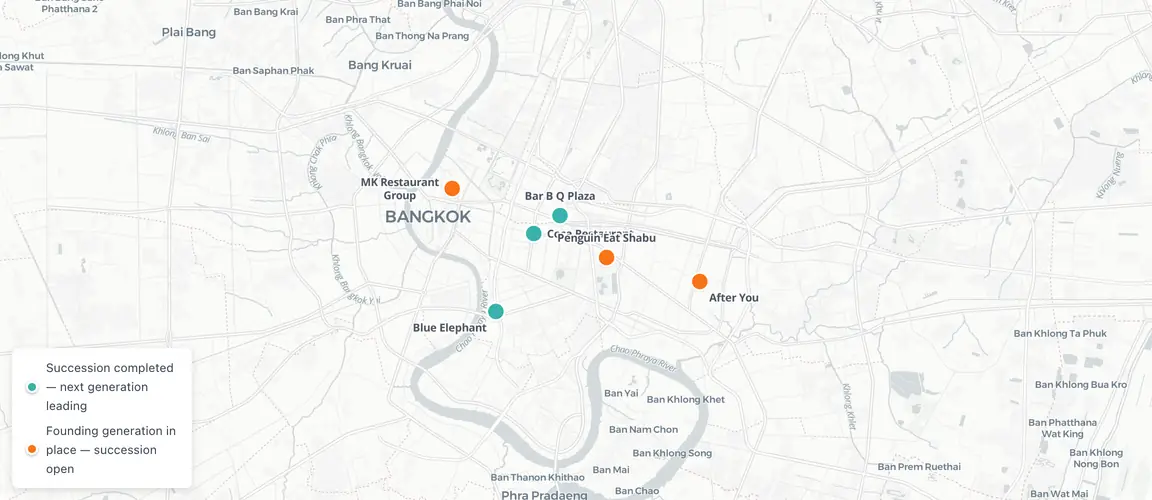
Natalie Phanphensophon shuttered Coca Restaurant's 54-year Siam Square address in 2020 rather than renew the lease. The family founded it in 1957; the decision to close it was hers. At MK Restaurant Group, Rit Thirakomen — age 74, chairman and CEO since 1985 — still occupies the same seat. No successor announced. One dynasty handed over. The other hasn't.
Thailand Restaurants: The Succession Wave
When the founders' children decide
In March 2020, Natalie Phanphensophon faced the decision that defines generational succession in the restaurant trade: whether to renegotiate an expiring lease on a 54-year-old flagship, or close it permanently. The Coca Restaurant outlet at Siam Square — Thailand’s original sukiyaki address, opened by her grandmother’s generation and known to every Bangkok family that had eaten out before the mall era — was running persistent revenue declines and about to come off lease. Natalie, who had joined as COO in 2016 and represents the third generation of the Pongsawat family, made the call. She closed it. The family pivoted to 100% delivery and began opening cloud kitchens — starting in Lat Phrao, expanding across Bangkok’s northern and western districts. By 2024, the chain had rebranded from Coca Sukiyaki to Coca Restaurant, and Natalie’s decision, taken at the worst moment in Thai dining history, had been validated by the operational results that followed.
Forty kilometres across Bangkok’s expressway network, in the chairman’s office of MK Restaurant Group, Rit Thirakomen is still in the same seat he has occupied since 1985. He is 74 years old. His family and the Hanjitkasem family together control more than 62% of the company’s shares. He founded the MK Suki chain that now operates 432 outlets and made Thai sukiyaki a weeknight habit for millions of Bangkok families across three decades. No public statement has named a successor. No corporate disclosure has announced a transition timeline.
One dynasty has completed its handover. The other hasn’t. Every institutional database covering Thailand’s restaurant sector has missed the difference.
What the databases miss
The pandemic forced us to try new things.
Thailand’s restaurant sector is not invisible. It is structurally misread.
The problem is not a lack of coverage; it is a specific analytical failure that affects every major restaurant intelligence platform. When a founder-owned company lists on the Stock Exchange of Thailand, the platform reclassifies it. It moves from “private, founder-controlled” to “public company.” Coverage increases; the founder’s retained stake falls out of the analytical framework. The story that defined the company before the IPO — who built it, how they survived, what governance authority they retained after listing — becomes invisible in the post-listing data environment.
After You is the starkest example. The dessert café chain co-founded by cousins Gulapat Kanokwatanawan and Maetup Borvornvirakit listed on the SET in 2016. Every restaurant analytics platform reclassified it correctly as a listed public company. What none recorded: as of March 2026 SET disclosure, Gulapat’s stake is 27.79% and Maetup’s is 25.35% — a combined founder-group position of 62.24%. After You is not a publicly managed company that happens to have a large individual shareholder. It is a founder-controlled business that has accessed capital markets while maintaining family governance authority. The distinction is material for any investor assessing succession timing, strategic flexibility, or governance risk.
MK Restaurant Group presents the same pattern at significantly larger scale. The Thirakomen and Hanjitkasem families together control more than 62% of a company with 432 outlets and a market position built over 40 years. S&P Syndicate — the 50-year-old bakery and restaurant conglomerate — has the Sila-On family occupying all three C-suite positions. Suki Teenoi, following JMART’s 30% acquisition at a THB 1.2 billion deal price (implying a THB 4 billion enterprise valuation in November 2022), still has founder Nattamon Pisankitvanich retaining approximately 70% of the company she built from THB 499 million in revenue (2019) to THB 7.08 billion (2024). These are not the capital structures of publicly managed companies in any functional governance sense. They are founder-controlled businesses that have accessed public capital or institutional equity while maintaining founding-family authority.
No English-language restaurant analytics platform has documented this as a sector-level pattern.
The succession wave
The handover was already in motion before COVID-19 arrived. What the pandemic did was accelerate it by approximately five years — compressing decisions that might otherwise have arrived gradually across 2025 to 2030 into a concentrated period of crisis and execution between 2020 and 2022.
Three of the sector’s anchor brands have completed the transition. Kim Steppe — son of Blue Elephant founders Nooror Steppe and Kris Steppe — was appointed CEO in approximately 2018, inheriting a Royal Thai cuisine restaurant with properties in Bangkok and Brussels and an export condiment line building international distribution. Chataya Supanpong, daughter of Bar B Q Plaza founder Choopong Choopojcharoen, became CEO around the same period, inheriting a 31-year-old chain with more than 220 outlets and CLMV master-franchise expansion already underway. Natalie Phanphensophon joined Coca as COO in 2016 and led the brand through the pandemic’s most consequential operating decisions. All three handovers were decided before any lockdown was announced. COVID forced each new leader to prove themselves in conditions their predecessors had never faced.
What the wave has not yet reached is MK Restaurant Group — the sector’s largest by outlet count, with the longest-serving founder still occupying the chairman’s seat. No transition has been announced or documented in any public filing. The governance structure — a 62%-plus family stake, a 74-year-old chairman, no named successor — has been on the public record for years without triggering the institutional coverage that followed the other three transitions.
The survivors
What follows passed the only test that matters for rigorous market intelligence: none of it can be derived from market-share databases, press releases, or aggregate restaurant coverage. It came from trade archives, corporate disclosures, and the Bangkok press record that no English-language platform has assembled.
Penguin Eat Shabu
Thanapan Wongchinsri founded Penguin Eat Shabu with a specific proposition: individual-portion Japanese shabu hotpots at a price point that made the format available to the Bangkok middle class, not just hotel dining rooms. When COVID-19 forced his first closure in February 2020, he spent three months analysing the situation before acting. In May 2020, as Thai restaurants began reopening under social-distancing requirements, he had THB 300 PVC partition booths custom-fabricated and installed at every outlet before the doors reopened.
The decision cost approximately THB 300 per unit. An AFP photographer documented the installation; the image circulated globally as evidence of a restaurant operator who had solved a specific problem with a specific object at a specific price — not with a brand promise or a communications strategy. Penguin’s partitions became the most-reproduced image of a Thai restaurant’s COVID response. The coverage that followed was not the kind that money buys: it was the coverage that accumulates when a founder makes a concrete decision under pressure and someone photographs it.
The delivery operation that followed was not a pandemic improvisation but a structural addition. Thanapan partnered with JWD cold-chain logistics to build a shabu delivery service that has since become a permanent revenue stream alongside in-restaurant dining. The booths remain. The delivery operation continues. Both are direct consequences of the founder’s decision-making during the crisis month that mattered.
After You
After You’s second crisis came during the 2021 second wave, when renewed Thai government lockdown measures forced café closures again. Gulapat Kanokwatanawan responded with a tactic that demonstrated the governance advantage of retained founder control after a stock market listing: she sourced 20 temporary cloud kitchen spaces by posting directly on Instagram, reaching venues across Ram Intra, Bang Phlat, and Rama II that had underutilised kitchen capacity. No board approval cycle, no task force, no consultant engagement. A founder who holds 27.79% of her company and has run it since founding can execute that kind of response in an afternoon.
The cloud kitchen capacity Gulapat assembled under lockdown pressure has since been retained as a permanent addition to After You’s distribution architecture. She told the Bangkok Post that “the pandemic forced us to try new things” — a characteristically understated summary of a distribution pivot that protected revenue through two consecutive closure events and produced a permanent operational change. The irony is precise: the listed status that made After You invisible to restaurant analytics is the same attribute that founder-control made irrelevant to how the company actually operates. After You’s most consequential pandemic decision was made possible by the governance structure that analysts had stopped tracking.
Coca Restaurant
The Siam Square closure decision had been building for years before the pandemic confirmed it. Natalie Phanphensophon had watched the flagship’s revenue trajectory declining through the late 2010s — a combination of shifting consumer traffic patterns in Siam Square, the footfall risk of a tourism-dependent location, and the capital that lease renewal would absorb. COVID removed the ambiguity. The lease expired. The decision to close the 54-year-old address permanently rather than renew it was Natalie’s to make — and she made it without hesitation.
What followed the closure demonstrated the quality of the judgment. Rather than seeking a replacement flagship, the family committed entirely to cloud kitchen distribution: five kitchens opened across Bangkok, starting in Lat Phrao and extending into the western and northern districts that Siam Square’s location had never reached. The network inverted the original model — instead of a destination that customers travelled to, a distributed infrastructure that reached wherever customers were ordering from. The rebranding from Coca Sukiyaki to Coca Restaurant in 2024 marked the completion of a transformation Natalie had been executing since 2016. The 67-year-old brand is now a third-generation operation with a distribution architecture that did not exist five years ago.
Blue Elephant
When COVID collapsed Blue Elephant’s revenue in 2020, Kim Steppe faced the arithmetic of hospitality crisis management: reduce costs enough to survive, without destroying the operational capabilities the business would need when demand returned. His resolution was personal. Kim reduced his own compensation by 80% and structured proportional reductions across the rest of the team, calibrated specifically to protect the lowest-paid staff from the deepest cuts. No one was let go. The entire team remained.
The outcome of that retention decision is quantifiable in Blue Spice, the brand’s Thai condiment and grocery export line, which now distributes to 47 countries. Export partnerships, product-line extensions, international distribution relationships: all of them required the team that Kim chose to keep employed at reduced pay rather than dismiss and attempt to rehire after the crisis passed. The operational continuity that his personal sacrifice preserved became the foundation for export growth that outlasted the pandemic by years. In 2024, Belgium awarded Kim the Order of Leopold — the country’s highest civilian honour for foreign nationals — for Blue Elephant’s three decades of cultural exchange between Thailand and Belgium. The award traces back, in part, to a decision made in early 2020 to take an 80% personal pay cut rather than reduce headcount.
Beyond the four
Bar B Q Plaza reported its first-ever 20% annual revenue contraction in 2020-21 — a THB 2.9 billion revenue year against a prior period of approximately THB 3.6 billion, in the chain’s 34th year of operation. Chataya Supanpong, who had taken the CEO role from her father, maintained CLMV master-franchise expansion through EFG/RMA Group during the contraction, built the V-Avenue virtual restaurant format during the downtime, and set a 2025 target of THB 4.5 billion across 270 outlets — stated in her own words to the trade press.
Suki Teenoi is the sector’s scale story. Nattamon Pisankitvanich grew the chain from THB 499 million in revenue and roughly 20 outlets in 2019 to THB 7.08 billion and 95-plus outlets by 2024 — a counter-pandemic trajectory that ran opposite to the sector’s general contraction. The JMART minority acquisition at implied THB 4 billion valuation is the sector’s most visible institutional entry; Nattamon retained majority control and the strategic authority that came with it.
MK Restaurant Group stands as the exception that defines the succession argument: 432 outlets, founding-family control above 62%, and Rit Thirakomen — age 74, in the chair since 1985 — without a named successor as of this writing.
Greyhound Café is the sector’s only documented founder exit at meaningful scale. Bhanu Inkawat sold to KBS Fashion Group, producing the canonical case study of what a completed exit looks like in Thai casual dining — and the reference point against which every other succession outcome in this sector is measured.
What this unlocks
Thailand’s founder-owned restaurant cohort has a governance structure that aggregate restaurant analytics does not surface. The intelligence required to assess it is available from SET disclosures, corporate governance filings, Bangkok business press in Thai, and four decades of trade coverage that no English-language platform has assembled into a coherent picture.
The brand profiles now viable from this research: After You (Gulapat Kanokwatanawan), Coca Restaurant (Natalie Phanphensophon), Penguin Eat Shabu (Thanapan Wongchinsri), Bar B Q Plaza (Chataya Supanpong), Blue Elephant (Kim Steppe and Nooror Steppe). A Sector Panorama covering Thailand’s full 20-brand founder-owned restaurant pool is feasible. Brand Resilience Profiles are viable for After You, Coca, and Bar B Q Plaza — all three have four-element crisis arcs with documented decision moments.
The update triggers that would warrant a second edition: MK Restaurant Group’s succession announcement, Iberry Group’s SET listing filing, or Suki Teenoi’s IPO.
What the record already shows
Thailand’s founder-owned restaurant dynasties have been building for 70 years. The Pongsawat family opened Coca in Bangkok in 1957. Rit Thirakomen opened MK’s first outlet in 1985. The Sino-Thai families who built this sector did so without institutional capital, without English-language coverage, and without appearing in any database that institutional investors routinely consult. They survived the 1997 Asian Financial Crisis, the 2003 SARS scare, and the 2020 pandemic — and the three that have completed their handovers did it with a next generation already running the operations before the crisis arrived.
Every analytics platform covering Thailand’s restaurant sector has classified After You as a public company. The founding cousins’ combined 62.24% stake is in the SET filings. Rit Thirakomen’s age and tenure are in every MK corporate disclosure. The succession wave that has already moved through three of the sector’s anchor brands is documented in the Bangkok business press, in Board of Investment records, and in the corporate registries of four decades.
Every analytics platform that covers Thai restaurants has already filed After You as a public company and stopped looking — missing that its founding cousins still hold 62.24% between them. The same blind spot covers MK and Coca, where the handover is already under way. The Sino-Thai dynasties that have built this sector since 1957 are documented in Thai-language corporate filings and trade press that English-language coverage has not yet assembled into one picture.
Researched 22 sources in English, Thai.