 Skip to main content
Thailand's Snack Dynasties: The Succession Test
Thailand's 15,000 7-Eleven stores are the sector's national qualification exam. Seven Sino-Thai snack dynasties built between 1925 and 1972 have been sitting this exam for 20 years. Three have IPO'd. The succession question nobody outside Thailand is asking: who leads the five that haven't.
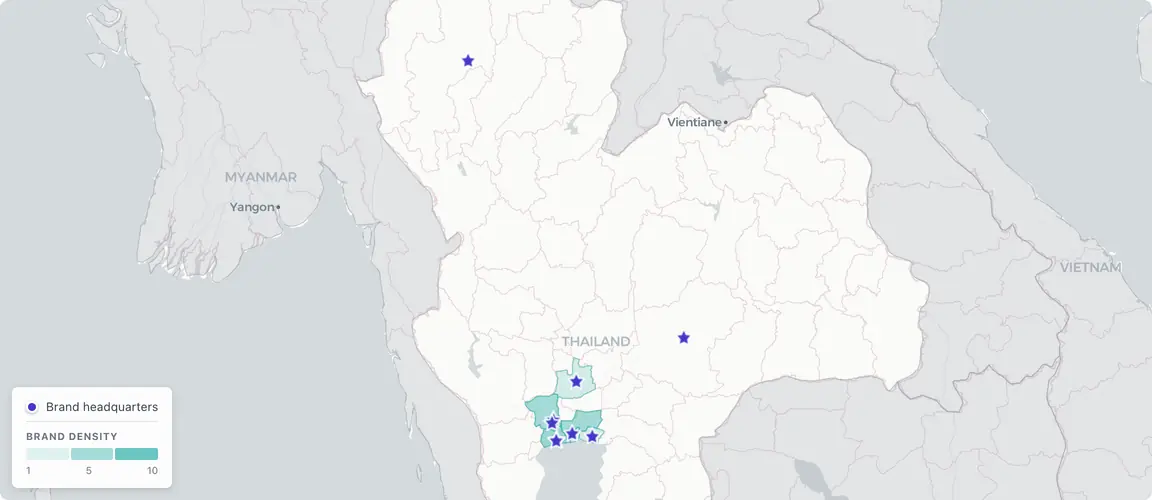
Thailand's snack dynasties: the Bangkok–Samut Sakhon core
The handover that decides it all
Thailand operates more 7-Eleven stores than any country outside Japan — 15,000 in a country of 70 million people. For the Sino-Thai families who built the country’s packaged-snack sector across a century, the CP All network has been less a distribution channel than a filter: brands that passed its SKU audit and packaging review compounded for two decades. Those that didn’t stayed regional, souvenir-grade, or invisible to institutional capital. Three have since listed on the Bangkok Stock Exchange — Tao Kae Noi in 2015, Chin Huay in 2022, Chao Sua in July 2024. The succession question nobody outside Thailand is asking: who comes next for the five that haven’t?
From Swatow to Ekachai Road
Almost every Thai snack of national consequence was started by a Chinese immigrant family. The word tao kae (เถ้าแก่) is Teochew for “boss” — when a teenage dropout named his seaweed company Tao Kae Noi in 2004, he was naming it after the immigrant culture that had built the sector around him. Chao sua (เจ้าสัว) is Teochew for “merchant prince.” The house that used that name as its brand went public on the Bangkok Stock Exchange in July 2024.
The seven anchor houses — Chin Huay (1925), Heritage Snacks origins (1943), Chao Sua (1958), Mae Pranom (1959), Koh-Kae/Mae-Ruay (1964), Manora (1965), and Wai Wai (1972) — were almost all founded by Teochew, Hokkien, or Hainanese families who arrived through the Mahachai fishing port or the street-vendor routes around Yaowarat. The Koh-Kae mascot wears a judo uniform because founder Chookiat Ruayjaroensap was a collector of Japanese postcards. The corporate name of the Wai Wai parent — Thai Preserved Food Factory — was registered in Nakhon Pathom by a seven-family syndicate structured exactly as Teochew and Hokkien commercial networks had operated in Southern China for centuries: multiple families pooling capital in a jointly-governed enterprise.
CP All opened its first Thai 7-Eleven in 1989, decades after the dynasty-founding window had closed. But as the network expanded past 3,000 stores by the early 2000s and beyond 15,000 by 2024, it imposed a retroactive qualification exam. Brands already operating at factory scale could pass the SKU audit, the packaging requirements, and the price-point discipline. Brands serving niche or regional channels couldn’t. The filter wasn’t intentional — it was structural. The decade between 1997 and 2011 added two more tests: the Tom Yum Kung financial crisis and the Ayutthaya floods each eliminated competitors, concentrated production among low-debt domestic businesses, and rewarded founders willing to rebuild rather than exit. These three filters produced the cohort the SET listed in 2015, 2022, and 2024.
The Bangkok core and its corridors
The sector’s geography confounds the first analyst who looks at it. International investors expecting Thai food production to cluster near raw materials — in Chiang Mai for tropical fruit, in the Isan peanut belt — find the anchor brands concentrated in a 60-kilometre arc from Bang Khun Thian to Sam Phran: the port and factory districts where Teochew immigrants first settled, not the country’s agricultural heartland.
Samut Sakhon, the coastal province that commodity databases code as a seaprocessed-foods zone, holds the sector’s oldest foundations. Chin Huay’s first operation was in Tha Chalom, where the three founding brothers had access to the Gulf of Thailand anchovy supply that made fish sauce viable. Manora built its prawn-cracker factory in Samut Sakhon’s Charoensuk Road, twenty kilometres from where founder Dr. Apiwat Wangwiwat had first sold family crackers outside Thammasat University in the 1960s. The Bangkok factory district — specifically the Ekachai Road corridor in Bang Khun Thian — is where Chookiat and Jiraporn Ruayjaroensap set up the small frying operation in 1964 that became Koh-Kae, and where Mae Pranom’s Sirichai and Pranom Daengsupha began bottling chili paste a few years earlier.
Thirty kilometres north and west, the Sam Phran-Nakhon Pathom corridor fills a second cluster. Thai Preserved Food Factory chose Sam Phran for the land available for an industrial instant-noodle plant when Surin Napapruekchat and his founding families needed scale in 1972. Heritage Snacks & Foods established its Nut Walker manufacturing facility in Sam Phran when the Phonphaisan family converted a wholesale nut operation into a branded manufacturer in 1986. Both are within 45 minutes of Suvarnabhumi Airport, a logistics advantage the heritage-brand export programs would later exploit. Tao Kae Noi sits apart from this central arc — near Ayutthaya, in the Central Plain, where land was cheaper when the company scaled rapidly after 2004. That factory is the one the 2011 floods destroyed.
What the databases miss
No international commercial database has assembled this picture. These companies file with Thailand’s Department of Business Development in Thai. Their coverage in English ranges from sparse — Chin Huay PCL has two English Wikipedia footnotes, neither sourced to the company itself — to non-existent. Heritage Snacks exports to 60 countries and has no Crunchbase entry. Koh-Kae’s most detailed succession reporting appears in two Bangkok Post features from 2016 and 2019, behind a paywall, in a language most institutional analysts do not read.
The cultural framing compounds the blind spot. Western readers encode “Thai” as Buddhist-Tai — temple culture, royal agricultural projects. The snack sector is overwhelmingly Sino-Thai: Teochew and Hokkien families who arrived through Mahachai and built industrial operations across three generations while maintaining dialect, commercial customs, and family-governance structures that have no direct equivalent in a standard PE due-diligence template. The intelligence that surfaces through this window is, by definition, not available from conventional platforms. Euromonitor can name the brands and cite secondary-source production volumes. It cannot document the 2015 Mae Pranom family dispute — in which co-founder Pranom Daengsupha filed a police complaint alleging her daughter Siriporn had used a falsified power of attorney to transfer control after co-founder Sirichai’s 2013 death, mediated at Woradis Palace that August. It cannot document the Koh-Kae 7-Eleven redesign negotiation as Jumpoth Ruayjaroensap’s team lived it — the specific packaging audit requirements, the SKU count that had to change, the commercial logic that made acceptance the only viable path. That documentation exists in Thai-language business journalism. None of it has been indexed in English.
Who survived — and how
Four cases establish what surviving the filters required.
Tao Kae Noi. In 1997, Itthipat “Tob” Peeradechapan’s father lost the family construction business to the baht devaluation — approximately ฿40 million in debt. Itthipat was 17. He dropped out of university, traded his MMORPG account for seed capital, and tried several businesses before landing on seaweed snacks from roasted-chestnut kiosks. In 2004, a CP All buyer agreed to list his product in 7-Eleven stores on one condition: build a GMP-certified sanitary factory and deliver within a month. He did. The factory that resulted was destroyed by the 2011 Ayutthaya floods. Itthipat rebuilt in three months without pausing distribution. The same year, biographical film The Billionaire grossed ฿38.8 million and made the company’s crisis arc mainstream. Tao Kae Noi listed in December 2015, raising ฿1.4 billion, and reached Costco shelves in the United States by 2019. Three macro shocks — 1997, 2011, COVID — and the brand grew through each one.
Koh-Kae. Chookiat Ruayjaroensap stepped back around 2008, handing management to four heirs led by eldest Jumpoth. Revenue was approximately ฿600 million. The crisis was not financial — it was channel. CP All’s buyers demanded a complete SKU redesign and packaging overhaul to continue the 7-Eleven relationship. The gen-2 team could have resisted the redesign cost and complexity. They accepted it, executing new flavour lines, new packaging architecture, and convenience-store-specific formats that the founder’s original production line had not been designed for. By 2018, revenue had grown to approximately ฿2.6 billion — roughly five times in ten years. Koh-Kae now holds an estimated 85% of Thailand’s coated-peanut market and exports to 70 countries. The 7-Eleven redesign negotiation was the succession-and-adaptation test compressed into a single commercial decision.
Chin Huay. The three brothers from Swatow who founded Chin Huay (จิ้นฮ่วย — “Charoen Utsahakam” in Thai) in Tha Chalom in 1925 were fish-sauce producers. Their descendants became fish-canners, then dried-fruit processors, then a health-snack company. When COVID-19 collapsed demand for traditional canned fish in 2020, the third-generation Srisaengnam family — who had been quietly managing the 97-year transition — invested ฿50 million in a new R&D centre and pivoted toward mango probiotic drinks, plant-based snacks, and rambutan stuffed with pineapple, a product the company effectively invented. To reduce supply-chain exposure for European export, they opened a production facility in Preah Sihanouk, Cambodia. In September 2022, Chin Huay PCL listed on the SET. The gen-3 institutionalised what the gen-1 had started. The gen-4 is already in the company.
Kunna. In 2011, Nasha Jungkankul launched Kunna in Chiang Mai. She is the youngest daughter of a hardware-industry founder and built Kunna’s business on a channel the other dynasties had not courted: the Chinese-tourist souvenir circuit in Bangkok’s premium department stores. By 2019, Kunna had 30 SKUs and consistent best-seller status at Gourmet Market and Central Food Hall. Then, in early 2020, the Chinese tourist arrivals sustaining 80% of Kunna’s volume collapsed to near zero. Nasha pivoted to export: Russia, Kuwait, UAE — markets accessed through DITP’s export-development programs and re-positioned for diaspora audiences rather than souvenir tourism. At the 2020 ASEAN Business Awards in Vietnam, she was named Women Entrepreneurs of ASEAN. The tourist channel has not returned to its 2019 scale. Kunna’s survival is the case the souvenir-snack segment is still working through.
Five more brands built in this era — Heritage Snacks (Bangkok, 1943), Mae Pranom (Bang Khun Thian, 1959), Koh-Kae/Mae-Ruay (Bang Khun Thian, 1964), Manora (Samut Sakhon, 1965), and Wai Wai (Nakhon Pathom, 1972) — each carry their own version of this arc, still privately held. Wai Wai’s Pricha Napapruekchat became managing director in 1998, with gen-3 brother Veera now leading R&D and the Quick Terrace restaurant chain. Heritage Snacks exports to 60 countries across 9 group companies in 6 markets. Manora’s prawn-cracker business, built from Dr. Apiwat Wangwiwat’s student street-vending in the 1960s, still operates on the same founder-line ownership. Mae Pranom continues to operate under the family structure the 2015 governance dispute exposed.
The Teochew idiom
The sector’s cultural specificity matters because the intelligence gap it creates is structural rather than incidental. Western readers who try to assess Thai consumer brands through a Western-institutional lens find nothing — not because the brands are small, but because the lens is wrong.
The founding idiom is Teochew and Hokkien commercial culture: multiple families pooling capital, generational continuity as a structural assumption, internal governance by family council rather than board resolution. The second and third generations of these houses layered Thai institutional legitimacy on top of this inheritance without abandoning it. Jumpoth Ruayjaroensap is fluent in both Bangkok commercial culture and the Sino-Thai business community that still convenes in Yaowarat. The Srisaengnam family’s 2022 IPO announcement was structured to communicate institutional modernity to SET investors and continuity to the Teochew commercial community simultaneously. The Napapruekchat family’s restaurant chain name — Quick Terrace — is a deliberate anglicisation built for the generation that grew up in both registers.
The sector’s cultural thickness is what makes the succession risk legible from the outside. When the founding generation structured these businesses, they structured them for family continuity — not governance clarity. The transition from family-continuity logic to institutional-governance logic is the test the next five years will run on every house that hasn’t yet IPO’d.
The succession test
Three forces converged after 2020 to make the succession question urgent.
The first is biological. The founders of the seven anchor houses built their businesses between the 1920s and 1970s. Their successors — Pricha Napapruekchat at Wai Wai, Jumpoth Ruayjaroensap at Koh-Kae — are now in their 50s and 60s. Third and fourth generations are in every company. Whether those generations have the institutional architecture — named succession, governance documents, an external-facing board — to run a publicly-listed or IPO-ready business is not answered by the SET filings alone.
The second force is the capital-markets demonstration effect. Tao Kae Noi’s 2015 listing set the template. Chin Huay’s 2022 listing proved it could apply to a 97-year-old food producer whose first products were bottled fish sauce. Chao Sua’s July 2024 debut — opening 24.58% above its offer price on the first day of trading — confirmed that the SET will price a 66-year-old Korat rice-cracker brand above its book value on day one. The signal to every private heritage family: your brand has a market-discoverable value, and remaining private is now a deliberate choice rather than the only option.
The third force is the cautionary documentation. In August 2015, co-founder Pranom Daengsupha and her daughter Siriporn reached a mediated settlement at Woradis Palace over the governance of Mae Pranom — the chili-paste brand they had built since 1959. The dispute had entered the public record when Pranom filed a police complaint alleging a falsified power of attorney transfer following co-founder Sirichai Daengsupha’s 2013 death. Mae Pranom continues to operate. But the case is cited by every Thai business journalist covering Sino-Thai succession as the documented reference for what happens when generational transfer proceeds without a governance structure capable of handling disagreement. Every snack dynasty principal in this cohort knows this story. What they do with it in the next five years is the test.
Three IPOs, five decisions
Thailand’s seven snack dynasties have been selling into markets on five continents for decades. Heritage Snacks exports to 60 countries. Koh-Kae sends its coated peanuts to 70. Tao Kae Noi seaweed reaches Costco shelves in the United States. None of them appear in any standard emerging-market brand intelligence database. The revenue figures, where public, come from SET filings most international analysts have not read. The succession dynamics — six documented generational transitions, one documented failure case, and two succession gaps — are assembled in Thai-language business journalism that no Western intelligence service has aggregated.
Three IPOs in a decade confirm what the sector’s builders have always known: these are real businesses, with real margins, at real scale. Five more families are now deciding whether the next chapter requires the same institutional step — or whether the governance structure they inherited is sufficient for a second century.
Seven dynasties, three IPOs, a century of ledgers kept in Thai — the record was never hidden, only never translated.
Researched 15 sources in English, Thai.