 Skip to main content
Thailand's herbal dynasties outlast the state
Thailand's herbal sector looks state-dominated — Abhaibhubejhr is a Ministry foundation, Doi Kham is royal, one flagship is PE-owned. The investable layer is Thai-Chinese dynasties that stewarded their formulas across four generations, survived a price-cap crisis, and turned a K-pop moment into export credibility.
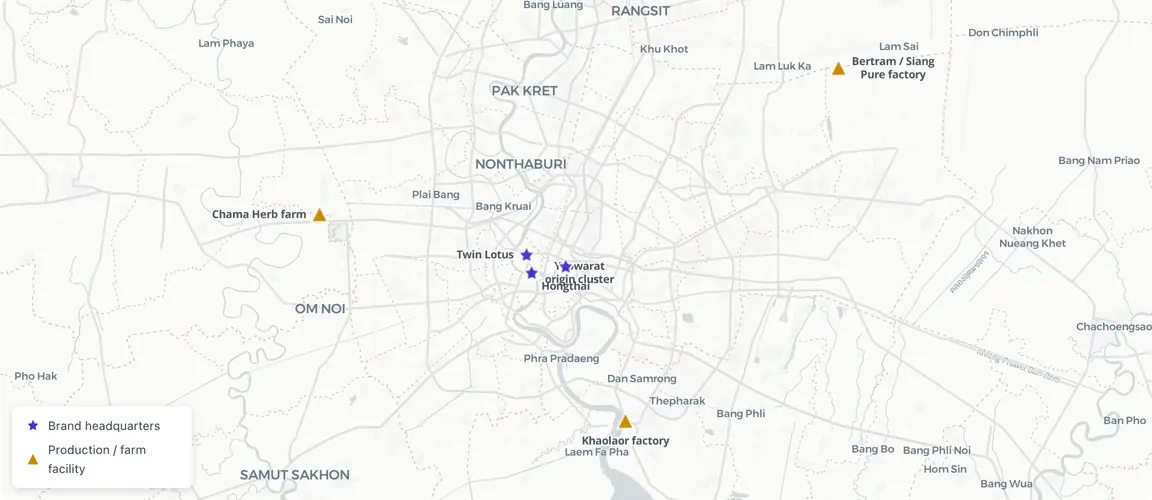
Thailand's herbal medicine sector: geographic context
Older than the state that regulates it
When Thailand changed pharmacy distribution rules in 1977, Dr. Boonkij Leelertphand bet his Bangkok pharmacy on something nobody made domestically: a herbal toothpaste, ground dark brown, with no imported substitute and no domestic competitor. The formula was elementary. The market insight was not. Nearly five decades later, his son Bundit runs three companies, sells into 24 countries, and reports that China — where a bird’s-nest beverage line now outsells the toothpaste — is Twin Lotus’s most promising market.
The 1977 decision is not Thailand’s herbal sector in miniature. It is its representative story: a moment at which an institutional pressure that should have ended a family business instead became the founding logic of a durable export operation. Understanding why requires understanding what the sector’s visibility problem is, who actually holds the investable layer, and what two recent crisis years revealed about which brands will outlast the next disruption.
The sector that hides its best assets
Thailand’s herbal and traditional medicine industry is, on its visible surface, dominated by institutions. Abhaibhubejhr is a Ministry of Public Health hospital foundation operating since 1941. Doi Kham’s herbal line is a Royal Project. Osotspa PCL’s Kilen brand is a division of a listed conglomerate. These are the names that appear in market-share data: well-documented, state-linked, outside the scope of founder-owned brand analysis.
Even the sector’s most internationally available name obscures its ownership. Khaokho Talaypu, the Phetchabun-sourced personal-care brand, carries “we continue our founder’s mission” language on its packaging. The unnamed 1987 founder did exist. He also retired in 2015, when Singapore-based private equity firm Springtide Equity Partners acquired the company. Khaokho Talaypu has grown 40% annually since acquisition and is now expanding into Watsons Philippines — but it belongs to private equity, not to its founding family. The founder’s son trained as a chef.
This ownership camouflage is the sector’s primary analytical challenge. Thailand’s herbal market — estimated at roughly 50 billion THB in 2022 by the Department of Thai Traditional and Alternative Medicine, with a government target of 100 billion THB by 2030 — appears well-populated. The investable founder-owned layer, once state foundations, royal projects, listed conglomerates, and PE acquisitions are stripped away, runs to fewer than 15 brands at meaningful scale.
Those brands are sorted into two cohorts that rarely overlap in strategy, supply chain, or crisis response. The heritage cohort traces its origins to Yaowarat, Bangkok’s Chinese district, where Teochew migrant families from Shantou built apothecaries starting in the 1920s and 1930s. The new-wave cohort was founded after 2001, built with explicit design logic and export awareness from the first year. Between them sits Twin Lotus — a 1973 pharmacy that grew into neither a heritage anchor nor a new-wave startup, but something more structurally durable: a family company that bet on its own formula at exactly the moment the market needed a domestic alternative.
What Yaowarat built before the tourists arrived
Mor Long Khaolaor, a traditional medicine practitioner, opened his shop on Bamrung Mueang Road in Bangkok in 1929. His family name did not survive the street sign — the pharmacy took the name of its location. The Phongboriboon family, which married into the operation, has now held the formula for four generations. Dr. Petchpailin Phongboriboon, a licensed TTM practitioner, serves as R&D assistant managing director. Khaolaor’s parasite formula, developed in the 1920s for rural Thailand, still sells in the same hospital-pharmacy channel where 1950s radio-cinema ads built the first national audience.
A few streets away in the same district, Gold Mints Products Co Ltd — the corporate name of Poy-Sian — has operated in some form since 1936, when the Laphbunsap family opened a herbal stall in Yaowarat. The second generation formalised distribution through Thailand’s ยาสามัญประจำบ้าน (household drug) designation, giving Poy-Sian inhalers the same protected status as the paracetamol on the pharmacist’s shelf beside them. The Thailand Foundation has described ya dom as “the Thai people’s 33rd organ.” Poy-Sian is the product most often cited when that metaphor circulates.
Bertram — legally Bertram Chemical (1958) Co Ltd after the 1982 restructuring — holds an unusual distinction for a Thai family company: its brand succession is a published WIPO case study. Boonchua Eiampikul, trained under Master Tang of Shantou, built Siang Pure Oil on a traditional Chinese formula. By the late 1990s, his daughters concluded that the brand looked outdated to younger Thai consumers. Rather than reformulate the original, they launched a subsidiary: Peppermint Field Aromatics, a modern ya dom inhaler designed from scratch for a generation that had grown up with Japanese and Korean personal-care aesthetics. Siang Pure retained its pharmacist-adjacent positioning. Peppermint Field captured the shelf space. Cambodia, where Bertram products are now distributed, is the brand’s largest single export market; a Bt500M factory there is planned.
These three brands — Khaolaor, Poy-Sian, Bertram — share a structural signature: they modernised without reformulating. The original product remained on pharmacy shelves. The expansion happened through adjacency — new sub-brands, new channels, new geographies — rather than by changing the founding formula that built the customer trust. Madame Heng (1949, Suwannamonkol Production Co Ltd) followed the same pattern in natural soap: the core herbal formulation held while distribution expanded into tourist-retail channels across multiple countries. Five Pagodas Ya Hom, a heritage ya hom maker in the 100 million THB range operated quietly by the Hengskul family, illustrates the opposite choice — minimal visibility, minimal marketing, continuing to supply the same hospital-pharmacy base that Mor Long Khaolaor first established in 1929.
Twelve months that revealed everything
The Department of Internal Trade’s intervention on 13 August 2021 was Thailand’s first national stress test of the herbal medicine sector in decades. The mechanism was straightforward: Commerce Minister Jurin Laksanawisit, citing a 48.46% retail price increase for fa talai jone (Andrographis paniculata) during the Delta wave, authorised DG Wattanasak Sue-iam to publish a retail-price list for 49 named manufacturers. Overpricing carried a penalty of seven years imprisonment or 140,000 THB.
The seed-price spike that produced the retail increase had built quickly. Fa talai jone had been added to Thailand’s National Herbal Drug List No. 2 (B.E. 2564) as an approved early-stage COVID-19 treatment. Seeds that normally sold for 0.20 THB were trading at 0.60–1.50 THB by the time the enforcement list appeared. By October 2021, the herb’s four-month growing cycle had restocked supply and prices normalised. The crisis lasted ninety days. What it revealed about brand discipline lasted longer.
Khaolaor, whose Samut Prakan factory had been building pharmaceutical-grade production since 1979, expanded its community-hospital supply during the surge rather than raising retail prices. By the time the crisis subsided, Khaolaor held long-term supply relationships with hospital networks it had not previously reached at scale.
Tamrab Thai Herbs, a 2001 national-retail-chain concept founded by Mahakhun Thepsuthin, had positioned itself earlier. In March 2020 — before the Delta wave — Tamrab Thai distributed 34,000 free fa talai jone packs as a CSR initiative. When the August 2021 intervention arrived, Tamrab Thai was already in consumers’ consideration set for herbal immunity products. The chain reported herbal category sales at ten times their pre-COVID level.
Chama Herb read the moment differently. Prinda Tangpiroontham concluded that the COVID-driven public acceptance of Thai herbs was the opening she had been waiting for. Chama Herb launched its consumer brand in September 2022, twelve months after the price-cap crisis, with internationally certified organic credentials and an integrated farm-to-clinic model that produced Thailand’s first certified-organic TTM clinic alongside its supplement and cosmetic lines.
What the fa talai jone crisis revealed was not market vulnerability — the disruption lasted ninety days — but which companies treated the crisis as an operational problem and which treated it as a marketing problem. The distinction is not semantic. Khaolaor, already positioned in hospital supply chains, expanded its institutional reach. Tamrab Thai, which had given away product when others were building inventory, captured the demand surge. Chama Herb used the public-acceptance moment to time its formal brand launch. All three are structurally stronger post-2021 than pre-2020.
The K-pop amplification that began in 2023 was structurally different: external demand reshaping the sector from outside, rather than a regulatory intervention shaping it from above. Lisa BLACKPINK was photographed using a Hongthai green inhaler. The product sold out overnight. Hongthai reported 350 million THB in 2023 revenue — the brand had generated 24.8 million THB in 2021. Jennie BLACKPINK’s cameo with a Poy-Sian product drove a secondary surge in Korean and Indonesian tourist demand for the Yaowarat brand.
What the K-pop moment revealed was operational — not brand — readiness. For Poy-Sian, the demand surge arrived at a brand that had operated continuous hospital-pharmacy distribution for eighty-seven years. The supply chain was not stressed by a viral moment; it expanded with it. For Hongthai, the surge arrived at a brand that had grown from a grade-six dropout’s street-market recipe into a 350 million THB operation inside two years, with GMP-ASEAN factory certification still in process.
The Consumer Protection Police Division and Thai FDA inspection of Hongthai’s factory in 2023 — carried out over alleged unlicensed production — was the logical consequence. Founder Theerapong Rabuetham went on live radio to explain that licensing applications and blueprints had been filed, that he had not been notified of the inspection, and that no enforcement action had been initiated before the raid. A 4-rai GMP-ASEAN factory was simultaneously announced for 2025 completion. The brand is now building the infrastructure that should have preceded, rather than followed, the Lisa moment.
The contrast between Poy-Sian’s 2023 response and Hongthai’s encodes the sector’s core structural lesson: formula integrity is the credential a heritage brand defends. Operational infrastructure is the credential a growth-phase brand builds. Both are necessary. They do not arrive in the same order for every kind of company.
A new generation with different bets
Thailand’s new-wave herbal brands share one structural decision with the heritage cohort — all are explicitly founder-owned — and diverge on almost everything else. The heritage cohort grew into export almost incidentally; distribution followed demand from Thai diaspora and traveller channels, not export-first strategies. The new-wave cohort was built, from its first year, to reach markets that do not speak Thai.
ANONA, founded by Eunice Supicha Korjareonpanich — who left office work at twenty-five to design a premium version of the ya dom her parents used — is the most explicit example. ANONA’s giant and Hanuman inhalers are tourist-souvenir objects first and herbal medicine second. Priced for duty-free retail and designed for gift-giving to someone who has heard of BLACKPINK but not of Poy-Sian, the brand is formally positioning Thailand’s most ancient personal-care product as a luxury export category.
Chama Herb is building a different model: vertical integration from soil certification to consumer product, with a TTM clinic as the brand’s proof of seriousness. Prinda Tangpiroontham’s farm holds parallel organic certifications across four international standards — a supply-chain credential that most Thai herbal brands do not carry and that ASEAN and European import partners increasingly require. The planned 300 million THB revenue target within five years of the 2022 brand launch suggests a company that expects to monetise the credential rather than simply hold it.
Hongthai is the stress-case between the two. Theerapong Rabuetham refused to dilute his camphor formula when Chinese supplier upgrades raised costs by roughly 2,000 THB per three-kilogram batch before COVID — a decision that preserved the product’s efficacy while compressing margins. When the Lisa moment arrived, the formula was intact. The factory infrastructure was not. The story is now about whether operational compliance can catch up to a brand that grew faster than its licensing.
What 52 years of holding a formula proves
Bundit Leelertphand did not inherit his father’s pharmacy. He inherited the decision his father made in 1977: to bet on a dark-brown toothpaste that no competitor made domestically, when the regulatory change that ended pharmacy distribution would have destroyed the business if Dr. Boonkij had simply wound down the clinical operation.
Twin Lotus now operates three group companies, more than 150 SKUs, and distribution in 24 countries. The product that most clearly illustrates what 52 years of formula integrity produces is the bird’s-nest beverage line developed by Bundit’s late brother. In China — where Twin Lotus is now the group’s largest single export market — the bird’s-nest line outsells the toothpaste that built the company. A formula designed for Thai oral-care habits became Thailand’s most prominent herbal export to China because the brand behind it had already spent three decades proving it would not dilute its ingredients for margin.
This pattern runs through the heritage cohort and is only beginning to appear in the new-wave brands. Khaolaor did not thin its parasite formula during the fa talai jone crisis. Bertram did not dissolve Siang Pure to fund Peppermint Field. Poy-Sian distributed the same product through the 2023 K-pop surge as through the 1970s hospital-pharmacy expansion.
The sector’s structural advantage — and the reason fewer than 15 founder-owned brands at meaningful scale can anchor a 50 billion THB market — is that the formula covenant between a founding family and its customers is not replaceable by institutional players. Abhaibhubejhr can produce better-documented herbal medicines than most private brands. Doi Kham can source from higher-altitude farms. Neither can claim four generations of an unbroken founding family. The private equity firm that bought Khaokho Talaypu in 2015 markets the brand as if it can.
The families that have not sold are the sector’s investable layer. What they have proved — across regulatory disruptions, price-cap crises, and viral K-pop moments — is that the covenant holds as long as the formula does.
Researched 31 sources in Thai, English.