 Skip to main content
Thailand Fashion: The Handover Wave Begins
Two outsiders launched Thailand's first global luxury bag brand with a film score's savings and a Paris concept store's stockist order. Boyy is the outlier. The sector that produced it is invisible to every institutional database — and four of its founders are within five years of a handover they haven't begun to plan.
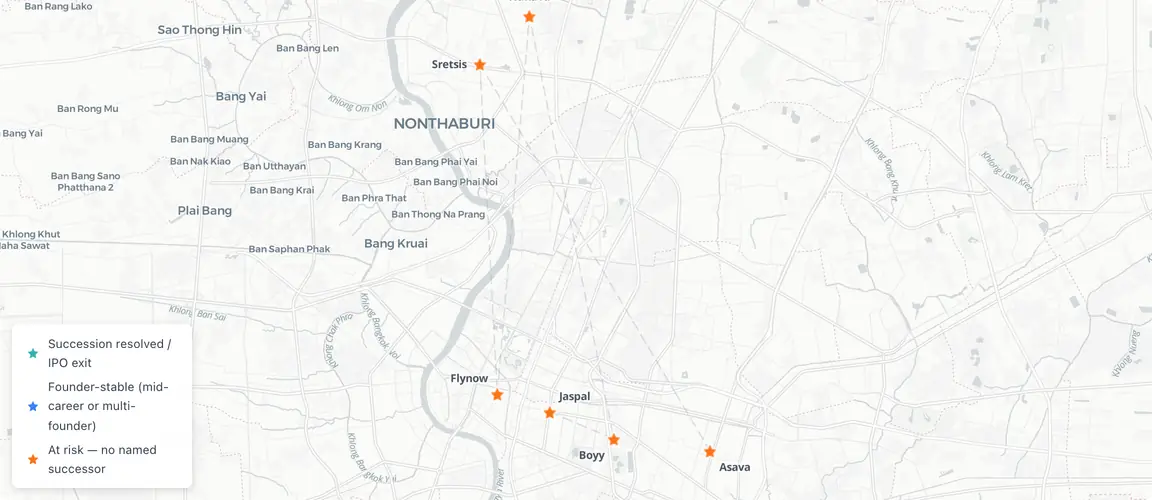
Thailand Fashion: Founder-Owned Brand Geography and Succession Wave
The first handover generation
Jesse Dorsey had a film score’s worth of savings — USD 10,000 — and a co-founder named after a Boyy bag. The Canadian composer and Thai journalist Wannasiri Kongman launched their accessories brand in New York in 2006. Their first stockist was Colette Paris. Their third bag, the Slash, became the anti-It bag: a silhouette that refused to play the seasonal desire game that Louis Vuitton and Gucci win on marketing budgets. Boyy didn’t have a marketing budget. It had a thesis.
No English-language intelligence product has mapped the sector that produced them. The Thai fashion industry — an ~$8.6B market generating brands that reach Bergdorf Goodman, the Raffles Hotel Arcade in Singapore, and Minami Aoyama in Tokyo — exists almost entirely below the institutional radar. The founders who built it are 55–68 years old. Four of them have no documented succession plan.
From mattress imports to Milan
I have no wife, no kids, so I dedicate my life to fashion.
The sector is older than it appears. The Singhsachathet family opened the first Jaspal store at Bangkok’s Siam Center in 1972, three years after registering their mattress-importing business. Fashion was an adjacency. Fifty years and two generations later, Jaspal is a 970-store ASEAN conglomerate worth ~USD 260M, with 25 brands across fashion, footwear, and lifestyle — and a filed SET IPO.
Somchai Songwattana started earlier and smaller. In 1983, at age 20, with USD 8,000 and 14 workers, he launched Flynow in Bangkok. Twelve years later, at London Fashion Week 1995, Flynow Black was voted one of the top five designers of the season. He came home with European distribution and a story no Thai fashion press had imagined. He is still the sole creative engine. He is 65 or older.
NaRaYa arrived in 1989 — a different story. Vassilios Lathouras, a Greek businessman scouting opportunities in Thailand, was assigned a Thai company representative named Wasna Roongsaenthong. They married and registered a company called Narai Intertrade with THB 1M in capital, beginning in motorcycle-parts export. Supply shortages pushed them into textiles. In 1993, their first sewing factory opened with 15 machines and 15 employees; the retail point inside Narai Phand department store measured two square metres. Today, NaRaYa employs 3,000 people and works with 4,000 contracted rural artisans across Buriram and Khon Kaen provinces.
Sretsis came out of a New York apartment in 2002, launched by three sisters after Pimdao received a 2-day window to decide on a Gaysorn retail space. Asava launched in 2008, when Polpat Asavaprapha walked away from his family’s Toyota dealership after ten years at Marc Jacobs, Max Mara, and Armani in New York. Boyy followed a month later in the same year. Each founding was distinct: different capitals, different strategies, different degrees of prior industry exposure. What they share is Bangkok, the same five crisis events, and the same moment in the founder lifecycle.
Bangkok’s five nodes
Thai fashion production is almost entirely Bangkok-based, with five recognisable clusters.
The Ratchaprasong–Ploenchit luxury corridor anchors the sector commercially. Central Embassy, Central World, Gaysorn, and Erawan host the flagships of Boyy, Sretsis, Asava, Kloset, and Jaspal’s premium lines. This strip was the epicentre of the 19 May 2010 arson and the COVID tourist collapse — every featured brand has direct retail exposure here.
The Siam cluster — Siam Paragon, Siam Center, Siam Square — is where the sector was born. Jaspal’s 1972 Siam Center origin anchor is still there. Kloset started in 2001 as a 9-square-metre rack shop on Siam Square. Flynow and Issue maintain Siam Paragon presence. The energy is younger, faster, and less international than the Ploenchit corridor.
Thonglor and Ekkamai function as the design-district alternative — Boyy’s first multi-level standalone boutique opened there in 2011 (later closed when the landowner sold), and Asava is headquartered in the neighbourhood. Independent designers and the newer BIFW circuit brands — Painkiller Atelier, Leisure Projects, 27FRIDAY — cluster here.
Then there is the production belt. NaRaYa’s headquarters and main factory sit on Chaengwattana Road in Nonthaburi; Sretsis is also headquartered in Nonthaburi with an in-house factory. This is the integrated manufacturing zone within Greater Bangkok. And extending northeast into Isaan — Buriram province, Khon Kaen province — NaRaYa’s 4,000 contracted rural artisans form a supply chain that most competitors cannot replicate, because it took thirty years to build.
What the databases miss
English-language institutional intelligence has a consistent problem with the Thai fashion sector: it doesn’t cover it. Euromonitor cites aggregate market size. Bloomberg carries Jaspal only after the PLC conversion in 2023 and the IPO filing made corporate structure legible. WWD covered Boyy after the Via Bagutta flagship opened in Milan — not before. NaRaYa, with ~USD 21M in estimated revenue and one of Southeast Asia’s largest artisan supply networks, has not been profiled by any Western trade publication in depth.
The structural reasons compound. Thai-language business media — Brand Buffet, Longtunman, Marketeer, Positioning Magazine, Manager Online — carries the deep founder profiles, the financial context, the succession discussions. Most is paywalled or difficult to access. The 2023 Marketeer and Brand Buffet profiles documenting Asava’s “THB 1 billion kingdom” fifteen years after launch exist only in Thai. Asava’s FY2020 branded revenue of THB 201M (~USD 6M), confirmed via DBD-derived data, appears nowhere in any English-language analytical product.
The analytical frame also undersells the companies. “Thai bag brand” erases what NaRaYa actually is: a vertically integrated, artisan-sustained manufacturing enterprise that has survived three crisis waves and generates international revenue across 18 country-level operations. “Independent accessories brand” erases what Boyy is: a Milan-headquartered luxury house with a Danish flagship and a coherent anti-It-bag thesis that has attracted Bergdorf Goodman and Lane Crawford as wholesale accounts on merit, not because of marketing spend.
The gap is not a mistake. It is a structural feature of how Western institutional capital approaches Southeast Asian consumer brands.
Three crisis waves, eight survivors
The sector has documented resilience across three distinct shocks, and that documentation is what separates this coverage from what Euromonitor’s methodology can produce.
The first wave was the 1997 Asian Financial Crisis. The baht collapsed in July 1997. NaRaYa’s affordable-craft positioning — fabric handbags at sub-luxury price points, made in Thailand — coincided with a devaluation that made Thai-made goods competitive just as the post-crisis tourism recovery began to build. In Wasna’s own Thai-language testimony, the founding narrative jumps from 1989 to the 1993 factory launch to international expansion — she does not invoke 1997 as a pivot moment. The crisis was a tailwind the founders were already positioned for, not a strategy they consciously adopted.
The second wave was the 19 May 2010 arson. Following UDD protest suppression, coordinated arson struck approximately 35 Bangkok buildings. Central World — the heart of the Ratchaprasong cluster — was looted and set ablaze; the ZEN Department Store wing collapsed. CPN, the mall operator, issued an immediate two-part response to all affected tenants: rent waiver from April 2010 through reopening, and relocation space in other CPN malls. NaRaYa’s “Grand Opening” at the renovated Central World is archived on the Central World Facebook page — it returned as an anchor tenant. Flynow, Jaspal sub-brands, Kloset, and Issue all had Central World exposure; each navigated the dislocation through other CPN properties while the mall rebuilt.
The third wave was COVID-19, 2020–2022. Thailand’s inbound arrivals fell from 39.9M in 2019 to under 500,000 in 2021 — a ~99% collapse. For NaRaYa, whose customer base is structurally millions of inbound visitors per year, the shock was existential. The response: four sub-brands launched by 2022 (NaRaYa Silk, LaLaMa bohemian, NaRaYa Tea Room, Darivari skincare), diversifying revenue while retaining the 3,000-person workforce and 4,000-artisan contract network. The company’s stated intent was to position Thai craft for a global stage not dependent on Bangkok airport arrivals.
Boyy’s response was structurally opposite — and revealing. Rather than retreat from international exposure, Dorsey and Kongman installed their Milan Via Bagutta flagship across a 17-month process that completed in April 2023, partnering with photographer Jim Goldberg and the FOS/OK-RM creative collective. New silhouette launches were frozen in favour of classics. The brand was explicitly anti-tourist-retail from its founding; COVID merely confirmed that the thesis was right.
Jaspal’s response was the most consequential for the sector’s succession story. Between 2020 and 2023, third-generation CEO Charan Singhsachathet accelerated ASEAN store expansion, converted the family company to a Public Limited Company on 31 May 2023, and filed an IPO via Kasikorn Securities. 108 new stores were planned for 2024, of which 44 overseas — Vietnam, Cambodia, Malaysia as priority markets, with Marimekko and Camper distribution rights extending the brand footprint. Jaspal became the sector’s first managed succession transition: a reference case for how a Thai fashion family can institutionalise without losing operational control.
Sretsis took the fourth path: the sisters invested in e-commerce infrastructure and launched a worldwide free-shipping model through sretsissuper.com, combined with a heritage-archive collection strategy that monetised the brand’s twenty-year back catalogue. Co-founder structure distributed the succession risk that sole-founder brands carry entirely on one person’s health and calendar.
Craft-meets-cosmopolitan
Thai fashion identity is shaped by three forces that outsiders rarely combine correctly.
Royal and Buddhist craft heritage — silk, Benjarong porcelain motifs, gold thread embroidery, Rattanakosin-era courtly references — runs through Sretsis prints, Asava’s ceremonial dresses, Nagara’s couture, and Flynow’s avant-garde silhouettes. This is not the same as “traditional craft” in the ethnographic sense. It is a living design language.
Bangkok cosmopolitanism arrives via Parsons and Central Saint Martins. Pimdao Sukhahuta and Polpat Asavaprapha both trained at Parsons. Matina Sukhahuta took her jewellery degree at Saint Martins. The Thai designers who built the export-capable brands are unusually New York and London-formed — more so than their peers in Vietnam or Indonesia — which is why their work reads internationally without trying to read locally.
And there is the Sino-Thai merchant DNA. NaRaYa’s Wasna comes from a Chinese-Thai grocery family in Bangkok. The Singhsachathet family built Jaspal from a mattress-importing base established by Chinese immigrants. This commercial tradition — disciplined capital, family-retained control, long time horizons — is what makes Thai fashion brands resilient through crises that would bankrupt Western VC-backed competitors.
The clock the market hasn’t set
The founders are 55–68. That fact has not yet registered in any institutional database.
Jaspal’s succession is executing. Charan Singhsachathet is 3rd-generation CEO; his brothers Viseth and Yosathep serve as deputy CEOs in business unit roles. The PLC conversion and IPO filing represent the institutionalisation of governance structures that will eventually allow non-family capital to enter. Greyhound, the sector’s exit reference, was acquired in 2014 by Sub Sri Thai for THB 1.85B (~USD 58M): Bhanu Inkawat had built a 34-year brand and resolved the succession question through sale. That multiple is now on the record.
The at-risk cases are more urgent. Somchai Songwattana is reported past 65 and remains the sole creative engine of Flynow — the Black Label, the Gold Label, the leather line, the show direction. Co-designer Chamnan Pakdeesuk has been credited on the Gold Label since at least 2013, but his role has never been formally documented as a succession arrangement. When Flynow’s Sea Mist collection closed the 2025 Bangkok International Fashion Week, Somchai took his bow. No succession announcement followed.
Polpat Asavaprapha has stated explicitly, in multiple public interviews, that he has no wife and no children, and that he dedicates his life to fashion. Asava Group cleared the THB 1 billion revenue threshold in 2023 — fifteen years after founding, four sub-brands, including a hospitality arm generating ~20% of group revenue from just two restaurants. There is no succession plan on the record.
Vassilios Lathouras and Wasna Roongsaenthong founded NaRaYa thirty-six years ago. They employ 3,000 people directly and support 4,000 artisans in Buriram and Khon Kaen. In Wasna’s Thai-language interviews, the only crisis she returns to is COVID — the succession question has not entered the public record. An investor assessing NaRaYa today must model the scenario in which two founders in their mid-60s to early-70s transition a 4,000-artisan supply chain to new management without a documented plan.
Hiding in plain sight
A sector producing Southeast Asia’s only independent luxury accessories brand at Bergdorf Goodman wholesale level. A family conglomerate executing a documented SET IPO that has never appeared on a Bloomberg sell-side screen. A 36-year-old artisan network that survived a 99% tourism collapse because it was vertically integrated before anyone called that a strategy.
The intelligence exists. It is in Thai-language business press, in DBD corporate filings, in the founder interviews that have been published in Marketeer and Brand Buffet and Brand Buffet’s fifteen-year retrospective profiles. It has not been assembled into a single English-language analytical product.
The founders are 55–68. Mapping ownership structure and documenting succession plans is a 1–3 year task, ahead of the handover wave now underway across the sector. When Flynow’s Somchai eventually steps back, the brand’s creative direction has never been formally addressed. Asava’s founder has stated no succession plan exists at all.
Somchai Songwattana has closed Bangkok Fashion Week from the same chair for three decades, and no filing, interview, or press profile has ever named who takes it when he doesn’t. Jaspal wrote its succession into a public prospectus; Flynow, Asava, and NaRaYa have not, and the Thai-language record that would show whether they are quietly preparing one is not being read by anyone pricing this sector in English. Somchai is in his late sixties. The next fashion week he skips will answer the question institutional intelligence never asked.
Researched 24 sources in English, Thai.