 Skip to main content
Thailand Boutique Hotels: Three Crisis Corridors
On 25 September 2024, Michelin awarded Three Keys to Keemala and The Siam Bangkok — placing two family-owned Thai boutiques alongside Aman and Mandarin Oriental. Neither appears in a Western institutional database. Both were built by Thai founders who survived three crises, rebuilt their assets, and refused to sell.
Thailand boutique hotels: three crisis corridors
Forged by three crises
On 25 September 2024, Michelin’s inaugural Thai hotel selection gave Three Keys to Keemala in Phuket and The Siam in Bangkok — placing them alongside Aman, Mandarin Oriental, and Four Seasons. Both are family-owned. Both were built by Thai founders navigating three decades of compounding disruption. Neither appears in Euromonitor, IWSR, or any Western institutional database covering Asian hospitality.
The Siam is where this sector makes itself visible. Krissada Sukosol Clapp, Creative Director and co-owner, built it on land his family had held along the Chao Phraya river since 1973 — territory inherited from a dynasty that began when his grandfather Kamol Sukosol imported twelve radio sets from the United States in 1939. The Michelin Keys arrived eighty-five years after that trading company was registered. The Siam sits in Bangkok. Most of the sector’s story doesn’t.
The tier the databases missed
I'll get an attractive price, and we can expand faster.
Thailand’s hospitality sector reads, from outside, as a corporate chain story. Minor International’s Anantara properties, Dusit International, Centara Hotels & Resorts, Onyx Hospitality — these are the names in the analyst notes and the M&A coverage. They are publicly listed, English-reporting, institutionally legible.
Beneath them sits a cohort that has never been mapped in any language most investors read.
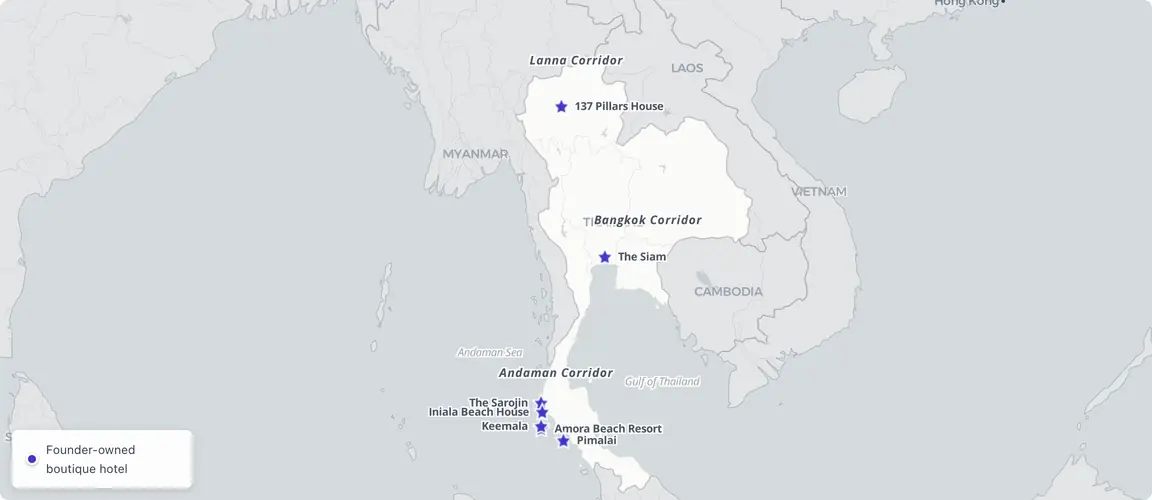
Brandmine has confirmed 13 independent founder-owned multi-property groups operating at institutional quality in Thailand: 137 Pillars Hotels & Resorts, AKARYN Hotel Group, Amora Hotels & Resorts, Cape & Kantary Hotels, Cape Fahn, Iniala Beach House, Keemala, Pimalai Resort & Spa, Rachamankha, Sri Panwa, Sukosol Hotels, The Sarojin, and X2 Resorts. A further 9 groups are undergoing ownership verification. The combined pool controls an estimated 4,000–6,000 keys across Bangkok, Phuket, Phang Nga, Krabi, Koh Samui, Koh Lanta, Chiang Mai, Chiang Rai, Hua Hin, and Ayutthaya.
None of these groups appears in the consolidated intelligence products that cross the desks of Singapore family offices, Hong Kong PE funds, or Japanese trading houses scoping Southeast Asian hospitality. Their founders are documented in Thai-language trade press — Krungthep Turakij, Prachachat Turakij — and in English-language hotel industry outlets TTG Asia and Hotel Management Australia. They are absent from the databases international capital uses to identify investable cohorts.
The 2024 Michelin Keys changed the visibility equation without changing the underlying data architecture. It is now possible for a non-Thai institutional reader to confirm that family-owned Thai boutiques operate at the same quality tier as Aman and Four Seasons. It is not yet possible to find them, understand their succession status, or model their capital needs from any single English-language source.
That is the intelligence gap. It has been here for decades.
Three crises, three corridors
The founder-owned tier was not built despite disruption. It was built through three crises that eliminated less resilient operators and gave the survivors land positions, acquisition opportunities, and founding stories that no corporate brief can replicate.
The first was the 1997 Tom Yum Kung crisis. The Thai baht lost nearly half its value against the US dollar between July and December 1997. Thailand’s entire hospitality pipeline stalled — unfinished projects were abandoned, leveraged operators defaulted, and land changed hands at prices that no subsequent market cycle has replicated. For operators with domestic cash reserves and no USD-denominated borrowing, the collapse was a generational acquisition window. Dr. Tanapun Siriphatrawan, who had made his fortune in Don Mueang Airport duty-free retail, acquired Amora’s first property in Melbourne in 1997. The Charn Issara family’s third-generation heir Vorasit Issara would later trace the land that became Sri Panwa on Phuket’s Cape Panwa to this same crisis-era accumulation. The groups that moved in 1997–2000 hold land positions that define the sector’s cost structure today.
The second was the 2004 Boxing Day tsunami. The wave struck Thailand’s Andaman coast on 26 December 2004, killing approximately 5,000 people and destroying the coastlines of Khao Lak, Phang Nga, and Natai Beach. It arrived at properties that were not yet open and at homes that belonged to people who would become founders. The Andaman corridor — Phuket, Phang Nga, Krabi — is where the sector’s most cinematic crisis arcs live: tsunami-destroyed pre-opening builds, rebuilt properties, Michelin-validated outcomes two decades later.
The third was COVID-19 in 2020–2022. Across AKARYN, Amora, 137 Pillars, Sukosol, and Keemala, the pandemic compressed a succession wave into a 24-month window. Next-generation owners returned from investment banking and consulting careers, assumed operational control, and made capital decisions under zero RevPAR. Thailand’s international arrivals fell from 39.8 million in 2019 to 428,000 in 2021 — a 99% collapse. The groups that had not entered the period with covenant-heavy debt had room to move. Amora’s Brisbane acquisition, committed in 2020, is the sector’s most precisely documented example of counter-cyclical capital allocation under those conditions. They are still in those roles.
The geography of the sector reflects these three events. The Andaman corridor is where the tsunami stories live. The Gulf coast — Koh Samui, Hua Hin, the coastal wellness properties — is where the COVID succession wave has been most visible in new format development: SALA Samui’s post-COVID consolidation, Aleenta Hua Hin’s wellness repositioning, Cape Fahn’s positioning ahead of the White Lotus Season 3 halo. The Lanna corridor in the north is a different story: not crisis survival but deliberate restoration, heritage building funded by families who chose not to beach-invest when everyone else was going south.
Bangkok functions as the sector’s prologue and its operational centre — where holding companies are registered, second-generation owners base themselves, and The Siam sits, Three Keys awarded, available for inspection by anyone who knows to look.
The succession that changed the math
In 2021, Earp Siriphatrawan formally took over Amora Hotels & Resorts from his late founder father, Dr. Tanapun Siriphatrawan. He had been working toward it since COVID began.
The succession is documented with unusual precision. Earp had completed degrees at LSE in economics and at London Business School, worked as a consultant at PwC, and built a track record at Siam Commercial Bank’s investment banking division. His father had died years earlier; his mother Amornrat — the brand’s namesake — held the chair. COVID, when it arrived, was also an acquisition window.
In 2020, while the pandemic closed borders and CDL Hospitality Trusts needed liquidity, Earp negotiated the purchase of the Novotel Brisbane for approximately A$76 million. The deal closed during one of the most illiquid periods in Asian hospitality M&A. CDL needed certainty; Earp had capital and a clear repositioning thesis. He committed to a reported A$30 million upgrade — not maintenance expenditure but a public signal that the buyer intended to operate the asset under the Amora flag at a higher standard. The property re-opened as Amora Hotel Brisbane in February 2024. In parallel, he committed THB 500 million — approximately US$14 million — to renovate Amora Beach Resort Phuket, completed in the fourth quarter of 2023.
His stated five-year target is to double the portfolio from 6 to 12 properties. He has been explicit about the logic: “I’ll get an attractive price, and we can expand faster.” The Brisbane acquisition proved he is not speaking hypothetically.
This is the investment case a sector spotlight exists to make visible. A named second-generation owner with Western financial credentials, a counter-cyclical acquisition on the public record, a stated growth target, and a family group that has operated through the 1997 crisis, a decade of platform-building, and a COVID renovation cycle — all within a geography that just received its first institutional quality validation from Michelin. None of this appears in an analyst note.
The Amora succession is also a template. AKARYN’s Anchalika Kijkanakorn, 137 Pillars’ Nida Wongphanlert, and Sukosol’s third generation each represent variations on the same pattern: a founder-built platform, a credentialed next-generation owner, a documented handover event. The details are available. They simply require a research methodology that institutional platforms have not applied to this market. Earp’s succession is the most legible because it includes a public M&A record. The others are documented through board filings, press interviews, and direct operator verification — the sources Brandmine uses and Euromonitor does not.
The naming of that next generation also illustrates the visibility gap the English record leaves. Thai business press covering Amora names a Gen-Z heir, Chawphat Siriphatrawan, leading the group’s repositioning toward a five-star standard — a thread that runs parallel to the English-language account of the succession rather than replacing it. Which romanised name an institutional reader encounters depends entirely on which language they search in. The family is the same; the record is split across two of them.
Ten months from tsunami to opening
Andrew and Kate Kemp had been planning The Sarojin for twelve years. They left Hong Kong for Khao Lak, built a 56-key resort on the Phang Nga coast, and had scheduled their opening for early January 2005.
The Boxing Day tsunami arrived on 26 December 2004. It destroyed the interior of the building — everything installed during construction — while the structure itself survived. The Kemps faced a capital allocation decision within days. The construction crew could be paid and the rebuild accelerated. The staff — 53 people, most from Khao Lak — could be retained and paid through the reconstruction period regardless of timeline.
They paid the staff.
The Sarojin opened on 7 October 2005, ten months after the tsunami. Each of the 56 guest residences is named after a staff member who stayed through 2005. In the same year, the Kemps founded the Sarojin Khao Lak Community Fund, which has since rebuilt a fishing fleet, supported school reconstruction, and planted mangroves under a 2022 “One Booking One Tree” programme. As of October 2025 — the resort’s twentieth anniversary — the staff demographic is 100% Thai and 70% Khao Lak-born.
In September 2024, Michelin gave The Sarojin Two Keys.
The Kemps’ story does not appear in a hospitality sector database because no hospitality sector database tracks the decision a founder makes when they pay people over machinery. That is the specific gap Brandmine documents. The Sarojin is the sector’s most complete example of what crisis-tested means in practice — not as an attribute label but as a dated, named, verifiable decision arc from 2004 to 2025.
Dynasty, matriarch, three keys
The Sukosol family story begins in 1939, when Kamol Sukosol imported twelve radio sets from the United States and registered a Bangkok trading company. He accumulated a 20-acre Pattaya plot in 1972 that became the Siam Bayshore Resort when it opened in 1975 — the family’s first hotel, under his daughter Kamala’s leadership.
Kamol died in 1980. Kamala built what followed.
Over three decades, Kamala extended the group from a single Pattaya resort to a five-property Bangkok-and-Pattaya presence. She is a recorded jazz vocalist and a 2009 Forbes Asia “Hero of Philanthropy.” Her children each took a distinct role: Marisa Sukosol Nunbhakdi as Executive VP, Daranee Sukosol Clapp as VP Finance, Krissada Sukosol Clapp as Creative Director.
Krissada built The Siam on the family’s 1973 riverside land in Bangkok. It opened in 2012. In September 2024, Michelin gave it Three Keys — placing a family hotel built on inherited territory alongside Aman Bangkok.
The crises that followed were financial, not just dynastic. In a 2025 interview at the age of 89, Kamala described the 1997 baht collapse in plain terms — the currency falling from 25 to 38 to the dollar overnight — and the debt it left her: “I had to repay it for a full fourteen years. I’d just made the last payment when COVID arrived.” (An earlier third-person retelling stretched the figure to thirty years; her own account is the primary record.) The Siam itself ran more than THB 400 million over budget. She built through both.
The Sukosol arc illustrates a structural feature of the founder-owned tier: the crisis that determines longevity often arrives early and without warning. Kamol’s 1980 death could have ended the hotel operations. Instead it produced a matriarchal succession that ran for more than three decades. The Three Keys did not arrive in spite of that succession; they arrived because of it.
Five threads, one argument
The Tier 1 anchors establish the category. Five threads demonstrate its breadth.
AKARYN Hotel Group was built by Anchalika Kijkanakorn after a decade at GE Capital and studies at Harvard Business School. She is the first — and so far only — Thai female Chairperson of Small Luxury Hotels of the World. COVID redirected AKARYN from expansion toward repositioning: Aleenta Retreat Chiang Mai opened in April 2023 as the group’s first dedicated wellness retreat, a bet on a sub-segment now growing faster than any other in the family-owned tier. Her description of Thai family hospitality — “offering before you ask” — is the shortest precise definition of kreng jai, the deferential anticipatory care that distinguishes service at family-owned properties from anything a corporate manual can codify.
Iniala Beach House opened on Natai Beach in December 2013. Mark Weingard’s beachfront home had been destroyed there in the 2004 tsunami; he had lost his fiancée Annika Linden in the 2002 Bali bombings. The house he rebuilt brought eleven international designers — among them the Campana Brothers and Jaime Hayón — to design eleven suites. In November 2024, Aulis Phuket at Iniala won Phang Nga province’s first Michelin restaurant star. The same stretch of Natai Beach that was destroyed in 2004 now holds two of Thailand’s most internationally recognised addresses.
Keemala was built by the Somnam siblings — Samornpun and Tanapong — on Kamala Beach in Phuket. They are fourth-generation Phuketians. Keemala received Three Michelin Keys in the 2024 inaugural selection, alongside The Siam. Their documented stance on wildlife tourism — no elephant activities, an explicit anti-exploitation policy — reflects how fourth-generation local families relate to their region’s ecosystems, a policy rarely read by investors from outside the market as a business signal.
Pimalai Resort & Spa holds Kantiang Bay on Koh Lanta, Krabi — the first high-end property to anchor an island that had been accessible only by ferry. It was built by Anurat Tiyaporn on 250 rai with 900 metres of private beachfront; his daughter Charintip Tiyaporn now runs it as the documented second generation. It holds Two Michelin Keys and Small Luxury Hotels Considerate Collection status. Its coral propagation programme is the sector’s most consistently documented sustainability credential.
137 Pillars Hotels & Resorts carries the 1889 Borneo Trading Company teak house in Chiang Mai — acquired in 2002 by Panida Wongphanlert, who found it while looking for a retirement home and spent twelve years restoring it. Her daughter Nida Wongphanlert joined in 2015 as Owner-GM of 137 Pillars Suites & Residences Bangkok. The Chiang Mai property received a Michelin Key in 2024. It represents the Lanna corridor’s argument: that cultural restoration is as investable as beach luxury, but competes in a different capital market with a different buyer profile.
A succession wave already in motion
The 2025 Michelin Keys update was, at the time of writing, expected but not yet published. If the preliminary 62-hotel figure circulating in Thai trade media is correct, the cohort is already growing beyond the 2024 stamped baseline.
The succession wave is not theoretical. Earp Siriphatrawan is executing a documented acquisition strategy. Nida Wongphanlert is running a Bangkok property her mother built. The Somnam siblings hold one of the two highest-rated family hotels in Thailand. Anchalika Kijkanakorn is named in SLH’s governance and has opened a third property since the pandemic. These are active operators in mid-transition, not founders resting on completed arcs.
These families built their positions during crises that Western capital was watching from outside. The 1997 crisis was when Thai baht collapsed and land cleared. The 2004 tsunami was when Andaman coast properties sold at distress. The 2020 pandemic was when Novotel Brisbane went to an Amora, not a REIT. Each of those transactions was completed and documented before outside investors identified the pattern.
Thirteen Thai hotel families have been here all along, building, inheriting, rebuilding, expanding — in a record that was public the entire time, in Thai-language trade press international databases never indexed.
Researched 67 sources in English, Thai.