 Skip to main content
Sijilmasa: The Mint That Ran the Mediterranean
For six centuries, every gram of West African gold entering Mediterranean commerce passed through a single oasis at the edge of the Sahara. Sijilmasa minted the coins Christian kings copied, underwrote an empire from Senegal to Zaragoza — then vanished when governance failed first and the Atlantic sea routes made revival impossible.
Geographic Context: Sijilmasa and the Western Trans-Saharan Gold Route
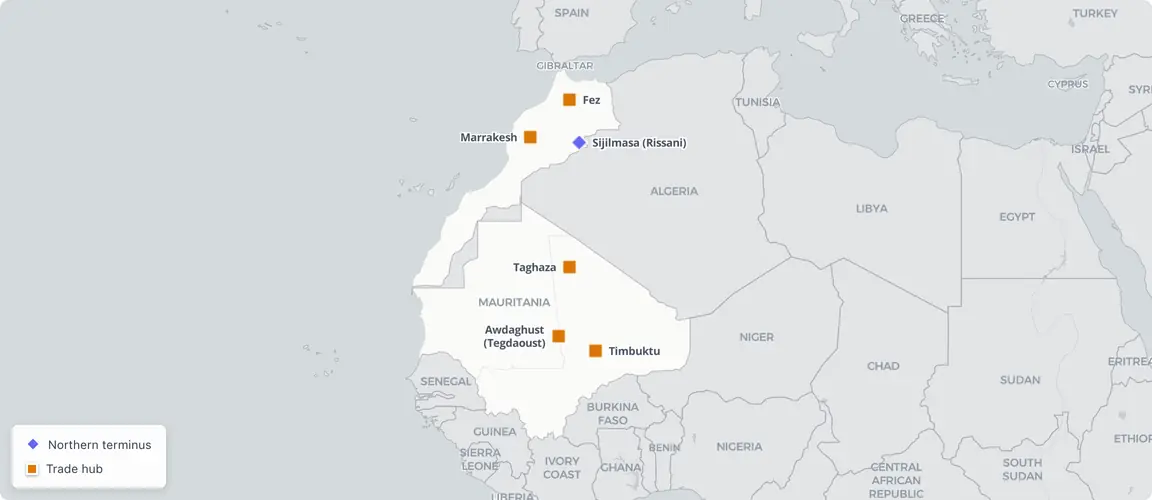
The mint that outlived its own city
In the year 951 CE, the Arab geographer Ibn Ḥawqal arrived in the Saharan trading town of Awdaghust and encountered a document that stopped him. It was a promissory note — a commercial debt instrument — for 42,000 dinars owed to a merchant resident of Sijilmasa (سجلماسة), a city six hundred kilometres north at the Saharan edge of Morocco. The sum represented roughly 190 kilograms of gold. Ibn Ḥawqal, who had seen the treasuries of caliphs, wrote that the figure would have been considered “unheard of” in Iraq, Fars, or Khurasan. He also reported that the independent emir of Sijilmasa commanded revenue roughly equal to half the annual income of the entire Maghrib.
The 42,000-dinar note was not a curiosity. It was evidence of a financial infrastructure: trust systems, credit instruments, and commercial networks that allowed two merchants in a desert trading post to bind themselves to obligations worth a small war chest, with no state enforcement mechanism beyond commercial reputation and religious law. That infrastructure was Sijilmasa’s true product — more valuable, in the long run, than any single consignment of gold.
Today, Sijilmasa is a partially excavated mound about one kilometre north of Rissani, in Morocco’s Drâa-Tafilalet region. Its most prominent feature is a crumbling pisé gate. It was named to the inaugural 1996 World Monuments Watch list of the hundred most endangered sites. Most visitors, on the rare occasion they come, are looking for something else.
The last good water before the desert
All that gold which the merchants obtain is minted in the town of Sijilmasa.
To understand what Sijilmasa was, it helps to understand what it stood next to. The Tafilalt oasis sits on the Wadi Ziz, fed by snowmelt from the High Atlas. It is the last reliably watered pocket of land before the Sahara proper begins. To the south: open desert, Taghaza’s salt mines (also in the Sahara), Awdaghust, and eventually the goldfields of Bambuk and Buré in West Africa, a camel journey of roughly sixty days each way.
The camel made this corridor commercial. Per the historical record, widespread adoption of the camel among North African nomadic groups from the third and fourth centuries CE turned what had been an impassable barrier into a regulated trade route. The logic was arbitrage: West African gold was abundant but inedible; Saharan salt was scarce in the south and traded near weight-for-weight against gold at Timbuktu. Whoever controlled the interface between the desert corridor and the Mediterranean markets controlled the spread between what gold cost in Bambuk and what it fetched in Fez or Cairo.
Sijilmasa was founded in 757 CE by Sufrite Khariji Berbers — a religious-political minority that had broken with Umayyad orthodoxy after the Berber revolt of 740–742 and needed somewhere to build an independent city-state. They chose well. The Tafilalt oasis gave them water and date palms for provisioning caravans. Geography gave them the choke point. Within two centuries, the city they built was the mandatory northern terminus for gold moving out of sub-Saharan Africa.
Dynasty after dynasty — Midrarid, Maghrawa Zenata, Almoravids, Almohads, Marinids — the prize was always the same: whoever held Sijilmasa held the northern mint.
The mint that ran the Mediterranean
The city’s monetary power was specific and measurable. From the early tenth century, gold from the Sudan was assayed and struck into dinars at Sijilmasa, and those dinars — not raw dust — entered Mediterranean circulation. Al-Masʿūdī, writing around 943 CE, was direct about it: “All that gold which the merchants obtain is minted in the town of Sijilmasa.”
The Almoravid conquest of 1054–55 amplified this to continental scale. Invited by Sijilmasa’s own ulama, the Sanhaja Lamtuna took the city, then Awdaghust, founded Marrakesh around 1070, and within a generation controlled an empire stretching from Senegal to Zaragoza. They defeated a combined Castile-Aragon army at Sagrajas in 1086.
The engine was the mint. By 1058, the Almoravid leader Abu Bakr ibn ʿUmar struck dinars in his own name at Sijilmasa — roughly 4.15 grams, approximately 0.900 fine gold. The standard spread. A 1992 excavation at Aqaba, Jordan, recovered 32 medieval gold coins; 29 had been minted at Sijilmasa before 1013. The coin had circulated as far as the Red Sea.
Christian Iberian kings did not resist the temptation to imitate. Alfonso VIII of Castile struck marabotines in 1191 with Arabic legends still intact — the etymological root of the Spanish maravedí, a currency that would persist for six more centuries. The Almoravid dinar out of Sijilmasa was, for its century, the western Mediterranean’s de facto reserve currency: the standard of fineness that everyone measured against, even after the dynasty that struck it had fallen.
Three communities, one infrastructure
What made Sijilmasa commercially exceptional was not a single merchant community but three, operating on overlapping trust systems in the same city.
Arab and Berber Muslim caravan operators worked the desert routes under sharia partnership contracts — qirad and mufawada — that allowed distant obligations to be enforced without courts. The 42,000-dinar promissory note that stopped Ibn Ḥawqal was evidence of this system at scale: two merchants could bind themselves to multi-year commercial obligations across eight hundred kilometres of desert, settlement enforced by commercial reputation and religious duty.
The Jewish community added a parallel infrastructure. The Cairo Geniza — the archive of discarded documents preserved in a Cairo synagogue and analysed systematically by S.D. Goitein in A Mediterranean Society — reveals Sijilmasan Jewish merchants operating continuously from at least the late tenth century. Joseph ben ʿAmram, the city’s chief dayyan (religious judge) around 997 CE, corresponded with the Babylonian geonim; his daughter Esther’s 1037 marriage contract, preserved in the Princeton Geniza Project, records her wedding to the leader of the Iraqi congregation in Fustat, Cairo. The al-Sijilmasi family name recurs in the Geniza through the twelfth century, tracing a trading diaspora that extended from Almería in al-Andalus to Baghdad. Abraham ibn Ezra’s 1146 elegy called Sijilmasa “the city of geonim.”
This was not incidental cosmopolitanism. It was structural. The Geniza letters document what Goitein called a network “between partners in Almeria, Fez, and Sijilmassa along the route to Cairo” — merchants using halakha (Jewish law) to enforce contracts that ran alongside, and sometimes intersected with, sharia instruments. The result was a commercial infrastructure that could clear credit across multiple legal systems and three religions. By 1247, King Jaime I of Aragon issued a safe-conduct for the Jews of Sijilmasa to relocate to Majorca and Catalonia — evidence that the city’s commercial diaspora had become valuable enough for a Christian monarch to want it.
When a trading city births an empire
The Almoravid origin story is the most consequential fact about Sijilmasa — and the least understood outside specialist circles.
In 1054–55, the Sanhaja Lamtuna under Abdallah ibn Yasin and Yahya ibn Umar took Sijilmasa at the explicit invitation of the city’s ulama, who had grown intolerant of their Maghrawa governor Masʿud ibn Wanudin. The merchants of Sijilmasa, it seems, preferred religious reformers they could work with to corrupt officials they had to pay off. They got both — and then a continental empire they had not specifically requested.
The commercial wealth of Sijilmasa financed the Almoravid expansion northward. Marrakesh was founded around 1070 as the new political capital. The Almoravids crossed into al-Andalus in 1086 at the request of the taifa kings, defeated the combined forces of Alfonso VI of León and Castile at Sagrajas, and within two decades governed from Senegal to Zaragoza. The ideological movement that conquered two continents was underwritten by a mint in a desert oasis — and by the merchant class that had decided to trade their imperfect governor for a religious army.
The lesson Ibn Battuta drew from his four-month stay in 1351–52 was simpler. He called Sijilmasa “a very beautiful city with abundant dates of good quality,” comparing its dates favourably to those of Basra. He bought camels and departed south with a caravan. By his own account Sijilmasa was still his benchmark for what a wealthy, gardened, mixed-use city looked like when he described Quanzhou, China, a decade later. Outwardly, in 1351, nothing seemed broken.
What the Marinids extracted
Everything that happened after 1273 is a case study in what happens when a monopoly platform is governed for extraction rather than resilience.
The Marinid dynasty took Sijilmasa in 1273–74 and built the Bab Fez gate — still partially standing today — as evidence of their control. What they did not build was a constituency. Each dynasty that had held the city before the Marinids had treated the mint as something to be taxed; none had invested in redundancy, infrastructure, or the political goodwill that would have motivated the city’s population to defend it in a crisis.
The Almohads had destroyed the Jewish community in 1146–48. The Marinids allowed competing Saharan termini — particularly Saadian Sharifian power in the Draa valley, 150 kilometres west — to chip away at Sijilmasa’s monopoly position without forcing adaptation. The city was extracted to death by slow degrees, dynasty by dynasty, century by century.
The first rupture came in 1363: a Marinid succession war produced a sack of Sijilmasa. The city had suffered sieges and conquests before — this was different. The 1363 destruction was not a foreign power seizing the mint; it was the dynasty that held the mint fighting over who would keep extracting it.
The final rupture came in 1393. A Marinid civil war on the death of Sultan Abu al-Abbas produced an internal revolt in Sijilmasa: the inhabitants killed the Marinid governor and demolished the city walls themselves. Ronald Messier and James Miller, authors of the standard modern monograph The Last Civilized Place: Sijilmasa and Its Saharan Destiny (University of Texas Press, 2015), note the bitter irony: the apogee and the road to decline were the same Marinid period. The city was governed into irrelevance by the same dynasty that, at its strongest, had built the Bab Fez gate.
This is the governance-failure sequence that matters for the historical lesson: Sijilmasa was not destroyed by the Portuguese. It destroyed itself. The Portuguese arrived after.
What the Portuguese finished
The Marinid collapse of 1393 preceded the construction of São Jorge da Mina fort on the Akan Gold Coast by 89 years. Portuguese mariners reached Elmina in 1471. King João II built the fort in 1482. Bartolomeu Dias rounded the Cape in 1488. Vasco da Gama reached India in 1498. By 1500, roughly 737 kilograms of West African gold was flowing to Lisbon annually through Atlantic sea routes, bypassing the Sahara entirely.
The arithmetic was permanent. Trans-Saharan caravan trade did not disappear immediately — it continued via Timbuktu toward Tlemcen and Cairo well into the seventeenth century. But the structural premium that had made Sijilmasa rich — the fact that every gram of West African gold had to pass through the northern terminus — was gone. Gold no longer needed to go north across the Sahara if it could go west to the Atlantic coast and then directly to Lisbon.
Leo Africanus, visiting in the early sixteenth century, saw “stately and high walls” already ruined. Moulay Ismaïl, the Alaouite sultan born in Sijilmasa in 1645, partially rebuilt the city in the late seventeenth century as a regional administrative seat. The Aït Atta nomads destroyed that rebuild in 1818. The medieval city was never reconstructed because the trade economy that had justified it no longer needed it.
What the Portuguese finished, in other words, was not a living city but a corpse that had not yet acknowledged its own death.
The lesson from the northern terminus
The research on Sijilmasa’s collapse consistently converges on an insight that is counterintuitive to anyone trained to look for the “killer technology” explanation: governance failure was the proximate cause; Atlantic routes were the permanent cause; but the gap between the two determines the lesson.
If Sijilmasa had not collapsed in 1393, would the Atlantic routes have revived it? Almost certainly not — the geographic constraints were real. The city had no deep harbour, no rail equivalent, no route to the Atlantic coast. But the question is whether it might have adapted into something other than a mint-city. The merchants of Sijilmasa had already demonstrated, in the 42,000-dinar credit infrastructure, the Cairo Geniza networks, and the Almoravid underwriting, that they could do more than forward gold. They had built trust systems, diaspora networks, and financial instruments that worked across three legal systems and two continents.
That capability did not require the northern terminus. It required the northern terminus to be intact long enough to allow diversification.
The Marinid extraction model made diversification impossible. The window between the 1363 sack and the 1393 collapse was thirty years. The window between the 1393 collapse and the Portuguese fort at Elmina in 1482 was 89 years. The window between the Atlantic disruption becoming structurally irreversible (c. 1500) and the final destruction of the rebuilt city (1818) was three centuries of diminishing irrelevance.
Three patterns recur across the sequence. First: every dynasty that conquered Sijilmasa treated the mint as a cash flow to extract, not an asset to defend — monopoly attracted predation, not investment, across four successive regimes. Second: the destroyer was not the threat under surveillance. Sijilmasa’s merchants had reason to worry about drought, Saharan rivals, and Marinid politics; the immediate rupture came from their own governor, and the permanent lock-out came from a Portuguese fort built 89 years later, on a coast none of them had reason to watch. Third: the interval between rupture and replacement ran longer than the record shows anyone acting on. Between the governance collapse of 1393 and the Portuguese route substitution of 1482–1500, almost a century passed. The record shows no adaptation in that interval — the caravans kept running the same corridor until the corridor stopped mattering.
The partially excavated mound near Rissani awaits a more politically convenient moment for systematic archaeology. The Tafilalt is the ancestral home of the ruling Alaouite dynasty — King Mohammed VI’s family traces its legitimacy through Moulay Sharif’s proclamation here in 1631, on the ruins of what the Marinids had destroyed. Digging below the Alaouite occupation layers means digging through national-foundation narrative. The French-Moroccan team led by François-Xavier Fauvelle has worked the site since 2012 and continues.
Somewhere under those crumbling pisé walls are the foundations of the mint that ran the Mediterranean. No one has found it yet.
Researched 15 sources in English, Arabic, French.