 Skip to main content
The Son Was Named. The Will Was Never Written.
Zheng Yonggang told a magazine in 2018 that a son born into his family should inherit it. More than four years later he was dead in Japan, without a will or a trust, for a group he had built twice from nothing. What followed was a two-year war between son and widow, a regulatory letter, and a bankruptcy that left the founding family with stock worth nothing.
Where Shanshan's Control Actually Went
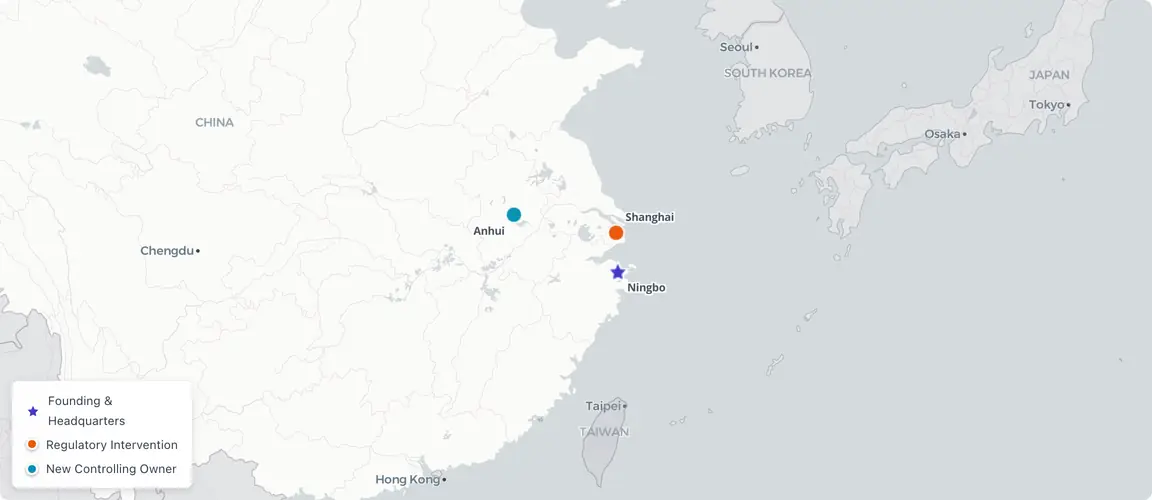
Succession timeline
Zheng Yonggang told a Chinese business magazine, in October 2018, exactly how his succession would work. “I am grooming my son [Zheng Ju] to succeed me,” he said. “I’m very traditional, just a farmer; my philosophy is: a son born into my family should inherit it.” He had said versions of this before. Zheng Ju had spent years inside the company, eventually rising to company president, doing what founders’ magazine profiles describe as “learning to take over.” By any conversational measure, the succession was settled.
It was not settled. On February 10, 2023, Zheng Yonggang died of a sudden heart attack, reportedly while traveling in Japan. He was 65. He left no will, no trust, and no governance instrument of any kind — nothing that converted more than four years of stated intention into an enforceable legal fact. What followed was not a smooth transition to the son his father had named in print. It was a two-year war between that son and his father’s widow, a regulatory intervention by the Shanghai Stock Exchange, a share freeze on the single asset that controlled the group, a bankruptcy restructuring with confirmed claims of RMB 33.55 billion, and a final settlement in which the founding family’s stake in the company Zheng built twice over 34 years was reduced to units with no meaningful economic value.
This is not a story about a bad son, an opportunistic widow, or a company that made a strategic mistake. It is a story about a document that was never written, and what happens to enterprise value when it isn’t.
Two reinventions, one omission
I am grooming my son to succeed me... I'm very traditional, just a farmer; my philosophy is: a son born into my family should inherit it.
Zheng Yonggang did not build one business. He built two, a decade and a half apart, each time reading an industry cycle before his competitors did. In 1985, he was appointed to turn around the failing Yinxian Cotton Mill — a three-year rescue that established his reputation as a manager who could fix what others had given up on. In May 1989, that reputation earned him a harder assignment: an insolvent state factory, the Ningbo Yonggang Garment Factory, carrying debts exceeding RMB 10 million and three failed managers in three years. Zheng saw what the previous managers had missed — the equipment and export experience were sound; only the brand and the market were missing — and launched Shanshan menswear on that foundation.
The launch itself required a second bet with no safety net. Later in 1989, with no capital to spare, Zheng borrowed money to air “杉杉西服,不要太潇洒” (“Shanshan Suits — don’t be too dashing”) — China’s first televised suit advertisement, on a medium no clothing company had used before. It worked. Shanshan listed on the Shanghai Stock Exchange in January 1996, the first listed company in China’s apparel industry, and by 1998 its brand market share peaked near 37.4% — China’s number-one suit brand.
Then, while the apparel business was still profitable, Zheng did something most operators at the peak of a winning business do not do: he started dismantling his own advantage. In 1999 he committed capital to a joint venture on mesophase carbon microspheres, an anode material for lithium batteries — a technology he later admitted he did not understand. “I’m not a scientist, I don’t understand the technology,” he told an audience of entrepreneurs in December 2022, recalling the decision. “Everyone around me said I was crazy, but entrepreneurs aren’t ordinary people — entrepreneurs look at the future.” By 2001, Shanshan’s mass production of the material had ended a Japanese monopoly on lithium-battery anode materials. By 2013, the battery-materials division had overtaken apparel in revenue. The pivot was complete before most of the market understood it had started.
He did it once more, past 60. In 2020 and 2021, Shanshan acquired LG Chem’s LCD polarizer business for more than RMB5 billion (~$770 million), forming Shanjin Optoelectronics and becoming the world’s largest polarizer supplier. “This polarizer pivot wasn’t something I proactively chose — it was forced on me,” Zheng told National Business Daily in April 2021. Elsewhere in the same interview, he put it more starkly: “This is my last battle. I will accomplish it, and I’m proud of that.” Group revenue reached RMB 20.7 billion that year, up 152%; the share price peaked at RMB 43.47 in October 2021; market capitalization crested at roughly RMB 72.5 billion in 2022.
A man who read three industry cycles ahead of his competitors — cotton mills, menswear, lithium materials, polarizers — never once applied that same foresight to the one document that would decide what happened to any of it after he was gone.
A verbal will is not a will
Zheng’s 2018 quote is the load-bearing irony of this entire case, and it deserves to be read twice. He did not merely intend for his son to inherit — he said so, on the record, in a mainstream business publication, describing years of active grooming. This was not an offhand remark. It was a stated succession plan, repeated across multiple interviews over several years, treated by outside observers as settled company policy.
What it was not: a will. Not a trust. Not a share-transfer mechanism, a dual-class governance structure, or any instrument a Chinese court would recognize as binding on Zheng’s estate. When he died, Chinese intestate succession law — not his 2018 interview — determined what happened to his shares, and intestate succession law does not know or care what a founder told a magazine. It distributes an estate among statutory heirs according to a fixed hierarchy, and a widow sits inside that hierarchy on equal footing with children, whatever the deceased may once have said about a farmer’s philosophy of inheritance.
This is the mechanism, stated plainly: a public, repeated, entirely sincere verbal designation of an heir carries no legal weight against a widow’s statutory inheritance rights when there is no will. The son Zheng Yonggang spent years describing as his successor had, at the moment of his father’s death, exactly the same formal claim to the company as anyone else the law recognized as an heir — which is to say, a claim that had to be litigated, not simply honored.
Six weeks, then a letter
The board did not wait for the estate to be settled. On March 23, 2023 — six weeks after Zheng Yonggang’s death — Shanshan’s board elected Zheng Ju chairman by full vote. On paper, this looked like the succession his father had described: the groomed son, formally installed.
Zhou Ting (周婷) did not accept it. Zheng Yonggang’s widow, a former financial television news anchor before she married into the family, publicly contested the legitimacy of the board meeting and asserted her own claim to control through inheritance. The dispute was no longer a family matter conducted in private; it was now a public contest over the leadership of a listed company with, at its 2022 peak, a market capitalization of approximately RMB 72.5 billion.
Three days after the contested vote, the Shanghai Stock Exchange issued a formal regulatory work letter urging orderly resolution of the succession dispute. Regulatory letters of this kind are not routine. The SSE does not typically involve itself in a listed company’s internal family disputes; that it did so here signals how visibly the governance situation had already deteriorated, and how directly the succession chaos was beginning to threaten the operating company itself — the widening gap between shareholders’ interests and an unresolved family control fight.
The freeze
In April 2023, Zhou Ting and her three minor children filed suit against Zheng Ju, seeking control of the company through inheritance rights. The suit succeeded, at least procedurally: courts froze the 51% holding-company stake that determined control of the entire Shanshan group — not a peripheral asset, but the pivotal one, the single block of equity whose ownership settled every downstream governance question.
A freeze on a controlling stake is not a resolution. It is a form of paralysis with legal cover. Neither side could act decisively while the litigation proceeded, and a company whose founder had run it by instinct and personal authority for three decades now had no one with unambiguous authority to run it at all.
By May 2023, the two sides reached what the record describes as a truce: both Zheng Ju and Zhou Ting joined the board, with Zheng Ju remaining chairman. It read, at the time, like a resolution. It was closer to a ceasefire — the underlying question of who actually controlled Shanshan remained open, and the governance paralysis that had begun in March did not lift. It merely became quieter.
The reversal
The quiet did not last. In November 2024, the Shanghai Stock Exchange disciplined the company over controlling-shareholder fund occupation — a formal regulatory finding, not an internal dispute, involving RMB 1.788 billion. The consequence was direct: Zheng Ju stepped down as chairman. Zhou Ting — the widow whose claim to legitimacy the board had effectively rejected twenty months earlier — became chair of the company herself.
The reversal is worth sitting with. The son publicly named as heir in 2018, formally elected chairman in March 2023, was out. The widow whose claim the board had originally contested was in. Whatever the “true” succession intention had been, the mechanism that actually decided the outcome was neither a father’s stated wish nor a son’s board election. It was a sequence of litigation, regulatory discipline, and shifting control — the predictable result of resolving a governance vacuum through legal combat rather than a drafted instrument.
The debt cascade
Governance paralysis has a cost, and by mid-2024 that cost was compounding. A debt cascade accelerated through the second half of 2024; by January 2025, roughly 95% of the group’s ex-listco interest-bearing debt — RMB 12.621 billion — had become classified as short-term, a structural signal of a company that could no longer refinance on its own terms.
In February 2025, the Ningbo Yinzhou District Court accepted a substantive-consolidation bankruptcy restructuring petition for Shanshan Group. Confirmed creditor claims would reach RMB 33.55 billion. In June 2025, Zheng Ju’s remaining personal shares — 1.81 million — were judicially executed to zero. The son who had once held his father’s succession promise in an interview transcript now held, in the company that promise concerned, literally nothing.
A first restructuring plan, led by a shipbuilding-industry consortium, was put to creditors in November 2025 and rejected over synergy concerns. It was, by then, the second attempt in two years to resolve what a missing document had set loose. The eventual rescuer arrived by a different logic entirely.
By this stage of the case, Zheng Ju’s own standing inside the company he had briefly chaired had effectively ended. Chinese press reporting places him as reportedly residing in Japan, no longer an active participant in the governance fight Zhou Ting had won. The son whose succession his father had described in a 2018 interview was, by 2025, absent from the boardroom, absent from the shareholder register in any meaningful sense, and absent from the outcome entirely.
The state’s calculation
In February 2026, a consortium led by Anhui Wanwei Group and Conch Group — both ultimately controlled by the Anhui State-owned Assets Supervision and Administration Commission — was selected as the new investor. The commercial logic was clean and specific: Wanwei supplies polyvinyl alcohol feedstock for polarizer manufacturing, the exact industrial vertical Zheng himself had called, in a 2021 interview, “my last battle” — the same pivot he separately described, elsewhere in that interview, as “not something I proactively chose… it was forced on me.” Total consortium investment was capped at approximately RMB 7.16 billion; the direct share purchase, roughly RMB 4.99 billion for 13.5% of the company, sat within that cap, and a concert-party arrangement added a further 8.38%, bringing voting control to 21.88%.
Where the founding family had held a strategic asset it could not govern, a state-linked industrial buyer saw a supply-chain fit it could integrate immediately. The restructuring plan built on that fit was approved by creditors, shareholders, and the court in April 2026. Ordinary creditors are expected to recover approximately 2.3% of their claims in cash. Shanshan survives as an operating company — now under Anhui SASAC control. The founding family’s control-chain equity was reduced to subordinate trust units with no meaningful economic value: an outcome close to zero, arrived at through a legally precise and entirely foreseeable process.
What Zheng Ju’s shares were actually worth
It is worth being precise about what died with Zheng Yonggang and what didn’t. The company itself survived — battered, restructured, and now state-controlled, but operating, employing people, and manufacturing products the market still wants. The polarizer business Zheng called his last battle continues under new ownership with a cleaner supply chain than it had before. In the narrowest sense, the enterprise Zheng Yonggang built endured.
What did not survive was his family’s ownership of it. Not because the business failed commercially — its assets were valuable enough to attract a state-linked industrial buyer within three years of the founder’s death — but because no legal instrument ever converted a father’s repeated, sincere, publicly stated wish into something a court would enforce against a widow’s statutory claim. The distance between “I am grooming my son to succeed me” and a signed will turned out to be the entire distance between the family keeping the company and losing it.
This is not, in China, an unusual gap. According to the 2024 China Family Business Succession Report, cited by Fudan Business Knowledge and 36Kr, roughly 68% of private Chinese entrepreneurs have no formal will — and roughly 80% of that group cite cultural discomfort with discussing after-death matters as the reason. Zheng Yonggang, by every account a decisive operator who had twice reinvented a business ahead of its decline — menswear before the market saturated, lithium anode materials before the industry matured — appears to have applied that same anticipatory instinct to every part of his enterprise except the one document that would have protected his family’s claim to it. The pattern this case demonstrates is not particular to Shanshan. Missing succession planning is a common starting condition for founder-controlled Chinese companies — and this is what happens when that condition meets sudden death: no instrument, statutory succession law deciding what a magazine interview could not.
The nearest comparable case outside China follows an almost identical mechanism with a different geography: Andrei Trubnikov’s Natura Siberica in Russia, where an intestate death also triggered an immediate control war, regulatory and legal entanglement, a collapse in operating value, and an eventual distress sale that left the founding family with a fraction of what the company had once been worth. Different market, different sector, the same missing instrument — Trubnikov’s family kept a fraction; Zheng’s kept nothing at all.
Zheng Yonggang spent 34 years building a company twice: once as China’s dominant suit brand, once as the world’s largest polarizer supplier. He read industry cycles before his competitors did, twice. He never wrote down who the company belonged to. That omission, not any decision his son or his widow made afterward, is the mechanism this case exists to document.