 Skip to main content
How Siyanli Outlasted Its Buyer
In July 2019, CHJ Jewellery terminated its RMB 1.295 billion acquisition of Shanghai Siyanli. The beauty chain had spent eighteen months reorganizing around A-share assumptions that evaporated. Seven years of ownership turbulence followed — two PE sponsors, a pandemic loss year, an antitrust fine — before Beauty Farm paid RMB 1.25 billion.
The Corporate Geography of a Seven-Year Succession: Beijing Origin, Shanghai Core, Hong Kong Exit
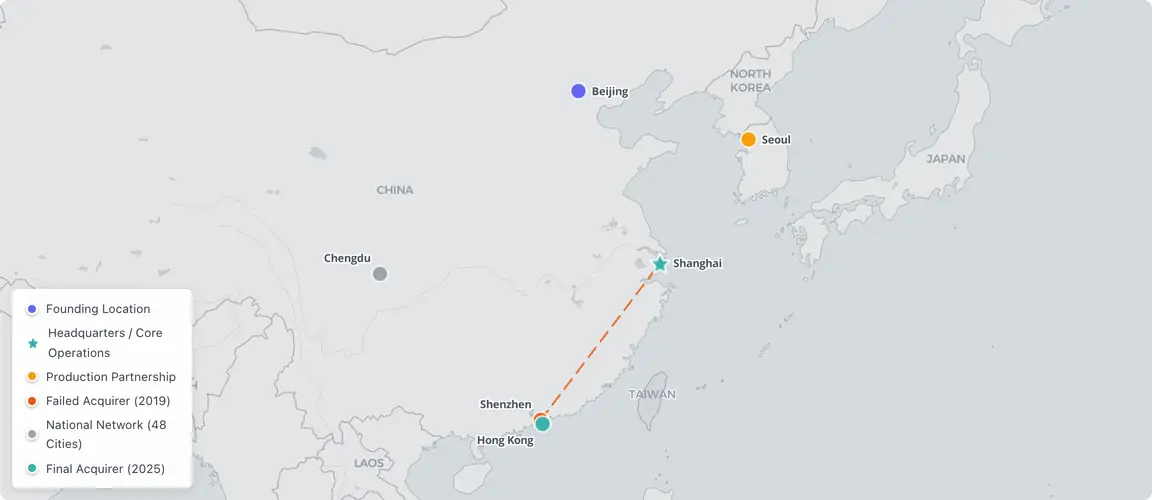
In 1996, a beauty salon opened inside Beijing’s Shidu Department Store. It was the China franchise vehicle for Decléor, then a French professional skincare brand under L’Oréal, offering Thai-design SPA protocols and botanical aromatherapy — a concept that pre-dated China’s mass adoption of lifestyle beauty as a category by roughly a decade. The operator, identified only as “Mr. Zhang” in twentieth-anniversary coverage, chose the name Siyanli (思妍丽) and began building what would become one of China’s largest premium beauty-services networks.
Twenty-nine years later, on the afternoon of 1 July 2019, CHJ Jewellery (潮宏基) officially terminated its RMB 1.295 billion acquisition of Shanghai Siyanli. The announcement was administrative. The damage was structural.
For eighteen months, Siyanli had reorganized its governance, performance commitments, and capital allocation around becoming an A-share listed subsidiary. Board reconfigured. Cash-flow plans locked. Cumulative profit targets of RMB 1.0 to 1.6 billion set for 2018 to 2021. When the deal collapsed, the company was free — but free to do what? The strategic architecture built for one future had to be dismantled before another could be constructed.
Most companies don’t survive this. The organizational cost of a failed acquisition is not merely financial — it is existential. A management team that spent eighteen months building toward one strategic identity must now construct another from the wreckage. The team’s credibility with staff, franchisees, and suppliers is compromised. The departure architecture that was supposed to provide liquidity for existing shareholders has dissolved. And in China’s 2019 regulatory environment, where the CSRC had tightened scrutiny on cross-sector A-share roll-ups, finding a replacement buyer was not a matter of running another process. It was a matter of surviving long enough for the right buyer to appear.
Siyanli survived — and six years later exited to a better buyer at an equivalent headline price.
The deal that broke
This is a 三强聚合 consolidation — uniting the first, second, and third-largest beauty-services brands in China under a single platform.
The trouble began with arithmetic. In March 2018, Shenzhen-listed CHJ Jewellery (002345.SZ), a jewellery group, announced it would acquire 74% of Siyanli for RMB 1.295 billion. But CHJ Jewellery’s controlling Liao family was buying from an intermediary — Chaoshang Jingchuang (潮尚精创) — that the family itself had assembled just one month earlier from Standard Chartered Direct Investment’s pre-existing stake. The Shenzhen Stock Exchange immediately queried the 794.57% asset-revaluation premium, questioning goodwill-bubble risk and related-party-transaction abuse in a stinging April 2018 inquiry that drew public scrutiny.
In October 2018, the deal was restructured with a mixed cash-and-script payment, raising the consideration to RMB 1.337 billion. But the real structural problem arrived on 28 December 2018, when MBK Partners — the Asia-focused private equity firm formerly led by former Carlyle Asia principals — signed a separate agreement to buy 23.53% of Siyanli directly from existing shareholders. Six days later, CHJ Jewellery withdrew its CSRC application. By the time it formally terminated in July 2019, two buyers held competing stakes in a company whose entire operational strategy assumed one of them would prevail.
The regulatory fallout continued. In December 2019, China’s State Administration for Market Regulation fined MBK RMB 350,000 for failing to file the 23.53% stake acquisition under Anti-Monopoly Law concentration rules — a warning to PE peers that had no operational effect on Siyanli but confirmed the governance complexity the brand had endured.
The cost of deal collapse is not measured in the headlines. It’s measured in the eighteen months a management team spent building a company for a future that evaporated. Performance commitments designed for an A-share trajectory — requiring 41% profit growth in the first year alone — had to be unwound. Governance structures configured for public-company reporting had to be reconsidered. And CHJ Jewellery’s own balance sheet was deteriorating: a RMB 209 million goodwill impairment on its earlier FION acquisition was draining management bandwidth from the Siyanli integration before it had even begun.
Most critically, the company needed to find new purpose: not a listed subsidiary, not an independent operator in its old form, but something in between — a brand with institutional shareholders whose only mandate was to build value for a strategic exit.
What the pandemic tested
By October 2020, MBK Partners and Standard Chartered had consolidated their stakes through an LBO structure valued at approximately USD 224 million. CHJ Jewellery’s residual 26% — held through subsidiary Zhuosheng Investment since January 2017 — was sold to Shanghai Anyan for RMB 474.5 million. Clean cap table. Professional sponsors. Clear exit trajectory. Then Shanghai went into COVID lockdown.
Ten weeks of store closures across Siyanli’s home market — where it held its densest network, with more than 90% of revenue derived from China’s top-20 first- and new-first-tier cities — produced a post-tax loss of RMB 36.4 million on revenue of RMB 565 million. It was the only loss year in the brand’s disclosed financial history. For a company that had just survived a deal collapse, the pandemic was a second existential test within three years.
The operational infrastructure held. CEO Wang Li (王莉) and General Manager Hu Shiwen (胡世文) — the same management team that had navigated the CHJ Jewellery unwind — maintained store operations, preserved the 60,000 active membership base, and continued the BIOYAYA medical-aesthetics expansion through the disruption. The franchise systems, the proprietary beauty school established in 2009, the DR.Bio skincare line launched in 2012 in partnership with a Korean growth-factor laboratory — all absorbed the blow.
The recovery was the sharpest single year in the brand’s disclosed history. In 2023, revenue surged 44.7% to RMB 818 million with a post-tax profit of RMB 69.4 million — a swing of more than RMB 100 million in net income from the prior year. The franchise network proved its resilience: 45 franchised locations continued operating alongside 118 directly-operated stores, and the brand’s in-house product lines — DR.Bio skincare and the distributed French and Korean brands (THALGO, DELAROM, WELLKIN) — maintained their shelf presence through the disruption. By 2024, Frost & Sullivan certified Siyanli as the #3 beauty-services brand in China by revenue: RMB 849 million, RMB 81 million profit, with H1 2025 tracking at RMB 423 million revenue and RMB 44 million profit. The Shanghai Commerce Commission had designated Siyanli as a Shanghai Multinational Regional Headquarters — among the few beauty-and-wellness companies to hold this distinction. The brand that had entered the pandemic as a PE-backed turnaround emerged as an institutional-grade acquisition target.
The engine the buyer wanted
What made Siyanli worth RMB 1.25 billion to Beauty Farm Medical Health in October 2025 was not primarily the 163 lifestyle-beauty stores. It was BIOYAYA.
The first BIOYAYA outpatient medical-aesthetics clinic had opened in Shanghai in 2011 — a full decade before China’s medical-aesthetics segment attracted mainstream institutional capital. The regulated Chinese medical-aesthetics market grew from RMB 77.6 billion in 2016 to RMB 154.9 billion in 2020, an 18.9% CAGR per Frost & Sullivan. Siyanli was already inside the market when that growth began. By the time Beauty Farm acquired the company, the network had grown from four clinics in 2018 to 19 by mid-2025, generating 50 to 60 percent gross margins against the roughly 30 percent typical of a Siyanli lifestyle store. The regulatory licensing requirements — outpatient medical institution qualification, qualified medical staff, facility standards — create barriers that consumer-beauty brands cannot cross without years of organizational investment. Siyanli had eleven years of operating experience in a segment competitors were still entering.
The 院线 (institutional-channel) positioning reinforced the premium. Since 1996, Siyanli had occupied first-floor and mezzanine positions in first- and new-first-tier city malls — the same addresses as luxury-goods retailers. More than 90% of revenue came from top-20 Chinese cities. This was not mass-market beauty. It was a structural commitment to a geography and customer profile that makes the brand expensive to copy and uncomfortable to compete with directly. The 60,000 active members represented a 44% incremental addition to Beauty Farm’s own membership base — a customer acquisition cost that no marketing spend could replicate.
The succession that wasn’t about a founder
Most succession stories feature a founder stepping away. Siyanli’s is different. No single founder figure drove the exit decision. The original operator — “Mr. Zhang” — hosted the brand’s twentieth-anniversary gala at Beijing’s China World Hotel in September 2016 but had long since receded from the public narrative. What makes this a succession story is the transfer of institutional identity: a brand that survived its own near-acquisition, rebuilt its purpose under PE ownership, and then found the consolidator whose strategy made the brand’s full potential visible.
Beauty Farm structured the deal at 67% cash (RMB 836 million) and 33% in new shares (15.798 million Beauty Farm shares at HKD 28.71 per share) — a structure that embedded Siyanli’s legacy shareholders, including MBK Partners, in the acquirer’s equity through staged 2026 lock-ups. The independent appraiser, Jinzheng, assessed Siyanli’s goodwill at RMB 1.395 billion — more than the total consideration — reflecting intangible value in membership, brand positioning, and the BIOYAYA clinical network.
The comparison with CHJ Jewellery’s 2018 bid is instructive. CHJ Jewellery offered RMB 1.295 billion for 74% — implying a full-company value of approximately RMB 1.75 billion. Beauty Farm paid RMB 1.25 billion for 100% of a company seven years older, with a cleaner cap table, a proven BIOYAYA platform, and a Frost & Sullivan top-three ranking. The lower headline figure obscured a superior strategic outcome: no earn-out, no performance conditions, no regulatory questions about asset revaluation premiums. The deal closed in six months.
The consolidation bet
Beauty Farm’s acquisition of Siyanli was the third move in a deliberate 三强聚合 (top-three consolidation) strategy. Chairman Li Yang (李阳) had already acquired China’s #1 beauty-services brand (Beauty Farm itself, the listed parent) and #2 (NARUIER, acquired in 2024). Siyanli, ranked #3 by Frost & Sullivan, completed the set. The combined entity would operate four parallel premium lifestyle-beauty banners — Beauty Farm, NARUIER, BELLECHE, and Siyanli — under a deliberate strategic positioning doctrine where multiple brands co-exist in the same prime malls to capture different customer micro-segments.
The integration playbook is explicit: systematically push Beauty Farm’s medical-aesthetics and sub-health capabilities into Siyanli stores, replicating the NARUIER integration model whose adjusted net margin rose from 6.5% in 2023 to 10.4% in H1 2025 post-acquisition. Centralized digitalization through Beauty Farm’s 38-system in-house digital platform — a roughly RMB 100 million, decade-long build — would unify customer CRM across all four banners, lifting combined active membership above 200,000. Management has guided to combined Group 2026 revenue of RMB 4 billion and adjusted net profit above RMB 500 million.
The risks are real. Beauty Farm’s debt-to-asset ratio rose to 78.45% by H1 2025. An RMB 510 million acquisition loan adds interest expense. Four premium banners targeting overlapping demographics in tier-1 cities create brand cannibalization risk. And the absence of any earn-out or performance-commitment clause in the Siyanli deal means 100% of goodwill risk sits with the acquirer’s shareholders.
What the brand that outlasted its buyer teaches
The conventional narrative about failed acquisitions treats them as setbacks — deals that didn’t close, value that wasn’t realized, time that was wasted. Siyanli’s trajectory suggests something different.
The CHJ Jewellery collapse forced a reorganization that ultimately produced a stronger company. The A-share listing thesis had imposed performance commitments that constrained management decision-making. When those constraints lifted, management invested in BIOYAYA expansion — growing from four clinics to 19 in five years — weathered a pandemic, and emerged with operational metrics that attracted a consolidator whose strategy valued exactly what Siyanli had built.
The MBK/Standard Chartered LBO period — often treated as a holding pattern in brand narratives — was the interval during which Siyanli rebuilt itself as an acquisition target on its own terms rather than someone else’s listing vehicle. The professional sponsors imposed financial discipline without operational interference, allowing the management team to grow the brand into the strategic asset that Beauty Farm’s consolidation thesis required.
The lesson is not that deal failures are secretly beneficial. It is that brands built on structural, hard-to-replicate assets — 院线 positioning in premium mall locations, BIOYAYA’s decade of clinical licensing experience, 29 years of continuous operation through three different ownership configurations — can survive ownership turbulence because the value lives in the infrastructure, not in any single ownership structure.
The CHJ Jewellery collapse, in retrospect, was a gift disguised as a catastrophe. It freed management from performance commitments designed for an A-share trajectory and forced a reassessment that produced the BIOYAYA expansion, the operational discipline that survived a pandemic, and the Frost & Sullivan ranking that made the Beauty Farm deal possible.
Siyanli’s trajectory shows the value in premium beauty services was never in the store count or the revenue line. It sat in the clinical licensing infrastructure, the membership base, and the 院线 positioning built over decades — assets no acquirer could assemble by writing a bigger check. Beauty Farm’s bid recognized this; CHJ Jewellery’s 2018 offer, from a jewellery group seeking diversification, priced the company without it. The brand outlasted its first buyer. Whether the consolidation bet that follows preserves what made Siyanli worth acquiring now turns on whether Beauty Farm’s integration can replicate the NARUIER margin gains without eroding the premium positioning underneath them.
For the full story of Siyanli’s ownership turbulence and operational resilience, read the Shanghai Siyanli brand profile on brandmine.ai.