 Skip to main content
Serbia Wine: The Grape No Database Can Benchmark
A wine made from Prokupac — a grape no Western sommelier could name — won Serbia's first Decanter gold at 95 points. The man who made it was a former Paris economist who chose the variety on a spreadsheet, not a heritage claim. He is one of a founder-built cohort exporting on grapes no framework has a category for, in a market that did not exist 35 years ago.
Serbia wine: a national revival, not one terroir
Erased, rebuilt, and now exporting the difference
A Serbian red called Tri Morave Rezerva won the country’s first Decanter gold medal, 95 points — and the grape at its core was Prokupac, a variety almost no Western sommelier could reliably place. The man who made it had spent years in Paris as an economist before he ever planted a vine. He did not choose Prokupac out of sentiment, or because his grandfather grew it. He chose it the way an analyst chooses an asset: because it was the one variety no competitor could copy.
This is the strange shape of Serbian wine. A sector that did not exist as a private market 35 years ago is now producing wines that score points international critics reserve for Tuscany and the Rhône — and it is doing so on grapes that appear in no investment database, behind an export footprint so small that the quality leap is effectively invisible. Serbia makes roughly 30 million litres a year across 22 districts, with a viticultural history reaching Roman times. In 2024 it exported about €21.3 million of it, most to former-Yugoslav neighbours and Russia. The gap between what is in the bottle and what the world has noticed is the entire story.
What the communists could not erase
I want Prokupac to become what Sangiovese became in Tuscany.
To understand why Serbia’s best wineries are founder-owned, you have to understand how thoroughly the alternative was destroyed.
After 1945, communist authorities nationalised private wineries across Serbia and compelled growers to deliver their fruit to state combines — predavali, the verb means to hand over, not to sell. Commercial winemaking became the property of the state. In the most violent cases the erasure was physical: the Spasić family’s eight hectares of Župa vineyards, with documented records reaching back to an 1856 property contract, were razed to the ground by authorities in 1948, and again in 1953. A century of accumulated knowledge was bulldozed twice in five years.
What survived did so in households. Families kept making wine for themselves, kept the grape varieties alive in garden plots, kept the techniques in memory. This is the quiet mechanism that makes the indigenous-variety thesis possible at all: while the state combines standardised on whatever yielded volume, it was the home cellars that preserved Prokupac and Tamjanika and the Morava grapes as living plants rather than archive entries. When the state finally loosened its grip, the knowledge was waiting — but the commercial infrastructure was gone, and so was the capital, and so was the market. A founder restarting in 1990 inherited the grape and nothing else.
That is why the founding dates cluster where they do. The earliest modern private winery, Podrum Radovanović, was registered in 1990, the first after Yugoslavia began to break apart. The real wave came after October 2000, when a functioning banking system returned and private registration became possible. Kovačević, Temet, Aleksić, Maurer, Matalj — almost the entire serious cohort dates to the decade after 2000. These are not old houses. They are first-generation companies built by people who remember a time when what they do was, in effect, illegal.
Four regions, four characters
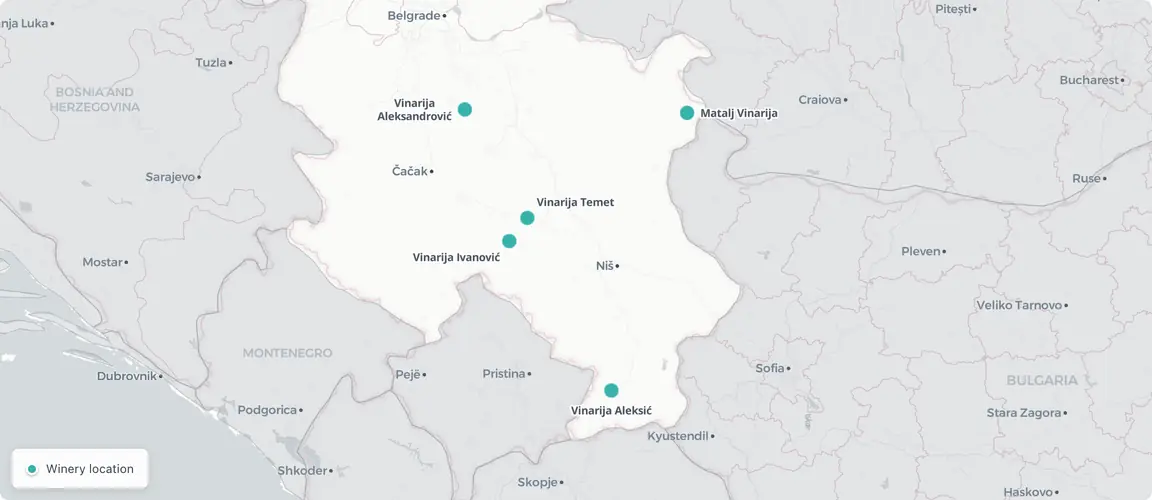
Serbia’s wine is not one place. Drive the country and the sector dissolves into distinct regional personalities, each with its own grape logic and its own founder type.
The largest cluster sits in Fruška Gora, the wooded ridge above the Danube in the north, where more than 150 cellars make crisp whites and where a natural-wine revival has taken hold. This is where the sector’s revenue leader, Kovačević, rebuilt a defunct 1930 cellar in Irig into a billion-dinar business, and where Oszkár Maurer tends what may be the oldest planting of Kadarka on earth, vines put in the sandy phylloxera-resistant soil around Subotica in 1880.
South of Belgrade, Šumadija carries the royal heritage. This is Karađorđević dynasty country, where the pre-war court drank a blend called Trijumf, and where Aleksandrović, Despotika, and the fast-rising Matijašević now make Bordeaux blends and increasingly serious Prokupac. Further south still lies Župa, the ancestral homeland of Prokupac itself, where Ivanović is the recognised standard-bearer and Spasić guards the aromatic white Tamjanika. And in the country’s far eastern corner, hard against the Bulgarian border, the all-but-forgotten Negotin appellation — celebrated at 19th-century Paris exhibitions, then left to depopulate — is being rebuilt one cellar at a time.
The point of the geography is what it is not. There is no single Serbian wine region the way there is a Bordeaux or a Barolo. The producers that matter are scattered across the whole country, separated by hundreds of kilometres and unified by nothing except a shared bet on what Serbia can uniquely grow.
What the databases miss
Here is the structural reason institutional capital has not arrived: there is nothing for it to read.
A private-equity analyst evaluating a wine sector reaches first for the track record — decades of filings, volumes, export data, brand-equity studies, the indexed memory of how a market behaves. Serbia has none of it. The market was administratively extinguished in 1945 and only restarted in 1990, so the longest commercial history available is a single human career. The financials that do exist live on a Serbian-language national registry, the APR, accessible through portals like CompanyWall, in a language no Western allocator has learned to read. And the producers who are actually differentiated are exporting on Prokupac, Tamjanika, and Morava — varieties for which the global frameworks have no benchmark, no comparable, no price history, no category at all.
This is not a quality problem. It is a legibility problem. The Decanter golds are real; the wines are in the glasses of critics who have been to Negotin and Župa; the brands have importer relationships in nine and thirty countries. The intelligence simply has not been assembled into the form institutional capital requires. Euromonitor can tell you Serbia makes 30 million litres. It cannot tell you why a former Paris economist concluded that an obscure rural red was the single most defensible asset in the country’s wine economy — and was proved right at 95 points.
That is the gap. The crisis-survival record, the founder reasoning, the precise grape-by-grape competitive logic — all of it exists, in Serbian, in interviews and registry filings, documented by people who had reason to write it down.
Who is still standing
The proof of the thesis is not in the abstract. It is in five founders who can each name the moment quitting would have been rational, and the decision they made instead.
Nebojša Aleksić built Vinarija Temet on a refusal. When he returned from an economist’s career abroad and began planting in the Three Moravas after 2008, the prevailing market wisdom held that only international varieties — Cabernet, Merlot, Chardonnay — could sell. He bet the other way, on indigenous Prokupac and Morava, and converted the estate to organic in 2018. Soon after, his Tri Morave Rezerva became the first Serbian indigenous-variety wine ever to win a Decanter gold, at 95 points. He has since said plainly what he is trying to do: turn Prokupac into what Sangiovese became in Tuscany. It is no longer an eccentric ambition. It is a category he opened.
Ivan Ivanović inherited his crisis. His father, Dragoslav “Gaga” Ivanović — the quiet spokesman of Prokupac in its Župa homeland — died in 2020, just as COVID shut down the restaurant channels that sell premium wine and catastrophic hail cut the harvest to a fifth of normal. Ivan stepped into the succession at the single worst moment a Serbian winemaker had faced in two decades. He did not retrench. In 2021 he delivered the first organically certified wine Župa had ever produced, holding the varietal-Prokupac standard he had been handed rather than diluting it to survive.
Miodrag Radovanović was first. He registered the country’s first modern private winery in 1990 and made wine straight through the decade that followed — sanctions, no functioning banks, the January 1994 hyperinflation that ranks second in recorded history only to Zimbabwe’s. He operated on family capital because there was no other kind available, and he survived to be called the King of Cabernet. His winery is the anchor case for the entire 1990s wave: proof that a brand could be built in an economy designed to make brand-building impossible.
The Aleksić sisters — Dragana, Maja, and Marija — built the first women’s winery in the Balkans, in Vranje, against open skepticism in a sector run by men. They chose to build a brand from scratch under their own name rather than partner beneath an established one. That brand now posts 561 million dinars in revenue, exports to nine markets, and holds three Decanter golds — the clearest export proof the thesis has produced.
And Darko Matijašević, a returnee from a US finance career, rebuilt an ancestral estate at Orašac and ran straight into a sector-wide sales decline in 2025. Rather than discount, he held his premium position — his Čukundeda Superiore Prokupac lists above €600 in restaurants — and grew 20% in a year the rest of the sector shrank. His SoviNoa placed eighth among more than 670 Sauvignons at Decanter, a result no Serbian white had any business achieving.
None of these stories is in a database. Each is the kind of evidence that cannot be reconstructed from a press release — a named person, a named threat, a named decision, a measurable outcome. That specificity is the whole point.
Beyond the bottle
There is a temptation to read all this as nostalgia — peasant grapes, family land, a wounded country making wine again. That reading misses what the founders themselves understand.
The indigenous-variety bet is not a heritage gesture. It is the only competitive position Serbia can hold. On Cabernet and Chardonnay, the country competes against every large producer on earth and loses on cost and scale. On Prokupac and Tamjanika and the Morava varieties, it competes against no one, because no one else grows them commercially at quality. The diaspora threads run through everything — the Trijumf recipe mailed from Canada in 1992, the Burgundy couple priced out of France who came to revive a Roman cellar village in Negotin, the founders who spent decades in Switzerland and the United States before coming home with capital and standards. What looks like sentiment is, underneath, a clear-eyed reading of where the defensible margin lives.
Two converging timelines
Two developments are unfolding at once, both time-stamped.
The first is the China-Serbia Free Trade Agreement, signed in October 2023 and in force since 1 July 2024 — the first China FTA with any Balkan country. It phases the wine import tariff down by 20% a year toward zero by 2029. The runway is real but unproven: Chinese customs recorded just 73,900 litres of Serbian wine in the first five months of 2024, ranking Serbia 20th among suppliers, and the early figures fell year-on-year. The producers positioned to capture the upside are precisely the differentiated ones — those with an indigenous-variety story, international medals, and an importer already in place. A generic Serbian Merlot has nothing to say to a Chinese buyer. A 95-point Prokupac does.
The second is demographic. The founders who restarted this sector are now between roughly 56 and 71. The reform-era cohort that survived sanctions and hyperinflation has reached its handover decade all at once — Radovanović, who registered the first private winery in 1990; Aleksandrović, whose family pulled the Trijumf recipe back from Canada; Maurer, who saved the 1880 Kadarka vines. Kovačević, the revenue leader, is already a third-generation owner building toward a fourth-generation handoff. Ivanović is the case study in what that transition costs when it arrives unplanned — a death, a pandemic, and a harvest disaster in the same year. The export tariff phase-down and the founders’ handover decade have arrived at the same moment.
What the record shows
The Decanter scores have already answered whether Serbian wine is good. What remains undocumented is the reasoning behind it.
The handful of producers with genuine indigenous differentiation, proven medals, and installed export capacity — Temet, Aleksić, Ivanović, Matalj, Matijašević — number perhaps eight wineries making serious Prokupac, in a country where the founding generation is handing over and the tariff phase-down has already started. The Trijumf recipe came back from Canada because one émigré thought to put it in an envelope before the people who remembered it were gone. Serbia spent 45 years having its wine erased and 35 years rebuilding it from memory. The grapes it grows are the one thing no competitor can plant — and the record of how they were saved sits in Serbian, in registry filings and founder interviews that few outside the country have read. The sector rebuilt itself from memory once, when almost no one was watching.
Researched 23 sources in English, SR.