 Skip to main content
Russia Wine: The Invisible Distribution Layer
On February 28, 2022, Russia's largest independent wine importer ceased all shipments. The world assumed it wouldn't restart. It did — and has since grown to ₽44.9 billion, hired a director from Diageo and Pernod Ricard, and begun building an export strategy. The distribution layer everyone assumed was dead is now building something new.
Russia Wine Distribution: The Moscow–St. Petersburg Corridor
The layer that closed for a day
On the same Monday morning, Maxim Kashirin and Anatoly Korneev made an identical call for SimpleWine, Russia’s most sophisticated premium wine importer — over 100 boutique stores, a wine school that had trained the country’s professional sommelier community, twenty years of relationships with 7,000 restaurants and hotels including Ginza Project and the Novikov Group. The announcement went out not through a press release but through Stanislav Lisichenko, a prominent Moscow restaurateur, via Telegram: shipments suspended. The euro had crossed 110 rubles. Pricing existing inventory at that exchange rate meant either destroying client relationships or absorbing losses the company could not sustain. What made the pause survivable wasn’t scale. It was twenty years of clients who valued SimpleWine’s expertise enough to wait.
The empire nobody mapped
The distribution story for Russia’s wine market has always been written from the production side — the Abrau-Durso vineyards, the Fanagoria harvest, the Krasnodar terroir. What sits between the vineyard and the wine store — the importer, the logistics company, the bonded warehouse — has gone almost entirely undocumented.
This was never a small industry. Five founder-owned companies in Russia’s wine distribution sector collectively moved more wine into the country than most European nations export to any single market. Each reports at scale individually: Luding around ₽44.9 billion in 2024, SimpleWine around ₽45 billion, AST ₽25.2 billion, Aromatny Mir ₽22.5 billion at its retail entity, Fort Wine ₽3.3 billion. None appears in any international wine industry database. None has been profiled in English-language business press. Their founders are known primarily in Russian trade media, if at all.
The architecture of Russia’s wine distribution was assembled across four layers, each built by a different generation of entrepreneurs in the decade following Soviet collapse. At the mass end: Krasnoe & Beloe, founded in Chelyabinsk in 2006 by Sergey Studennikov, now operating 20,500 stores across Russia — a nationwide retail empire built from a single kiosk. At the specialist import end: Luding Group, founded in Moscow in 1993 by two Armenian entrepreneurs who named their company for an acronym they believed in — Любовь, Удача, Деньги И Наш Господь. Love, Luck, Money, and Our Lord.
In between those poles: SimpleWine, built by Maxim Kashirin and Anatoly Korneev into Russia’s most sophisticated premium import operation, with over 100 boutique stores and a wine school that trained the country’s professional sommelier community; Aromatny Mir, built by the Zadorin brothers who opened a wine shop two months after Russia’s 1998 sovereign default and proceeded to open a thousand more without giving a single press interview; AST International, where Leonid Rafailov spent twenty-five years managing a company he didn’t own before buying it out from under an exiled oligarch. And Mistral Alko — the specialist built for a single niche: exclusive importer of Abkhazian wines into Russia, an entire country’s production funnelled through one company.
None of these stories has been assembled in the language international capital reads.
Everything runs through Moscow
Russia is the world’s largest country. Its wine distribution industry is not.
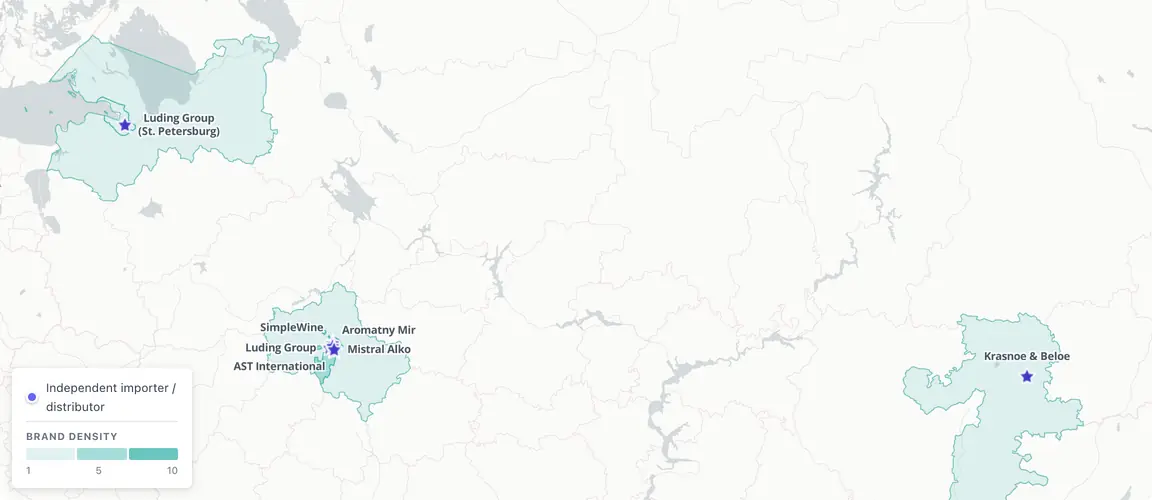
Every significant independent wine importer in Russia — every company with a founder story worth reading, with a crisis arc worth documenting — operates from within 600 kilometres of the same city. Luding Group runs its operations from the Ochakovo-Matveyevskoye district of Moscow. Its St. Petersburg branch, at Shushary on the city’s southern edge, is the company’s only major outpost outside the capital. AST International trades from Kakhovka Street in Moscow’s south. SimpleWine opened its first vinoteka on Stepana Supruna, then expanded to a dozen St. Petersburg locations. Aromatny Mir runs its logistics from Selyatino, a Moscow Oblast customs zone. Mistral Alko, sole importer of Abkhazian wines into Russia, operates from Moscow’s southeast.
The one major exception is Krasnoe & Beloe, headquartered in Chelyabinsk in the Urals. But Krasnoe & Beloe is not part of this distribution layer — it is a mass retail chain that became a direct importer after 2022, bypassing companies like Luding entirely. Its geographic separation from the Moscow corridor is structural. It serves the mass-market consumer everywhere in Russia at once, and doesn’t depend on the relationships and logistics infrastructure that the capital’s import network spent thirty years assembling.
This concentration is not coincidental. Moscow is where Russia’s premium and mid-market wine consumption is densest, where Moët Hennessy and Diageo set up their Russian subsidiaries, where the bonded warehouse infrastructure for imported goods is most sophisticated, and where the restaurants and hotels that order wine by the case are clustered. Building a wine import company in Novosibirsk in 1993 was possible. Building one that could source from 37 countries, maintain 5,000 SKUs, and serve a thousand restaurants was not — not without access to Moscow’s logistics infrastructure, its banking relationships, and its proximity to what was, in the 1990s, Russia’s only significant fine-wine consumer base.
The corridor is 600 kilometres long. The industry it produced is the entire import layer for a country of 147 million people.
What the databases miss
Search for Russia in any major wine industry database — Wine Intelligence, IWSR, Vinexpo market intelligence — and you will find production volume data from Abrau-Durso and Fanagoria, import totals from Eurostat, and market size estimates built from customs data. You will not find the name Luding Group. You will not find Leonid Rafailov or the management buyout from Telman Ismailov’s family that made AST International the only asset in that empire not passed to creditors. You will not find the 50/50 partnership between two Armenian entrepreneurs who maintained equal ownership for thirty years across a kidnapping attempt, a murder, a divorce lawsuit that reached Russia’s Supreme Court, and a full operational shutdown.
These are not boutique operators. Luding Group’s ₽44.9 billion in 2024 revenue is comparable to mid-sized European wine multinationals. Its 5,000 SKUs from 300 producers in 37 countries represents more supplier diversity than most national importers anywhere in Europe. Its network of regional branches from Kaliningrad to Yakutsk is a logistics operation that cannot be assembled overnight.
The invisibility is structural. All five significant independent wine importers in Russia are registered as private limited liability companies — ООО. None is publicly traded. None files accounts accessible to foreign databases. Their founders rarely give interviews to English-language media, and Russian trade press coverage — even when substantive — remains behind a language barrier that no major wine analytics firm has attempted to cross systematically.
The result is a market that looks, from the outside, like it collapsed in 2022. Wine imports disrupted. Sanctions imposed. Ruble in freefall. The institutional assumption followed naturally: the independent importers must have folded, their models unviable. Federal retail chains confirmed stepping in as direct importers.
What the databases could not capture: the founders who had already survived kidnapping plots, contract killings, and a decade of ruble volatility had no intention of stopping. What they did was pause, reprice, and restart.
Who’s still standing
The pause was intentional, and Luding Group made the identical call the same Monday SimpleWine did. Russia’s largest independent wine importer told its clients what no company of its scale had ever said: deliveries suspended, effective immediately, no forecast for resumption. The euro had breached 122 rubles at market open — a currency chasm too wide for moving wine to still count as commerce. Then, on Tuesday March 1, Luding restarted. Where SimpleWine’s advantage was twenty years of client relationships willing to wait, Luding’s was different: thirty years of founder ownership and a scale — 500,000 bottles a day, 5,000 SKUs from 300 producers in 37 countries — that made a one-day pause a pricing exercise rather than an existential one.
Luding’s crisis was older and deeper. The company had been stress-tested long before 2022. In February 2009, Moscow’s criminal investigation division intercepted a kidnapping ring — led by a serving police captain — targeting Artur Varzhapetyan’s seventeen-year-old daughter Lili, then a student at MGIMO. Officers staged a sting: Lili entered a shopping center, changed clothes with a policewoman lookalike in a restroom, and the kidnappers seized the decoy. The plotters had demanded €10 million ransom. Varzhapetyan declined to elaborate publicly beyond calling it “a family matter.”
Less than two years later, in December 2010, Ara Khachatryan — General Director of Luding’s St. Petersburg division — was found shot in his car on Daev Pereulok in central Moscow. He had been killed execution-style. A murder case was opened. No arrests were ever reported. Luding continued operations without interruption.
The divorce arrived in 2018. Varzhapetyan’s wife, Anna Shakhnazarova — herself a Luding executive for years — filed for divorce and demanded half of Varzhapetyan’s 50% stake, arguing the company shares were marital property. If successful, the claim would have broken the 50/50 partnership that had structured the company for twenty-five years. The case reached Russia’s Supreme Court. EGRUL records as of 2025 still show Varzhapetyan holding 50%.
When February 2022 arrived, this was a management team that had navigated kidnap plots, contract killings, and Supreme Court proceedings. The one-day shutdown was a pricing exercise, not a panic.
AST International’s survival required a different kind of resilience. Rafailov had been AST’s operational head since it was founded in 1992 — but not its owner. The company was created by Telman Ismailov, the oligarch behind Moscow’s Cherkizovsky market. When Ismailov fled Russia in 2009 ahead of criminal investigations, his family retained 80% of AST for eight more years. Throughout that period, Rafailov ran the business. In 2017, he and partner Simandu Simanduyev executed a management buyout. AST became the only Ismailov asset that did not pass to creditors.
That ownership transition came with institutional knowledge that proved decisive after 2022. AST had been the first Russian company to resume Georgian wine imports after the 2006–2013 Russia-Georgia embargo — building supplier relationships and logistics infrastructure that almost no other distributor had. When Georgian wine exports to Russia surged from $160.8 million in 2022 to $182.6 million in 2024, Russia absorbing 66% of all Georgian wine exports, AST was positioned. Rafailov had publicly predicted Georgia would overtake Italy as Russia’s top still wine supplier. It did, by May 2023.
Among the specialized operators, two smaller companies tell the structural story of the post-2022 landscape. Aromatny Mir — 1,000 stores, founded in October 1998 two months after Russia’s sovereign default — remained a family business operating in studied anonymity until March 2025, when a reported corporate conflict between the Zadorin brothers and a potential sale to Alexey Mordashov’s Severgrup at 22 billion rubles became Russia’s most-discussed retail deal. Mistral Alko built its position differently: sole importer of an entire country’s wine output, Abkhazian wines distributed into Russia through a single company, protected from currency volatility by ruble-zone pricing and immune to the sanctions dynamics that disrupted the European supply chain.
The casualty wasn’t the importers
The 2022 disruption did produce one genuine casualty — not among the independent importers, but in the traditional distribution model itself.
What no wine industry analyst had quite mapped was the extent to which Russia’s federal retail chains had been building direct import capability throughout the preceding five years. X5 Group became Russia’s number-one wine importer by volume in 2022, shipping 34.9 million liters — overtaking Luding for the first time. Mercury Retail Group’s Bristol logistics arm grew Georgian wine imports by 109% in early 2023. Magnit ranked among Russia’s top wine importers by year-end.
The dynamic these chains exploited was structural: Georgian wine’s advantage in Russia — zero CIS tariff, ruble-lari settlement, no sanctions risk, direct logistics, Soviet-era brand recognition — required no specialist expertise. Any retailer with a logistics arm could add Georgian SKUs. No niche importer could build a defensible position in a category that large players could enter without difficulty.
The response from Russia’s independent importers has been to move upstream. Luding now produces its own wine at Olymp Winery in Krasnodar and its own spirits at the Kolomna plant in Moscow Oblast. In January 2025 it acquired Polugar — a heritage Russian grain distillate brand — for an estimated ₽300 million. Own brands now constitute roughly 30% of Luding’s revenue. In October 2024, the company hired Garegin Shakhmelikyan — previously with Diageo and Pernod Ricard — as managing director, specifically to develop an export strategy. A company that spent thirty years moving wine into Russia has started building a programme to move Russian spirits out.
Two signals of restructuring
Two signals mark this as a transitional moment in the distribution layer.
The first is succession. Aromatny Mir’s potential sale to Severgrup is not confirmed, but it is specific — a named buyer, a named valuation, a named timeline. If the Zadorin brothers exit, one of Russia’s largest specialised wine retail chains moves from founder-owned to corporate. The intelligence value of the NDD profile changes the moment that happens.
The second is export orientation. Luding’s hire of a Diageo-pedigreed managing director is not a management upgrade — it is a strategic signal. The company is positioning itself to move Russian-produced alcohol outward, into markets that have not been systematically approached. Whether it succeeds is unclear. That it is attempting this, from a base of ₽44.9 billion in revenue and production assets across Russia and Armenia, is not.
The founders who built these companies are not being replaced. In some cases, they are exiting: Aromatny Mir’s reported sale process is the clearest documented instance.
What compiling it would take
None of the intelligence here requires proprietary research infrastructure to access. All of it sits in Russian corporate registries, trade press archives, court records from Moscow’s Dorogomilovsky district, and customs data that any analyst with time and language capability could compile.
It has not been compiled. Not in English. Not in any format accessible to international capital.
Luding Group — 500,000 bottles a day, thirty years of founder ownership, the only voluntary shutdown-and-restart of an operator this size in the 2022 disruption — does not appear in any wine industry database used by institutional investors. Leonid Rafailov’s management buyout from Ismailov’s creditors, and the Georgian wine foresight that positioned AST perfectly when that market reopened, is not documented anywhere in the intelligence products international buyers use. The Zadorin brothers’ 1,000-store empire, built in complete anonymity since 1998, has never been described in English prose.
These companies have been building, surviving, and transforming for thirty years in one of the world’s largest consumer markets. The intelligence existed, scattered across Russian registries and trade media. It was never assembled anywhere — until now.
Rafailov spent twenty-five years running a company before he owned it. The Zadorin brothers spent twenty-seven years never giving an interview. The founders themselves hold knowledge no database records — which supplier relationship survived the embargo and which one didn’t. Aromatny Mir’s potential sale to Severgrup illustrates what changes when that knowledge passes to a new owner: only whichever part of it the new owner decides is worth keeping.