 Skip to main content
Tatarstan FMCG: A $584M Ghost No One Tracks
A Yelabuga sauce maker sold ₽50.2 billion of mayonnaise, ketchup and confectionery in 2025, exporting to 42 countries — and no Western database lists it. Its founders had already spent three years insulating the company from a criminal bankruptcy case attached to a business next door, before that case even opened.
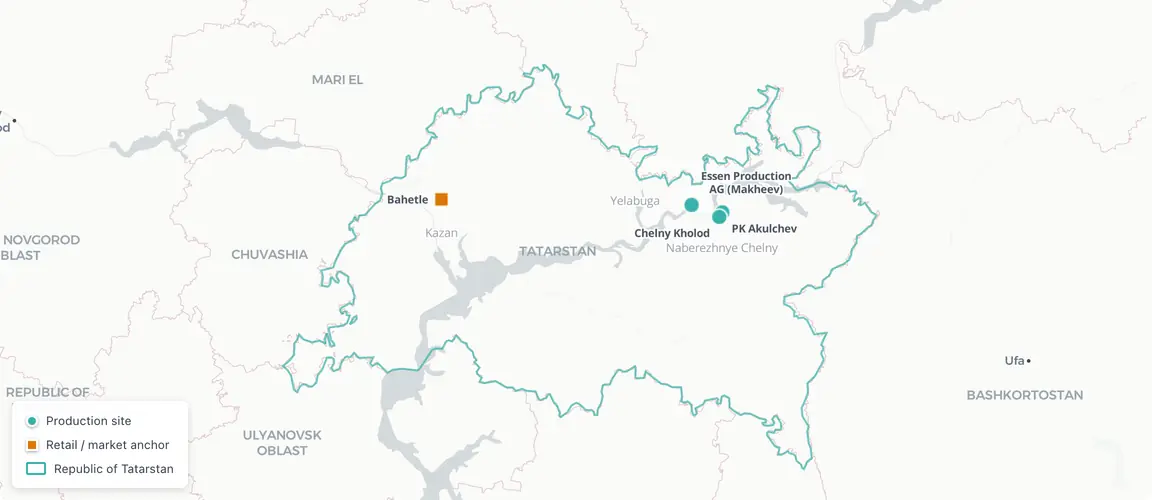
Tatarstan's factories cluster in two towns, not the capital
The split that outlived the case against it
In April 2018, Leonid Baryshev and Vadim Makheev quietly transferred their ownership stakes in the Essen retail chain — 23 hypermarkets across Tatarstan, Bashkortostan, Chuvashia and Mari El, operated by Optovik LLC (ООО «Оптовик», “wholesaler”) — to two other parties: businessman Andrei Rodionov and a company called RDK LLC (ООО «РДК»). The move was procedural on paper and complete two years before the retailer’s first sign of trouble. By the time creditor Alexander Fokin petitioned prosecutors in September 2020 to investigate deliberate bankruptcy under Russia’s Criminal Code Articles 196 and 201, the two founders’ names were no longer on the retailer’s ownership documents. Investigators searched Essen Production’s own offices anyway, in April 2021, and both founders left the country. But the criminal case attached itself to the retail shell they had already exited — not to the production company still bearing their names, still setting revenue records, still growing.
That production company is Essen Production AG, and its 2025 numbers explain why the separation mattered. Revenue reached ₽50.2 billion — up 15.7% on the year before, with ₽4.95 billion in net profit — on exports to 42 countries under Gulf-recognized halal certification. No Western intelligence database lists it. A three-year-old legal maneuver, executed before anyone could see it coming, is the reason a half-billion-dollar company still reads as invisible.
What survived the split
I'd like to become a small "Unilever" in the Russian market.
Essen Production AG — АО «Эссен Продакшн АГ» — was not always two companies. Baryshev and Makheev met at a Yelabuga pedagogical university, sold their cars, borrowed from Makheev’s father, and started making mayonnaise together in 1998. Three years later they merged their two individual proprietorships into a single joint-stock company and gave the brand its name: Makheev (Махеевъ), spelled with the archaic hard sign that reads as heritage rather than accident. By the mid-2000s the business had grown enough to need a second arm — a retail chain to move product directly to Tatarstan shoppers, built as a separate legal entity, Optovik, trading as Essen.
For over a decade the two arms grew together. Then, in 2018, they were pulled apart. The production company kept the brand, the plant, and — as Business Online later reported — every liquid asset that had accumulated in the group by that point. The retail arm kept the stores, the leases, and, within two years, the debts. When the hypermarkets began closing “for technical reasons” in January 2020, the real estate underneath them had already moved to another entity and been leased back to the business that no longer owned it. It was a restructuring that looked, from outside, indistinguishable from an exit — until the exit proved to be from the right company at the right time.
The case that never quite closed
What followed reads like the textbook version of Russian entity separation, because in the trade press that covered it, it became exactly that. Over a hundred arbitration suits accumulated against Optovik through 2019 as supplier payments fell behind. Fokin’s September 2020 complaint triggered a formal criminal investigation — Article 196 carries up to seven years for deliberate bankruptcy, Article 201 up to ten for abuse of authority. In April 2021, investigators searched Essen Production’s own offices, not just the retailer’s; the following month, roughly ₽1.5 billion in assets were arrested, including property belonging to Makheev’s wife. A creditor settlement in August 2021 committed Optovik — with Essen Production AG standing as guarantor — to pay more than a billion rubles across eight stages over four years.
No public record shows what happened to the criminal case after that. The last reliably reported status, from Business Online in mid-2022, was that the investigation continued in Moscow with no charges filed. There is no confirmed verdict, no confirmed dismissal, no confirmed closure — a governance asterisk that has simply never been resolved in public, three years and counting. What is confirmed is what happened to the company the case never reached: production revenue rose from ₽42.4 billion in 2022 to ₽50.2 billion in 2025, and by 2025 the same Vadim Makheev had openly registered as the majority owner of Nakhodka, a hard-discounter chain that grew directly out of the retail collapse the criminal case was investigating.
Four ways of surviving the same test
Essen’s story is the sharpest version of a pattern that runs across Tatarstan’s founder-owned FMCG cluster: separate what can be lost from what must survive, and do it before the loss becomes unavoidable.
PK Akulchev, founded by Sergei Akulchev in 1995 as Russia’s first maker of soft waffles, faced a different kind of forced separation. A fire on the night of 22–23 May 2020 destroyed five of the plant’s seven automated production lines in Naberezhnye Chelny — during the pandemic, with no advance warning and no legal maneuver to soften it. Akulchev told the city’s mayor recovery would take up to eighteen months. He signed a leasing deal, spent roughly ₽79 million on new boilers and equipment, restored two lines within two months, and reached 80% capacity by autumn — reverting workers to manual labor rather than halting output entirely. Revenue reached ₽3.03 billion by 2024, up 21.4% on the year, and in late 2025 Akulchev acquired a Chelyabinsk factory, pledging roughly ₽1 billion toward its first cross-border expansion.
Chelny Kholod, the ice-cream maker Gazilyan Shakirzyanov has run since 1987, faced no single dramatic crisis — only the slow structural pressure of rising input costs across a decade in which the company still had to supply 69 Russian regions without retreating from scale. It posted a record ₽1 billion profit in 2024, on revenue up 10% to ₽4.6 billion — survival measured not in a single decision but in a sustained refusal to shrink.
Bahetle, the Tatar national-food supermarket and catering chain Muslima Latypova founded in Kazan in 1998, met its test in the retail battlefield itself. Federal chains — Magnit, the fast-expanding Pyaterochka — pushed into Tatarstan hard enough that the region’s own chain count grew two-and-a-half-fold over seven years while independent operators’ combined market share nearly halved. Bahetle’s answer was to retreat from a Moscow expansion attempt and refocus entirely on what a federal chain cannot replicate: Tatar national foods — echpochmak, chak-chak, belesh — sold as both everyday staples and gastronomic souvenirs, anchored in halal positioning and outreach to the Gulf trade-show circuit.
None of these four founders avoided the pressure that came for their businesses. Each one found the part of the business that could be separated, exposed, or sacrificed — and protected the part that could not.
Two towns building, one capital watching
Tatarstan’s FMCG geography splits cleanly, and the split is not where a reader would expect it. Production concentrates in two industrial towns along the Kama river — Yelabuga and Naberezhnye Chelny, together accounting for roughly three-quarters of the cluster’s output by Brandmine’s own directional estimate, since no official Rosstat or Tatarstanstat regional breakdown exists. The republic’s capital, Kazan, produces almost none of it.
Yelabuga — population roughly 78,000, easy to miss on a map of a country the size of Russia — is where Essen Production AG’s sauce plant sits and where PK Akulchev’s production company is registered. Its pull factor has a name: the Alabuga special economic zone, roughly ten kilometers from Yelabuga and twenty-five from Naberezhnye Chelny, a free-customs-zone regime with ten-year exemptions from land, property and transport taxes. fDi Magazine, the Financial Times group’s investment-intelligence publication, has named Alabuga the best platform in Europe for large projects six separate times — a credential that means little to most Western FMCG buyers, because most Western FMCG buyers have never heard of Alabuga, or Yelabuga, or looked for either.
Naberezhnye Chelny, twenty-five kilometers away, is the confectionery-and-cold heartland: Essen’s confectionery plant, Akulchev’s waffle lines, Chelny Kholod’s ice-cream production, and a handful of smaller entrants all draw on the same industrial base — the labor pool, logistics and land that KamAZ, Russia’s largest truck manufacturer, built the town around decades earlier. Kazan, by contrast, concentrates corporate FMCG and retail rather than production. Nefis Group’s Mr.Ricco mayonnaise line — a real competitor to Makheev, but a non-founder-owned corporate entity, not part of this cluster — operates from the capital. So does Bahetle’s supermarket network, and so did the now-contracting Edelveis grocery chain, the republic’s oldest, ceding shelf space to Magnit and Pyaterochka as federal chains have pushed in. A reader who sees “Tatarstan” and pictures Kazan — the republic’s best-known city, its halal-finance showcase, its KazanForum host — pictures the wrong half of the map.
Why nobody outside Tatarstan is counting
Almost none of this is documented in English. The compass of Tatarstan’s FMCG cluster — TAdviser’s financial disclosures, Business Online’s investigative reporting on the bankruptcy saga, Realnoe Vremya’s export coverage, Chelny-biz’s local business reporting — exists entirely in Russian regional trade press, the kind that institutional analysts in London, Singapore or Dubai rarely read and Euromonitor rarely cites by name. Ninety-five percent of the source material behind this cluster’s public record is Russian-language; an English-language search for “Essen Production” or “Makheev” returns almost nothing beyond the company’s own bilingual website.
Two structural barriers compound each other here, and neither is an accident of scale. The first is linguistic: a genuinely large business, documented in granular detail, simply never crosses into English because nobody with an English-language research mandate has looked. The second is the entity-separation pattern itself, playing out one more time at a different altitude. Just as Essen Production AG’s criminal exposure attached to a retail shell the founders had already exited, the cluster’s institutional visibility attaches to Kazan — the city Western attention already reaches — while the actual value sits in towns that attention has never had reason to visit. Founder Leonid Baryshev told Agroinvestor, in an unguarded moment, that he’d like to become “a small Unilever in the Russian market” — a genuinely large ambition, stated by a man running a company most multinational competitors have never heard of, from a city most of them could not place on a map.
This is not obscurity by accident. It is the same separation logic that protected Essen from its own retail collapse, operating at the level of geography and language instead of corporate structure: the value sits where the scrutiny does not reach.
Halal infrastructure, not a niche export tool
Tatarstan is a Muslim-majority republic within the Russian Federation, and that fact shapes this cluster’s FMCG identity more directly than any single business decision. Halal certification here is not a specialized export add-on bolted onto an otherwise secular business — it is a domestic mainstream requirement, and products built to that standard circulate not only toward Gulf export markets but across Russia’s own Muslim-majority republics: Chechnya, Dagestan, Ingushetia, Kabardino-Balkaria, Bashkortostan. Kazan has built an entire identity around this infrastructure, positioning itself as Russia’s halal and Islamic-finance hub through events like KazanForum, and retailers such as Bahetle have built their brand specifically on Tatar national foods — echpochmak, chak-chak, belesh — sold as everyday staples to the local Tatar population and as gastronomic souvenirs to visitors alike.
The founder mythology carries its own local color. The Makheev name itself emerged almost by accident — a designer’s red lettering on an early mayonnaise-jar lid — and the founders leaned into it afterward, cultivating a folk legend of a merchant named Makheev who supposedly built a mayonnaise factory in old Yelabuga. It is invented heritage wearing the costume of real heritage, in a region where the two are often genuinely hard to tell apart: KamAZ’s Soviet-industrial legacy, Zarya’s 1924-founded confectionery works and its legendary tort Tatarstan cake, the Kama river towns themselves, all form a cultural substrate this cluster’s founders draw on without needing to manufacture it. It also helps explain something a purely commercial reading would miss: both Baryshev and Makheev have sat as regional political figures in the Tatarstan State Council, alongside running their production business — a pattern that would read as unusual conflict-of-interest territory in most Western markets and reads, here, as simply how business and regional identity intertwine in a republic this size.
Since 2022, a different kind of insulation
The 2022 sanctions shock forced Tatarstan’s exporters to rebuild their channels almost from scratch, and the cluster’s answer has been the same structural instinct applied outward. Makheev’s export certification runs through МЦСиС «Халяль», the Russian Muftis Council’s own halal certification center — the one Russian body whose certificate is recognized across the Gulf. In July 2023, the center gained accreditation from the Gulf Cooperation Council’s own accreditation body, and its head, Aidar Gazizov, stated plainly what that means: recognition in the UAE, Saudi Arabia, Bahrain, Kuwait, Oman, Qatar and Yemen. Layered on ISO 22000 food-safety certification, that single accreditation event opened doors that Western sanctions had closed elsewhere.
The company has used it. Makheev’s export footprint grew from 32 countries in 2019 to 42 by the end of 2024 — the Baltics, Germany, Greece and Scandinavia; the CIS states; and, increasingly, the Gulf, China, South Korea, Turkey and Iran. Exports now account for roughly 15 to 18 percent of sales. Akulchev is chasing the same channel harder: a targeted 200% increase in exports over five years, aimed at the same Middle East and Asia corridor. Neither company is hiding from sanctions. Both are routing around them, using the one certification that a sanctions regime built around Western financial rails cannot touch.
What this cluster is worth watching for
An investor or distributor who engages with Tatarstan’s halal-certified FMCG producers now — while the Gulf-recognition advantage is still new enough that few Western buyers have noticed it exists — gets there before the channel crowds. Nefis Group’s Mr.Ricco already competes from Kazan with corporate scale; further consolidation is the likely direction once more buyers discover what Business Online’s readers already know. A certification event three years old is still, right now, underexploited by everyone outside Russian-language trade press — and that gap narrows every quarter Makheev adds another export country to the list.
Chelny Kholod kept supplying 69 regions through a decade of rising costs and posted its best year yet. Akulchev rebuilt two production lines by hand and came out the other side buying a rival’s factory. Essen Production AG separated a bankruptcy case from a business empire before the case had a name, and the empire is now worth half a billion dollars nobody outside Tatarstan is counting. Four different businesses, four different threats, the same underlying instinct: protect the part that has to survive, and let the rest be someone else’s problem. The founders who mastered that separation first are the ones building the export channels now — and the Gulf recognition they are using to do it will not stay a quiet advantage indefinitely.
Researched 40 sources in English, Russian.