 Skip to main content
One Bankruptcy, a Whole Corridor
One bankruptcy sale is the direct ownership origin of at least eight of Tatarstan's current dairy producers — a single state-brokered liquidation that scattered 28 plants across five regions in 2017. A decade later, only some of the heirs have a documented plan for what happens next.
Where one empire's pieces landed
One collapse, two kinds of aftermath
In 2014, a man barely into his twenties registered a dairy company under his own father’s name — while that father was still working through the personal bankruptcy that had just cost him an empire of 28 plants. The son did not rename anything. He did not distance himself from the collapse. He kept the discredited name, leased plants from the state manager who had inherited his father’s ruins, and a decade later was running one of the three largest cheese producers in Russia. His story reads, at first, like a single family’s recovery. It is really the origin story of an entire regional industry: at least eight of the dairy and cheese producers now operating in Tatarstan trace their ownership directly back to the same 2012–2017 bankruptcy that broke his father — and the region’s current owners split cleanly into two groups: those who have a documented plan for what happens next, and those who don’t.
The empire that became eight companies
In 2018 we bought the former VAMIN dairy plant in Stolbishche and completely renovated one workshop.
VAMIN Tatarstan (ВАМИН Татарстан) was built the old way: one man, one holding company, decades of acquisition. Registered in 2002 around a Soviet-era agricultural base, it absorbed 34 companies and grew to 28 dairy plants under founder Vagiz Mingazov (Вагиз Мингазов), a former regional senator. By the mid-2000s it was the dominant force in Tatarstan dairy, and Kommersant (Коммерсантъ) later estimated its products held about 35% of Kazan’s own retail dairy market — a single company shaping what an entire capital city drank and ate.
The end came in stages. Mingazov stepped down as general director in 2011 as the company’s finances deteriorated. Creditor VTB, owed ₽436 million, triggered formal bankruptcy proceedings in September 2012. Tatarstan’s own authorities argued the empire had grown too large to survive — Kommersant quoted the reasoning directly: “such a super-holding has no real right to further existence.” The state itself bought VAMIN’s remaining assets through a lessor called Tatagrolizing (Татагролизинг), at what Kommersant’s sources called “a pittance,” and resold them piecemeal. When the case formally closed in November 2017, claims exceeded ₽12.6 billion; the assets themselves had fetched only ₽2.7 billion at sale, and creditors recovered roughly ₽2 billion of what they were owed. Mingazov himself was declared personally bankrupt in 2016, having personally guaranteed ₽1.2 billion in loans.
What makes this a sector story rather than a single company’s collapse is what happened to the pieces. Agrosila and the Udmurt conglomerate Komos Group took the largest plants and folded them into corporate structures. Marat Muratov’s (Марат Муратов) management company, which had been running VAMIN’s assets for the state, kept the Mamadysh plant and rebuilt it as Azbuka Syra («Азбука сыра»). A scatter of smaller, largely unrelated buyers picked up the rest — among them a Sicilian restaurateur, an oil-money investor, and, eventually, the founder’s own son.
The son who kept the discredited name
The company he registered in 2014 was informal at first, operating on plants leased from the state manager overseeing VAMIN’s remains. In 2017 he bought two of those plants outright — the Arsk and Baltasi combines — and consolidated them into a new entity, OOO Archa, that would become GK Vamin (ГК «Вамин», ООО «Арча»). Despite what one Tatarstan business outlet later called the Vamin brand’s lingering “negative vibe,” the name never changed.
The growth that followed is the sharpest founder-recovery arc in the sector. Archa’s revenue moved from ₽7.9 billion in 2022 to ₽9 billion in 2023 to ₽13 billion in 2024. By 2024 the group’s cheese output reached 23,000 tonnes, placing it third among Russian cheese producers nationally — up from fourth the year before, a ranking confusion in the press that traced simply to two different years’ data being compared. Mingazov has described the whole group’s turnover, across all entities, as “about 30 billion rubles” — a figure he reports himself and that carries no independent audit, distinct from the ₽13 billion booked at the Archa entity level.
He has been candid, in interviews, about both the fear and the motivation. “There was no fear,” he told BUSINESS Online, describing the decision to rebuild under his father’s name. “There was a desire to prove something to myself and to my father. I took it as a challenge and a chance to establish my own independence.” Elsewhere, describing the same period: “I saw my father’s suffering. I saw how some acquaintances’ attitude toward the family changed. Did it hurt? Yes. But at the same time a huge desire grew to help my father and to prove to myself: I can.” On the legal relationship between his company and the defunct original, he has drawn a clean line: “In the legal sense it has no relation to OAO Vamin, apart from the similar name.”
The clearest sign that Mingazov had actually arrived, not just survived, came in 2024 — briefly, and in a direction nobody expected. He bought Danone’s entire Russian business, the multinational’s local operations sold off in the wake of sanctions-era retreats, closing the deal in May 2024 through a vehicle called Vamin R, majority-owned by his own Vamin Tatarstan entity. Seven months later, in December 2024, he passed the holding company to Ruslan Alisultanov (Руслан Алисултанов), who became its sole owner. The round trip lasted less than a year: a man whose father lost an empire to a state-brokered sale had, for a few months, owned the Russian arm of a French multinational — and then let it go. What the deal’s actual economics were, and what Mingazov’s own exit consideration amounted to, were never disclosed.
Five regions, one shared history
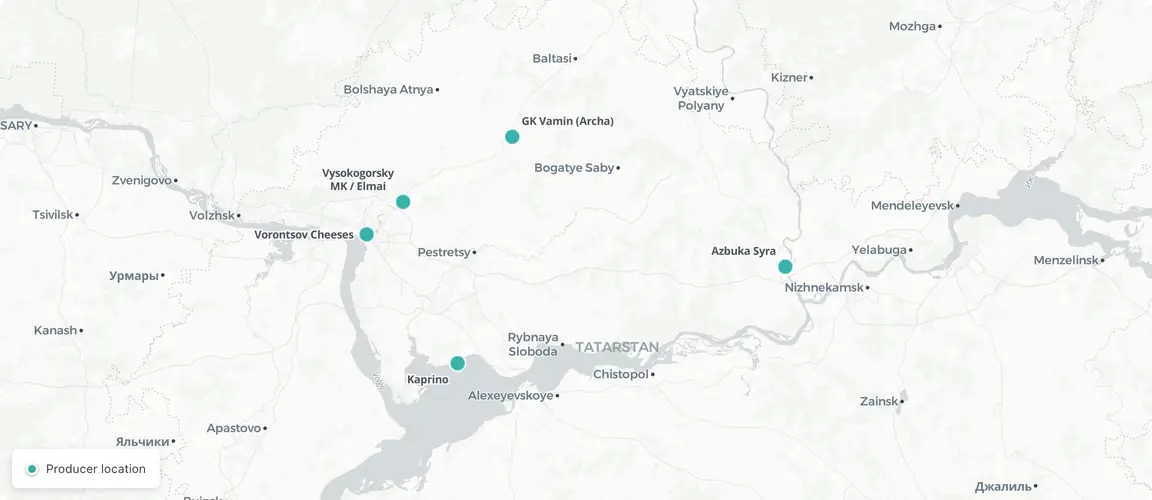
The plants VAMIN once owned didn’t relocate when they changed hands — they stayed where they were built, and the result is a dairy sector spread across five distinct regional clusters that look, at first glance, like organic specialization. They aren’t. Kazan-Zelenodolsk-Vysokaya Gora, closest to the republic’s largest consumer market, now hosts GK Vamin’s Arsk-Baltasi core alongside a fast-growing upstart, Vysokogorsky MK’s (Высокогорский молочный комбинат) Elmai (ЕлМай) brand. The Arsk-Baltasi northern belt itself was the old VAMIN heartland and remains the Mingazov family’s own political base. Mamadysh, a plant that has operated continuously since 1974, became Azbuka Syra under Marat Muratov — whose wife holds the controlling stake while Muratov himself serves, without official status, as an aide to Tatarstan’s president. The Yelabuga-Naberezhnye Chelny cluster took the Alabuga Sote/Vkusnyaev brand («Вкусняев», Алабуга Соте), whose actual beneficial owner still doesn’t match its registered one. And in the southeast, where oil money moved into dairy processing, a Muslyumovo farmer named Fait Shaimurzin (Фаит Шаймурзин) bought a VAMIN shard through Tatagrolizing and built it into Faiza/Ekomilk («Фаиза» / «Экомилк»).
Each cluster developed its own character — mass-market scale in Kazan, heritage cheese in Mamadysh, oil-adjacent capital in the southeast — but none of it happened by organic regional specialization. It happened because a single company’s forced liquidation scattered assets to whoever showed up with capital, and geography did the rest.
Two smaller brands round out the map without fitting its central story cleanly. Bavlinskoe Moloko («Бавлинское молоко»), founded from scratch in 2012 by Ravil Sadykov (Равиль Садыков) after the local dairy supply collapsed, has no VAMIN ancestry at all — its trademark, registered in 2022, is Sadykov’s own, and its kaymak and katyk sell through Magnit under a Tatar grandmother-recipe identity the founder describes without embellishment: “I grew up in a village and for a long time couldn’t imagine life without real farmer’s cheese, sour cream, kaymak and other products that grandmothers made from their cows’ milk.” Alabuga Sote, trading as Vkusnyaev, sits at the opposite extreme: a mass regional drinking-milk operation whose registered owner and reported beneficial owner don’t match.
Who’s still standing, and who isn’t sure what’s next
Not every plant descended from VAMIN. Kaprino («Каприно»), in the Laishevo district town of Stolbishche, has no ancestral tie to the empire at all — but it occupies a former VAMIN plant, bought outright in 2018 by Giuseppe Sparta (Джузеппе Спарта), a Sicilian who had opened Kazan’s first pizzeria back in 1993. With Italian technologists, he built a cheese operation making more than 20 varieties, including a goat’s-milk cheese sourced from neighboring Mari El. Sparta died in December 2021, at 78. His widow, Nailya Sparta (Наиля Спарта), took over as general director and has kept the plant running — she has spoken about the purchase directly: “In 2018 we bought the former VAMIN dairy plant in Stolbishche and completely renovated one workshop.” What she hasn’t said publicly, and what no public record answers, is who inherits the company’s equity now that her husband is gone.
Azbuka Syra carries its own disclosure, of a different kind. Muratov’s wife, Gulnara Muratova (Гульнара Муратова), holds the equity in trust for the family — two company-registry snapshots, taken almost a decade apart, show two different splits: 75/20/5 in 2017-18, and roughly 90.1/9.9 as of an August 2024 filing. The gap between them is not a contradiction still waiting on a dated extract; it tracks the exit of a minority co-owner over that period, leaving Muratova consolidated at the higher share. What stays on the record either way: one of Tatarstan’s largest cheese operations is held, on paper, by the family of a politically connected official.
Not every survivor traces to VAMIN at all. Vorontsov Cheeses («Воронцовские сыры») started from nothing in 2017, when Alexander Vorontsov (Александр Воронцов) made his first cheese on a kitchen stove; the operation grew to sell into federal chains in Kazan and St. Petersburg. In 2024, for the first time since he started, growth stopped. “We usually grew year over year,” he said, “but not in 2024.” His is a founder-controlled business with no succession plan on record either — just a single owner absorbing a cost squeeze that’s hitting every small operator in the region at once.
What outsiders miss
Tatarstan’s dairy industry is Tatar-rural and Muslim-inflected in ways that shape both product and positioning, not just demographics. Halal certification here is mainstream, not a niche add-on: ZMK, one of the region’s largest processors, obtained certification from the Tatarstan Muftiate’s own halal committee, and GK Vamin redesigned its packaging in 2025 specifically to foreground its halal status. Place and family names carry unusual weight, too. VAMIN’s own name was an acronym — built from the first syllables of founder Vagiz Mingazov’s own name — and Mintimer (Минтимер Мингазов) kept it deliberately, despite what one Tatarstan business publication called the brand’s lingering “negative vibe.” Business, politics and family overlap here openly rather than quietly: VAMIN’s founder was a sitting senator, and Azbuka Syra’s controlling stake sits with the spouse of a senior regional official. In a sector this personal, ownership disclosure isn’t a footnote to the culture — it is the culture.
Why the next crisis is already visible
Tatarstan’s dairy sector isn’t short on raw material. The republic produced 2.281 million tonnes of raw milk in 2024, 6.7% of Russia’s national output and the largest of any region in the country. What’s tightening is everything downstream of the cow: raw-milk prices are rising, interest rates are punishing anyone carrying debt, and Mingazov himself has said as much plainly — “most of the profit goes precisely toward paying down the interest rate. But since our debt load is small, we feel comfortable on that front.” Not every operator can say the same.
The squeeze is landing hardest on exactly the producers whose ownership question is already open. Kaprino’s equity has sat unresolved for four years. Vorontsov just posted his first flat year. Neither company has a documented succession structure, and both are small enough that a single bad year, or a single unresolved inheritance, could force a sale to whichever larger, better-capitalized buyer is paying attention — the same mechanism, on a smaller scale, that turned one bankrupt empire into eight separate companies a decade ago.
The window that’s opening, and closing, at once
Exports are where the sector’s split becomes a forecast. Tatarstan’s agriculture ministry reports dairy exports of $15.1 million, up 39.7% year on year, with the state naming Vamin Tatarstan itself, the Apastovo plant and MK Kasymovsky as the growth points — though the ministry’s own figures don’t specify which year that growth covers. GK Vamin says it began shipping to seven new countries in 2024, and in 2025 it added halal certification and first shipments to Azerbaijan, Uzbekistan and the UAE. Nationally, Russian dairy exports reached 191,900 tonnes in 2025, with Kazakhstan the single largest buyer — a figure from a commercial aggregator that should be read as indicative rather than official. Set against those numbers, Tatarstan’s export-ready tier is exactly one company deep: GK Vamin has the scale and the halal infrastructure; every other producer in the region, craft or corporate, has none of it. Vorontsov’s aged cheeses have gone abroad exactly once, ordered individually by a single French customer — a data point, not a channel.
That asymmetry is the sector’s real risk, more than any single company’s balance sheet. A region whose entire export capacity sits inside one company, built on a founding event that already redistributed an empire once, is one bad year away from redistributing again.
Not for long
Halal certification and a first wave of exports to Azerbaijan, Uzbekistan and the UAE arrived for GK Vamin in 2025 — proof that at least one heir to the VAMIN carve-up has moved past survival into genuine growth. But the sector’s founding event was a forced sale, and forced sales don’t require the next generation’s consent. Kaprino’s widow-operator, Vorontsov’s flat year, and Azbuka Syra’s family trust holding a politically connected official’s equity are not separate stories. They’re the same fracture line VAMIN left behind, still running under the surface, waiting for the next plant to change hands the way the last twenty-eight did.
Researched 54 sources in English, Russian.