 Skip to main content
Russia Specialty Coffee: The Chokepoint Filter
A roaster in Izhevsk that stamps 'PROUDLY ROASTED IN IZHEVSK' on its bags responded to a 2022 shipping-line collapse by buying its own import chain outright — and now reports ~10bn roubles a year. Four other founder-owned coffee chains in Russia lost control since 2018, but none to that crisis.
Five regions, one sector
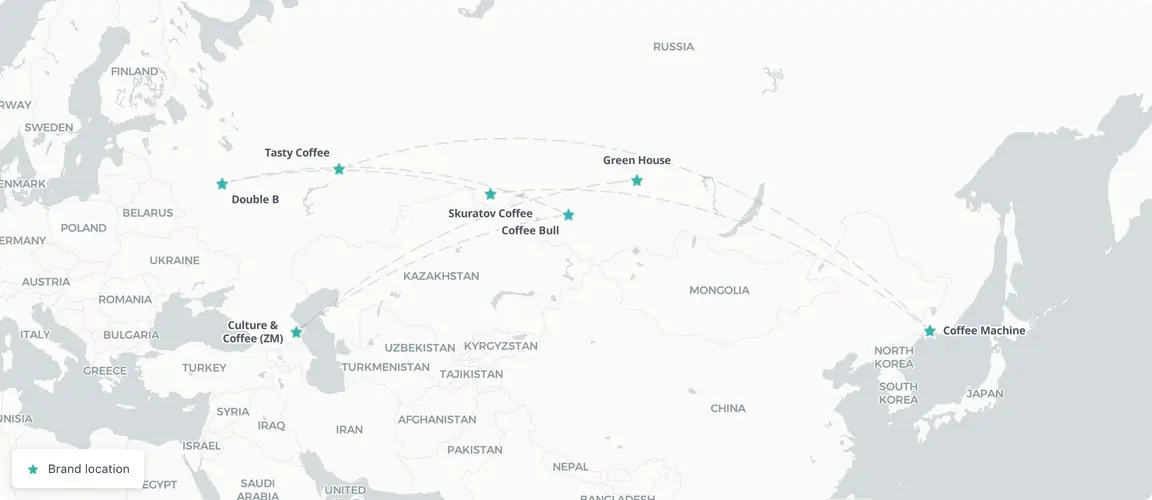
Fifteen years, one filter
Dmitry Lutchenko lost his own company to an early investor not long after he founded it — pushed out of operational control of the drive-through auto-café format he had just built in Vladivostok, on the country’s Far-East edge, years before Moscow had ever seen the concept. He didn’t walk away. He kept the brand name, Coffee Machine, and rebuilt around it through a franchise model rather than starting over under a different one. That rebuild, not the shipping crisis that would hit the sector five years later, is the sector’s first proof of the same underlying pattern: a founder who has already lost his chokepoint once will spend whatever it takes to hold onto whichever piece of it he can still recover.
That pattern — hold or lose the one lever only the founder can pull — turns out to be the dividing line in Russia’s specialty-coffee sector, tested most sharply by the March 2022 shipping shock and the four founder-control losses that bracket it on either side. Some founders held their lever through the shock. Others had already lost theirs years before it arrived. The crisis that was supposed to test the whole sector instead revealed something narrower and more useful: which founders still had something left to defend, and which had already let it go.
The country the coffee database misses
The main shipping lines have suspended coffee shipments in the Russian direction and are not accepting requests for empty containers. Disruptions will be 100%.
Global audiences who think about Russian coffee at all tend to picture Moscow — a hipster café scene, imported machines, Italian-trained baristas. That picture is a press artifact, not the sector’s shape. Scoping research identified roughly 44 qualifying specialty-coffee chains spread across at least 18 cities, and the country’s most distinctive brands sit nowhere near the capital.
The largest specialty roaster in Russia operates out of Izhevsk, a city of the Udmurt region better known, if it is known at all, for firearms manufacturing. Tasty Coffee’s founders, Mikhail and Artem Sharov, started roasting there in 2008 with a used roaster and a loan, at a moment when — as the company itself has put it — “there was no specialty market in the country, and people looked at roasters from Izhevsk with incomprehension — everyone drank Italian coffee, and the idea of making something of your own seemed strange.” The country’s most original coffee format, the drive-through auto-café, wasn’t invented in Moscow either. It was born in 2011 in Vladivostok, the Far-East edge of the country, seven time zones from the capital, when Dmitry Lutchenko and Valentin Alekseev opened the first Coffee Machine location years before the format reached western Russia.
Keep going and the pattern holds. Viktor Skuratov built a brew-bar chain in Omsk, in Siberia, starting on instant “3-in-1” sachets before he had the money for real roasting — and only later took the format to Moscow, in his own words, “where nobody was waiting for it.” Novosibirsk, Omsk, Krasnoyarsk, Tomsk, and Barnaul form a self-taught Siberian roasting cluster whose talent traces back to Traveler’s Coffee, the Novosibirsk chain that trained a generation of roasters before its own founders lost control of it. And in Makhachkala, capital of Dagestan, coffee shops have become the region’s defining “third place” — a Muslim-majority republic where alcohol venues are culturally constrained, cafés filled the gap organically, and baristas invented hybrids like the raf with urbech, a nut-paste variation no Moscow menu carries.
None of this is documented in English. Of the sources underpinning this reporting, every one is written in Russian — trade press, corporate filings, regional outlets most Western analysts have never opened. A multi-billion-rouble, geographically dispersed founder economy has simply never been assembled into an account anyone outside Russia could read.
The regional split is not evenly distributed, and the imbalance is itself part of the story. The capital region — Moscow and St Petersburg together — still accounts for roughly 40% of the sector’s chains by scoping-pass estimates, and it is where premium sit-down formats like Kofemania and monocafé specialty pioneers built their reputations. But that 40% is also the most over-covered slice of the sector in Russian trade press, which is exactly why it reads internationally as the whole picture rather than the largest single region among several. The Siberian roaster cluster — Novosibirsk, Omsk, Krasnoyarsk, Tomsk, Barnaul — holds a further quarter, built on the self-taught roasting culture Traveler’s Coffee’s diaspora seeded. The southern resort corridor around Sochi and Krasnodar, the Far East around Vladivostok and Khabarovsk, and the North Caucasus around Makhachkala each hold smaller shares, but each has produced a chain — Coffee Machine, Culture & Coffee, the drive-through format itself — that the capital did not.
The shock that tested a supply chain, not a market
The 2 March 2022 warning from SFT Trading was not abstract. Green coffee beans reach Russian roasters almost entirely by sea, through European ports, and when shipping lines suspended Russia-bound cargo and importers found themselves owing foreign exchange debts to plantation owners they could no longer pay through normal channels, the entire import architecture the sector depended on seized up at once.
What happened next is where the sector’s real story lives. Tasty Coffee did not wait for the shipping lines to resume normal service. The company moved toward what it now describes as “fully own import” — building direct control over sourcing rather than depending on the intermediary layer that had just proven fragile. Coffee Machine, a thousand kilometers further east and structurally isolated from the worst of the European-port bottleneck by its own Far-East geography, had already built its own food-and-coffee production arm before the crisis hit, supplying more than 150 retail points from Vladivostok to St Petersburg. Both companies responded to the same structural threat by taking direct ownership of the piece of the business an outsider could otherwise have used as leverage against them.
Smaller Siberian and Far-East roasters tell a related but distinct story. Already operating at a scale less dependent on just-in-time European logistics, several treated 2022 as an accelerant — a reason to build direct-farm sourcing relationships rather than an existential threat requiring emergency intervention. The shock did not hit the sector uniformly. It hit hardest exactly where a company’s chokepoint — import, supply, format — sat outside the founder’s direct control.
Who is still standing
The four-element test for whether a brand’s crisis story earns real weight is simple: a named founder, a named threat, a named decision, a verifiable outcome. Five of the sector’s chains clear it.
Tasty Coffee. Mikhail and Artem Sharov’s response to the 2022 shock — buying direct control of their own import chain — did more than get the company through the crisis. It positioned Tasty Coffee to become the country’s largest specialty roaster, reporting roughly 10 billion roubles in 2025 revenue, up an estimated 50% year on year. In April 2026, the brothers sold a 20% stake to Vostok Investments, heir to Baring Vostok’s Russian assets — and kept 80% for themselves. The deal came on their terms, negotiated from a position the 2022 decision had built, not forced by an investor who had already gained the upper hand.
Coffee Machine. Dmitry Lutchenko’s company tells a different kind of survival story — one where the threat came first from an early investor, not from 2022. Lutchenko was ousted from operational control by that investor not long after founding the auto-café format in Vladivostok in 2011. He kept the brand name and rebuilt the company via a franchise model rather than starting over under a different one, growing it to roughly 2.2 billion roubles in turnover with its own production supplying more than 150 points, Vladivostok to St Petersburg. The chokepoint he fought to keep was the brand itself.
Double B. Anna Tsfasman’s story is the sector’s clearest cautionary tale. She founded Double B in Moscow in 2012; by 2019 an investor and franchisee conflict had ousted her from the company she built, leaving her with a 14% stake against her investors’ 75%. Double B now operates as a joint-stock investment vehicle. Whatever chokepoint Tsfasman might once have held, she did not retain it through the conflict — and the company’s transformation into an investor-controlled entity followed directly.
Coffee Bull. Vladislav Bykov’s Barnaul chain is the sector’s most recent and starkest casualty. A tax and credit squeeze, compounded by a costly move into a confectionery workshop and a widening cash gap, forced Bykov to close the company entirely on 20 April 2026. Staff later alleged unpaid wages. Unlike Double B, Coffee Bull was not absorbed by an investor — it simply ran out of the capital to keep operating, a different failure mode with the same underlying lesson: no chokepoint survives an empty account.
Traveler’s Coffee. Anvar Piriev and Christopher Tara-Brown founded the Novosibirsk chain in 2002, and for close to two decades it trained much of the talent that would later found the Siberian roasting cluster’s other chains. A corporate war among founders and investors escalated into a criminal case; the parent company was declared bankrupt in 2019, and a co-owner received a seven-year sentence. Traveler’s Coffee’s chokepoint — its own leadership structure — fractured from within, long before any external shock arrived. What survived was not the company but its diaspora: the people it trained went on to found much of what followed.
Could a market-research firm have written any of these five paragraphs? A firm like Euromonitor can tell you Tasty Coffee’s approximate revenue and that Double B changed ownership in 2019. It cannot tell you that Lutchenko kept the Coffee Machine name specifically because rebuilding under a new brand would have meant starting the format’s recognition from zero, or that Tsfasman’s ouster left her at 14% against a specific 75% investor bloc. That specificity — the decision, not just the outcome — is what a filing never records and a founder interview always does.
More than a heritage story
It would be easy to read the Izhevsk-not-Moscow framing as nostalgia — provincial grit, an underdog geography, a feel-good regional-pride story. The founders themselves would reject that reading, and the evidence backs them up.
The provincial origin of these brands is not sentiment. It is where the defensible position happens to sit. A roaster or chain based in Moscow competes on the same terms as every national and international operator with capital to spend on the capital’s rents and its saturated attention. A roaster in Izhevsk or Omsk or Makhachkala competes on terms only it controls — proximity to a specific customer base, a specific supply relationship, a specific cultural fit the capital’s chains cannot replicate on arrival. Skuratov built loyalty in Omsk for years before testing Moscow; Makhachkala’s café culture grew “from below,” organically, filling a cultural role no franchise import model could have manufactured. The provincial base is not where these founders started because they had to. It is where the chokepoint they eventually defended was built.
Two forces closing the window
Two developments are compounding each other right now, and neither is slowing down.
The first is the consolidation wave. Boomerang Capital, a private-equity fund, acquired One & Double in 2026 for an estimated 200–300 million roubles and separately acquired Double B — the same brand Anna Tsfasman lost in 2019 — while negotiating for Cofix as of mid-2026. This is not a single opportunistic purchase. It is a systematic roll-up, and it is actively hunting the same founder-owned chains that survived 2022 for a different reason than the shock revealed: not every founder who held their chokepoint through a supply crisis can hold it through a determined acquirer with capital to spend.
The second is generational. The founders who built this sector — Lutchenko in Vladivostok, Skuratov in Omsk, the Sharov brothers in Izhevsk — are the people who lived through both the 2022 shock and the years of provincial building that preceded it. They are alive, and they are the last people who can tell the chokepoint story firsthand: what the threat actually looked like, what the decision actually cost, what almost didn’t work. Four peer brands have already converted to investor or PE control since 2018. The pattern is established. The remaining founder-owned brands are not a permanent category — they are the ones who have not yet faced the acquirer with the right offer, or the cost crisis with no reserve left to absorb it.
The two forces reinforce each other in a way that narrows the window faster than either would alone. A private-equity fund does not need every founder-owned chain to sell — it needs enough of them, at the right moment, to build a national footprint by acquisition rather than by building from scratch. And a founder weighing an offer today is weighing it against a sector where four peers already sold, where one peer simply ran out of money, and where the shipping crisis that might once have justified holding out for a better deal is now four years in the past. The circumstances that made 2022 a defensible reason to stay independent do not reproduce on demand. What Boomerang Capital is buying in 2026 is not distressed assets — it is exactly the founder-built, chokepoint-defended companies that proved themselves in the crisis, now available on terms the crisis no longer provides an excuse to refuse.
What the record shows
Anna Tsfasman’s Double B is the sector’s cleanest counter-case. She held 14% against her investors’ 75% by the time they forced her out in 2019 — a stake too thin to defend, in a dispute that predates the 2022 shock by three years. Nothing about the shipping crisis changed that outcome, because the outcome had already been decided. What separates Double B from Coffee Machine, or from Tasty Coffee’s Sharov brothers, was never the size of the crisis each founder faced. It was whether, at the moment the pressure arrived, there was still a lever left in that founder’s own hands to pull.
That test is not finished. Boomerang Capital’s roll-up is not stopping at Double B and One & Double — it is actively negotiating for Cofix as of mid-2026, and it will not need every remaining founder-owned chain to sell, only enough of them at the right moment. The founders who can still narrate, on the record and in their own words, exactly which lever they held and why are the ones this sector’s real history depends on — and that generation is not going to be available to ask indefinitely.
Researched 33 sources in Russian.