 Skip to main content
Russia Fashion: The Vacuum Nobody Watched
In 2022, more than five hundred Western brands abandoned Russia — and the founder-owned fashion labels that poured into the vacated storefronts had already survived worse. A man imprisoned three times in Soviet labour camps now runs the country's largest fashion retailer. The sector grew the instant the West stopped watching it.
Russia fashion: a Moscow revival, founders from the periphery
The vacuum nobody watched
When Zara, H&M, and Uniqlo walked out of Russia in 2022, a jeans company run by a man who had served three Soviet prison terms walked in. Gloria Jeans took over the largest H&M in the country — a five-thousand-square-metre flagship on Moscow’s Tverskaya Street (Тверская) — and within two years had occupied more than two hundred vacated storefronts, driving revenue toward ~₽78 billion ($1B USD, at early-2026 exchange rates). Its founder, Vladimir Melnikov (Владимир Мельников), was orphaned at twelve and imprisoned three times for the Soviet crime of trading jeans. In 2024, Forbes valued him at $1.7 billion.
This was the most dramatic chapter in the history of Russian founder-owned fashion. It is also almost entirely undocumented outside Russia. More than five hundred Western consumer brands suspended their Russian operations in a matter of months — and at the same moment, the analysts, ratings agencies, and intelligence platforms that might have tracked who replaced them packed up too. The sector got bigger the instant the West stopped watching it.
The cooperative that came out of the basement
To survive, you must always keep throwing on wood.
The sector is older than the headlines suggest, and it was forged in scarcity from the start. Its founding document is the 1988 Soviet Law on Cooperatives, which legalised private enterprise for the first time since the 1920s. Melnikov and his wife Lyudmila registered Gloria — the USSR’s first legal jeans manufacturer — emerging from the basement where they had been sewing illegally. He had spent the previous decade in and out of labour camps for fartsovka (фарцовка), the black-market trade in Western goods that the planned economy could not provide.
Three years later, in 1991, a Soviet stadium engineer named Boris Ostrobrod (Борис Остроброд) founded Sela (Сэла) — Hebrew for “rock” — from Israel, where he had emigrated the year before. He began by importing goods from China. An accidental oversupply of down jackets in 1992 “flew off the shelves,” and Sela became one of the first companies to build branded fashion retail in a country whose Soviet distribution system had left nothing of the kind behind. Industry observers came to call it “the Russian analog of H&M.”
What set these founders apart was not vision but conditioning. They had learned to operate where currencies failed and rules changed overnight, and the discipline showed the moment the system buckled. In August 1998, the ruble lost roughly 70% of its value and the dollar tripled. Russian retailers raised prices 200–300% to survive. Ostrobrod did the opposite: he froze Sela’s prices for exactly thirty days, absorbing the loss item by item, on the bet that customers brutalised by a decade of chaos would remember who had not exploited them. They did. The price freeze created a customer loyalty competitors could not buy, and it wrote the Russian crisis playbook — invest when others retreat.
Each subsequent shock culled the field. The 2008 financial crisis and the 2014 sanctions-and-devaluation double-blow drove dozens of chains under; 56 trade networks left the Russian market in 2014–2015 alone, 50% more than during 2008–2009. Of the Russian fashion retailers founded in the early 1990s, the survivors still standing by 2020 could be counted on one hand: Gloria Jeans, Elis, Zarina, and Sela. The brands that reached 2022 intact were, almost by definition, the ones that had already survived everything.
From the provinces to Tverskaya Street
Russian fashion is, commercially, a Moscow story. Its founders are not. The geographic irony runs through every name in the sector.
Melnikov came from Rostov-on-Don, where he was orphaned and put to work on a factory lathe at fourteen. Andrey Artemov (Андрей Артемов), who founded Walk of Shame, came from Ufa, the capital of Bashkortostan, 1,400 kilometres from the capital — a distance that matters in a fashion industry as Moscow-centric as Russia’s. Ostrobrod came from the industrial Urals, by way of Leningrad and then Israel. The talent was provincial and diasporic; the stage was Moscow.
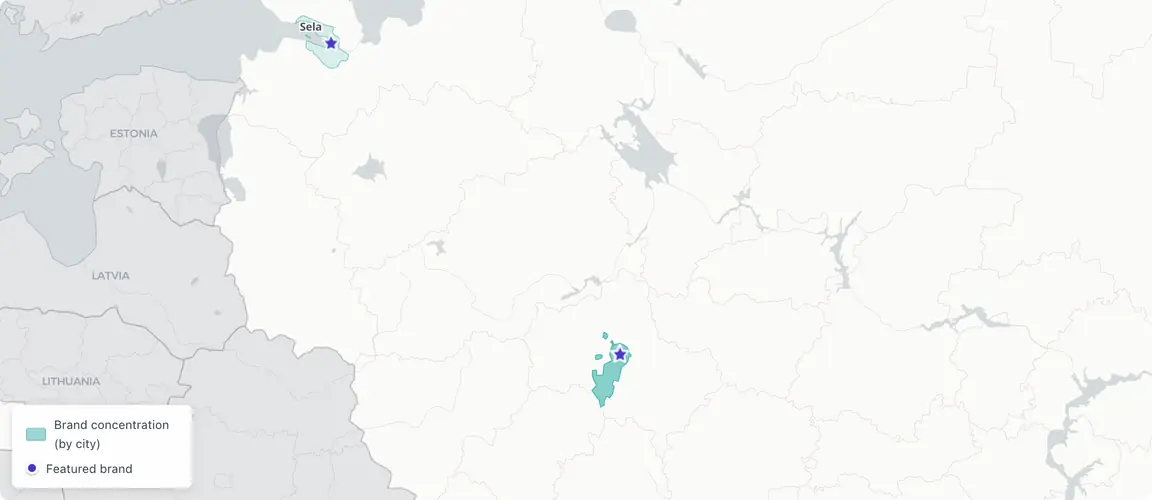
And it was on that stage that the vacuum opened. The most valuable retail real estate in the country — the flagships of Tverskaya, the prime mall corridors that Nike, Zara, and H&M had occupied — emptied within months in 2022. Russian founders rushed in. LIMÉ, a fast-fashion brand built by Dmitry Khokhlov from Samara, moved into former Nike and Zara flagship locations and reached ~₽34.4 billion ($450M USD) in revenue. Gloria Jeans took the largest former H&M in the country. St. Petersburg holds the sector’s other pole — the birthplace of Sela, and the base of Melon Fashion Group, the consolidator now rolling up brands the way the West once rolled up Russian shelf space.
Beneath the commercial map lies a second geography that no shopfront reveals: the craft heartlands. When Gourji rebuilt its supply chain inside Russia, the trail led not to Moscow but to the periphery — cloisonné enamel from Kostroma, lacquer-miniature painters in the Fedoskino villages who spend three to four weeks on a single pen, metalworkers in Kazan and Tula. The sector concentrates in Moscow. The people and the materials that feed it come from everywhere else.
What the databases stopped reading
The standard explanation for why a sector goes uncovered is that it is too small, too informal, or too new to document. None of that applies here. The Russian fashion sector is among the most thoroughly documented cases in the entire Russian consumer landscape. The problem is where the documentation lives.
It lives in Russian. Forbes Russia ran a detailed account of how Gloria Jeans “captured the market after the departure of H&M and Zara.” RBC, Vedomosti, and Snob carry the founder profiles, the store counts, the revenue context, the succession debates. The corporate filings exist. The interviews exist. What does not exist is any English-language analytical product that assembles them — because the two barriers that wall off this sector compound each other. The language barrier kept the material out of Western databases before 2022; the sanctions wall finished the job, because the same month the brands left, the analysts left with them.
This is the gap that Euromonitor cannot close. It can cite an aggregate market size and a growth rate. It cannot tell you that a three-time Soviet convict took over the largest H&M in Russia, or that a cufflink-maker spent seven years rebuilding his supply chain for a crisis nobody had forecast, or that a New York buyer purchased a Russian designer’s entire collection sight unseen during a sanctions crisis. Those facts are not in any database. They are the difference between knowing a market exists and understanding who will win it — and right now, that understanding is available only to whoever is willing to read Russian and look.
Who walked into the vacuum
Four founders show what the crisis playbook looks like when it is tested to destruction.
Gloria Jeans. The decision that made Melnikov was not the 2022 land-grab; it was the 2009 one that preceded it. In the middle of the financial crisis, he destroyed a profitable $70M wholesale business overnight, cut 28 regional offices to seven, and bet everything on company-owned retail. It looked like madness. It built the operational machine that, thirteen years later, could absorb 200 vacated storefronts in a single rush and open 70 stores in one year. Melnikov says the lesson came from a prison transport in the taiga, where eight of seventeen men froze to death beside a fire they had stopped feeding: to survive, you must always keep throwing on wood.
Sela. Ostrobrod proved the playbook first and exited cleanest. The 1998 price freeze scaled into an empire of ~600 stores across 14 countries and $200M in revenue by 2011. When he recognised that the business needed capital he could not supply, he did the thing most Russian founders never manage: he sold, transferring Sela to Melon Fashion Group in 2019 in the largest deal in Russian fashion-retail history. Ostrobrod died in 2023, four years after the exit — a complete founder arc, succession resolved by design rather than by crisis.
Walk of Shame. Artemov’s test came in 2014, when Crimea sanctions sent the ruble down 50% and the import-dependent machinery of a young Moscow label — fabric, payments, logistics — seized up at once. For most emerging Russian brands, that was extinction. Instead, Humberto Leon of Opening Ceremony discovered Walk of Shame on Instagram and bought the entire collection sight unseen — the first time the store had ever ordered without seeing the clothes. The brand reached 150 stockists with 70% of sales abroad and presented at Paris Fashion Week in 2019. A Russian designer, validated by New York, during a sanctions crisis, through a phone app: no trade database contains that sentence.
Gourji. Dmitry Gurzhiy (Дмитрий Гурджи) built the clearest case of all. The 2014 crash, with import duties already consuming 45% of product cost, made his Italian production economically impossible — he lost, in his words, “not one million rubles.” Rather than fold, he spent seven years relocating every element of manufacturing into Russia, finishing in 2021. One year later, Cartier, Tiffany, and Bulgari exited Russia, taking an estimated 80% of premium-jewelry volume with them. Gourji (Гурджи), already fully domestic, was the brand built for a vacuum nobody had foreseen.
The self-irony defense
There is a temperamental thread running through these brands that the Western stereotype of Russian fashion — austere Soviet throwback or oligarch trophy — never captured. It is self-irony, and it turns out to travel.
Gourji’s debut collection put a golden angel where Lenin’s face had been on a Soviet October Star. Walk of Shame took the morning-after walk home and made it a name a buyer in Paris would stock. Gosha Rubchinskiy and Outlaw Moscow turned post-Soviet youth aesthetics — subway marble, Perestroika kitsch, tracksuit melancholy — into a global language, while Ulyana Sergeenko and Igor Chapurin carried Russian craft into couture. None of it apologises for where it comes from, and none of it treats that origin with reverence. It treats it as material.
That posture is not decoration; it is the export strategy. A brand confident enough to play with its own history builds an identity specific enough to be unrepeatable — which is precisely why Walk of Shame could sell 70% of its output outside a country under sanctions. Cultural specificity, handled with a straight face, would have read as nationalism. Handled with irony, it reads as point of view.
The correction that followed the land-grab
The easy phase is already over. By late 2025, twelve of the brands that had rushed into the post-exodus boom had shut down, and the most aggressive occupier of all was contracting. Gloria Jeans is closing its flagship former-H&M on Tverskaya — the trophy of the whole land-grab — as rents of ₽168–204 million a year (~$2.2–2.7M USD) outrun what the store can earn. The company cycled through three CEOs in eighteen months across 2024–25; revenue fell 14% and profit dropped fourfold; Melnikov returned to run it himself for the fifth time. Seizing empty real estate, it turns out, was never the hard part.
The hard part is what separates a land-grab from a brand: the discipline to survive the correction that follows the rush. That correction is now sorting the sector, and a second dynamic runs alongside it. The founders are aging. Melnikov is roughly seventy, holds 99.9% of his company personally, and keeps every trademark in his own name; an estimated 20–35 founder-owned Russian fashion brands at commercial scale have founders between 60 and 75. Sela showed one template — Ostrobrod’s managed sale to a strategic buyer. Most of the others have documented no plan at all.
Both dynamics are visible now, while they are still unfolding rather than finished. The correction is culling brands publicly, month by month; the founders’ ages are matters of public record. Both processes are underway in Russian-language sources that no English-language database has read.
What the sanctions wall hid
For an investor, the signal is a cohort of crisis-tested operators, mid-consolidation and mid-succession, with no Western competition for their shelf space. For a buyer, it is a roster of suppliers that has already survived worse shocks than the next one is likely to bring. For a partner, it is a generation of founders who built brands that travel on identity rather than on a favourable political climate. Each of these facts sits in the same overlooked record: the sector that filled Russia’s largest retail vacuum in a generation has never been mapped in a language most of these readers can access.
The intelligence exists. It is in Forbes Russia and RBC and Vedomosti, in the founder interviews and the corporate filings, scattered across Russian-language sources and sealed behind a sanctions wall. It has not been assembled anywhere.
A three-time Soviet convict running the largest former H&M in the country. A cufflink-maker who rebuilt his entire supply chain for a sanctions crisis years before it arrived. A provincial designer validated by New York during the last crisis but one. These brands did not appear when the West left. They had been operating in Russian-language obscurity the entire time — surviving, building, waiting for someone to read the record in their own language.
Researched 74 sources in English, Russian.