 Skip to main content
Russia Bakery-Café: A Founder's Named Limit
A St Petersburg bakery chain grew revenue 53-56% over three years while posting a net loss every single year — then swung to profit the moment its founder explained, on the record, exactly where he'd deliberately capped growth. Two peer chains facing the same pressure didn't get to make that choice.
Two capitals, three survivors
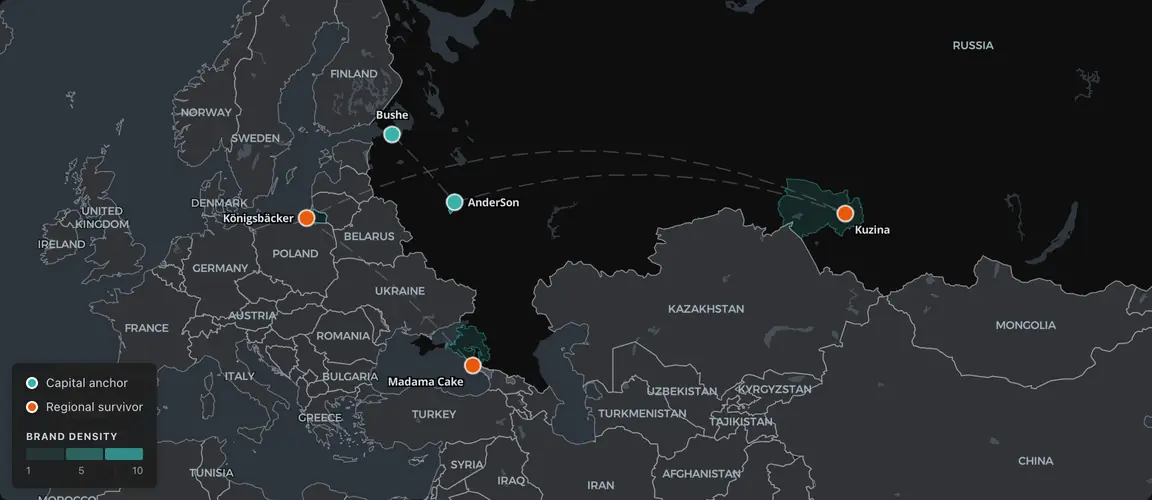
One choice, three outcomes
Anastasia Tatulova (Анастасия Татулова) spent 2020 to 2022 serving as Russia’s own SME business ombudsman — the state’s designated advocate for small business survival — while running the Moscow family-café chain AnderSon she had built to more than 40 locations. That role did not protect her. Autumn 2022 brought tax raids she later described as deliberate pressure to leave the country, and by November 2023 grocery retailer VkusVill had acquired 100% of her brand in a deal worth an estimated ₽600–800 million. She did not lose her chokepoint to a market shock. She lost it to the same government apparatus she had briefly represented.
Oleg Lega (Олег Лега), hit by the same cost pressure and scrutiny in the same years, got a different outcome. Revenue at his St Petersburg bakery chain Bushe kept climbing, ₽3.4 billion to roughly ₽5.3 billion, through three straight years of net losses — a combination that by any conventional reading signals a company in trouble. By 2025 it had swung to a ₽7.4 million profit, and Lega still owned 100% of it. The variable that separated his outcome from Tatulova’s was not capital, and it was not luck. It was whether the founder could name, specifically and publicly, the line he would not cross — before a crisis forced the question for him.
The country the pastry-case photos miss
There is a scale at which a network stops being alive and becomes industrial. We have reached that edge.
International coverage of Russian bakery culture, to the small extent it exists at all, defaults to heritage imagery: European café concepts, imperial-era pastry traditions, artisanal croissants photographed for lifestyle features. That framing is not wrong, exactly. It is simply the wrong altitude. Behind the pastry case sits a founder economy that has just been through the sharpest consolidation event in the sector’s history, documented almost entirely in Russian-language corporate registries — EGRUL filings, regional court records, trade-press interviews — that no international restaurant-industry database has ever assembled.
Scoping research identified roughly 17 genuinely founder-controlled bakery-café chains inside a broader Russian bakery-and-confectionery market that Vedomosti and the Infoline research group size at more than ₽1 trillion as of 2024, with the country’s top-10 chain footprint growing 8% year-on-year even as the total bakery count barely moved. Within that pool, the founder-controlled, café-format set — the businesses with a named founder, a dine-in room, and a pastry-forward menu, as distinct from bread-only quick-format chains like Nastoyashchaya Pekarnya (Настоящая пекарня, “Real Bakery”) — clusters overwhelmingly around two cities. Moscow and St Petersburg together account for an estimated 70% of the pool, and it is precisely that capital concentration that the 2023 consolidation wave hit hardest.
Three regional pockets sit apart from the capital pattern entirely, and they read as survivors rather than stragglers. Kaliningrad, the former German exclave of Königsberg, hosts a genuinely dense multibrand cluster — Königsbäcker, Kruassan Kafe (Круассан Кафе), and Porto (Порто), all run by the same holding group, Evropeyskie Konditerskie LLC (ООО «Европейские кондитерские»), whose disclosed owners include Oleg Ponomarev (Олег Пономарев), a prominent local retail businessman behind the region’s Vester (Вестер) supermarket chain. Königsbäcker alone runs roughly 40 points, commercializing a Königsberg heritage story — German pastry names, a German place-identity — that no Moscow or St Petersburg chain could credibly replicate, because the region’s isolation and tourism economy are what make the heritage story sellable in the first place.
Novosibirsk and the Siberian belt show the opposite lesson: format fragility at scale, in the one region that tried to compete with the capitals on capital-market terms. Omsk’s Pryano-Rumyano (Пряно-Румяно), by contrast, stayed small and founder-run under Vyacheslav Lykov (Вячеслав Лыков) — a self-described seventeen-year entrepreneur who also operates a coffee chain and a hostel, and has spoken publicly about overcoming addiction — precisely the kind of founder-specific texture a market database has no field for. Sochi and the Krasnodar resort belt produced a different survival pattern again: Anna Pryadko’s (Анна Прядко) Madama Cake (Мадама Кейк) began as a maternity-leave baking hobby around 2016 and scaled, by 2019, into the city’s best-known author’s patisserie, riding a seasonal, high-footfall tourist market that rewards a single skilled founder rather than an operations-scaled chain. None of this — the capital concentration, the three distinct regional survival mechanisms, or the specific process by which three marquee capital chains lost founder control in a single year — has been documented in any language accessible to an institutional reader who does not read Russian trade press.
Three founders, the same year, three different pressures
The pressure that hit Russia’s bakery-café sector between 2022 and 2023 was not one shock. It was two forces arriving close together: capital-tier cost inflation squeezing already-thin café margins, and a wave of state and tax scrutiny that fell unevenly but hit hardest on the sector’s highest-profile founders.
Bushe (Буше) felt the cost side first and most directly. St Petersburg rents, payroll, and food costs rose through 2022 in ways that, in Lega’s own account, would have forced a choice between raising prices past what the market would bear or selling at a loss. He chose neither. Instead he held pricing discipline and absorbed the resulting losses — ₽29.3 million in 2022, corroborated independently by RBC St Petersburg and Novy Prospekt beyond the original registry filing; ₽18.3 million in 2023; ₽53.2 million in 2024 — while revenue kept growing roughly 53-56% over the period as the network expanded to some 36 points across two bakery brands. The losses were not concealed. They were, in his framing, the cost of not becoming “industrial.”
AnderSon (АндерСон) felt the state-scrutiny side. Anastasia Tatulova (Анастасия Татулова) had built her Moscow family-café chain to more than 40 locations and, in a twist no bakery-chain founder could have scripted, spent 2020 to 2022 serving as Russia’s own SME business ombudsman — the state’s designated advocate for small business survival. That role did not protect her. Autumn 2022 brought tax raids she later described, through RBC, as deliberate pressure to leave the country. By November 2023, VkusVill had acquired 100% of the brand and its base assets in a deal Infoline valued at ₽600–800 million. Tatulova was subsequently designated a foreign agent and placed on an MVD wanted list. She did not lose her chokepoint to a market shock. She lost it to the same government apparatus she had briefly represented.
Kuzina’s (Кузина) Erik Shogren (Эрик Шогрен) faced a slower-burning version of the cost pressure — sugar prices up 110% by his own managing partner’s account to Kommersant-Sibir in April 2022, chocolate up 70%, imported flavourings up 250% — compounding into technical defaults on ₽70 million of Moscow Exchange bonds by 2024 and a tax-driven bankruptcy suit by 2025. Unlike Lega, Shogren never got to complete a deliberate response to the pressure. He died in December 2025, in the middle of the unwinding. The Novosibirsk court declared Kuzina bankrupt the following May, opening a five-month administration period. Roughly 27 of the chain’s Novosibirsk points reportedly still traded as of July 2026 — under a trademark-holder arrangement no single source has confirmed cleanly enough to state as settled fact.
Who is still standing
Bushe. Oleg Lega’s chain is the only one of the three that ends this period with founder control fully intact and a stated rationale on the record for how it got there. The EGRUL company card shows 100% ownership as of its most recent filing. The financial arc — three years of widening then narrowing losses, then a return to profit exactly as revenue crossed ₽5 billion — is not a story a registry filing alone could tell. A filing shows the numbers. It does not show that Lega named his limit in a 2021 interview, before the losses started, and held to it through three years of a market reading those losses as distress.
AnderSon. Anastasia Tatulova’s arc runs in the opposite direction: from the most publicly credentialed founder in the sector — a state ombudsman role is not a title chains normally acquire — to a forced sale and a foreign-agent designation within roughly eighteen months. The specific detail a market-research firm’s ownership-change note would never capture is the sequencing: the tax raids arrived not despite her state role but, in her own account, connected to it. Institutional credibility with the state turned out to be a liability the moment the state’s priorities shifted.
Kuzina. Erik Shogren’s story is the sector’s most complete crisis dossier and its least resolved outcome. A death, a bond default, and a bankruptcy filing are individually verifiable facts. What is not yet verifiable — and this matters for how the story should be read, not just told — is who actually controls the Kuzina trademark today. One regional investigation states the mark moved to an unaffiliated Moscow-region holding company back in 2022, insulating individual café operators from the parent’s bankruptcy. A separate corporate registry snapshot still lists the original, now-also-bankrupt Novosibirsk entity as the registered holder. Both cannot be current. Until Rospatent confirms one or the other, Kuzina’s survival is a fact; the mechanism behind it is not.
Could a market-research firm have written any of the three paragraphs above? A firm like Euromonitor can report that AnderSon changed hands in 2023 and cite the deal’s estimated value. It cannot tell you that Tatulova called the pressure “the biggest and most terrible crisis… since the 1917 revolution,” or that Lega named his growth ceiling two years before the losses that would test it, or that Kuzina’s actual post-bankruptcy trademark status is genuinely disputed between two named sources rather than simply unknown. That specificity — the decision, the quote, the unresolved discrepancy stated as unresolved rather than smoothed over — is the intelligence a registry filing never contains.
Two capital-tier peers sit between these three cases and deserve one line each. Bratya Karavaevy’s (Братья Караваевы) founders, Evgeny Katsenelson (Евгений Каценельсон) and Igor Moiseev (Игорь Моисеев), built a Moscow chain on sibling-branding despite not actually being brothers — a marketing device that outlasted the company itself, which sold to fuel-station operator Neftmagistral in March 2023 for up to an Infoline-estimated ₽100 million against a 2021 net loss of ₽36 million. Khleb Nasushchny (Хлеб Насущный) never had a Russian founder to test in the first place: a Le Pain Quotidine franchise run by a British operating company, it collapsed alongside its management company’s 2024 bankruptcy, its last café closing in December 2025. Neither had a Bushe-style stated limit to defend, and neither survived with anything resembling founder control intact.
Not a heritage story
It would be easy to read Bushe’s survival as a nostalgia narrative — an old-school St Petersburg baker who refused to modernize, rewarded for stubbornness. The evidence argues against that reading. Lega’s stated position was never anti-growth. Bushe’s revenue nearly doubled across the loss years; the network expanded to 36 points and a second bakery brand. What he refused was a specific kind of growth — the kind that would have required either raising prices past what his market would bear or accepting an operational scale at which, in his words, the network stops being “alive.” That is a capacity constraint stated as a strategic choice, not a heritage sentiment. Volkonsky (Волконский), the other capital-tier chain that survived the consolidation wave with family control intact, tells a structurally similar story: artisanal positioning as a deliberate constraint on scale, not a marketing description bolted onto an otherwise conventional growth strategy.
The regional pockets confirm the pattern from the opposite direction. Königsbäcker’s ~40-point Kaliningrad cluster and Madama Cake’s Sochi following did not grow by competing with Moscow on Moscow’s terms — they grew by defending a specific, non-replicable local position (German-heritage branding in a former German exclave; author’s-cake craft in a resort city) that a capital-tier acquirer would gain nothing by absorbing. A grocery chain buying AnderSon acquires a Moscow café format it can staff and supply from its own distribution network. The same buyer acquiring Königsbäcker would acquire a heritage story it cannot relocate, sell, or replicate anywhere the group’s actual owners are not already established locally — which is precisely why no acquirer has tried. The stated limit, in every surviving case, is also the structural fact that protects it.
Two compounding pressures
Two pressures are compounding right now, and neither is easing.
The first is continued consolidation appetite. Bratya Karavaevy’s sale to a fuel-station operator and AnderSon’s sale to a grocery retailer were not isolated opportunistic purchases — they establish that non-restaurant capital sees value in absorbing founder-built format and customer base, regardless of whether the acquirer has any hospitality expertise of its own. A chain the size Bushe has reached, ₽5 billion-plus in revenue and 36 points, sits squarely in the range that kind of buyer targets next.
The second is generational and, in Kuzina’s case, already irreversible. Erik Shogren cannot explain his own decisions anymore. Oleg Lega can, and has — but the interview in which he named his growth limit is already four years old, predating the losses it explains. The founders who built this sector’s clearest crisis narratives are not a permanent resource. Every year that passes without a fresh, on-record account of why a founder chose what they chose is a year closer to that account existing only as speculation reconstructed from bankruptcy filings, the way Kuzina’s now must be.
What the record shows
Erik Shogren never got the chance to draw his own line. Bond defaults, a tax-driven bankruptcy suit, and his own death in December 2025 resolved Kuzina’s fate before he could explain, in his own words, what he would or wouldn’t have accepted. Roughly 27 of his Novosibirsk points reportedly still trade — under a trademark-holder arrangement no single source has confirmed cleanly enough to call settled. His is the sector’s least resolved outcome precisely because the pressure outpaced the decision.
That is the sharpest version of the pattern this sector now shows: capital, market position, and pastry quality sorted no one. What separated a founder who kept control from one who lost it, or one who ran out of time entirely, was whether a line had already been named before the pressure arrived to test it. A grocery retailer and a fuel-station operator have already proven they will buy a founder-built bakery chain on non-hospitality terms, and Kuzina’s bankruptcy proceeding runs into October 2026 — active consolidation, not a closed case. The founders who can still explain, on the record, exactly where their limit sits are the ones worth reading now, while they are still the ones telling the story.
Researched 36 sources in Russian, English.