 Skip to main content
The City That Built a Culture It Couldn't Keep
Built from nothing in 1462 on an empty island, Ribeira Grande became the first European city in the tropics and the operational hub of the early Atlantic slave trade. The Crown captured the cash. The people who passed through captured something the Crown could not: a language, a faith, a music — Kriolu, which outlasted the system that made it.
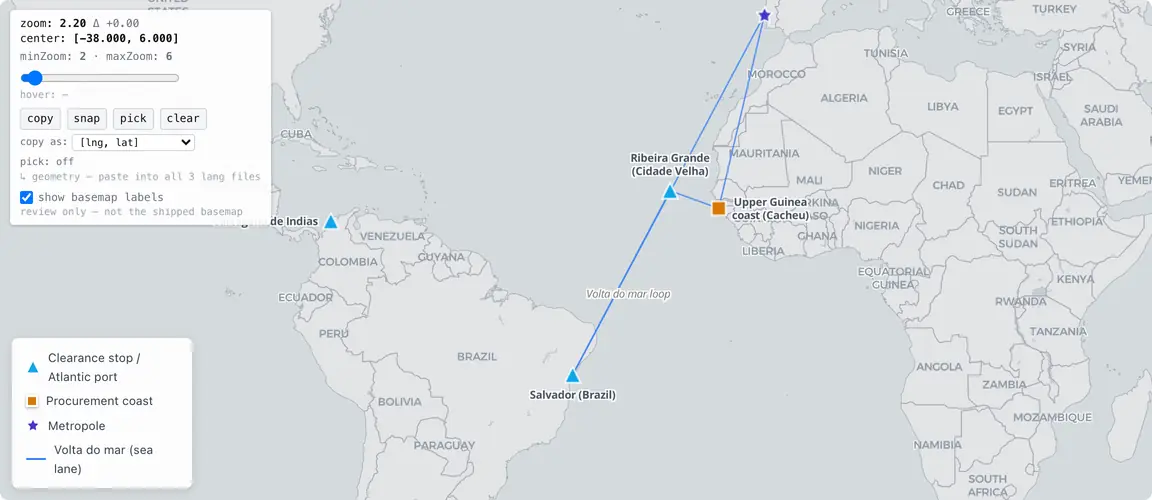
Geographic Context: Santiago and the volta do mar
Indispensable by decree, disposable by route
In 1712, a French admiral named Jacques Cassard sailed into Ribeira Grande and took everything. His men stripped the cathedral floor of its marble, carried off the bronze bells, and emptied the archive of the diocese — the Tombo Velho, the written memory of two and a half centuries. The bishop’s lament survives because he wrote it down afterward: the raiders had left “not a single prayer book to read the mass.” Cassard reportedly abandoned more than a million livres’ worth of plunder on the quay because his ships could not carry it all.
The city did not recover. Within sixty years the Portuguese Crown moved its colonial capital twelve kilometres east to Praia, and Ribeira Grande was demoted to a village and renamed Cidade Velha — the Old City. Today it holds fewer than 1,300 people. But the thing the city had already produced, the thing Cassard could not load onto a ship, was by then unrecoverable for an entirely different reason. It had escaped into the mouths of children.
The island built from nothing
I can see the importance the site has for Cabo Verde to understand our history and our identity.
Most great trading cities grow where people already are. Ribeira Grande grew where no one was.
When the Genoese navigator António da Noli, sailing in Portuguese service, sighted Santiago in 1460, the island was uninhabited. There was no pre-existing port to capture, no local kingdom to negotiate with, no substrate culture to absorb. Portugal built the town from the keel up, and it built it for one reason: position. Cape Verde sits roughly 570 kilometres west of Senegal, at the precise latitude where the Northeast Trade Winds meet the North Atlantic Gyre. The Portuguese had perfected the volta do mar — the counter-intuitive trick of sailing far west into open ocean to catch the westerlies home — and Santiago was the last reliable freshwater stop before that turn.
The Ribeira Grande valley offered three rare assets at once: a perennial stream on an otherwise arid rock, a defensible plateau where Fort Real de São Filipe would later stand at 120 metres, and a sheltered south-facing roadstead. Founded in 1462, it became the first permanent European city in the tropics. Vasco da Gama watered here on his way to India in 1497; Columbus called the following year. By the time Brazil opened to colonisation around 1530, the islands sat at the literal mid-point of the Atlantic triangle.
What made the position commercially decisive was not geography alone but a royal decision. A 1466 charter from Afonso V gave Santiago’s residents tax-exempt trading rights along the West African coast, granted because the dry climate made farming unreliable and the Crown wanted the islands populated. The same licensing structure made Santiago the mandatory clearance point: ships loading enslaved Africans anywhere on the Upper Guinea coast were required to pay duties at Ribeira Grande. The town became indispensable by decree, then by habit.
The seasoning station
The euphemism was “seasoning.” Its meaning was brutal.
Enslaved Africans purchased on the mainland were brought to Santiago to be processed before onward shipment — baptised, taught rudimentary Portuguese, broken to plantation labour, and acclimatised before the Atlantic crossing to Brazil and the Spanish Caribbean. The scale grew with terrible speed. There were perhaps 30 enslaved people on Santiago in 1510. By 1582, the census of the sargento-mor Francisco de Andrade recorded roughly 13,400 inhabitants on the island, of whom about 11,700 were enslaved.
Around the central Pelourinho — the marble pillory raised between 1512 and 1520 — the town arranged the machinery of a transshipment economy: warehouses, a Misericórdia hospital, ship-repair facilities, the bishop’s mansion with its archive, and some eighteen churches and chapels. Infrastructure followed the trade rather than preceding it. The historian Toby Green’s most defensible estimate puts exports at roughly 2,000 to 2,500 enslaved people per year from Cape Verde at the 1525–1550 peak, with the qualification that off-the-books traffic may have doubled the official record. The figures are necessarily estimates; the SlaveVoyages database’s regional total of around 147,281 embarked Africans for the whole of 1501–1600 is a lower bound, and it conflates the offshore islands with the mainland Senegambian coast.
The trade ran on an economy so closed it bordered on the surreal. Cotton grown on the islands was woven by enslaved women into narrow strips of cloth called panos da terra, six stitched together — and these panos became a standard currency on the Upper Guinea coast for buying enslaved people. The enslaved, in other words, produced the money used to purchase more of the enslaved. A monopoly company would later ship some 95,000 panos to the Guinea coast in a single decade. The system was self-feeding, and for a century it made Ribeira Grande one of the busiest commercial nodes in the Atlantic world.
The men the Crown could not tax
The Crown licensed the trade. It did not run it.
The actual procurement network was run by the lançados — “those who threw themselves” onto the coast. They were Portuguese exiles, convicts, and Sephardic Jews fleeing the 1496 expulsion, who settled along the Petite Côte and the Rios da Guiné, married into Wolof, Mandinka, and Papel families, and became the de facto operating system of the trade. They spoke the languages, held the local kinship ties, and moved the goods the Crown depended on but could never fully control. A 1606 Jesuit report counted around a hundred Portuguese on the Senegalese coast quietly following Mosaic law while professing Catholicism in public; by 1641 a synagogue operated at Joal.
It is the sharpest inversion in the story. The most distrusted people in the system — the exiles, the outcasts, the religious refugees the metropole wanted gone — became its indispensable intermediaries. The Crown held the contracts and collected what duties it could. The lançados held the relationships, and relationships are harder to confiscate than warehouses. When the metropolitan monopoly tried to disintermediate them, it failed, because there was nothing to seize: the asset was distributed across a hundred marriages and a thousand obligations on a coast the Crown barely reached.
The lesson is not flattering to anyone, but it is exact. In an extractive system, the durable operational asset is rarely the licence. It is the intermediary class that the principals distrust precisely because it cannot be replaced.
The route that no longer needed them
Ribeira Grande’s strength was that ships had to stop there. Its fatal weakness was that this was true only as long as the ships needed water, provisions, and a clearance stamp more than they needed speed.
The crisis arrived as a slow compound, not a single blow. The first element was violence. Pirate attacks began in 1541. In November 1585, Francis Drake arrived with 25 ships and some 2,000 men, plundered the city over twelve days, stripped the cathedral’s bronze bells, captured seven Portuguese slave ships at anchor, and burned part of the town. England raided again in 1592; the Dutch came in 1598; and in May 1712 Cassard finished the work. Each raid taught the same lesson: a harbour that cannot be defended is a liability, and a one-asset town has no fallback. Portugal’s 1580 absorption into the Spanish crown had made Cape Verde a legitimate target for every enemy of Spain — the Iberian protection that had once kept the town safe had become the reason its enemies came.
The second element was quieter and more decisive. As Brazilian sugar and Caribbean plantation demand scaled through the seventeenth century, slavers increasingly sailed direct from Luanda or the Bight of Benin straight to the Americas, bypassing the Cape Verde clearance point entirely. The volumes that had once justified a mid-Atlantic stop now justified going around it. Ribeira Grande was not conquered out of relevance; it was routed out of it. The town that duties had made mandatory became, to the men sailing the larger ships, simply out of the way.
The third element was the land itself turning lethal. The dry climate that had always constrained the islands produced, in 1773–1776, a drought-famine that “is said to have removed 44 percent of the population” across the archipelago, in the historian Cormac Ó Gráda’s account. The Crown had already ordered the capital moved to Praia in 1712; the transfer was completed by 1770. Ribeira Grande, gutted by Cassard, bypassed by the trade, and emptied by hunger, simply faded — demoted to Cidade Velha, the Old City, and slowly buried by valley wash and time.
What escaped on the ships’ departure
And yet the most durable thing the city ever made was, by the time of its collapse, beyond anyone’s power to destroy.
Out of the forced proximity of Portuguese settlers and West Africans — Wolof, Mandinka, Fula, Temne, Manjak, Balanta, speaking mutually unintelligible languages — there emerged, by the late fifteenth or early sixteenth century, a stabilised creole that children inherited as a first language. Roughly 90 to 95 percent of its lexicon derives from fifteenth- to seventeenth-century Portuguese, but its sound system, its grammar of tense and aspect, and its core vocabulary of social relations come from the West African substrate. Genetic studies have since corroborated the strong Senegambian — particularly Mandinka — contribution to the population that spoke it. This was Kriolu: the oldest living Portuguese-based creole, today the everyday language of nearly a million people, and, alongside Portuguese, a co-official language of the republic.
The system was designed to deny enslaved people name, language, and continuity — to move them as cargo. It produced, instead, a people who built their own language, their own syncretic faith still visible in Cidade Velha’s chapels, their own music, their own currency, and eventually their own nation. The Portuguese Crown captured the cash flow. The people who passed through the system captured the meaning.
That meaning compounded across centuries the way money never did. The famines that emptied the islands drove emigration to American whaling fleets from the 1790s, and from that seed grew a diaspora that today numbers around 1.5 million — more Cape Verdeans live abroad than on the islands’ roughly 600,000. Massachusetts alone is home to some 70,040 Cape Verdean Americans by the 2020 Census. Their remittances ran 14.07 percent of national GDP in 2022 and reached a record €278 million in 2024, according to the Bank of Cabo Verde — a structural pillar of the modern economy, sent home by descendants of the people the entrepôt once processed as freight.
The recovery completed itself as recognition. In 2009, UNESCO inscribed the Historic Centre of Ribeira Grande as Cabo Verde’s first World Heritage site, transforming a forgotten ruin into a national origin-myth. In 2019, it inscribed morna — the elegiac Kriolu song-form that Cesária Évora, the “Barefoot Diva,” carried to a Grammy and the world — on the list of Intangible Cultural Heritage. The culture born in the entrepôt had become the thing the country most legibly sells. President Jorge Carlos Fonseca, visiting the Cambridge archaeologists excavating the site, put the point plainly: the ruins matter because they let Cabo Verde understand its history and its identity.
The asset that stays when the route changes
Ribeira Grande was, for a century, genuinely indispensable — not merely advantaged but unavoidable, a place ships were required to be. That is as strong a commercial position as any operation has ever held. And it evaporated the moment the route changed, because the position was made of geography plus a single licensing regime, and both were rented, not owned.
The pattern recurs across extractive, route-dependent economies more often than the comfortable language of “value chains” admits — this history states it in its purest form, because Ribeira Grande’s rise and fall left almost nothing else standing in the way of the pattern.
Geography was leverage only as long as the route needed it. Cape Verde mattered when ships needed water and clearance; once volumes justified direct routes, the island was disposable. Its position — a mandatory waypoint that existed by licence rather than by value — held only while the route ran through it, and stopped holding the instant a cheaper route existed.
The intermediary class the principals distrusted was the durable operating system, not the disposable middle. The lançados were exiles and outcasts; they were also irreplaceable. What the Crown could tax and confiscate — the warehouses, the harbour, the clearance stamp — it eventually lost to raid, obsolescence, and famine. What it could never fully own — the relationships the lançados built into the coast — is the part of the system the Crown never actually controlled in the first place.
The largest pattern is the last one. In hostile, extractive conditions, the long compounding return accrued to the people who stayed and built identity, not to the principals who passed through to collect. Drake left. Cassard left. Portugal left in 1975. The Kriolu population remained — and what Cabo Verde now sells to the world is precisely what that population built: a language, a music, a diaspora, a heritage site that draws the descendants home. The Crown’s fees vanished with the route. The culture did not.
Cidade Velha today is a town of fewer than 1,300 people, twelve kilometres from the capital that replaced it, beautiful in its ruin. It is also the most precise record available of a hard truth about extraction: the operator captures the perishable value, and the people who pass through capture the kind that lasts. The entrepôt could be sacked, looted, and bypassed. The thing it accidentally made could not be loaded onto Cassard’s ships — and that is the only thing that is still here.
Researched 23 sources in English, Portuguese.