 Skip to main content
When Heritage Became a Hazard
In 1786, Francis Light's free port let five ethnic trading communities build shops side by side — a density no exclusive port allowed. In 1969 the free port was abolished. In 2008 UNESCO inscribed the resulting cluster to protect it. Instead, the listing triggered the rent spike that has since driven out 82% of the residents its heritage trades depended on.
George Town: A 259-Hectare Living Cluster
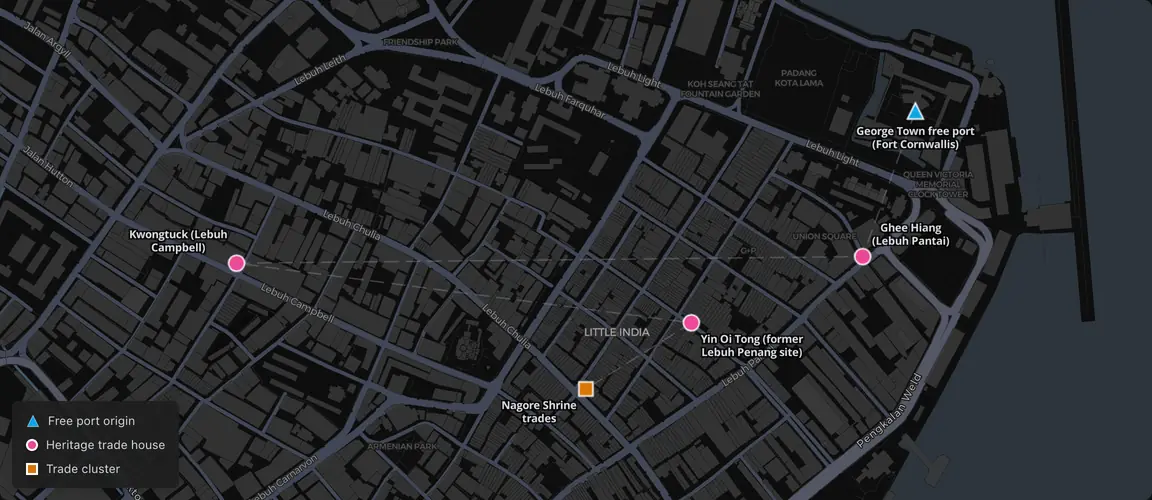
The policy that built it, the listing that unbuilt it
Haja Mohideen has made songkok by hand for most of his life, working from a narrow alcove beside the Nagore Shrine on Lebuh King. He is George Town’s last one. “It is not difficult to hand-make songkok,” he told researchers cataloguing the trade before it disappears. “What makes it difficult is to make a living.” Two streets away, a 185-year-old sundries shop went online for the first time in 2021, its fourth-generation owner learning e-commerce in his eighties. Both scenes are happening in the same 259-hectare zone that UNESCO inscribed in 2008 as a living monument to exactly this kind of trade. The listing was supposed to protect businesses like these. Instead, it helped price them out.
A free port with five owners
It is not difficult to hand-make songkok. What makes it difficult is to make a living.
George Town exists because Francis Light needed a harbor with no exclusive claims on it. In 1786, the British East India Company officer secured Penang from the Sultan of Kedah and declared it a free port — no duties, no monopoly, open to whoever showed up with goods to trade. Within a decade a Hakka medicine peddler named Koo Suk Chuan had arrived from Canton and opened a small shop on Pitt Street; his business, later known as Yin Oi Tong, would operate continuously for over two centuries. He was not alone for long. Chinese merchants came for the tin and spice trade. Malay traders worked the coastal routes they already knew. Indian Muslim traders — the community that would found Hameediyah and the Nagore Shrine trades — brought spice and textile networks from the Coromandel Coast. Peranakan families, descendants of earlier Chinese-Malay intermarriage, built commercial dynasties. Arab traders, among them the Yemenite family behind S.M. Badjenid & Son, established what would become Malaysia’s oldest perfumery.
No single community controlled George Town’s commerce, and that was the point. An exclusive port — Portuguese Melaka before it, Dutch Batavia alongside it — restricted trade to one power’s merchants and one power’s rules. Light’s free port had no such restriction, and the absence of restriction is what let five distinct trading communities build permanent infrastructure within walking distance of each other rather than compete for a single monopolist’s favor. By 1836, a Cantonese trader named Woo Fook Yin had opened Kwongtuck on Campbell Street — the founding year is approximate; one academic source places it as early as 1831, but multiple independent accounts converge on the mid-1830s. By 1856, Teng Tou Ku, a Fujian laborer, was selling pastries from a roadside stall at Weld Quay that would become Ghee Hiang. Within a single generation of Light’s declaration, the businesses that still operate in George Town today already had their shopfronts.
This is the detail conventional market intelligence misses entirely: George Town’s heritage density is not a cultural curiosity, it is a direct structural consequence of a specific 1786 policy choice. Remove the free port and you remove the reason five communities settled permanently in one compact zone instead of scattering to wherever a single colonial monopoly permitted them. The city’s most valuable modern asset — a living, walkable cluster of multi-generational, multi-ethnic family firms — was manufactured by a tax policy, not by accident.
What the free port built
By the early twentieth century, the cluster the free port had seeded was operating at genuine scale. Yin Oi Tong expanded from its original Pitt Street shop to seven shophouses along Lebuh Penang and Lebuh China, running separate retail and wholesale medicine operations — one of Southeast Asia’s most prominent traditional Chinese medicine establishments. Ghee Hiang had grown large enough that four families — the Ch’ng, Ooi, Yeap and Yeoh — jointly purchased the business in 1926 for several thousand ringgit, establishing a four-family partnership structure that would endure, strained but intact, for a century. Kwongtuck’s founding family had moved through three generations, weathering the Second World War with the shop still standing on Campbell Street.
The trades were not confined to food and medicine. Around the Nagore Shrine, the Indian Muslim community built songkok-making, textile trading, and spice merchandising into hereditary crafts, passed from father to son through direct apprenticeship rather than formal instruction. S.M. Badjenid & Son’s Arab perfumery survived a wartime destruction of its original building and was rebuilt in place — a family staying with the same address across a national catastrophe. Rattan weavers, signboard carvers, joss-stick makers, and kapok-mattress producers filled out a craft economy so dense that a 2012 door-to-door survey by George Town World Heritage Incorporated catalogued traditional trades across more than 5,000 premises.
This was the George Town that would eventually persuade UNESCO’s evaluators: not a preserved museum district, but a functioning multicultural trading economy still doing, in the twenty-first century, approximately what it had done in the eighteenth — Chinese sundry shops beside Malay craftsmen beside Indian goldsmiths beside Peranakan traders, each community’s businesses still standing in the same shophouses their founders had occupied.
None of this density was inevitable or automatic. Ghee Hiang’s four-family structure — Ch’ng, Ooi, Yeap and Yeoh, bound together since the 1926 purchase — required those families to keep cooperating across three subsequent generations, through a shared ownership arrangement that had no legal precedent to draw on and no guarantee of holding. Yin Oi Tong’s seven Lebuh Penang and Lebuh China shophouses meant seven separate leases, seven sets of staff, and a wholesale operation that depended on the same free-port import channel Kwongtuck was using two streets away — the businesses were competitors in the same trades, occupying the same zone, drawing on the same policy advantage, and neither drove the other out. That non-displacement is itself part of the free port’s structural legacy: a zone built on the absence of exclusivity kept producing outcomes without exclusivity, long after Light himself was gone.
The policy withdrawn
In 1969, the Malaysian federal government abolished Penang’s free port status. The change is barely remembered outside the businesses it hit directly, but two of the cluster’s oldest firms — independently, in unrelated interviews decades apart — identified it as a genuine structural wound. Kwongtuck could no longer import directly from China; goods now had to route through Kuala Lumpur, adding cost and time to a trade the shop had run efficiently for over a century. Yin Oi Tong’s wholesale medicine trade, which depended on direct import of Chinese herbal stock, absorbed the same blow. Neither firm collapsed. But the free port’s disappearance removed the specific mechanism that had made George Town’s location an advantage rather than merely a heritage backdrop — and both businesses spent the following decades operating despite their location, not because of it.
The abolition mattered less in the moment than it would in retrospect, because George Town’s shopfronts kept functioning through inertia and habit even after the economic logic that built them had been withdrawn. Families continued in the trades their grandparents had started because the trades were what they knew, not because the location still conferred the advantage it once had. This is the quiet middle act of the story: a cluster continuing to exist for a generation after the reason for its existence disappeared, running on accumulated momentum rather than renewed purpose. When the next policy shock arrived, the cluster had no comparable structural advantage left to fall back on.
The listing that finished the job
The next shock arrived wearing the appearance of rescue. In 2000, Malaysia repealed the Control of Rent Act, ending decades of rent controls on George Town’s pre-war shophouses. In 2008, UNESCO inscribed George Town — jointly with Melaka — as a World Heritage Site, citing its “outstanding universal value” as a living multicultural trading port and cataloguing 3,642 heritage buildings across a 259-hectare core and buffer zone. The inscription was meant to protect precisely the trade fabric this article has traced from 1786: Chinese, Malay, Indian, Peranakan and Arab businesses still operating from their historic addresses.
What UNESCO’s evaluators did not anticipate — and what the George Town case now demonstrates for any city courting the same recognition — is that heritage listing and rent decontrol arrived within eight years of each other, and together they behaved as one mechanism rather than two. World Heritage status made George Town’s shophouses desirable to boutique hotel operators and café chains willing to pay tourist-economy rents that no traditional trader could match. Decontrolled rents meant landlords were free to accept those higher bids. Academic research on the period documents, in the dry language of a peer-reviewed journal, “unprecedented capital appreciation, rent spike, and replacement of original inhabitants and their traditional trades with tourism-related businesses.” The businesses UNESCO inscribed the district to protect became, within a decade of that inscription, the businesses least able to afford to stay in it.
The numbers are not subtle. Penang Heritage Trust president Clement Liang has documented the heritage core’s resident population falling from roughly 50,000 before the 2008 listing to approximately 9,000 by 2024 — an 82% collapse in sixteen years, even as six million tourists now arrive annually to see what the residents left behind. A 2020 Penang Institute survey of fourteen historic trades during the COVID-19 lockdown found twelve calling the pandemic the worst crisis of their working lives, nine reporting zero income during the movement restriction period — a crisis that arrived on top of, not instead of, the gentrification pressure already displacing them. When Yin Oi Tong’s traditional Chinese medicine practice finally vacated its Lebuh Penang premises in 2009, it had operated at that address for 124 years. It left the year after the listing that was supposed to keep it there.
What survives, and how
Not every heritage business is disappearing, and the difference between the ones adapting and the ones vanishing is instructive. Kwongtuck’s fourth-generation owner, Woo Shee Khow, was in his eighties when the 2015 introduction of Malaysia’s goods and services tax forced him to learn a computerized point-of-sale system in English, a language he did not speak fluently — the abacus and tin cash box he had used for decades were retired that year. Six years later, in April 2021, the shop registered its first website and shifted to nationwide delivery, bridging a business older than Malaysian independence into e-commerce within the same decade its owner was learning to use a till. Ghee Hiang survived a near-fatal crisis of its own making: in 1999, litigation between second- and third-generation members of the four founding families paralyzed the company for seven years, ending only when an architect with no food-industry background, brought in to mediate, oversaw a court-ordered buyout that reduced the ownership structure from four families to two and returned production to handmade methods.
The businesses without a clear successor tell a different story. Haja Mohideen’s songkok trade has no named heir. The city’s handmade joss-stick craft passed, after its last two male practitioners died within a year of each other in 2020 and 2021, to a Thai-born daughter-in-law who now carries it alone — an unplanned succession that is either a fragile accident or the only reason the craft still exists, depending on how the next decade unfolds. A 2012 GTWHI survey catalogued traditional trades across more than 5,000 premises; the underlying research behind this article identified at least twelve of the cluster’s thirty-five most-documented heritage brands as facing acute succession uncertainty, with sole proprietors in their seventies through nineties and no confirmed next-generation operator.
What separates the survivors is not capital, cultural pride, or family size — the songkok and joss-stick trades had all three. It is whether a specific, named person was willing and able to take over a business that the surrounding economics had made structurally difficult to sustain. Haja Mohideen’s own diagnosis, delivered in the same interview that produced this article’s central quote, names the mechanism precisely: making the product by hand was never the hard part. Making a living from it, in a heritage zone whose rents now reflect its tourism value rather than its trading value, is.
The paradox George Town proves
George Town’s arc runs in a full circle that most heritage narratives never complete. A free port built a multicultural cluster because it removed the exclusivity that would have prevented it. The free port’s withdrawal in 1969 weakened that cluster by removing the trade advantage that had justified its location, though inertia carried the businesses forward for another generation. The 2008 UNESCO listing then arrived to protect what the free port had built — but by pairing recognition with a decontrolled rental market, it converted the heritage the trades represented into a commodity that priced most of the traders out of the neighborhood their ancestors had settled. Melaka, inscribed alongside George Town in the same 2008 listing, kept comparably rich colonial-era architecture. It did not retain the same density of living, operating multi-generational firms — the buildings survived there; in George Town, for now, the businesses inside them still do.
The next chapter of this specific paradox is already being written by owners in their eighties and nineties, and it will be decided within the next decade, not the next generation. Ghee Hiang and Kwongtuck found their successors. Yin Oi Tong found a way to keep its practice alive after losing its address. Haja Mohideen has not yet found his. Whether George Town’s heritage core still contains living heritage trades in ten years, or only the buildings that once held them, depends on whether the next round of family successions goes the way of the survivors documented here — or the way of the songkok maker still waiting, as of this writing, for an answer.
Researched 26 sources in English, Chinese, Malay.