 Skip to main content
Ouidah: The Port That Got Its Gods Back
For thirty years before 1727, more enslaved Africans passed through Ouidah than any other port on the continent. The town exported over a million people — and one thing it could not keep: the Vodun religion they carried. A century and a half later, that faith came home from Haiti, Brazil, and Cuba to anchor a national holiday and a EUR 449M memorial economy.
Geographic Context: Ouidah and the Atlantic Round-Trip
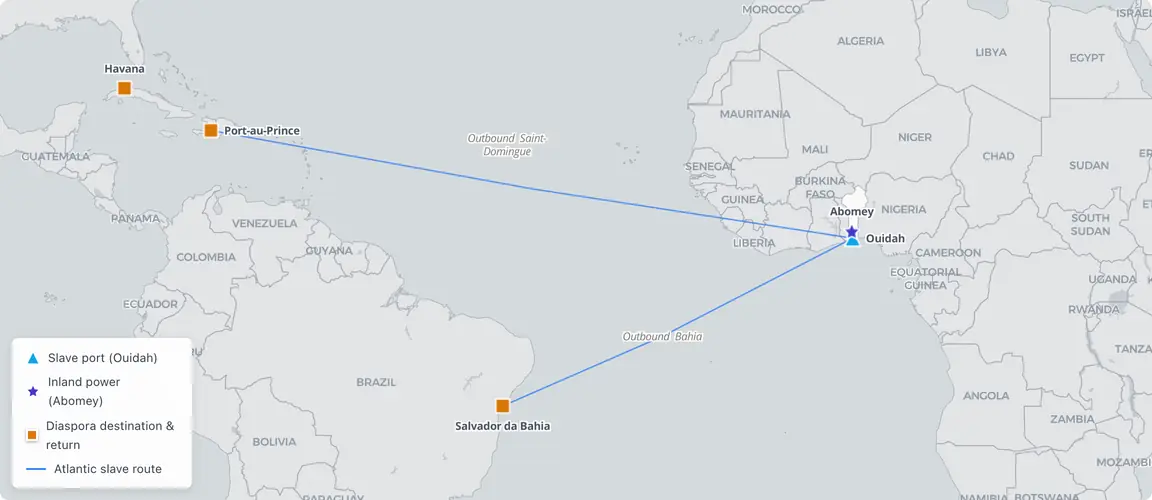
What the kingdom could not keep
For thirty years before 1727, more enslaved Africans walked through one West African town than through any other place on the continent. The town was Ouidah. They were marched four kilometres down a sandy track, past a tree they were forced to circle until they forgot where they came from, to the Atlantic surf and the Door of No Return. By the time British gunboats forced the trade to stop in the 1850s, more than a million human beings had been shipped out.
The captives carried one thing the port could not confiscate. A century and a half later, it came home.
The town that commerce built where geography forbade it
The slave trade is the ruling principle of my people. It is the source of their glory and wealth.
Ouidah should never have become a great port. It sits four kilometres inland from a violent surf-break with no natural harbour; long boats had to ferry captives through the breakers to ships anchored a mile offshore. That a place this badly sited became one of the highest-volume slave ports in human history is itself the first lesson of the story — commercial logic, when the rents are large enough, overrides geography completely.
In local tradition the town was founded in the late sixteenth century by the Hueda, an Aja people whose economy rested on lagoon fishing and farming until European demand for captives drew them toward the sea. The forts came in sequence. The English Royal African Company built William’s Fort around the 1680s. The French erected theirs in 1704. The Portuguese completed Fort São João Baptista de Ajudá in 1721, on land granted by the king of Whydah and financed by tobacco-tax revenue from Bahia. Three European powers operated fortified trading posts within walking distance of one another, each paying ground rent to a local king, each sending an annual diplomatic mission inland to the court.
The forts sat alongside something older. The Temple of Pythons, home to the royal pythons of the Hueda serpent cult, predates Dahomey’s conquest; today it stands directly opposite the Basilica of the Immaculate Conception, built in 1909. Two religious systems face each other across a single square — the visual shorthand for everything Ouidah would become. The town was a meeting point of currencies as well as creeds: Maldivian cowrie shells, shipped halfway around the world, made up roughly 44% of the payment for captives at the Bight of Benin, alongside Brazilian tobacco and cachaça, European firearms, gunpowder, and textiles.
Then, in March 1727, the inland Fon kingdom of Dahomey conquered the coastal kingdom of Whydah. The event was newsworthy enough to reach the Boston News-Letter by 19 March. Dahomey, ruled from Abomey a hundred kilometres inland, kept the three European forts but placed all commercial authority under royal officers. For the next 165 years, Ouidah was Dahomey’s engine.
An extraction machine with a state behind it
What Dahomey built was not a market. It was a state-run extraction system. Annual military campaigns into Mahi territory to the north and Yoruba lands to the east captured human beings whom the crown distributed to private merchants at the coast for export. The kingdom’s entire fiscal architecture — military pay, royal revenues, the annual ceremonies, the price of palm oil itself — assumed that captured people could be sold at Ouidah.
The most consequential figure in that machine arrived from the other side of the Atlantic. Francisco Félix de Souza, a Brazilian-Portuguese trader from Salvador, reached Ouidah around 1800. Jailed by one king over unpaid debts, he escaped, financed a prince’s coup, and was rewarded by the new King Ghezo with the title of Chacha — viceroy of Ouidah. He died in 1849 reportedly leaving fifty-three wives, more than eighty children, and roughly twelve thousand enslaved persons. The Chacha title is hereditary; the de Souza family remains prominent in Benin today, having supplied a post-independence head of state and a president of the National Assembly. De Souza is the human anchor of the story precisely because he is indefensible: a kingmaker and a slaver whose descendants govern the modern republic.
He was the most powerful member of a wider class — the Aguda, Brazilian-Beninese returnees from Bahia who built Ouidah’s Afro-Brazilian architectural quarter and whose descendants now run its museums and foundations. Some Aguda had themselves been enslaved and freed; others were slave traders. The diaspora, even at the height of the trade, was already a two-way street.
The scale of what passed through is documented, if incompletely. Ana Lucia Araujo’s analysis of the trans-Atlantic slave-trade database records roughly 16,500 captives embarked at Ouidah during one king’s reign and some 30,400 during Ghezo’s — and these are only the documented voyages. Robin Law’s authoritative 2004 history ranks Ouidah second only to Luanda among all African slave ports; more recent scholarship places it third, behind Luanda and Bonny, noting that Ouidah was dominant for a comparatively short window. The number that survives every revision is the order of magnitude: across the long arc of the trade, the Bight of Benin embarked roughly two million people, about 16% of the trans-Atlantic total, and Ouidah was the largest single port along that stretch of coast.
The route had a clear centre of gravity. From 1770 to 1850, roughly 61% of captives embarked from the Bight of Benin were sent to Brazil — overwhelmingly to Salvador da Bahia, which is why Bahia, not Lisbon or London, became the cultural counterweight to Ouidah. The eighteenth-century French trade funnelled captives to Saint-Domingue, the colony that would become Haiti. The British presence peaked early, in the 1680s to 1710s, before shifting east. Each corridor mattered less for the goods it carried out than for what it would carry back.
The forty-year squeeze
The crisis did not arrive as a single event. It was a slow tightening that ran for four decades, and Dahomey could not escape it because it had no other business.
Britain abolished its own slave trade in 1807 and slavery in its empire in 1833, then sent the West Africa Squadron to suppress everyone else’s. At the Congress of Vienna in 1815, Britain pressured Portugal to confine the trade south of the equator — a restriction Brazilian traders, de Souza among them, routinely ignored. Through the 1830s, British naval interdiction intensified while Brazilian-financed clandestine voyages continued from Ouidah to Bahia and Cuba. In 1844 Dahomey lost a war to Abeokuta, a non-slaving Yoruba refuge city that became a rival palm-oil power. The squeeze was coming from every direction at once: the navy at sea, a rival on land, and a shrinking pool of buyers.
In July 1850 Captain Frederick Forbes met King Ghezo and recorded the speech that has defined African slaver intransigence ever since: the slave trade, Ghezo told him, was “the ruling principle of my people… the source of their glory and wealth.” The mother, he added, lulls her child to sleep with songs of triumph over an enemy reduced to slavery. The line reaches us through Forbes’s English translation, not as a verbatim Fon transcript, and abolitionists put it to immediate use — but as a description of how completely the kingdom’s identity had fused with the trade, it is accurate.
This was not bravado. It was an accurate description of a trap. When the Royal Navy blockaded Dahomey’s ports in March 1851 and Ghezo signed a treaty terminating slave exports in January 1852, he simply moved the trade to neighbouring ports, then reopened Ouidah outright in 1857. Ghezo’s offer to Forbes to switch to palm oil was not a moral conversion — it was a request that Britain subsidise the transition, because Dahomey’s palm-oil production itself ran on domestic slavery. Britain refused. There was no version of the kingdom’s economy that was not slavery.
Ghezo was assassinated in 1858. His son Glele continued the trade on a reduced scale; the last documented embarkations from Ouidah came around 1860. The end was military. In the Second Franco-Dahomean War, Dahomey’s famous all-female regiment, the Agojie, was annihilated at the village of Adégon on 6 October 1892 — by the Smithsonian’s account, seventeen soldiers returned from a force of 434, most cut down by French bayonet charges against six French dead. France annexed Dahomey in 1894. Cotonou’s deep-water port, the railway, and independence in 1960 all passed Ouidah by. By the late 1940s its population had stagnated around 14,600. The Marxist-Leninist regime of Mathieu Kérékou (1972–1991) killed Vodun priests, destroyed shrines, and cut down sacred groves. Ouidah became a poor coastal town with monuments nobody visited.
What revived it was not commerce. It was the return of what had left.
Two trees on the road to the sea
The four-kilometre march from the auction square to the beach passed two trees, and the contrast between them is the whole story in miniature — though the historical exactitude here is softer than the heritage signage suggests, much of the ritual detail reaching us through twentieth-century reconstruction for the UNESCO project rather than eighteenth-century record. The symbolism, however, is durable, and it proved literally true.
Captors forced the captives to circle the first — the Tree of Forgetfulness — so that they would lose their memory of home, their names, and any will to return. It was an instrument of erasure, imposed from above. The captives answered with a counter-ritual at the second. The Tree of Return was circled so that the souls of those who died overseas would find their way back to Ouidah. One tree was the system’s attempt to sever; the other was the captives’ insistence that the severing would not hold. Today diaspora pilgrims tie ribbons at the Tree of Return bearing the names of the countries their ancestors were taken to. A ritual designed to guarantee a homecoming for the dead has become the framework for a homecoming of the living. Forced rituals, it turns out, create counter-rituals, and the counter-ritual is the one that lasts.
The cargo that could not be controlled
Here is the asymmetry the whole story turns on. Everything Dahomey exported by force, it lost. The one export it could neither keep nor kill was the religion the captives carried with them.
Vodun — the faith of the Fon and Ewe — went through the Door of No Return and refused to die overseas. In Saint-Domingue it became Haitian Vodou, and on the night of 14 August 1791 a Vodou ceremony at Bois Caïman helped ignite the revolution that produced the first free Black republic. In Bahia it became Candomblé. In Cuba it fused with Yoruba-Lucumí practice to become Santería. It syncretised with Catholic saints, found new patrons, organised resistance, and survived three centuries of colonial and post-colonial suppression — including Kérékou’s.
Then it came back. The pivot was a festival. From 8 to 18 February 1993, President Nicéphore Soglo convened the First International Festival of Vodun Arts and Cultures — Ouidah 92 — bringing practitioners from Haiti, Cuba, Brazil, and the United States to the port their ancestors had been shipped from. UNESCO launched its Slave Route Project in Ouidah in August 1994, on a proposal from Haiti. The Door of No Return memorial arch was inaugurated on 30 November 1995. In 1996 Benin made 10 January a national holiday and declared Vodun a religion of the state.
The numbers now describe an industry. Rebranded “Vodun Days” under President Patrice Talon, the January 2025 edition drew an estimated 435,000 participants over three days, according to Benin’s statistics institute. A memorial-tourism complex budgeted at EUR 449.3 million — a hotel, a life-size slave-ship replica, a Vodun performance arena — is rising at Djegbadji, financed in part by a EUR 167.37 million Bank of China loan signed in December 2019 and explicitly designed to capture diaspora pilgrimage spending. The former Portuguese fort, once the smallest colony in the world at five acres before Dahomey annexed it in 1961, is being reborn as a museum of memory and slavery. Roughly 11.6% of Beninese name Vodun as their primary religion, but tens of millions worldwide trace ancestry to it. That is leverage no Dahomean king ever held — and it derives entirely from the export the kingdom could not control.
The return is not a simple homecoming, and Ouidah’s own practitioners are careful about the language. Many distinguish sharply between local Fon and Ewe Vodun and the syncretic diaspora forms — Haitian Vodou with its Catholic saints, Cuban Santería with its Yoruba-Lucumí lineage. The reunion is less a parent receiving its children than a family of estranged cousins meeting after two centuries apart, each having become something the others would not quite recognise. The Marina Project draws its own critics, who note that a memorial to slavery is being designed largely by foreign architects and ask whether the memory of the trade is being turned into a theme park. These are real tensions. But they are the tensions of a place that has something valuable enough to argue over — which is itself the measure of how completely the asymmetry has reversed.
What you cannot own
The temptation is to read Ouidah only as tragedy. The crossroads frame reads it as a case study, because the religion forced out the Door of No Return is the clearest demonstration available of a single principle: anything extracted under coercion acquires its own agency outside your control.
The principle is not confined to the eighteenth century. A founder who fires the people who carry a company’s culture does not erase that culture; it walks out the door and reassembles inside a competitor. Engineers laid off without ceremony build the rival product and write the retrospective. A brand that exports its aesthetic into a market it cannot defend watches that aesthetic acquire a legitimacy the origin can no longer reclaim without negotiation. A recipe that leaks, a patent that lapses, a model that is copied — three years on, the diasporic version is often bigger, more refined, and embedded somewhere beyond the reach of any lawsuit. The diaspora always organises. What leaves your hands under duress does not stay yours.
But Ouidah also teaches the corollary, and it is the more useful half. The return is not zero-sum. The original can host the diaspora and become more powerful than it was alone. Dahomey ran Ouidah as an extraction engine and lost everything — the forts, the trade, the kingdom, the Agojie. Modern Benin runs Ouidah as a place of return and commands a global faith of tens of millions. The same town, the same religion, the same Atlantic routes. The difference is the direction of travel, and the recognition that the thing you could not keep is worth more when it chooses to come home than it ever was when you sent it away in chains.
Researched 19 sources in English, French.