 Skip to main content
One Million Subscribers, Zero Ad Spend
Seven years after launching a five-hundred-dollar advisory firm, Chris Devonshire-Ellis spun out a publishing subsidiary and wrote the first fifty issues. Twenty-five years later, Asia Briefing has over a million subscribers across seven regional titles — and the firm has never paid for third-party advertising.
Seven publications, nine thousand kilometres: an editorial arc no rival can replicate
Timeline
In the summer of 1999, seven years after founding a Hong Kong advisory firm on a five-hundred-dollar cheque and a misspelled surname, Chris Devonshire-Ellis sat down to edit the first issue of a magazine he would give away for free. He had no formal accounting credentials. He would personally write the next forty-nine issues. The Big 4 firms competing for the same clients watched him spend editorial time that would never bill, and drew the obvious conclusion: it was a vanity project.
The fifty issues nobody asked for
Don't borrow money. If you can keep the banks out of your business, it's called bulkhead financing.
A partner at a global firm operates on a simple arithmetic. Hours are the unit of work; clients pay for hours; hours spent writing articles are hours not billed. Content exists to support business development, which is another way of saying it must be produced efficiently and delegated down. A partner who personally writes fifty issues of anything has mismanaged their own time.
Devonshire-Ellis did not share the arithmetic. Dezan Shira had been founded on US$500. It carried no bank debt — still does not — which meant it carried no obligation to deliver the quarterly margins that partner-track firms cannot negotiate away. The founder could spend his time on whatever work he thought would matter in twenty years, because there were no capital allocators to explain it to.
The work he chose was editorial. China Briefing launched in 1999 as a free publication, aimed at the foreign investor who needed to understand why Shenzhen’s tax rate was fifteen percent while Shanghai’s was twenty-five, or how a Wholly Foreign-Owned Enterprise differed from a joint venture, or what the State Administration for Industry and Commerce would accept as a director’s home address. The content was practical and unglamorous. It addressed questions no Western business publication asked, because Western business publications were not built to maintain the relationship required to answer them well.
The first fifty issues were a statement of editorial register. The founder was signalling — to anyone paying attention — that this publication was built from inside the advisory work, not alongside it. A partner at a global firm could not have produced the same magazine, because the partner did not have the material. The material accumulated from doing the work, one client engagement at a time, and it compounded into authority only if someone was patient enough to let the archive grow.
Why the Big Four couldn’t copy it
By 2003, when SARS froze corporate travel across Asia, China Briefing had produced roughly a hundred issues. The global firms were not absent from Asian regulatory publishing — KPMG, Deloitte, EY and PwC all maintained competent client tax alerts, and several international law firms ran topic blogs. What none of them had built was the specific thing Chris had built: a free, country-branded standalone publication, written in investor-facing register rather than technical alert format, running continuously as its own title. The economic model of a global firm cannot support the editorial patience required for that shape.
Three structural problems stood in the way. The first was liability. A Big 4 firm that publishes specific regulatory guidance takes on exposure to readers who act on it — exposure underwritten by insurance at premium rates negotiated centrally. Free content multiplies reader count without multiplying client revenue; the actuarial calculation pushes toward publishing less, not more. Dezan Shira’s answer was different because the firm was small enough to know its readership and substantial enough that sophisticated readers understood they were reading general intelligence, not bespoke advice.
The second was partner economics. Content that moves a client relationship forward is valuable; content that builds a brand over decades is valuable; but only the first can be billed to a partner’s origination credits this quarter. A partner who writes extensively without billable correlation is penalised in compensation review, and the incentive ripples down. The person best placed to produce intelligence is the person least willing to spend time producing it for free.
The third was geographic patience. Global firms rotate partners through Asian assignments on three-to-five-year cycles. Institutional memory resets with every rotation. Dezan Shira’s publishing voice was, and remains, the voice of someone who stayed. Devonshire-Ellis spent seven years in mainland China without leaving; he vacationed there; he learned the language imperfectly but persistently. The magazine sounded like the work of a person who was not going to be re-posted to New York in eighteen months, and sophisticated readers heard the difference.
None of this was a shape the Big 4 chose not to pursue. It was a shape they could not choose, because pursuing it would have required restructuring their compensation model, their liability posture, and their geographic-rotation system simultaneously. Structural reform of that scope is harder than letting a smaller competitor own a category whose value is difficult to see until the decades have compounded.
The temptation to pause
Every crisis asked the same question of the publishing operation. The answer, whatever the moment’s logic, was always no.
In the early months of 2003, when SARS emptied hotel lobbies from Beijing to Singapore and corporate travel budgets collapsed within three weeks, the case for suspending editorial output was easy to make. Magazines cost money to produce; revenue from consulting engagements had stopped; a prudent operator would consolidate. Dezan Shira did not suspend. Clients who had been reading China Briefing for four years now needed it more, not less — they were making decisions remotely, from offices where their local counterparts could not travel either, and the publication was the one reference they could still count on to be current.
The same question arrived in September 2008, when Lehman Brothers collapsed and the firm’s European and American clients sharply reduced advisory spending. It arrived again in March 2020, when COVID-19 froze global business travel for the second time in seventeen years. It had arrived earliest, in 1997 — before the publishing operation had even launched, when the Asian Financial Crisis nearly destroyed the five-year-old firm. The discipline that emerged from that recovery, to protect cash-flow services and maintain reserves, is what later made the editorial investment defensible through every subsequent shock.
What distinguished Dezan Shira was not the absence of temptation but the absence of a mechanism by which temptation could prevail. The firm carried no bank debt, answered to no external capital, and operated on a flat partnership structure that did not force any individual partner’s income statement to absorb editorial overhead as a discretionary line. When a crisis hit, there was no treasury meeting at which publishing could be cut because there was no treasury meeting. The decision was the founder’s, and the founder had decided in 1999 that the archive was the point.
This turned out to be a structural advantage the Big 4 could not acquire at any price. Their editorial operations, where they existed at all, sat on budget lines that senior management reviewed annually. Every review produced the same quiet pressure to reduce. Continuous output, year after year, through every economic shock, required an organisational form that did not exist inside a global partnership of forty thousand professionals.
The February 2020 op-ed illustrated the principle in its purest form. On the third day of what would become the COVID-19 pandemic, China Briefing published a piece drawing explicit parallels to SARS in 2003 — specific observations about supply-chain rebound patterns, provincial re-opening sequences, and the rhythm by which Chinese factories had previously recovered from epidemic shutdowns. The piece was unpolished and fast. It was also, on February 3rd, one of the only English-language analyses that did not treat the outbreak as unprecedented. Readers who needed operational guidance that week found it in a publication that had been building the relevant archive since 1999. That alone is what made the editorial continuity valuable — and what made it unbuildable in the panic of the moment.
Twenty-five years of writing into a market
The 1997 Asian Financial Crisis had taught Devonshire-Ellis a discipline he carried into every subsequent shock: protect the operating model, regardless of what the operating environment does. Thailand’s baht devaluation in July 1997 had wiped out nine months of projected income at a five-year-old firm; recovery came through cash-flow services and reserves, practices the firm has maintained since. Publishing survived the crisis because the firm’s balance sheet survived it.
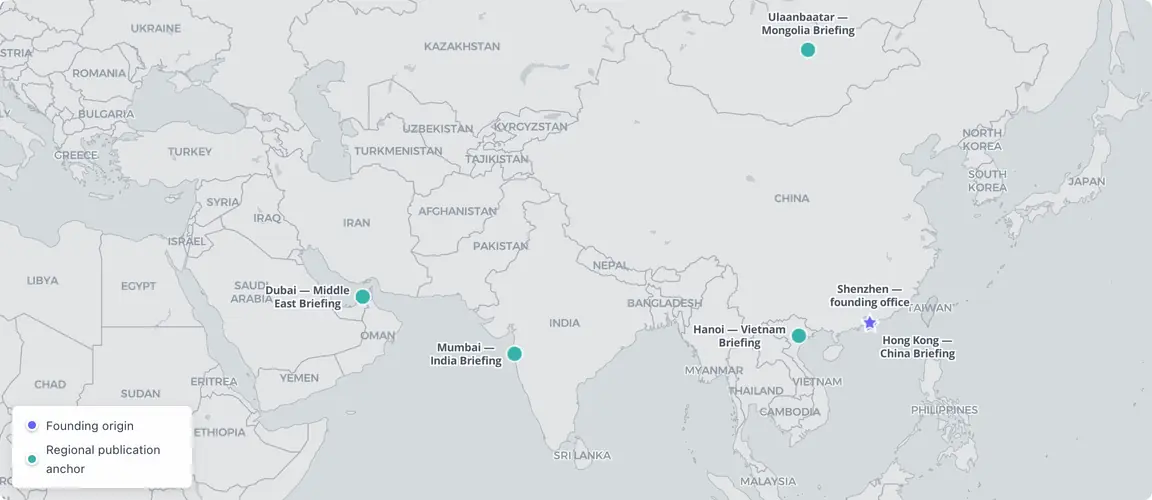
The same discipline carried the publishing operation through SARS in 2003, the Global Financial Crisis in 2008, COVID-19 in 2020, and the US–China trade war that began in 2018 and has not ended. Every shock tempted the rational business decision to pause editorial investment. Dezan Shira did not pause. The publishing operation expanded — into India and Vietnam in 2007 and 2009, into ASEAN in 2013, into the Middle East in 2022 — each new regional title launched roughly concurrently with the firm’s physical expansion into the same territory.
The pattern was not accidental. Middle East Briefing went live alongside the Dubai office in 2022, which meant reader relationships were forming with Gulf-based businesses months before the advisory practice was fully staffed. Mongolia Briefing preceded the Ulaanbaatar office by years. By the time a client in the region needed professional advice, the publication had already established a voice they recognised. Market entry had been pre-paid in editorial labour.
What this produced, compounding quietly over two decades, was a corpus of regulatory, tax and compliance writing that no competitor could assemble from a cold start. Over a hundred books. Over a thousand magazines. Seven regional publications — China Briefing, India Briefing, Vietnam Briefing, ASEAN Briefing, Middle East Briefing, Silk Road Briefing, Russia Briefing — each with its own editorial calendar, each covering provincial and jurisdictional detail absent from the Asian coverage of every global news organisation. Subscribers now exceed one million. In twenty-five years, the firm has not paid a single third party for advertising; the publication network is the entire top-of-funnel.
An incumbent evaluating whether to replicate this archive faces an unforgiving calculation. Starting from zero today, with perfect execution, the earliest a competitor could reach parity is 2049. Nothing about Asia Briefing’s reach rests on technology a rival could license or copy; it rests on twenty-five years of continuous publication that cannot be compressed into fewer years. Time is the one input capital cannot buy back.
What accumulates
In 2015, Asia Law Portal named Devonshire-Ellis first on its annual list of people to watch in Asia-Pacific legal commentary — the citation pointing explicitly to Dezan Shira’s publications as the reason he was worth watching. Four years earlier, Accountancy Age had profiled him among ten of “China’s leading lights,” alongside the Big 4 China chairs and senior Chinese accounting regulators. He was the only non-accountant on that list. He held no formal accounting credential. The qualification that underpinned both recognitions was the archive itself.
This is the deepest insight of the terrain. In markets where Western credentials carry limited weight — because the credential bodies evolved around Western regulatory systems and translate imperfectly into emerging-market practice — the substitute is demonstrable engagement. A Chartered Accountant designation persuades a London institution; it persuades a Jakarta tax bureau rather less. What persuades in Jakarta is evidence of sustained attention. Sustained attention is what a twenty-five-year publishing archive looks like when viewed from the outside.
Reader relationships compound even more slowly than the archive itself. A foreign investor who begins reading China Briefing in 2005 to understand a VAT refund procedure does not become a client in 2005. They become a client in 2018, when their firm decides to establish a Wholly Foreign-Owned Enterprise and they remember, at the moment of decision, a publication they have trusted for thirteen years. The trust is the asset, and the publication is the vehicle by which trust was built.
Competitors examining the reach — more than a million subscribers, twenty-five years without a third-party advertising spend — see a distribution statistic. The number is misleading. The relevant metric is not how many people read Asia Briefing in any given year; it is how many of them have been reading it for seven years, for twelve years, for twenty. Those are the readers who become clients, and that cohort is not buildable in less time than it took to build.
Consider the mechanics by which a reader becomes a client. A compliance officer at a mid-sized German industrial firm begins reading China Briefing in 2010 because her employer is setting up a representative office in Shanghai and her incumbent advisor has provided guidance she cannot verify. She subscribes quietly; the publication becomes part of her monthly reading. She forwards articles to colleagues when regulatory changes affect ongoing engagements. Her trust in the editorial voice accumulates without a single commercial transaction taking place.
In 2016, her firm decides to acquire a minority stake in a Chinese supplier, and she needs counsel on the structure. She does not issue a request-for-proposal to advisory firms; she writes to the editorial inbox at China Briefing asking whether the publisher handles advisory work in this area. The advisory relationship begins from an editorial relationship that is six years old. Her firm’s retention pattern lasts through 2024, bridges the pandemic, and expands into India Briefing reading when a second subsidiary opens in Bangalore. No business-development conversation, no pitch deck, no procurement process — only a publication that had made itself trusted one month at a time.
This is the mechanism Asia Briefing was built to operate. It cannot be compressed. A competing firm that launched a similar publication in 2020 would, in the most optimistic case, be generating comparable client-flow in 2030. By that point Dezan Shira will have accumulated thirty-one years of archive. The gap widens faster than it can be closed.
The archive as territory
The question sophisticated investors now ask about founder-owned advisory firms in emerging markets is the wrong question. They ask about revenue multiples, partner retention, and billable utilisation — metrics borrowed from the global-firm playbook. The metric that actually predicts durability in these markets is content authority. Does the firm have an archive? How deep is it? Is the editorial voice the founder’s, or has it been delegated to juniors whose tenure is measured in quarters?
Dezan Shira is not the only founder-owned advisory firm to have grown through editorial patience, but it is the firm that has done so most visibly and for the longest period. The pattern — free intelligence as client acquisition, archive depth as durable advantage, founder voice as editorial anchor — is legible wherever the credential-based incumbent model fails to translate. It has shown up in regional law firms in the Middle East, in tax advisory shops in West Africa, in consulting practices in Southeast Asia whose founders have spent years paying attention in public.
What the 1999 bet demonstrates, twenty-five years on, is that a brand depreciates and a credential does not travel, but an archive accumulates. It grows by one issue at a time. Competitors cannot scale it by spending more, because they cannot get back the years they did not spend writing.
The founder who recorded “Five Minutes English” segments for Shenzhen local radio in 1992 to supplement startup income understood, without needing to theorise it, that attention was the scarce resource. He has spent the twenty-five years since then paying it, in public, in print. A million subscribers and twenty-five years without a paid ad are the receipt.