 Skip to main content
Mongolia's Natural Beauty Sector
From yak milk proteins and sea buckthorn surviving -40°C winters, Mongolia transforms centuries of nomadic skincare tradition into EU-certified organic brands. A landlocked nation between Russia and China building with botanicals no coastal competitor can replicate — yet a sector the global beauty industry hasn't discovered.
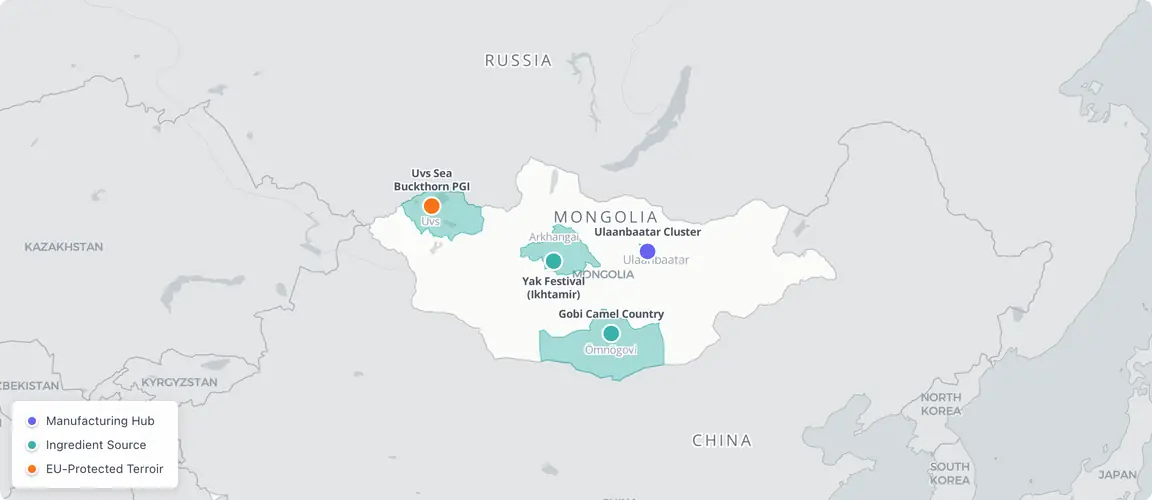
From steppe to shelf — Mongolia's ingredient geography
Brand Distribution
From kitchen table to export grade
In 1989, a Czech-trained chemist rented a room in Ulaanbaatar, hired three employees, and began producing 150 liters of shampoo a day on a food-grade mixer. Mongolia had one type of soap. ‘Doctor Una’ — who would go on to publish the country’s first cosmetics textbook and achieve its first cosmetics export to Japan — was building a private industry in a country that had suppressed traditional botanical knowledge since 1924 and had no domestic quality standards at all. Thirty-seven years later, the sector she pioneered still registers as a rounding error in global beauty trade databases. What those databases miss: a cluster of EU-certified organic brands building from -40°C sea buckthorn, high-altitude yak milk, and Gobi botanicals that no coastal competitor can source.
The knowledge Stalin couldn’t erase
Mongolia’s natural beauty sector descends from survival necessity, not vanity. The Secret History of Mongolia (Монголын нууц товчоо, 1240 CE) documented medicinal plants—sea buckthorn, wild herbs, artemisia—used by nomadic herders whose livelihoods demanded functional skincare in climates swinging from -40°C winters to +40°C summers. Traditional Mongolian Medicine, influenced by Tibetan Buddhism and Indian Ayurveda after the 16th century, formalized over 400 medicinal plant species into pharmacopeia transmitted through monasteries. The core innovations were portable, multipurpose ingredients from livestock: yak butter for cracked nipples and frostbite, sheep tail fat (high in omega-3 and fat-soluble vitamins A/D/E/K) as moisturizer during Tsagaan Sar festivals, camel milk roasted into facial powder for Gobi herders, and fermented mare’s milk (airag) as probiotic health drink.
The Soviet era (1924–1990) nearly erased this knowledge. Stalinist purges destroyed 700 monasteries in the 1930s—the institutional repositories of medical and botanical expertise. Traditional practices were reframed as “folk medicine” or banned outright as religious superstition. For 70 years, Mongolia produced a single type of soap under centralized planning. Nomadic herders preserved family knowledge orally, but an entire generation grew up disconnected from traditional remedies.
The 1990 Democratic Revolution catalyzed cultural revival: protesters used traditional Mongolian script as symbolic rejection of Soviet Cyrillic, Genghis Khan (Чингис Хаан) was rehabilitated as national hero, and monasteries reopened. Mongolia’s modern cosmetics industry, however, began earlier than most accounts suggest — in 1989, when Czech-trained chemist “Doctor Una” started MonCream with three employees, a rented room, and a food-grade mixer producing 150 liters of shampoo per day. She would go on to publish Mongolia’s first cosmetics textbook and achieve the country’s first cosmetics export to Japan — surviving what she describes as 268% inflation after Soviet collapse. The organic revolution came later: in 2014, Goo launched Mongolia’s first modern organic skincare line, followed by Lhamour (Лхамур) in 2014.
The 2019 formation of the Mongolia Cosmetics Cluster—backed by EU TRAM funding—marked international validation. The EU’s later recognition of “Uvs (Увс) Chatsargana” (sea buckthorn) as Mongolia’s first Protected Geographical Indication (~2022-2024) legitimized what grandmothers had known for centuries: extreme climate produces extraordinary botanicals.
From the steppe to the shelf
Mongolia’s natural beauty sector follows a classic nomadic-to-urban value chain: rural aimags (provinces) supply raw ingredients while Ulaanbaatar (Улан-Батор) handles manufacturing, formulation, and export coordination. This geographic logic reflects both heritage (herders in traditional grazing lands) and modern economics (production requires infrastructure unavailable outside the capital). The result: the majority of industry activity concentrates in Ulaanbaatar, but the sector’s authenticity depends on sourcing from extreme climate regions where -40°C winters and 250+ sunny days produce botanicals with concentrated bioactive compounds.
Ulaanbaatar anchors the sector’s commercial activity. The capital is where Lhamour, Gilgerem, Goo, and Helen Botanical Beauty maintain headquarters, conduct formulation work, and manage export logistics through Chinggis Khaan International Airport. EU TRAM funding established cluster offices here, providing shared infrastructure for organic certification, stability testing, and export documentation — resources no single rural province could sustain alone.
The ingredient heartland lies further out. In the Khangai Mountains, Arkhangai province’s high-altitude pastures produce yak milk with exceptional fat content; Lhamour sources directly from family farms in Ikhtamir soum, where the annual Yak Festival has preserved traditional herding culture through decades of Soviet interruption. To the west, Uvs province holds Mongolia’s most significant sea buckthorn territory — a landscape of wild thickets and cultivated rows that earned the EU’s Protected Geographical Indication (~2022-2024) for “Uvs Chatsargana,” and supplies Gilgerem and Goo with an ingredient whose provenance now carries legal protection. Övörkhangai, anchored by the UNESCO-listed Orkhon Valley, adds yak products and sea buckthorn grown along the Ongi River, where replanting programmes begun in 2004 to combat desertification have quietly created another ingredient corridor.
South of all of this, Ömnögovi opens onto the Gobi Desert — Bactrian camel country, where desert plants evolved extreme hardiness under conditions that temperate competitors cannot replicate. Further north and west, the remaining provinces contribute in quieter ways: Khövsgöl’s northern herders supply yak and reindeer products, Khovd adds farmed sea buckthorn, and Bulgan provides wild herbs — a dispersed network of small suppliers whose cumulative contribution gives Mongolian formulations their geographic range.
The hidden market story
Reality vs. perception
Mongolia produces natural beauty products drawing on over two millennia of documented botanical heritage and EU-recognized Protected Geographical Indications. Yet 99% of global beauty industry stakeholders have never heard of Mongolian skincare. When international buyers think “natural beauty origins,” they default to France (prestige), New Zealand (purity), Korea (innovation), or Iceland (exotic). Mongolia doesn’t register—despite authentic nomadic heritage narratives, extreme climate ingredients unavailable elsewhere, and EU-certified organic credentials.
The perception gap creates absurd disconnects: Mongolian brands export raw sea buckthorn oil to China and Korea, which return it as finished cosmetics dominating Mongolia’s domestic market. Lhamour—Mongolia’s most sophisticated exporter with a Forbes 30 Under 30 founder, Amazon US presence, and distribution across Asia and Europe—exemplifies both the sector’s quality and its invisibility. Even within Mongolia, a Czech-trained chemist had been formulating cosmetics since 1989 while the sector remained internationally unknown.
Why hidden: Five overlapping barriers
Geographic Isolation: Landlocked between China and Russia, Mongolia faces higher export costs than coastal competitors. No direct sea access means rail through Russia (Trans-Mongolian Railway) or road/rail through China (Zamyn-Uud/Erenhot ports). International buyers default to familiar sourcing hubs with established logistics.
Language Barriers: Most brand websites, government reports, and industry data exist in Mongolian or Russian. English content is limited and often poorly translated. International analysts researching “Asian natural beauty” focus on India, Korea, Japan—Mongolia requires active language excavation that major research firms don’t undertake for a market this size.
Soviet-Era Knowledge Suppression: 70 years (1924–1990) of forced cultural erasure destroyed institutional knowledge transmission. The 700 monasteries purged in 1937 were Mongolia’s “universities” of botanical medicine. Post-1990 revival depends on oral traditions from aging elders—creating a documentation gap where grandmothers’ remedies lack the published research that Western buyers trust.
Analyst Blind Spot: Mongolia’s market is too small for major research firms to track granularly. Statista lumps Mongolian data into “Asia-Pacific” aggregates. Mongolia’s company data is nearly invisible on international transparency platforms. Without analyst coverage, investors don’t discover Mongolia even exists as a beauty origin.
Geopolitical Complexity: Trapped between authoritarian neighbors (Russia, China), Mongolia faces perception challenges. Western buyers worry about sanctions exposure, currency volatility, and political risk. The “Third Neighbor Policy” diversifying toward US/EU is unknown to most international stakeholders.
The gap
These barriers mean the brands exist but the buyers haven’t found them yet. Mongolian brands carry frontier market valuations that bear no relationship to the quality of their products or the authenticity of their heritage.
Building supply chains from scratch
Lhamour founder Davaadorj’s first challenge was not formulation — it was finding suppliers in a country where quality standards for cosmetics did not exist. No safety laws, no ingredient purity testing, no certification infrastructure. EU organic compliance required documentation that herders had never needed: harvest dates, processing methods, contamination controls.
The breakthrough came at the Yak Festival in Arkhangai province. Davaadorj met herders from Ikhtamir soum producing milk at high altitude, where the harsh climate forced yaks to develop exceptional fat content for survival. But convincing herders to document production for EU inspectors required translating between incompatible worlds. Traditional knowledge transfer was oral, seasonal, empirical. EU certification demanded written protocols, batch tracking, stability testing. Herders initially resisted: “We have made yak butter this way for centuries. Now you want paperwork?”
Davaadorj spent months building trust, showing herders that EU certification could command price premiums — transforming bureaucratic burden into market access. By 2016 she had established Mongolia’s first certified organic dairy supply chain for cosmetics. Uvs province’s sea buckthorn presented a different challenge: local processors used Soviet-era equipment that introduced contamination banned by EU standards. Davaadorj funded upgrades, betting that “Uvs Chatsargana” terroir would justify the investment. The EU’s recognition of Uvs sea buckthorn as Mongolia’s first Protected Geographical Indication (~2022-2024) validated that bet. Geography itself was the structural advantage.
She was not building alone. Across the emerging cluster, other founders were solving parallel problems — by 2018, certified organic supply chains stretched from Gobi camel herders to northern yak producers to western sea buckthorn cooperatives.
When Forbes recognition felt like failure
By 2020, the sector’s most visible brand had achieved what looked like success. Lhamour held EU organic certification, had built supply chains across Mongolian provinces, and grown to more than 50 employees at its Ulaanbaatar production facility. International recognition had arrived: Forbes 30 Under 30 (2017), Most Responsible SME in Asia, Amazon US distribution.
But the domestic market told a different story. Korean imports dominated urban Ulaanbaatar — K-beauty sheet masks, cushion compacts, Chinese mass brands at a fraction of the price owned the vast majority of Mongolia’s cosmetics market. Forbes recognition generated press coverage but not profitability. Amazon US provided credibility but minimal sales.
This was not one brand’s problem. It was a sector-wide pattern. MonCream had survived three decades of it — Doctor Una had been making cosmetics since 1989, weathering what she recalls as 268% inflation when GDP contracted by a third, publishing Mongolia’s first cosmetics textbook, achieving the country’s first cosmetics export to Japan. Three decades of pioneering, still invisible internationally. Other founders faced the same economics — ambitious expansion followed by brutal contraction as frontier market reality imposed discipline.
Around 2018–2019, the existential question crystallized: were these founders building sustainable businesses, or expensive proofs of concept that international buyers would never discover?
The formation of the Mongolia Cosmetics Cluster in November 2019 — backed by EU TRAM funding — marked a strategic pivot. If individual brands could not achieve distribution scale alone, perhaps collective action under the “Out of the Green” export brand would work. Shared booth costs at European trade shows (Vivaness, Cosmoprof, Bio Fach), centralized certification expenses, coordinated government advocacy — the cluster model acknowledged what everyone had learned: competing against Korean conglomerates alone was impossible.
But pooling resources did not solve the fundamental problem: international buyers still did not know Mongolia existed as a beauty origin.
What changed between 2019 and 2025
The breakthrough was not dramatic — no single viral moment or major acquisition. Instead, persistence compounded into credibility.
The Mongolia Cosmetics Cluster’s maturation from 2019 to 2025 built infrastructure that individual brands could not create alone. Under the coordination of Battsetseg Chagdgaa (who managed Gilgerem while chairing the cluster), the “Out of the Green” collective brand centralized resources for European trade shows, shared ISO 16128 organic certification costs, and provided a unified voice for government advocacy. By 2022, cluster members were exhibiting at Vivaness (Nuremberg), Cosmoprof (Bologna), and Bio Fach — building relationships with EU specialty retailers who had never heard of Mongolia. By 2024, a second German storefront opened in Freiburg, proof that repeat orders were following initial curiosity.
The EU’s commitment deepened. When the TRAM project concluded in 2021, the successor ITDM project continued with fresh funding and a mandate running through 2027 — signaling that Brussels saw Mongolia’s cluster as a long-term investment, not a one-off experiment. GSP+ utilization by Mongolian exporters improved meaningfully between 2023 and 2024, evidence that the trade preference infrastructure was being used more effectively.
But real validation came from buyers organically discovering Mongolian brands. Lhamour’s Amazon US presence — initially generating minimal sales — began converting as sustainability-conscious consumers researched ingredient sourcing. The “Uvs Chatsargana” PGI recognition gave EU buyers legal validation of terroir authenticity. Specialty retailers in Taiwan, South Korea, Hong Kong, Singapore, and Belgium began stocking Mongolian brands not as frontier-market charity but because extreme climate botanicals offered differentiation their shelves lacked.
Meanwhile, some brands had quietly reached international retail shelves through paths entirely outside the cluster — demonstrating that commercial scale was achievable independently when product quality was undeniable.
New tensions emerged alongside the progress. The World Bank’s reclassification of Mongolia as upper-middle-income in 2025 introduced GSP+ graduation risk — the very trade preferences enabling duty-free EU access could expire post-2027. And the dissolution of GASI (the General Agency for Specialized Inspection) created regulatory ambiguity, with the sector building international credibility while the domestic regulatory ground shifted beneath it.
The sector’s builders had moved from testing whether the model worked to documenting how fast it could scale.
What beauty meant in a nomadic world
Not vanity — function
In traditional Mongolian culture, “beauty” was inseparable from health and social function. Homemade yogurt brightened skin for special occasions—not from vanity, but because appearance signaled vitality and marriageability in sparse nomadic communities where first impressions determined alliances. Sheep tail fat, rendered during Tsagaan Sar (Lunar New Year) when families slaughtered the fattest sheep, was applied to skin as both celebration and preparation for harsh spring winds. Women who used these traditional methods were noted for “beautiful skin”—a marker of following ancestral wisdom and having access to quality livestock products, thus signaling family prosperity.
Today, ingredients like yak milk and sea buckthorn serve as identity anchors in a rapidly urbanizing society. Ulaanbaatar (46% of population) faces severe pollution (PM2.5 levels rival Beijing), imported fast fashion, and South Korean beauty standards introduced via K-dramas in the late 1990s. For the vast majority of the domestic market, “beauty” means Innisfree sheet masks, Etude House cushion compacts, and Chinese mass market skincare.
Two generations, two traditions
Indigenous traditions remain strongest in rural aimags where over half of Mongolians live. Herders still apply yak butter for cracked skin, drink airag for immune health during June-October milking season, and harvest wild sea buckthorn for winter vitamin supplementation. This knowledge transfer—grandmother to granddaughter, herder to herder—operates outside formal education systems. However, as Mongolia’s median age is 28 and youth migrate to Ulaanbaatar for jobs, the window for documenting elder knowledge is closing. Several brands race to formalize recipes before the last generation with unbroken transmission from pre-Soviet times ages out.
Urban youth view traditional ingredients through competing lenses: some embrace heritage as differentiator from Korean beauty conformity (Lhamour’s Forbes recognition repositioned “nomadic skincare” from backward to aspirational), while others see grandmother’s remedies as primitive compared to “scientifically advanced” K-beauty. The EU’s PGI recognition (~2022-2024) for Uvs sea buckthorn validated that traditional ingredients have international cachet, shifting perception among educated millennials.
The choice each founder makes
The sector navigates constant tension: honor ancestral knowledge or adopt Western formulation science? Brands resolve this differently — some lean into heritage formulations rooted in generational knowledge, others bridge both worlds through traditional ingredients with modern stability testing, still others emphasize EU compliance over folklore. This spectrum reflects broader Mongolian identity struggle: celebrate Genghis Khan legacy or integrate with global modernity?
Government support signals beauty as national priority—Ministry of Food, Agriculture and Light Industry signed Memorandum of Cooperation with Cosmetics Cluster (November 2019), National SME Development Program (2019–2022) targeted beauty alongside cashmere and leather as export sectors. However, support is inconsistent: as of 2023, Mongolia still has no beauty product safety law. This reflects gender dynamics—beauty is women-dominated (most founders and employees are women) in a parliament that’s 87% male. Policymakers deprioritize regulatory frameworks for “women’s industries.”
What outsiders miss
International buyers assume “nomadic heritage = unsophisticated formulation” and “extreme climate = contamination rather than potency.” They miss that Mongolia’s pristine environment (3.3M people across 1.56M km², minimal industrial pollution) produces ingredients with bioactive compound concentrations unavailable in temperate climates. Sea buckthorn with significantly elevated vitamin C concentration reflects evolutionary adaptation to -40°C winters and 250+ sunny days of UV exposure—conditions temperate climates cannot replicate. When herders supply sheep oil to cluster brands, they describe it as “something to be proud of”—a reversal from Soviet-era stigma where traditional practices were “backward.” Outsiders reduce this to “exotic ingredients”; Mongolians see it as reclaiming cultural identity after 70 years of suppression.
Why now
Structural conditions in 2025–2026
Global Natural/Organic Beauty Growth: The worldwide natural and organic beauty market continues rapid expansion. Consumers actively seek novel ingredient origins beyond saturated French and New Zealand narratives.
Ingredient Innovation Premium: Beauty buyers pay premiums for unique botanicals with provenance stories. Extreme climate ingredients command higher wholesale prices than commodity oils. Mongolia’s terroir differentiation strengthens as “clean beauty” consumers research ingredient sourcing.
Geopolitical Diversification: US-China tensions pressure supply chains. Mongolia offers a politically neutral alternative to Chinese ingredients and Korean formulations. “Made in Mongolia” signals exotic yet safe origin for Western buyers navigating trade wars.
2025–2026 catalysts
EU GSP Status: Mongolia’s Generalized System of Preferences status provides duty-free export of cosmetics to EU markets. The World Bank’s 2025 reclassification of Mongolia as upper-middle-income introduces GSP+ graduation risk post-2027.
Cluster Maturation: Mongolia Cosmetics Cluster’s track record since 2019 now demonstrates proven EU export capability. Members collectively exhibit at Vivaness, Cosmoprof, and Bio Fach with shared booth costs. The cluster has evolved from experimental collective to established industry association with group purchasing power. A second German storefront in Freiburg (2024) documents repeat demand beyond initial novelty.
EU Commitment: The successor EU ITDM project continues the work TRAM began, with a mandate running through 2027 — a documented signal of sustained European institutional commitment to the sector’s development.
Regulatory Flux: The dissolution of GASI created regulatory ambiguity. The sector has built international certification while the domestic regulatory ground shifted beneath it.
Heritage Documentation: Elders with pre-Soviet knowledge transmission are aging. Several brands have moved to document traditional formulations as part of that generational transition.
Structural conditions favoring established producers
The number of export-ready producers documented so far remains small: six EU-certified brands across the cluster since 2019. Buyers who have already established direct relationships with these producers hold agreements predating any broader “Mongolian beauty” market recognition. The GSP+ status, in place since 2005, has not yet been altered by the 2025 reclassification — the graduation risk applies to a future date (post-2027), not a present condition.
The current moment is one where quality has been documented — EU organic certification, a Protected Geographical Indication — while awareness of the sector outside a small buyer circle remains minimal.
What thirty-seven years of invisible work built
Mongolia’s natural beauty sector is a rounding error in global beauty trade. But it represents what Brandmine exists to illuminate: exceptional quality hidden from international audiences by language, geography, and analyst blind spots.
The story here is not one founder’s — it is an entire sector of founders making decade-long bets in impossible conditions. “Doctor Una” has been making cosmetics since 1989, surviving economic collapse, publishing the country’s first cosmetics textbook, achieving the first export to Japan — 37 years of pioneering still largely invisible beyond Mongolia’s borders. Dr. Baatar brings a 500-year lineage of traditional medicine healing, a heritage that dwarfs the “since 2014” narrative most analysts attach to this sector. Davaadorj at Lhamour bet her Columbia career on yak milk and -40°C sea buckthorn. A dozen other founders each chose to build in a market that every conventional metric said to avoid.
A landlocked nation between authoritarian neighbors has built EU-certified organic beauty brands from nomadic ingredients despite having no domestic quality laws.
The structural discount Mongolia’s beauty brands carry reflects geography, not quality. Buyers who source from Korea or France while these certified organic supply chains remain undiscovered are paying for marketing rather than provenance. The knowledge captured from elder practitioners — grandmothers’ remedy by grandmother’s remedy, harvest by harvest — is not easily reconstituted; it is being documented now, by founders who recorded its value before the global beauty industry took notice.
The EU has validated that Mongolia’s extreme climate terroir produces extraordinary botanicals — the Uvs Chatsargana Protected Geographical Indication is the legal record of that finding. What the cluster’s next phase documents is what else exists in systematically overlooked markets, still unrecorded.