 Skip to main content
Melilla: The City That Outlasted Every Ruler
On 17 September 1497, a Spanish captain occupied a ruined North African port without a fight. Five hundred years, seven ruling powers, and at least six sieges later, that same rocky peninsula still trades — the only sheltered harbour on an otherwise harbourless coast, still being fought over, still open for business.
Melilla: The Only Harbour on a Harbourless Coast
Trade timeline
Pedro de Estopiñán landed on 17 September 1497 with a small force under the Duke of Medina Sidonia and found almost no one to fight. The city he was sent to conquer had spent two centuries being fought over by the Kingdoms of Fez and Tlemcen until nobody had the will left to hold it — he occupied a ruin. Five hundred years, seven ruling powers, and at least six sieges later, that same rocky peninsula on Africa’s Rif coast is still Spanish, still trading, and still being fought over.
It is one of the very few genuine multi-civilizational trade crossroads still operating today, rather than sitting in a museum case. Once, the medieval geographer al-Bakrī reportedly described it as an ancient and prosperous town enclosed by walls — centuries before Estopiñán ever arrived.
Why nobody has heard of it
the worst defeat ever suffered by the modern Spanish Army
Melilla should be famous. It is one of Europe’s oldest continuously held overseas territories — Spain has controlled this patch of North African coast since before the word “Reconquista” had finished meaning anything, since before Columbus’s second voyage, since before most of the Americas had been mapped. A city with 2,600 years of continuous port activity, four documented faith communities, and a fortified old town sitting beside one of the largest concentrations of Art Nouveau architecture outside Barcelona ought to be a fixture of world-history syllabi. It is not.
Three forces buried the story. Geography did the first part: Tangier, thirty kilometres up the coast, commanded the Strait of Gibraltar itself and became Morocco’s glamorous, cosmopolitan diplomatic capital — an International Zone from 1923 to 1956, a magnet for spies, writers, and money. Melilla never rivalled it. Ceuta, Spain’s other North African enclave, held the superior deep-water position directly opposite Gibraltar. Melilla was always the junior sibling in prestige, if not in survival.
Politics did the second part, and it is the more damning reason. On 17 July 1936, the military uprising that became the Spanish Civil War was launched from Melilla. The first Nationalist concentration camp in that war opened in the city three days later. A place that might have marketed itself as a living trade museum instead became, in the national memory, the birthplace of a catastrophe — an origin point better forgotten than promoted.
Diplomacy did the third part, and it is still doing it. Morocco maintains a standing sovereignty claim over Melilla, as it does over Ceuta. The cities were never placed on the United Nations’ decolonisation list; Spanish sources call Melilla an autonomous city, and Moroccan and Arabic-language sources — Al Jazeera’s own encyclopedia among them — consistently render the same territory as محتلة, “occupied.” A place with a live, unresolved sovereignty dispute is a hard place to market as heritage tourism. Easier, for both governments, to let it stay quiet.
The scarcity that made it valuable
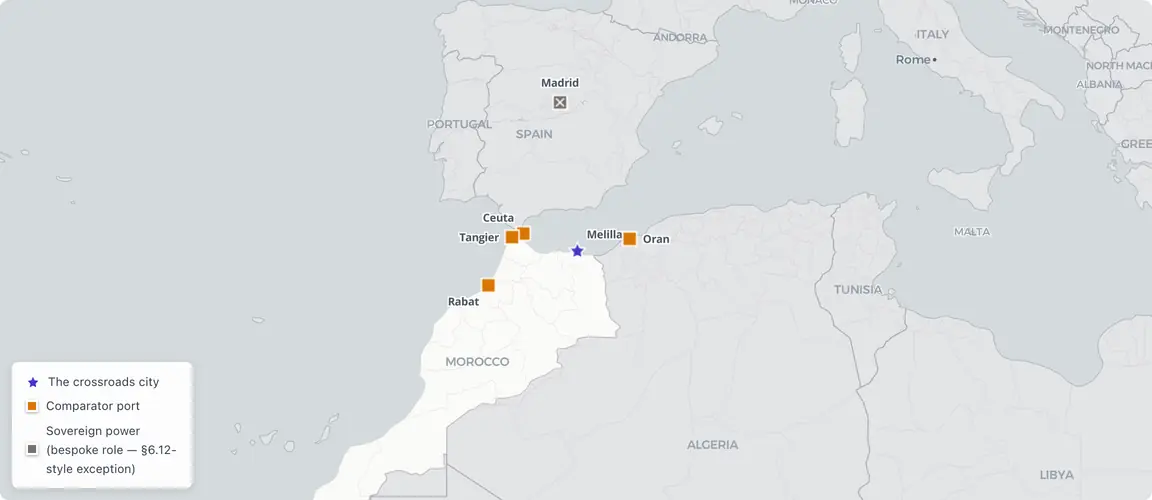
The reason any of the seven ruling powers bothered is written into the coastline itself. Melilla sits on the Tres Forcas peninsula, a headland thrusting roughly forty kilometres into the Mediterranean. On either side of it, the Rif coast is mountainous, harbourless, and was — for most of recorded history — controlled by fiercely independent tribal confederations that no outside power fully subdued. Between Tetuán in the west and the Algerian frontier in the east, Melilla’s anchorage was the only reliable maritime outlet the entire stretch offered. Whoever held this one rock held the only door onto an otherwise closed coast.
That scarcity, not scale, is the whole explanation for the sieges. Phoenician traders found the site in the 7th century BCE and called it Rusadir; archaeologists have confirmed a Carthaginian trading factory here, backed by a necropolis on the Cerro de San Lorenzo and a coin bearing a bee, ears of grain, and the legend “Rusadir.” Rome absorbed it into Mauretania Tingitana around 42 CE; Pliny and Ptolemy both cite it in passing as a working port. In 927, Abd al-Rahman III’s Umayyad Caliphate of Córdoba took the town and fortified it, and it was prosperous enough by then for al-Bakrī’s later description to survive. Then, across the 13th to 15th centuries, it became a frontier prize between two rival Muslim kingdoms — Fez and Tlemcen — fought over so repeatedly that its walls came down and its population thinned to almost nothing by the time Estopiñán arrived to claim an empty ruin for Spain.
Emptiness did not mean the position had stopped mattering. It had simply exhausted the last set of owners willing to defend it. Spain inherited the same scarcity value the Phoenicians had found — and inherited, along with it, the obligation to defend a rock that every subsequent regional power would periodically try to take back.
A hundred-day siege and a free port
The defense obligation was not theoretical. In 1774, Sultan Mohammed III laid siege to Melilla with 30,000 to 40,000 troops and, over a hundred days, fired something like 12,000 projectiles at the fortress walls. The Irish-born Spanish governor, Juan Sherlocke, held the city until a relief fleet finally arrived — an episode still commemorated locally as Our Lady of Victory. It is one of at least six sieges Melilla endured between the 17th and 20th centuries; the city’s defining trait, across five hundred years, is that its crises are recurrent rather than singular.
For roughly a century after that, Melilla stayed a garrison town of a few hundred people — a fortress with a purpose but no real economy. That changed abruptly in 1863, when the Spanish Crown declared Melilla a free port, the only authorised trade centre on the Rif coast between Tetuán and Algeria. Sephardic Jews from nearby Tetuán arrived to build the trading houses the new status demanded, and the population began, for the first time in centuries, to actually grow. Exports were modest and local — goat skins, eggs, beeswax — and imports were the staples of a coastal economy opening to the wider Mediterranean: cotton goods, tea, sugar, candles. It was not a spectacular commercial boom. It was, more importantly, proof that the same scarce position could generate an entirely different kind of value once the surrounding conditions shifted from siege warfare to trade.
The mining boom and Enrique Nieto’s mosque-free skyline
The real transformation came from underneath the ground. In 1908, the Compañía Española de Minas del Rif was founded to exploit iron ore deposits in the Rif hinterland, and a railway was built to carry that ore down to Melilla’s port. Between 1914 and 1967, the company shipped 32.5 million tonnes of high-grade iron ore, and — per the academic record of the operation — “most of the ore was exported to Europe, mainly to Germany and England, countries that accounted for 73% of its production.” A small colonial garrison town had, almost overnight, become a functioning industrial export node feeding two of the era’s great powers.
Money followed the ore, and money built a city. In 1909, the architect Enrique Nieto — a disciple of Antoni Gaudí — arrived in Melilla and, over the following two decades, turned its new Ensanche district into what has become North Africa’s largest concentration of Catalan Modernist architecture: more than nine hundred Modernista and Art Deco buildings, roughly five hundred of them formally catalogued, ranking Melilla second only to Barcelona itself in the density of this architectural style. Walk the Ensanche today and the effect is genuinely disorienting — wrought-iron balconies, floral façades, and sinuous Art Nouveau stonework standing a few streets from a fortified 15th-century old town, on the North African coast, inside a walled EU enclave. Nowhere else does that particular combination exist.
The mining town’s dark twin: the Rif War
The same mineral wealth that built Nieto’s Ensanche also produced Melilla’s single worst catastrophe. When Spain pushed inland from its coastal enclave to secure and defend the Rif iron mines feeding that boom, it collided head-on with the Rif tribal confederations under Abd el-Krim al-Khattabi — and lost, catastrophically. On 22 July 1921, at the Battle of Annual, Abd el-Krim’s Riffian forces annihilated General Silvestre’s overextended Spanish army and pushed the entire front back to Melilla’s own gates. The death toll reported to the Cortes Generales in Madrid was 13,192; Britannica gives a somewhat lower range of 8,000 to 10,000. Both figures are cited here rather than reconciled, because no single number commands consensus — but even the lower estimate describes what English-language sources call “the worst defeat ever suffered by the modern Spanish Army.”
Arabic-language sources tell the identical event from the opposite side, and the difference is not just emphasis — it is the entire moral shape of the story. Al Jazeera’s Arabic-language historical encyclopedia frames Annual as a Rif victory, led by Abd el-Krim with roughly four thousand fighters against a Spanish force that outnumbered them five- or six-fold, and centers the story on Spanish losses rather than Rif suffering. A Moroccan government academic source — the Ministry of Islamic Affairs’ own journal, Daouat al-Haq — uses the identical Spanish term for the disaster, “كارثة أنوال” (the Disaster of Annual), but frames its severity from the Moroccan side of the ledger: “the gravest defeat the Spanish army suffered on Moroccan soil across all eras of its presence.” Same event. Opposite valence, depending entirely on which coast you were standing on when it happened.
The consequences reached far beyond the battlefield. Annual wrecked the constitutional legitimacy of Alfonso XIII’s monarchy, triggered the Primo de Rivera dictatorship that followed, and hardened a generation of Spanish africanista military officers — Francisco Franco and José Sanjurjo prominent among them — into the very officer corps that would launch a coup fifteen years later. On 17 July 1936, that uprising began in Melilla itself; the first Nationalist concentration camp of the Spanish Civil War opened in the city three days after. Annual is the reason Melilla’s whole trade-hub history got quietly buried nationally: a city that had spent forty years building Art Nouveau prosperity on Rif iron ore became known instead as the place where Spain’s civil war was born — an origin story a nation understandably preferred not to advertise.
What the war was actually called, depending on who you ask
The Rif War of 1921 was not the first 19th- or 20th-century clash between Melilla and the surrounding Rif tribes, and the earlier episode carries the same double-naming problem in even sharper relief. In 1893, Rif tribesmen besieged the city and killed the Spanish governor, Juan García y Margallo, defending the fort of Cabrerizas Altas on 28 October. Spain deployed roughly twenty-five thousand troops in response; the fighting was resolved by the 1894 Treaty of Fez. In Spanish and English historiography this is the Margallo War, named for the fallen governor.
Moroccan and Rif sources give it a different name entirely: حرب سيدي ورياش, the War of Sidi Wariach, after the shrine and Muslim cemetery whose desecration by Spanish fort-building actually triggered the fighting. Moroccan history magazine Zamane, drawing on a 2019 document-based monograph by the Tétouan-based historian Dr. Jamal Atif, dates the trigger precisely: construction of the Fuerte de la Purísima Concepción began on and near the morabito of Sidi Wariach on 28 September 1893, and the surrounding tribes — thirty-nine kabyles, by the English-language record — united in response within days. Zamane stresses that the Moroccan central government, the Makhzen, was largely absent from the fighting, having been broken by its own defeat in the earlier Tetuan War of 1859–60 — a framing that reads the conflict as Rif tribal agency independent of any sultan, not a war between two governments at all.
The two names are not simply translations of each other. “Margallo War” makes the conflict about a fallen Spanish official. “The War of Sidi Wariach” makes it about Spanish encroachment on sacred Rif ground. Presenting both, side by side, is the only honest way to tell it — and it is worth noting explicitly, because a Spanish-only source set defaults, by omission rather than intent, to the first framing every time.
Worth flagging as its own finding: dedicated Arabic-language academic literature on Melilla specifically, as distinct from the Rif region generally or Abd el-Krim as a figure, turns out to be thin — concentrated almost entirely in a single outlet, the Moroccan Ministry of Islamic Affairs’ own journal Daouat al-Haq. That is a fact about the historiography, not a gap in this research: Melilla, a Spanish city under a live Moroccan sovereignty claim, appears to be understudied on the Moroccan side of the literature roughly in proportion to how awkward it is to write about.
The mule women and the border that closed
Melilla’s most recent economic identity has nothing to do with iron or free-port tariffs and everything to do with the border fence itself. From the mid-1980s, an informal cross-border trade grew up around Melilla’s duty-free retail sector: clothing, household goods, small appliances, and foodstuffs carried by hand across the frontier by porters — overwhelmingly women, known locally as porteadoras, “mule women” — into the Moroccan city of Nador and the wider Rif interior. At its peak this informal economy moved goods at real scale, sustaining thousands of porters a day and functioning as a genuine, if entirely unofficial, trade artery between the EU and Morocco.
Morocco closed the commercial customs crossing in 2018, and the informal economy that had absorbed so much of Melilla’s post-industrial identity was effectively gutted overnight. The city’s dependence on the border as an economic mechanism, rather than merely a political line, has never been more exposed than in the years since — a genuinely open question about what Melilla’s economy becomes once its oldest asset, the crossing itself, stops functioning the way it always has.
That exposure turned lethal on 24 June 2022. A mass attempt to cross into Spanish territory at the Barrio Chino crossing ended in what Human Rights Watch documents as a death toll disputed by every party involved: the Moroccan government’s own count stands at 23; UN experts estimate at least 37; the Moroccan human rights organisation AMDH Nador, drawing on over a year of testimony-gathering with the investigative consortium Border Forensics, puts the figure at 27 dead and 77 still missing — a number that itself rose over time, from 64 reported at AMDH’s initial press conference to a final 77 confirmed by 2023–24. Border Forensics’ Arabic-language investigation calls the event a مجزرة — a massacre — and frames the crossing itself as a deliberately closed trap. None of the three figures has been formally reconciled with the others. They are presented here exactly as contested, because that contestation is itself the honest state of the record.
The city today
Melilla in 2025 counts 87,067 residents on 12.3 square kilometres — one of Spain’s densest and youngest territories, and, crucially, a living city rather than an archaeological site. Its population splits roughly between residents of Iberian-Christian and Amazigh-Muslim origin, with a much smaller Sephardic-Jewish community — around a thousand people today, down sharply from an estimated ~several thousand at its 1930 peak — and a small Sindhi-Hindu community of roughly a hundred. This is the demographic basis for Melilla’s official “City of Four Cultures” branding and its tourism “Route of the Temples,” launched in 2006, linking the Church of the Immaculate Conception, the Or Zaruah synagogue, a Hindu temple, and the Central Mosque within walking distance of each other.
It is worth stating plainly that this four-culture framing is partly a modern civic-branding overlay rather than an unbroken ancient fact. The genuinely old multi-faith commerce here is a three-way Christian-Muslim-Jewish story dating to the 19th-century free-port era; the Hindu-Sindhi presence is considerably more recent, dating only to the free-port and post-1947 period. None of that makes the coexistence performative — mixed communities living and trading together for over a century is a real and rare thing — but it does mean the “four cultures, since time immemorial” version of the story overstates its own antiquity, and a careful telling should say so.
Economically the city is fragile in ways the Modernista skyline doesn’t advertise. Its GDP per capita stood at €21,118 in 2024, against total output of roughly €1.825 billion — figures that place Melilla among Spain’s more economically dependent territories, heavily reliant on public administration and Spanish and EU transfers rather than the private trade that built it. Diversification efforts — logistics, a small startup cluster — remain nascent. Access, at least, is straightforward: ferries run from Málaga, Almería, and Motril, and daily flights connect Melilla’s small airport to Málaga, Madrid, and other Spanish cities.
What Melilla proves about surviving on a fault line
Strip away the specific centuries and the lesson is unusually clean for something this old. Melilla’s product changed completely, over and over, across 2,600 years: Punic ivory and metals, Roman grain shipments, medieval trans-Saharan gold likely passing through on its way to al-Andalus, Sephardic-brokered 19th-century textiles, Rif iron ore feeding German and British furnaces, twentieth-century duty-free consumer goods, and — in the present moment — the border crossing itself, now more valuable as a controlled chokepoint than as an open trade route. What never changed, across seven ruling powers and every imaginable regime type, was the recognition that the position — the one sheltered anchorage on an otherwise closed coast — held value to whoever happened to be in charge. Carthage valued it. Rome valued it. Córdoba valued it. The Kingdom of Fez valued it enough to fight Tlemcen over it. Castile valued it enough to send Estopiñán to occupy a ruin. Franco’s Spain valued it enough to launch a civil war from it. The European Union values it today as an external border checkpoint.
The entrepreneurial discipline this teaches is not really about resilience in the vague, motivational sense. It is more specific than that, and less comfortable. First: distinguish your durable asset — position, a set of trust relationships, a license to operate — from your perishable offering, the thing you happen to be selling this particular decade. The second one will change; that is not a failure of the business, it is the business working correctly. Second: when the ruling power changes — a new regulator, a new dominant platform, a new customer who controls the terms — do not defend the old product against the new reality. Re-underwrite, quickly and without sentiment, what the new power will actually pay for. Third, and hardest to internalise: if you are genuinely operating on a fault line, permanent low-grade crisis is not an interruption to the business model. It is the operating condition. Build the cash buffers, the diversified counterparties, and the optionality in from day one, because the next siege — commercial, regulatory, or literal — is not a hypothetical.
Melilla did not survive because it was strong in any conventional sense. A rock this small, held by this small a garrison, was never going to win by force against the powers that periodically tried to take it. It survived because, siege after siege and regime after regime, it kept proving willing to become something else entirely while standing in exactly the same place.
Researched 26 sources in English, Spanish, Arabic.