 Skip to main content
Malaysia QSR: The Halal Infrastructure No Bank Funded
One halal stamp clears market entry across 100+ OIC importing nations — and Marrybrown spent four decades building the JAKIM-certified supply chain behind it. That infrastructure, not capital or branding, is what took a Johor Bahru chicken shop into 16 countries no Western QSR has matched.
Marrybrown halal QSR: the OIC trust corridor
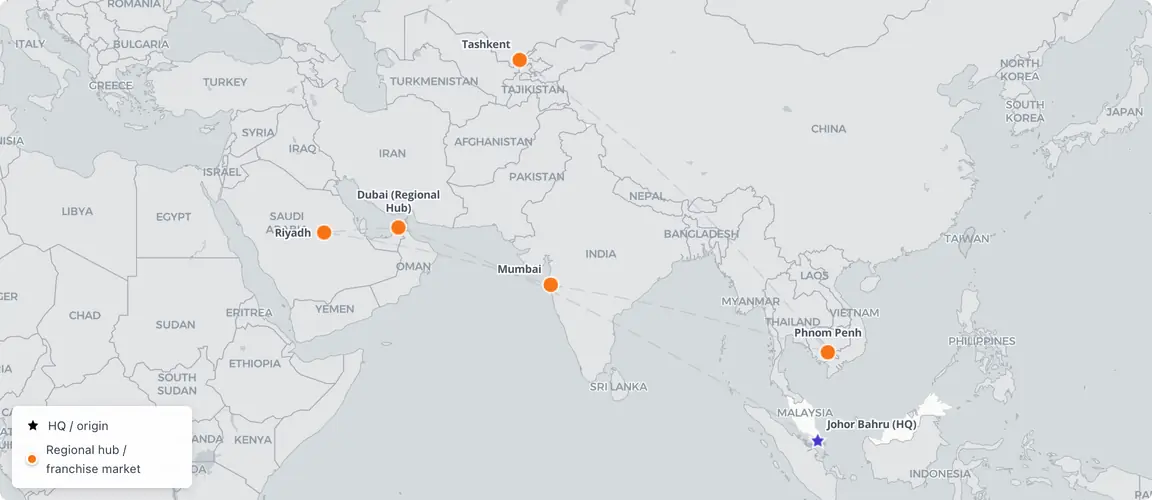
From a rejected loan to 16 countries on a halal stamp
Marrybrown was turned down for a bank loan in 1981 and opened in Johor Bahru anyway. Forty-three years later it operates in 16 countries and describes itself as the world’s largest halal QSR of Asian origin. The founding refusal is not the story — the architecture that carried the brand from it to 500 outlets across the OIC world is, and the question worth asking is why no Western competitor has been able to replicate it.
The defensive decision that became a structural advantage
Being a halal Malaysian brand helps convince master franchisees, especially in the Middle East, as they are more comfortable dealing with Malaysians.
In the late 1980s, when KFC and McDonald’s began their serious push into the Malaysian market, the competitive calculus was straightforward. The Western chains had brand recognition, capital, standardised supply chains, and the proven global template. Marrybrown had a regional following, tighter margins, and a positioning decision to make.
The decision they made is the story. Rather than competing on the Western chains’ terms — price, footprint density, promotional spend — the Liews committed to halal certification at supply-chain depth. Not a sticker on the menu. Not an ingredient-level attestation. The full stack: JAKIM-certified ingredients, JAKIM-certified warehousing, JAKIM-certified distribution, with overseas certifications managed through JAKIM-recognised foreign halal bodies.
JAKIM — the Department of Islamic Development Malaysia — is among the world’s most stringent and globally recognised halal authorities. Its certification is recognised by 85 foreign halal bodies across 47 countries, which means a product leaving a JAKIM-certified facility arrives at the border of most OIC markets with its trust already established. The importing country’s halal authority does not need to conduct its own inspection. The paperwork moves because the infrastructure is already verifiable.
The Liews built this infrastructure when it was expensive and operationally burdensome, at a moment when their survival argument was that they needed to differentiate from global chains that did not face the same commitment requirements. The result, visible only in retrospect, is that they constructed a structural advantage precisely because the cost of building it was high enough that no Western competitor had a reason to match it.
What the certification actually means
The halal infrastructure is misread from the outside as a market-segment play — a brand that targets Muslim consumers and has the paperwork to prove it. This reading is wrong in a way that matters for anyone evaluating the brand’s international reach.
Supply-chain-level halal certification is not a positioning statement. It is an infrastructure commitment that functions like a quality management system: every input, every process, every storage and transport step is documented and audited to a standard that a foreign regulatory body can verify without conducting independent research. When a master franchisee in Kuwait or Bahrain takes on a Marrybrown territory, they are not choosing to serve the local Muslim majority a Western-style chicken product certified to their standards. They are choosing an operator whose entire supply chain has been independently verified to a standard that Kuwait’s and Bahrain’s own halal authorities formally recognise.
Joshua Liew — third-generation CEO who now leads the group — has articulated the mechanism without the technical language: “Being a halal Malaysian brand helps convince master franchisees, especially in the Middle East, as they are more comfortable dealing with Malaysians.” The comfort is not aesthetic. It is institutional. JAKIM’s credibility travels ahead of the brand.
The Dubai hub and the GCC architecture
The Dubai regional hub, established in 2000, is the physical expression of the trust architecture. The Gulf Cooperation Council states — UAE, Saudi Arabia, Kuwait, Qatar, Bahrain — represent the most concentrated set of halal-certification-sensitive consumer markets in the world. They are also markets where the halal standard is not merely important but foundational: a food product that cannot demonstrate supply-chain-level certification does not compete.
Marrybrown established the Dubai operation as the coordination centre for GCC master franchisees. The model is consistent across markets: the master franchisee is selected for OIC-market alignment, the JAKIM certification is validated by the local halal authority (a procedural step, because the recognition framework already exists), and the menu is localised with regional items alongside the core fried chicken and rice offerings. Arabic rice and wraps in the UAE. The Tuna Burger and Curry Tuna Biryani in the Maldives. Nasi Lemak — the Malaysian coconut rice dish that functions as a national culinary signifier — as a universal halal-market marker in markets where the Malaysian origin itself is part of the trust signal.
The menu localisation layer is not marketing creativity. It is the operational expression of a principle: the halal certification creates market access, and localisation creates market fit. Neither works without the other. A certified chain that cannot adapt its menu has access but no pull. An adapted chain without certification has appeal but no infrastructure to stand behind it.
India and the 30% vegetarian layer
The Indian entry in 1999 added a complication that tests the infrastructure’s flexibility. India’s Muslim population — the second-largest in the world at ~200 million — is a natural halal-certification market. But India’s consumer restaurant market is structured around a majority-vegetarian preference that no halal-only menu can serve adequately.
Marrybrown’s response was to add approximately 30% vegetarian items to the Indian menu while keeping the halal certification intact for all remaining items. The result is a two-track offer: halal-certified meat products for Muslim consumers and regional vegetarian options for the broader market, with the JAKIM certification covering everything in the halal category.
The India approach is important for what it reveals about the model’s architecture. The halal certification is not a ceiling that prevents serving non-Muslim consumers. It is a floor that guarantees a minimum standard across the halal category while leaving room for market-specific additions above it. In markets where the Muslim consumer is the primary target — the GCC states, parts of Southeast Asia — the floor is sufficient. In markets where the Muslim consumer is one segment among many, the floor plus additions is the operating model.
The 2024 entries and the tourism-corridor thesis
Cambodia and Uzbekistan in 2024 represent the most recent expansion of the infrastructure’s geographic reach. Neither country is an OIC member with a predominantly Muslim population in the GCC sense. Cambodia is roughly 2% Muslim; Uzbekistan is majority Muslim but not a Gulf-style halal-certification environment.
The explanation Marrybrown offered — “rising demand for halal-certified food in high-tourism regions” — is analytically precise. Both Cambodia (Angkor Wat) and Uzbekistan (Silk Road tourism) are high-traffic destinations for Muslim travellers from Malaysia, Indonesia, the Gulf states, and OIC markets broadly. A Malaysian tourist in Phnom Penh who wants a halal quick-service meal is looking for JAKIM certification precisely because it is the standard they trust at home. The Marrybrown entry serves that traveller in Phnom Penh with the same certification architecture that served them in Johor Bahru.
The tourism-corridor thesis extends the halal trust infrastructure beyond resident Muslim populations into the global Muslim travel market. Every market on a major Muslim travel route becomes a potential Marrybrown territory, not just countries with Muslim majorities.
Where the model does not work
Sweden entered the Marrybrown network and closed. The specifics of the Sweden operation are not fully documented in available sources, but the pattern is instructive: a halal-certified QSR brand in a high-income Western European market with a small Muslim minority faces a different competitive landscape than in OIC markets. The trust-passport advantage that opens Gulf markets does not operate in the same way in a market where halal certification is niche rather than table stakes.
Syria and Iran, referenced in the brand’s historical record, did not develop into durable market presences. The geopolitical environment in both cases created operational barriers that no certification infrastructure can solve — sanctions, conflict, market access restrictions. The halal trust infrastructure is a competitive advantage within functional OIC markets. It is not a geopolitical passport.
These limits are important for calibrating the model’s scope. The trade-route argument is real, but it runs through the OIC corridor and the Muslim-travel infrastructure, not through Western consumer markets or conflict-affected geographies.
Why no Western competitor has matched it
KFC and McDonald’s have halal-certified operations in Muslim-majority markets. They have done so for decades. The distinction between their approach and Marrybrown’s is structural, not technical.
A Western QSR chain entering a Muslim-majority market typically certifies its local supply chain to local standards, manages certification market by market, and treats halal compliance as a regulatory requirement in each jurisdiction. This approach is operationally rational — it minimises the cost of compliance by scoping it to each market’s requirements. It does not, however, produce a single globally recognised credential that a master franchisee in any OIC market can point to without country-specific verification.
Marrybrown’s JAKIM certification is not market-specific. It travels. The 85 foreign halal bodies that recognise JAKIM span 47 countries, which means the credential that a Malaysian master franchisee negotiated in Johor Bahru is the same credential a Gulf master franchisee presents in Riyadh or Abu Dhabi. The cost of building this — the supply-chain-deep commitment made in the 1980s against the logic of matching Western competitors on Western terms — is the reason no Western competitor has replicated it.
The advantage’s size is proportional to the cost of building it. If it had been cheap to construct, the incumbents would have constructed it. It was not.
The third generation and the franchise multiplier
Joshua Liew’s leadership of the third generation is the current phase of a succession story that the brand’s international expansion partially obscures. Lawrence and Nancy Liew built the halal infrastructure and the initial OIC market entries. Joshua has been executing the franchise multiplier: converting the established trust architecture into a network that is 82% franchised, with master franchisees holding territory rights in markets where the Liew family has never operated directly.
The franchise model is the distribution mechanism for this structural advantage. At 82% franchised, Marrybrown’s expansion rate is not limited by the family’s capital or by the corporate team’s capacity to open and operate restaurants. It is limited by the supply of master franchisees who trust the JAKIM certification enough to stake their own capital and territory on it — and by Marrybrown’s capacity to identify, select, and support those franchisees.
Joshua Liew’s articulation of the trust mechanism — that Gulf master franchisees are more comfortable dealing with Malaysians because of the halal brand identity — is a description of the selection filter. The franchise multiplier works because the certification pre-qualifies the operator. The operator does not need to conduct independent halal due diligence; JAKIM’s credential is already established. What the master franchisee assesses is the operational model, the menu architecture, and the local market fit. The trust infrastructure is given.
The pricing gap that has not been addressed
Marrybrown’s revenue — estimated at ~RM150–250 million — is the figure of a regional chain with strong OIC presence, not of a recognised global brand. The gap between its operational footprint (16 countries, 500+ outlets, JAKIM-certified supply chain) and its institutional recognition (absent from Western QSR databases, not covered by major analyst firms) is precise: the brand’s intelligence exists in Malay and Chinese-language press, in JAKIM filings, in franchise disclosure documents that no English-language research platform has assembled.
This is the documentation gap that the halal infrastructure argument reveals most clearly. The infrastructure is in place. The market entries are documented. The third-generation succession is underway. The one thing that has not happened is the systematic mapping of the model by the institutions that would be positioned to assess its value — Gulf sovereign funds, OIC-aligned private equity, strategic acquirers in the Muslim consumer space.
Cambodia and Uzbekistan are already live. The next OIC market entry has followed the same pattern each time: it tracks where the Muslim travel corridor provides sufficient demand, independent of whether an English-language database has indexed the brand.
The certification the metrics do not capture
Marrybrown does not, by any standard metric, resemble a globally recognised brand. It is not publicly listed. Its financials are not disclosed. Its outlets are concentrated in markets with limited English-language press coverage. The franchise model means the brand name travels without the corporate structure being visible.
What the metrics miss is the architecture. A QSR brand with 43 years of JAKIM-certified supply chain, a Dubai regional hub that has served as the credentialing anchor for GCC expansion since 2000, a menu localisation model proven across vegetarian India and tourism-corridor Cambodia, and a third-generation CEO who articulates the trust mechanism in terms that Gulf master franchisees respond to — that is not the same brand as the database entry suggests.
The certification cannot be purchased retroactively. It was built, over decades, in the way the Liew family built it starting from a bank loan rejection in 1981 — the JAKIM filings, franchise disclosures, and Malay- and Chinese-language press documenting each step of that build remain unassembled by any English-language research platform.
Researched 18 sources in English, Malay.