 Skip to main content
Malaysia Education: Three Tiers, One Succession
A Malaysian family can enrol a child in a Taylor's school at six, a Taylor's college at eighteen, and Taylor's University at twenty-two — one founder's brand across three tiers. Taylor's, HELP and Sunway each span the full stack, and the founders who built it are now in their seventies and eighties, handing over all at once.
Malaysia Private Education: A Three-Tier Stack in One Valley
One handover across the whole stack
One Malaysian founding family sells education at every stage of a childhood — a primary school, a sixth-form college, and a degree-granting university, all under the Taylor’s name, all built between 1969 and 2017. The same child can move through the entire arc without ever leaving the brand, and the family is now passing all three tiers to its third generation.
No education database records this as a single fact, because no one looks at Malaysian private education as one structure. They look at three. International-school analysts track the K-12 tier. University rankings track the degree-granting tier. A separate trade body counts the sub-degree colleges in between. Each desk sees a slice. None sees that the same founding families — Taylor’s, HELP, Sunway — span the entire stack, or that the generation that built it is aging out of all three tiers at once.
How three tiers became one inheritance
The sector did not arrive as a system. It accreted in layers, each built by founders who started in one tier and climbed into the next.
The first layer was the school. Datin Freida Pilus opened Cempaka in 1983 because she could find no school she trusted for her own five children, then carried it through the next two decades into a five-campus network juggling Finnish, Cambridge and IB curricula. Ghulam Sayeed founded Sayfol in 1985 on the same impulse — an affordable international school, eventually with a second campus in Sabah. These were family enterprises before they were institutions.
The second layer was the college. Taylor’s had opened in Petaling Jaya in 1969; the Systematic group, SEGi’s ancestor, followed in 1977. Then came the cohort that defines the sector today: Peter Ng bootstrapped UCSI on RM2,000 in 1986, the Chan family founded HELP the same year, and Sunway College opened in 1987. They taught toward foreign degrees they could not yet award.
The third layer — the university — was a gift of legislation. The Private Higher Educational Institutions Act of 1996 legalised private universities and the 3+0 twinning model, letting students complete a full British or Australian degree on Malaysian soil at a third of the cost. The timing was extraordinary. Months later the Asian Financial Crisis collapsed the ringgit, made overseas study unaffordable, and pushed federal scholarship students back home. What should have been a catastrophe became a boom: campuses filled, and the colleges began their climb toward university status.
The crisis also produced the sector’s defining personal story. When Tan Sri Loy Hean Heong died in November 1997, his MBf conglomerate — one of the largest in 1990s Malaysia — collapsed within a year, wiping out the family fortune and triggering personal guarantees. His son, Dato’ Loy Teik Ngan, spent fourteen years clearing the debt. In 2001 he bought a minor stake in Taylor’s with borrowed money. That stake became Taylor’s University in 2010 and, in 2017, Taylor’s Schools — a consolidation of six K-12 campuses that completed the family’s descent back into the tier where Pilus and Sayeed had started. HELP did the same in reverse order, opening HELP International School in 2014. By the time anyone thought to map it, the tiers had interlocked.
The valley that holds the stack
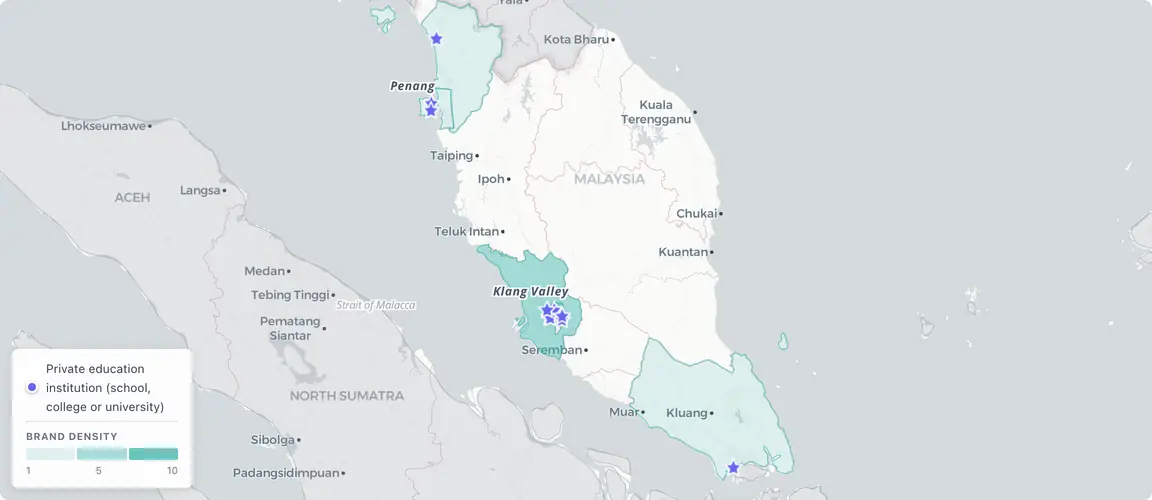
The most striking fact about this ecosystem is not its size but its compression. Roughly four-fifths of the sector’s tertiary enrolment sits within the Klang Valley, the metropolitan sprawl around Kuala Lumpur. The cross-tier families are all there. Sunway and Taylor’s anchor the southern Selangor corridor; HELP, UCSI and SEGi ring the capital; Cempaka runs campuses across the same districts. A parent in greater Kuala Lumpur can assemble an entire eighteen-year education from founder-owned institutions within a forty-minute drive.
Everything else is a foothold. Penang, the country’s electronics manufacturing hub, runs on a different logic — its colleges answer to industry rather than to demography. The National Semiconductor Strategy is now reshaping what the state’s employers need, pulling institutions like Equator College and the TVET-focused Forward College toward precision technical training that the Klang Valley’s generalist campuses cannot supply at scale. That story is told in full in Brandmine’s Penang private colleges spotlight; here it matters as the one regional cluster the capital does not dominate.
Johor is the emerging play. The Iskandar special economic zone and its EduCity precinct draw Singapore-facing families across the causeway, and Fairview’s largest IB campuses cluster there. East Malaysia — Sabah and Sarawak — holds satellite campuses serving Borneo and Brunei. And in Kedah sits the sector’s strangest institution: Albukhary International University, a non-profit waqf model that educates its students entirely on charity. The geography tells the investor everything the prose cannot: this is not a national sector with regional variation. It is a single metropolitan cluster with a few distant outposts.
What the analysts can’t see
For a sector this concentrated and this storied, the institutional intelligence is remarkably thin. The reasons are structural, and they compound.
The first is the tier-by-tier lens itself. International-school consultancies count the K-12 market. Ranking agencies and the higher-education ministry track universities. A national association tallies the sub-degree colleges that contracted from 616 to 384 over two decades — a 37.7% shakeout documented in Brandmine’s Malaysia private colleges spotlight. Each dataset is real. None of them joins the others, so the cross-tier family — the analytical unit that actually matters here — falls into the gap between three spreadsheets.
The casualties of that blind spot have names. Masterskill rode a 2010 listing to the top of the nursing-college market, then collapsed into losses by 2013 and saw its founder ousted. Binary University has run under a single founder for forty years, his son quietly groomed to follow. The One Academy, a Subang creative school that one industry index ranked the best in the world, was built by Parsons-trained founders. None appears in a university ranking or an international-school directory, because each sits one rung below the tiers those datasets track — founder-owned colleges in the same blind spot as the dynasties above them.
The second is language. The deepest coverage of these families runs through Bahasa Malaysia and Chinese-language dailies and through The Edge Malaysia’s subscription archive, which holds the granular record of every ownership transaction since 2012. None of it surfaces in the English-language databases that populate a cross-border investor’s briefing deck.
The third is a misperception about who owns what. From a distance, Malaysian private higher education looks like a corporate consolidator’s market — Laureate sold INTI to Hong Kong’s Hope Education for US$140M in 2020; private equity has cycled through SEGi, HELP and APU. The foreign observer concludes that the founders have already exited. The opposite is true. In 2024 two founding families paid premiums to buy their universities back from the funds that had held them for a decade. The corporates are arriving as the founders reconsolidate — and the gap between that perception and the reality is precisely what this article documents.
Who bought back, who built down
The sector’s character is clearest in its crisis record — the moments when staying in was not the obvious choice.
The Loy family of Taylor’s is the spine of the whole structure. Dato’ Loy Teik Ngan inherited not a business but a debt, and spent fourteen years clearing the personal guarantees that his father’s collapse had triggered. He re-entered through a borrowed stake in a single college, then methodically built upward to a university and back down to a six-school K-12 group. When KKR took a minority position in Taylor’s Schools in 2021, it was the first time a global private-equity name had validated a Malaysian family’s cross-tier education franchise — and the family kept control. The Gen-3 transition is now underway, documented in unusual detail through a Family Firm Institute case study.
The Chan family of HELP ran the opposite play. Southern Capital took HELP private in 2014 at RM2.53 a share. A decade later, in June 2024, the family’s CL Heritage vehicle bought back 70% of the group for RM200M (~$45M USD) plus roughly RM100M of assumed debt — and immediately began preparing a 2026 relisting on its own terms. In the intervening years the family had quietly opened HELP International School, building the K-12 feeder that now sits beneath the university. Adam Chan Eu-Khin, the second generation, is in the driver’s seat, with a Thailand acquisition on the horizon.
Jeffrey Cheah of Sunway solved the problem the others are still circling: founder mortality. Now in his eighties, he has placed Sunway inside a foundation-owned, not-for-profit structure and, in November 2025, pledged RM500M (~$114M USD) over five years to an endowment modelled on Harvard and the University of al-Qarawiyyin. The same month, Sunway climbed 129 places to #410 in the QS World University Rankings — the most-improved institution on the global table. No other Tier-1 founder has built a succession architecture this explicit.
Datin Freida Pilus of Cempaka proves the pattern runs through the school tier too. She built her institution organically through the 1997 crisis without ever taking private-equity money, hedged it across three curricula, and has handed operations to her sons while remaining the institution’s mentor. Forty-two years on, Cempaka is the K-12 sector’s clearest example of a completed founder-to-family transition.
Around these four sit the others, each a variation on the same theme. Clement Hii bought Navis Capital out of SEGi in 2024 at a 32% discount — a deal that handed the fund a 1.45% return on twelve years — and has placed his daughter on the board. Peter Ng still runs UCSI, the university he bootstrapped on RM2,000, with no successor named. The Chian family has taken Fairview’s IB network to Scotland and a London listing. And Limkokwing stands as the cautionary case: its founder died in 2021 with twelve campuses across Africa and Asia and no published succession plan, and the cracks — revoked accreditations, governance disputes — appeared almost immediately. The difference between the families that planned and the one that didn’t is the entire investment thesis in miniature.
More than a feeder system
To read this as a simple supply chain — school feeds college feeds university — is to miss what the stack means in Malaysia. Education here is the diaspora’s oldest mobility strategy, and the families who built these institutions are mostly Chinese-Malaysian: Cheah, Chan, Ng, Hii, Loy, the Chians. The scholarly literature on Malaysian “dynasting” describes exactly what these families practise — building and holding power within a lineage — and education is the asset they have chosen to compound across generations.
A second group bends the regulatory landscape. Bumiputera founders — Mohamed Haniffa at MAHSA, Syed Mokhtar Albukhary, Freida Pilus at Cempaka — move through ministry approvals with less friction and easier access to government-linked capital. The asymmetry is not incidental; it shapes who can scale and who must partner. And it sets up the sector’s quiet constraint: the 12.5% Bumiputera equity allocation required on any Main Market listing. HELP’s targeted 2026 IPO is the first founder-controlled cross-tier group to face that rule since the requirement was set.
Three forces, one dated horizon
Three forces converge on the same short span, each anchored to a dated, documented fact rather than a projection.
The first is demographic. The founders who built the sector are between seventy and eighty-five. Three of the cross-tier families have a transition under way — Cheah through his endowment, the Loys into Gen-3, the Chans into Gen-2. The rest do not. UCSI, SEGi, MAHSA and Sayfol have no published succession architecture, and Limkokwing has already shown what the unmanaged version looks like: revoked accreditations and governance disputes within months of the founder’s 2021 death, across twelve campuses at once.
The second is the public market. HELP’s targeted 2026 relisting is the first attempt to return a founder-controlled education group to Bursa Malaysia since the buyback cycle began.
The third is institutional appetite, already demonstrated. KKR is inside Taylor’s Schools. TPG’s Rise Fund, with state co-investors, controls APU. Hope Education owns INTI. Each of those deals shows a buyer paying for exposure to Malaysian education through a fund-controlled or corporate asset — none of them a founder-controlled, cross-tier group. No such group has yet traded.
A structure no one has mapped as one
School, college and university under a single family, in a single city, is a structure that exists nowhere in the public record as one entity. It is documented in pieces: an international-school consultancy’s K-12 count, a ranking agency’s university table, a trade body’s college tally, a family-firm case study. No dataset joins them.
The intelligence to see all of this exists. It is scattered across The Edge’s archive, the Chinese and Malay dailies, a family-firm case study, a ministry’s enrolment tables and a ranking agency’s annual table. It has never been assembled into one picture, because the people who track education in Malaysia track it one tier at a time.
These schools, colleges and universities have stood for thirty, forty, fifty years — built by the same families, in the same valley, climbing tier by tier while no one was counting them as one.
A buyer can acquire a campus, a brand, even a QS ranking. What no buyer can acquire after the fact is what these families built tier by tier over forty years — a school that feeds a college that feeds a university, all under one family, in one valley. That is the structure this article records, in one place, for the first time. Limkokwing already showed what happens to a cross-tier stack when no one records the succession plan before the founder is gone.
Researched 24 sources in English.