 Skip to main content
No Right to Work: Malaysia's Syrian Restaurants
On KL's Bukit Bintang strip, a Syrian-owned restaurant with 305,000 Instagram followers has never given a single interview. Its owners route all media queries through a company called 'dagateResources.' The anonymity isn't a brand strategy — it is a legal survival mechanism in a country that has never signed the 1951 Refugee Convention.
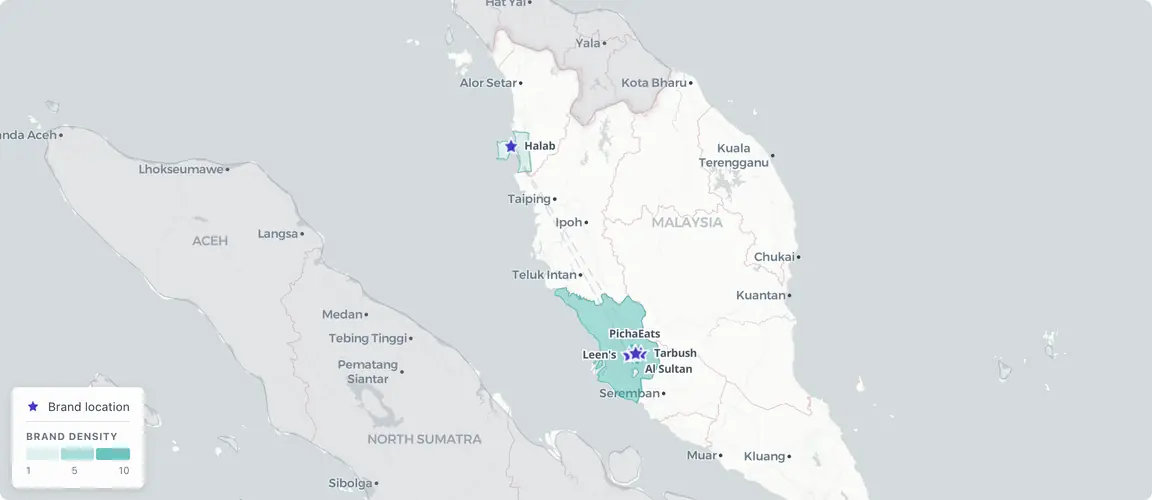
Malaysia Middle Eastern Restaurants: Geographic Concentration
Kitchens run on borrowed status
Malaysia’s Immigration Act specifies the penalty: up to RM10,000 in fines, five years in prison, six strokes of the cane for working without a permit. Over 80 Middle Eastern restaurants operate across Malaysia. Many of their founders — Syrian, Yemeni, Iraqi — have no formal right to work here.
One of them, Halab, commands 305,000 followers across three Instagram accounts. No journalist has spoken to a founder. Its owners appear in no filing, no press release, no database. Management queries route to a company called dagateResources. The all-Syrian kitchen closes at 4 AM.
The anonymity is not a brand strategy. It is the most reliable protection available to entrepreneurs the Malaysian state classifies as illegal workers. And it is the clearest window into the legal architecture that built the entire sector.
Before the war came the food
It was like stepping into water. I didn't know whether we were going to sink or float.
The Hadhrami traders who arrived in Malaya from Yemen’s Hadhramaut valley in the 19th century did not think of themselves as immigrants — they were following a route that had functioned for centuries. Under Article 160 of Malaysia’s Federal Constitution, Muslim Hadhrami Arabs who speak Malay are constitutionally classified as “Malay,” qualifying for Bumiputera privileges. Their descendants — the Al-Attas, Alhabshee, Al-Idrus families — have occupied positions in Malaysian politics, religion, and commerce across generations. This deep structural affinity meant that when Middle Eastern restaurants began appearing in Kuala Lumpur in the 1990s, they met a market already primed.
In 1994, the earliest documented Arabian restaurant chain in Malaysia appeared — Mandi Hadramot, pioneering Yemeni mandi specialties in KL. Its founders remain anonymous. In 1998, a Syrian from Aleppo named Mohyiddin Al Halabi opened a 200-square-foot shawarma bar with 11 stools at Ampang Point — a site his wife Shereene Abdullah later recalled as “infamous for previous business failures.” That bar became Tarbush. By 2012, Tarbush had grown to eight outlets with 260 staff and an RM400,000 monthly payroll, built without a single bank borrowing. The mechanism was straightforward: Mohyiddin cooked and operated; Shereene Abdullah ran the legal entity. The Malaysian spouse as the legal architecture — the model the sector still uses.
The Syrian civil war began in March 2011. Unlike the European refugee crisis, which drove millions onto perilous land and sea crossings, Malaysia’s visa-on-arrival policy for Syrians enabled direct flights from Damascus and Istanbul. Mahmoun Alghaz, a Damascus chef with 35 years’ experience, had arrived in 2010, before the war. Hasan Al-Akraa’s family fled Aleppo in 2012 — he was eleven years old. By 2012, one KL restaurateur estimated more than 200 Arab restaurants operating across the capital, serving an Arab community of roughly 200,000.
Four addresses, one invisible economy
Roughly 55% of Malaysia’s documented Middle Eastern restaurant outlets cluster in the KL Bukit Bintang–Ampang corridor — the strip between Changkat Bukit Bintang, Jalan Sultan Ismail, and Jalan Berami that locals call Arab Street. When Tarbush opened at nearby Ampang Point in 1998, it seeded a critical mass. Proximity to major hotels draws the 309,000 Middle Eastern tourists who arrive annually. The late-night economy — most outlets close at 2 to 4 AM — concentrates along the same strip that serves luxury hotels. Shisha culture, expat demand, and self-reinforcing restaurant density have made the corridor the natural address for any new entrant.
But the geography also reflects the legal infrastructure. The Bukit Bintang–Ampang corridor sits close to the UNHCR Malaysia offices on Jalan Ampang and to the diplomatic quarter. For a Syrian founder who may need to resolve a documentation problem, be represented before a tribunal, or maintain proximity to the systems that provide whatever informal protection exists, the corridor is simultaneously the most commercially and legally optimal address in Malaysia.
The suburban quarter — roughly 25% of the sector — occupies Petaling Jaya, Shah Alam, TTDI, Bangi, and Cyberjaya. This is where diaspora families actually live: lower rents, university towns, residential neighbourhoods where Yemeni mandi and Syrian-fusion restaurants serve families and international students. Leen’s and SAJ Bistronomy operate in TTDI, a neighbourhood that has become a secondary cluster of its own.
Penang accounts for roughly 10% of the sector, but punches above its weight in narrative richness. The Hadhrami diaspora has deep roots in George Town, predating modern Malaysia by a century. Halab’s million-dollar renovation of a colonial bungalow on Chulia Street anchors the contemporary scene. Tarbush, Rubin Mardini — a Syrian family operation that has relocated three times across Tanjung Bungah, Plaza Ivory, and Batu Ferringhi — and Damas (opened January 2025) complete it.
The remaining 10% reaches Langkawi, Genting, Kota Bharu, and Melaka: tourist gateways, transit points, and one remarkable exception. In Kelantan, Mahmoun Alghaz operates Just Doner — reportedly the only documented Middle Eastern diaspora restaurant in the state — after serving five years as personal chef to Sultan Muhammad V, who reportedly attended Mahmoun’s catering, returned the following day, and eventually hosted his wedding at the Istana.
The architecture of informal permission
The legal framework is unambiguous. Malaysia has not signed the 1951 Refugee Convention. The UNHCR-registered Syrians in Malaysia — approximately 2,500 people — hold cards that carry no legal force under domestic law. The Immigration Act 1959/63 classifies all refugees as illegal immigrants. Working without a permit: up to RM10,000 fine, five years imprisonment, six strokes of the cane.
So how did a sector of 80+ outlets with 400,000 combined Instagram followers get built?
Through four distinct mechanisms — each a chapter in how entrepreneurs navigate an impossible constraint.
The Malaysian spouse pathway is the foundational mechanism. Mohyiddin Al Halabi operates Tarbush through Shereene Abdullah. Ameer Alzalek registered Leen’s as LEENS DAMAS SDN BHD through his Malaysian wife. The mechanism is legal but not simple: it requires a Malaysian partner willing to bear full legal liability, and it produces a business whose legal identity belongs to someone other than its operator. The spouse pathway has enabled the sector’s most resilient brands — but it is inherently precarious.
A government resettlement window — the PPSMS program — offered a narrow pathway between 2015 and 2018. After Prime Minister Najib pledged refuge for 3,000 Syrians following the 2015 European crisis, Malaysia flew the first eight people from Istanbul in December 2015. The IMM13 permits issued under PPSMS provided limited documented employment rights. The window closed. The program documented what a legal pathway could look like; it did not create one at scale.
The anonymity strategy is what Halab built. Zero interviews. All queries through dagateResources. No public filing names a Syrian founder. Halab’s million-dollar renovation of a colonial bungalow in Penang — executed by people who command 305,000 Instagram followers across three accounts — was done by founders whose names the sector does not know. The silence is a primary source: what Halab’s owners will not say tells you precisely what they cannot afford to say. In a country that classifies their work as criminal, being unidentifiable is the legal strategy.
The structural workaround is PichaEats. Three Malaysian university students — Kim Lim, Suzanne Ling, Lee Swee Lin — built a social enterprise that makes the employment ban irrelevant by design. Refugee chefs cook from their own home kitchens. Home cooking is not employment under the Immigration Act. PichaEats markets, distributes, and monetises the food. By 2024, 35 refugee chefs from Syria, Palestine, Iraq, Afghanistan, and Yemen had collectively served 350,000 meals and generated RM4 million in revenue through the model. Forbes 30 Under 30 listed the founders in 2018. The employment ban had been turned into a business model.
Who stayed, and how
The May 11, 2020 Selayang operation is the sector’s most documented crisis. During the Movement Control Order’s first weeks — when Malaysia’s F&B sector was already suffering 90% revenue declines — immigration authorities arrested more than 1,300 people in a single sweep. The Bukit Bintang corridor lost its tourist pipeline entirely. Borders would not reopen for quarantine-free travel until April 2022.
Tarbush contracted from eight outlets to six. The exact circumstances — COVID-driven, strategic, forced by staff exposure risk — are not documented in available sources. What is documented: in May 2024, Tarbush expanded to The Exchange TRX, KL’s newest landmark development, 26 years after Mohyiddin Al Halabi opened 11 stools at a location his wife called cursed. The sector’s patriarch grew to a peak nobody predicted, contracted under the most severe pressure, and expanded again when it could.
On the same day MCO began — March 18, 2020 — Hasan Al-Akraa made a different decision. Hasan had arrived from Aleppo at age 11. At 14, he was arrested while washing dishes at a KL restaurant. He spent nine days in a detention centre under conditions he later described as producing thoughts of suicide. He emerged and eventually founded Al-Hasan Volunteer Network. On the first day of the lockdown, he mobilised 14 refugee chefs — Syrian, Afghan, Yemeni, Palestinian, Iraqi — to cook free daily meals for Ampang Hospital’s frontline healthcare workers. They cooked for 24 consecutive days, in partnership with Beyond Borders Malaysia and PichaEats’ ZazaMovement.
Two years later, a court ruling changed the legal landscape slightly. A Yemeni restaurant worker, identified in documents only as “Ahmed,” was dismissed unlawfully by his employer. Represented by Asylum Access, he brought his case to Malaysia’s Industrial Court. The court awarded him RM33,000 — and established a precedent: refugees can assert statutory employment rights under Malaysian labour law despite lacking work permits. The ruling did not legalise refugee employment. But it established that the courts would not permit employers to exploit that illegality.
Ameer Alzalek’s arc began in Damascus, where he worked as an accountant. He fled Syria around 2013. He spent years in hotel kitchens in Langkawi and Penang — La Pari Pari, Four Seasons — before moving to KL and working under Chef Gary Anwar at Ember Modern Bistro. During the pandemic, he sold jars of hummus from home. In November 2021, he was invited to the Tiffin at the Yard food market. In September 2022, he opened Leen’s Middle East Kitchen in TTDI. In December 2023, he opened SAJ Bistronomy. The company registered as LEENS DAMAS SDN BHD (1506297-K). SAJ stands for Syrian Authentic Jar — named after the hummus containers that kept him solvent through the lockdown, which became the brand concept for his fine dining restaurant. Tatler Asia, Robb Report, and The Edge have all profiled him. Twelve years from Damascus accountant to that coverage is the sector’s measured arc.
Why Malaysia was ready
Three structural forces made Malaysia the sector’s natural home — none of which appear in any Western analyst’s coverage of the country.
The Hadhrami diaspora established a deep Arab-Malay cultural affinity that predates the nation. Under Article 160, Muslim Hadhrami Arabs who speak Malay are constitutionally Malay, and their descendants have been present in Malaysian commerce, politics, and religious life for generations. When Hadramawt Palace opened its grand doors, prominent Hadhrami-Malay families attended as guests of honour. The historical legitimacy precedes the modern restaurant sector by over a century.
Malaysia has ranked first on the Mastercard-CrescentRating Global Muslim Travel Index every year since 2015 — nine consecutive years. The 309,000 Middle Eastern tourists who arrived annually before the pandemic spent an average of RM3,397 per capita over stays of 13.7 nights. This is not marginal demand. The Bukit Bintang corridor exists because hotel guests from Riyadh, Abu Dhabi, and Cairo want food they recognise at 2 AM, and they are willing to pay for it.
The domestic foundation is a 60%+ Muslim-majority population that has adopted mandi rice, shawarma, and hummus into mainstream food culture. The sector is not exotic to Malaysians. It is ordinary. Which is precisely what makes it commercially durable across cycles that have broken more fashionable concepts.
The threshold moment
In October 2024, immigration officers conducting a workplace raid in central KL told UNHCR-registered refugees: “Your UNHCR card is not valid, I will tear it up and lock you up.” Fortify Rights reported in June 2025 that immigration arrests had more than tripled in the preceding two years. The enforcement is not random — raids concentrate in the commercial districts where refugee-operated businesses are most visible.
Against this backdrop, in February 2025, Malaysia’s Parliament debated a proposal to grant UNHCR-registered refugees formal rights to work. The proposal remains pending as of May 2026.
Its passage would change the legal status, not the commercial record, of founders already operating. A founder who built in legal twilight and proved commercial viability over 5, 10, or 27 years has already demonstrated what formal legal protection would only formalise. Tarbush has operated for 27 years; Sahara Tent for 24 — both founder-operated, both approaching the age band where founders elsewhere in this dataset have already handed over or closed. No institutional buyer has documented them. No formal valuation exists.
A record that exists nowhere else
No Bloomberg database carries these founders. The founders who built Tarbush, Halab, and Leen’s made their most consequential decisions in a country that classified them as criminals for doing so. Those decisions are not in any press release. They are in The Star’s 2012 interview with Shereene Abdullah, in the Industrial Court filing that awarded Ahmed his RM33,000, in the Asylum Access case note about Abo Loay’s three failed businesses and his Chinese Malaysian delivery partner who handles his orders.
They are in the company registration number LEENS DAMAS SDN BHD (1506297-K). In the dagateResources name that absorbs Halab’s media queries. In the PPSMS intake records of the eight Syrians who flew into KL from Istanbul in December 2015, under a resettlement programme that ran from 2015 to 2018 and was not renewed.
The intelligence exists — scattered across legal filings, local press archives, company registries, and the human rights organisations that have been documenting this sector’s conditions since before Brandmine existed. It has not been assembled anywhere until now.
Tarbush was built over 27 years by a founder the Malaysian state classifies as an illegal worker. Sahara Tent, 24. Neither has a formal valuation. Neither has a documented successor. Both are recorded here, in one place, for the first time.
Researched 25 sources in English, Malay.