 Skip to main content
Malaysia Heritage Restaurants: The Handover Gap
On 8 September 2023, the third-generation cook who ran an Ipoh bean-sprout-chicken shop founded in 1957 died at 48. No successor has been named in any public record, and the shop still opens each morning. He is one of a founder-built heritage-restaurant cohort reaching its handover moment all at once — recorded by no database, read by no analyst.
Malaysia heritage restaurants: five regions
The handover gap
Simon Leong Shing Ching died at 48. For a generation of Ipoh diners he was Lou Wong (老黄芽菜雞) — the third-generation cook who had apprenticed under his uncle from the age of thirteen and taken over the family’s bean-sprout-chicken shop in 1996. His death, on 8 September 2023, opened a succession question the restaurant has yet to answer in public.
It is a single data point in a pattern no database has assembled. Across Malaysia, a cohort of founder-owned heritage restaurants built between 1928 and 1976 is reaching its third-generation handover at the same moment — and reaching it just as the first Michelin Guide arrives in the country and private equity proves the sector can scale. These kitchens have anchored Malaysian life for nearly a century. The intelligence about them has never been gathered anywhere.
What the cooks built
Malaysia’s heritage restaurant culture began in other people’s kitchens. The Hainanese were among the last major Chinese dialect groups to arrive in British Malaya, and they took the work the earlier arrivals had left behind: cooks and houseboys in colonial bungalows and Straits-Chinese towkay mansions. When they struck out on their own, they carried a hybrid repertoire with them — Hainanese chicken chop, roti babi, kaya toast — food learned in European households and re-plated for a local clientele.
Lee Tai Yik had cooked for the Kuala Lumpur businessman Choo Kia Peng before he opened Yut Kee (鎰記茶餐室) at 35 Jalan Dang Wangi on 15 January 1928, running it with his three wives. Two years later Tho Yuen (陶源) began rolling dim sum on Campbell Street in George Town. In 1940 Wong Sang Hai founded Hai Peng (海滨咖啡) on the Terengganu coast, carrying the kopitiam east along the colonial coffee trade.
The post-war decade professionalised the trade. In 1948 three brothers — Phang Chew Kan, Phang Meng Yun and Phang Shue Tang — graduated from a wantan-mee pushcart to a Jalan Pudu shophouse and founded Sek Yuen (適苑酒家); three-quarters of a century on, more than eighty of their descendants are connected to the business. In 1957 Wong Chiew Sun took over his father’s roadside porridge stall in Ipoh and built the bean-sprout-chicken formula that his nephew would later run as Lou Wong. A Hakka migrant from Bukit Mertajam, Choo Teik Seng, opened a porridge stall on Carnarvon Street in 1965 that became Teksen (德星茶餐室). Tham Bak Yuen and Sam Ah Looi opened Foh San (富山茶楼) in Ipoh in 1971, converting to dim sum two years later. By the time Usilappan Servai brought Chettinad banana-leaf rice to Petaling Jaya in 1976 as Kanna Curry House, the founding wave was complete.
What these founders share is not a cuisine — Hainanese, Cantonese, Hakka and Tamil-Chettinad kitchens have little in common at the stove — but a structure: a single family, a single recipe set, and an unbroken line of cooks who learned the dishes by standing next to the person who invented them.
Five regions, no single capital
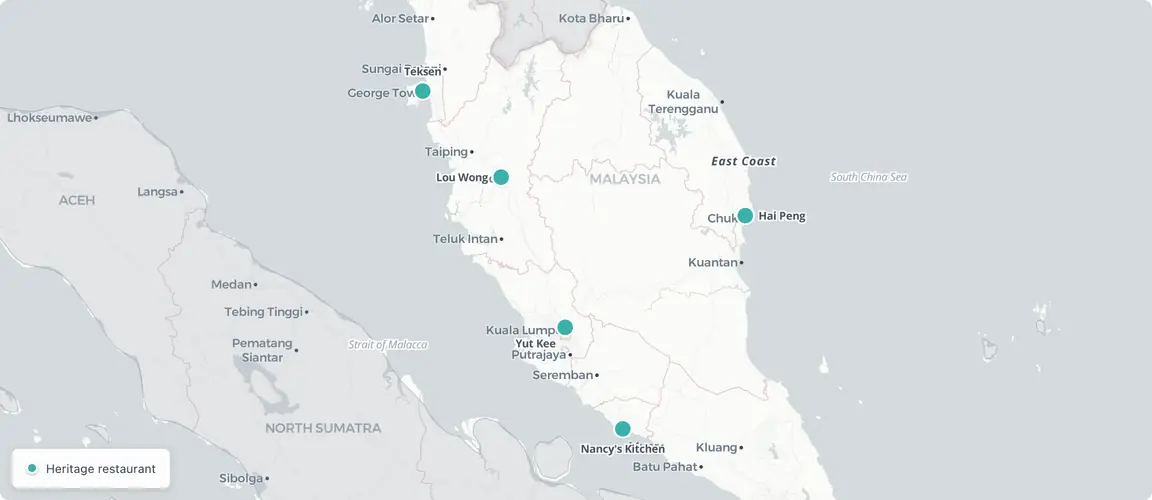
The cohort is often mistaken for a Kuala Lumpur story. It is not. Malaysia’s heritage restaurant tradition clusters across five distinct geographies, each with its own founder lineage and its own way of failing.
Kuala Lumpur and the Klang Valley hold the deepest concentration — roughly two-fifths of the country’s restaurants — and the oldest institutions. Pudu and Chow Kit anchor the Cantonese and Hainanese halls; Bangsar and Bukit Bintang carry Tamil-Hindu banana-leaf and the modern Malay fine dining that Bijan pioneered in 2003; Madam Kwan’s runs most of its sixteen outlets from here.
Penang’s George Town is the second pole, and the most exposed. UNESCO World Heritage status in 2008 both protected the shophouses and inflated their rents. Teksen, Tho Yuen and the now-shuttered Ocean Green operated within metres of one another on the Carnarvon–Campbell axis; the Michelin inspectors who arrived in 2022 found more to recognise here, per square kilometre, than anywhere else in the country.
Ipoh is a corridor of Cantonese dim sum and Hainanese bean-sprout chicken, where Foh San and Lou Wong sit among a dozen rivals within walking distance — a density that makes the city’s succession question especially acute. Melaka, also UNESCO-listed in 2008, is Peranakan and Hainanese chicken-rice-ball country: Nancy’s Kitchen has carried Nyonya recipes across three generations of women cooks, and Hoe Kee (和記雞飯) has anchored Jonker Street since 1962.
The fifth cluster is the smallest and the most fragile. On the east coast, in Kemaman, Hai Peng is the only nationally known heritage operator — and its story shows what idiosyncratic risk does to a single-town institution. There is no thick local market to absorb a shock here, no cluster of rivals to keep the trade visible. When the flood came in 2014, there was nowhere to fall back to.
What the databases miss
Walk into any of these restaurants at the breakfast hour and the commercial reality is obvious: full tables, cash trade, a brand that has outlasted five governments and three currency crises. Walk into an investment database looking for the same brand and you will find almost nothing.
The invisibility is structural, not accidental. These are private family companies that file no public accounts and issue no press releases; their revenue lives in the owner’s head and the cash register. The events that define them — a founder’s death, a flood, a family that split over who would keep the signage — are reported, if at all, in Chinese-language newspapers like Sin Chew Daily and Oriental Daily that no foreign analyst reads and no English-language database indexes. The succession crisis at Lou Wong is documented; it is simply documented in the wrong language for the people who allocate capital.
A second barrier is conceptual. Foreign visitors still file Malaysian food under “street food” — a curiosity to be eaten cheaply and forgotten — rather than under heritage enterprise. The category error is expensive: a 1928 institution with a four-generation customer base and a defensible local franchise gets valued, when it is valued at all, as a hawker stall rather than a brand.
This is the gap. The intelligence that would let an investor, a franchise partner or an acquirer understand these brands — who founded them, what crisis they survived, who decides their future — is not missing. It exists, scattered across vernacular press, family memory and court filings. It has simply never been assembled in one place, in a language the market can read, and the founders who hold that memory are stepping back now.
Who kept cooking when quitting was rational
Each of the four clearest cases survived a crisis at which closing would have been the rational choice.
Lou Wong’s was a death. When Simon Leong Shing Ching died in September 2023 at 48, he left a widow and four children, a 66-year-old Ipoh institution without a publicly named heir, and a founder — his uncle, retired since 1996 and still living — too far from the wok to return. The two Sin Chew Daily obituaries and the China Press report that covered his death name no successor; the deepest record of the shop’s future is silent on it. The restaurant chose to keep opening anyway, on the strength of a recipe and a name, while the question of who owns its future stays unanswered. It is the cohort’s succession crisis in its purest form: the brand outliving the only person who knew how to run it.
Hai Peng’s was a flood and a family. The 2014 floods drove the kopitiam out of its original Kemaman premises, and the dislocation split the founding family. Wong Sang Hai’s daughter, Elaine Wong, left to build Sukiyang Coffee — KL outlets in Starhill and Setiawangsa, plus a Valley Beans factory that now exports — while a sibling kept the Hai Peng signage and, by local accounts, a changed blend. One brand became two, each carrying half of the original. It is the textbook Hainanese-kopitiam fracture: succession not as handover but as schism.
Madam Kwan’s was a bankruptcy. Kwan Swee Lian had started out running a beauty salon, also called Sakura, on Jalan Imbi in the late 1950s before turning to food; by 1977 she had pioneered air-conditioned local-cuisine dining in Kuala Lumpur with her Sakura restaurant — serving nasi lemak on imported Japanese plates when local food was assumed to belong on hawker streets. The 1997 Asian Financial Crisis folded Sakura. Two years later her son, Rudy Foo, and daughter-in-law, Maureen Ooi, opened Madam Kwan’s in Bangsar Baru explicitly to rebuild the matriarch’s name — and grew it to sixteen outlets, including one in Singapore’s VivoCity. The family had already absorbed a private tragedy in the 1993 Highland Towers collapse; the restaurant was, in part, an act of repair.
Yut Kee’s was time itself. The Hainanese kopitiam that Lee Tai Yik opened in 1928 weathered the 1997 crisis, then in 2014 lost the building it had occupied for 86 years when the landlord sold, and moved around the corner to Jalan Kamunting. Its lineage is the colonial-Hainanese story in miniature: Lee Tai Yik, a Hainan-born former domestic cook, founded it; his son Lee Kong Han gave up a university place to inherit the shop; the third generation runs it now. That descent from the European household kitchen is why Yut Kee’s menu reads as Hainanese-Western — the chicken chop, the roti babi — rather than as nostalgia. Its third-generation owner, Mervyn Lee, has been unusually candid about the hardest question a heritage operator faces — whether the line should continue at all, or whether it is honest to let a 97-year-old institution end with the generation that still remembers its founder.
Around these four sit the commercial bookends. PappaRich showed how a homegrown chain dies: founded in 2006, around a hundred outlets at its 2017 global peak and more than sixty in Malaysia, then a RM37.22 million winding-up order in 2021. By the time Pinefood Sdn Bhd won the brand tender in February 2023, the Malaysian network had collapsed to twelve; the chain is being rebuilt from there. Loob Holding showed the opposite. After Chatime terminated its Malaysian master franchise in 2017, Bryan Loo converted 160 stores to his own Tealive brand within weeks; Creador took a 30% stake in 2021; and in 2025 the founder-controlled group filed a draft Bursa Main Market prospectus — before shelving the listing in April 2026 to focus on packaged goods and upstream supply. Between them they price the sector’s commercial worth in both directions.
The rest of the cohort fills in the texture. Sek Yuen’s 78-year run survived the pandemic’s traffic collapse and emerged with a Michelin Bib Gourmand in 2023 — the last survivor of what Chinese-language food writers call Kuala Lumpur’s “Four Heavenly Kings” of Cantonese banquet houses, the other three long gone. Teksen passed cleanly from Choo Teik Seng to his son, Choo Wei Yean. Foh San handed laterally to the founders’ brother-in-law when no direct heir stepped forward — and its halal-certified mooncake factory keeps the dine-in restaurant’s pork menu quietly distinct from a persistent assumption that the brand is halal. Aunty Aini’s drew Anthony Bourdain twice and Gordon Ramsay once to a Minangkabau kitchen in Negeri Sembilan, and is now opening a mother-daughter chapter in KL. Kanna Curry House weathered a 2012 national row over synthetic banana leaves to reach a third generation and seven outlets. None of it sits in a database. All of it is verifiable.
Beyond street food
The food itself carries an argument outsiders rarely parse. Malaysia is a Bumiputera-majority, halal-mandated market, yet its most institutionally embedded restaurant heritage is pork-serving Chinese-Malaysian cooking — Yut Kee’s roti babi, Sek Yuen’s pipa duck, Foh San’s pork-rib porridge. The cohort has evolved three ways of living inside that tension. Some stay proudly non-halal and let their customer base self-select. Others — a newer generation of dim sum operators — choose halal certification from the start, so that, as one founding couple put it, “all Malaysians could enjoy their fare.” A third group sits deliberately on neutral ground: the Tamil-Hindu banana-leaf shops, and Minangkabau kitchens like Aunty Aini’s, which reports that two in five of its customers are not Malay.
The most quietly radical move was to insist that this food deserved a tablecloth. When Kwan Swee Lian plated nasi lemak in an air-conditioned room in 1977, and when Bijan paired wine with Malay cuisine in 2003, they were making a claim that local food belonged in settings the country had reserved for imported cuisines. That argument — that heritage Malaysian cooking is serious enterprise, not nostalgia — is the same one the Michelin Guide would make, with more authority, two decades later.
Three things happening almost at once
The first is recognition. The inaugural Michelin Guide to Kuala Lumpur and Penang, published in December 2022, certified what locals had always known: it named Bib Gourmands for Sek Yuen, Teksen, Tho Yuen and others, and by its 2026 edition had expanded to 151 establishments and 58 Bib Gourmands. For brands that had never appeared in any international index, this was the first external signal an outsider could read.
The second is commercial proof. Loob Holding’s 2025 prospectus disclosed a founder-controlled Malaysian F&B group of real institutional scale — by early 2026 it ran more than 950 Tealive outlets, 140 Bask Bear stores and a presence across eleven markets. Even shelved, the listing established that a homegrown food-and-drinks operator could credibly approach the Bursa main board; PappaRich’s collapse established the downside just as clearly. The sector has documented both a ceiling and a floor.
The third is demographic, and it does not pause for the other two. The founders who built the 1928–1976 cohort are leaving the stage — by death, as at Lou Wong; by exhaustion and doubt, as at Yut Kee; by sale or quiet closure, as with Ocean Green’s exit after 44 years in 2025. Each departure that happens before the brand’s story is recorded removes intelligence that existed only in the founder’s memory.
Tourism sits alongside these three. Malaysia drew 25 million international arrivals in 2024, a quarter more than the year before, and a growing share of them travel to eat. The brands that have documented who they are, and settled who will run them next, meet that demand as recognised heritage enterprises today.
Before the recipes leave with their cooks
For an investor, the cohort is a rare thing: defensible local brands with multi-generational loyalty, trading well below the visibility that would price them properly, in a market that has just proven its food businesses can reach the public markets. For a franchise or expansion partner, it is a pipeline of proven formats — Madam Kwan’s and Tealive have already shown the path across the causeway and beyond. For the families themselves, the value is more fragile, because it is bound up in a single succession decision that, once made or missed, cannot be remade.
What unites all three is timing. A founder-owned heritage brand is worth most precisely when its founder is still there to explain it — and that is the moment now passing across the whole cohort at once. The Michelin certification and the Loob prospectus did not create these restaurants; they made them legible to capital for the first time, just as the people who built them began to leave.
When Simon Leong died in 2023, Lou Wong kept serving on the strength of a recipe and a name — and the rest of what he knew left with him. That arithmetic is now running across the whole cohort: every founder who steps back before someone records how Sek Yuen outlasted the lockdown, or who will run Yut Kee after Mervyn Lee, is an archive erased. The record survives only in obituary notices, Bursa filings and Chinese-language dailies — written faster than anyone is reading it, in a language the people who allocate capital never learned.
Researched 57 sources in English, Chinese, Malay.