 Skip to main content
Malaysia Heritage Hotels: The Succession Window
George Town's UNESCO core zone contains 5,013 buildings of fixed pre-war stock — none can be demolished. Within that constraint, a generation of founders built an internationally awarded heritage hotel cohort over fifty years. Three have now handed over. The rest are next. No institutional database has catalogued this succession.
Malaysia Heritage Hotels: Five Ecological Zones
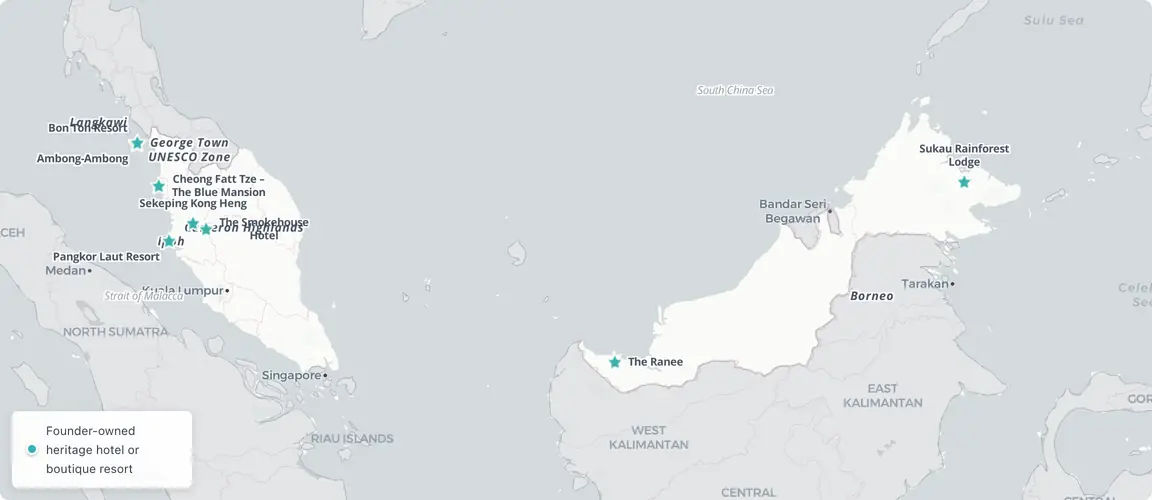
Three handovers documented, three still undecided
In March 1994, Luciano Pavarotti sailed to a private island off the coast of Perak and sang “O Paradiso” to 200 invited guests. The occasion was the opening of Pangkor Laut Resort — a Malaysian founder’s answer to what a luxury island hotel could be before that term existed in the regional vocabulary. Thirty years later, that resort’s third-generation heir oversees 38 properties on four continents. She did not inherit a guesthouse. She inherited a hospitality company.
This is the sector that institutional capital hasn’t seen. Malaysia’s founder-owned heritage hotels and boutique resorts — a cohort built over fifty years by architects, conservationists, ecologists, and expats — hold UNESCO recognition, international awards, and three documented succession transitions. None of them appear in standard hospitality intelligence databases as a named, analysed sector cohort.
The demolition that didn’t happen, and what came after
The story begins in 1937, when W.J. Warin opened a mock-Tudor hotel in the Cameron Highlands for British expatriates seeking relief from Malayan heat. The Smokehouse Hotel became a fixture of the colonial highlands until the Lee family bought it in 1977 and, notably, opened it to Malaysians for the first time. Eighty-seven years later it is still operating, still in the same architectural shell, still in the Lee family. That continuity is the earliest proof of the sector’s central thesis: founder-held, architecturally distinctive hospitality can survive without chains, without institutional capital, and without a rebrand.
The defining act of the modern sector happened in 1989. A group led by conservation architect Laurence Loh acquired the Cheong Fatt Tze Mansion in George Town — a derelict 38-room Chinese Baroque compound that the last family heir had abandoned, with thirty tenant families still living inside and demolition imminent. What followed was a six-year restoration, executed with imported Chinese craftsmen and thousands of rice bowls repurposed to recreate the mansion’s chien nien ceramic mosaics. The mansion reopened in 1995 as an 18-room boutique hotel. Five years later it won UNESCO Asia-Pacific’s “Most Excellent Project” for Cultural Heritage Conservation — eight years before George Town itself was inscribed.
That precedent mattered. When UNESCO inscribed Melaka and George Town on 7 July 2008, the heritage property asset class already had a template. The inscription triggered a boutique formation wave: shophouse conversions, colonial mansion restorations, and eco-lodge builds accelerated across five distinct geographic zones simultaneously. The Majestic Malacca had already reopened in January 2008 after YTL’s 2006 acquisition and a restoration costing approximately US$10 million. On Langkawi, Narelle McMurtrie had spent the decade between 1995 and 2004 importing eight antique Malay kampung houses from across the peninsula to construct Bon Ton Resort — a property with no architectural precedent. On the Kinabatangan River in Sabah, Albert Teo Chin Kion’s Sukau Rainforest Lodge had operated as Borneo’s first dedicated ecolodge since 1995, attracting David Attenborough and the BBC by 2011.
The sector’s formation was not coordinated. It was parallel — independent founders, across ecologically distinct regions, responding to the same thesis: that Malaysia’s pre-war built environment was worth restoring and that international guests would pay to stay inside it.
Five zones, no dominant capital
The majority of the cohort is in Penang. George Town’s UNESCO core zone — 109.38 hectares with a 150.04-hectare buffer, containing 5,013 buildings of fixed pre-war stock — concentrates the sector’s largest cluster. Conservation rules prohibit demolition within the zone. New entrants must restore existing fabric or not enter at all. That constraint, which initially suppressed development, has become the sector’s primary structural barrier to entry. Chris Ong’s George Town Heritage Hotels — Seven Terraces, Muntri Mews, Jawi Peranakan Mansion, and the 2025-opened Argus Residence — represent distinct architectural typologies within the same inscribed district. Shen Loh-Lim’s Qing Suites, which opened on 10 December 2025, is built into the Blue Mansion’s historic courtyard as Southeast Asia’s first TCM-anchored heritage hotel spa.
Langkawi tells a different story. The island’s hospitality leans toward landscape rather than building. McMurtrie’s Bon Ton and Temple Tree are assemblies of rescued Malay vernacular architecture, reassembled around pools and gardens. Joan and Ahmad Chik’s Ambong-Ambong Rainforest Retreat uses the family’s own land — acquired in the 1980s — as its primary asset, with conservation-first building protocols. Their son Amran Ahmed returned from HSBC and RBC banking in London in 2016 to launch Ambong Pool Villas, which has since earned Tripadvisor’s Travellers’ Choice Best of the Best five consecutive years.
Borneo functions at a different register entirely. Albert Teo’s Sukau Rainforest Lodge sits on the Kinabatangan in Sabah’s wildlife corridor — orangutans, pygmy elephants, proboscis monkeys at close range — where the primary tourism value is ecological rather than architectural. In Sarawak’s capital Kuching, Rosemarie Wong operates The Ranee and The Marian from two restored 19th-century shophouses, curating the Brooke dynasty’s century-long legacy as a hospitality product.
Cameron Highlands operates as a singular micro-climate — the only Tudor-era hotel stock in Malaysia, unchanged in atmosphere since the 1930s. And across Ipoh and the Klang Valley, architect Ng Sek San’s Sekeping Retreats catalysed a heritage revival in what had been a post-mining administrative town through a model of raw-luxe conversion that draws design-conscious domestic travellers in numbers that surprised even the Penang-centric press.
Five zones. Five architectural inheritances. The diversity within the cohort — conservation architects, ecologists, an Australian expat, a Hakka-Chinese naturalist, an Ipoh landscape architect — is the argument against the “charming guesthouse” characterisation.
What the databases miss
The sector’s invisibility to institutional capital has three overlapping causes.
The first is linguistic. The most detailed coverage of Malaysia’s heritage hotels runs through Bahasa Malaysia newspapers, Chinese-language dailies (Sin Chew, Oriental Daily), and Penang-focused English outlets. None of these appear in standard cross-border hospitality research workflows. The intelligence that informed this article includes a UNESCO Asia-Pacific award record, a VnExpress International feature on a third-generation hotel executive, a Malay Mail COVID-era operator survey, and a FITUR Madrid award citation from January 2014 — not the sources that populate institutional briefing decks.
The second is categorical. International hospitality databases categorise by chain, brand group, or operator scale. Malaysia’s heritage sector is almost entirely single-property or small-portfolio, family-led, non-branded. Its founders do not attend ITB Berlin. The properties appear on booking platforms under individual listings without category context.
The third is perceptual. “Heritage boutique hotel” in Southeast Asian shorthand connotes backpacker territory or upper-midscale romantic travel — not a cohort with UNESCO recognition, UNWTO awards, and Small Luxury Hotels of the World distribution. The gap between the sector’s actual credential density and its perceived tier is the mismatch this article documents.
Together, these three causes compound. A sector that publishes in three languages no aggregator reads, organises as single properties no category captures, and carries a credential density no casual perception expects does not merely go undercovered — it becomes structurally invisible, present in the record yet absent from the analysis. What is missing is not the intelligence itself. It is that no one has yet assembled the scattered pieces into a single, legible whole.
Who stayed when leaving was rational
The sector’s crisis record separates it from a directory listing.
Laurence Loh acquired the Cheong Fatt Tze Mansion in 1989 when the alternative was demolition. The 38-room compound had no established value as hospitality real estate. His group spent six years restoring what the building required rather than what a financial model would have specified. The 2000 UNESCO recognition validated both the conservation methodology and the commercial model. His son Shen Loh-Lim, now managing director, took a project stalled by COVID — the Qing Suites spa annexe, planned for 2020 — and opened it on 10 December 2025. The 35-year arc from acquisition to Qing Suites is a single, unbroken family commitment.
Peter Lee bought the Smokehouse in 1977 from a British colonial officer and ran it for thirty-one years before dying suddenly in early 2008. His son Alex Lee was living in Thailand. He returned to Cameron Highlands, stepped into management, and has run the property for seventeen years since. The 87-year-old hotel has had two owners in its history.
Francis Yeoh developed Pangkor Laut Resort in the early 1990s and invited Pavarotti to open it. The resort navigated the 1997 Asian Financial Crisis when regional luxury demand collapsed, then survived the 24-month COVID border closure as part of YTL Hotels’ broader portfolio. Yeoh Pei Xien’s elevation to Vice-President of Strategy and Transformation in 2024 marks the first third-generation Yeoh in the hospitality division. She described managing “nepo baby doubts” in a VnExpress International interview. The self-criticism is itself evidence that the succession is genuine rather than ceremonial.
Albert Teo Chin Kion built Sukau Rainforest Lodge on the Kinabatangan in 1995 with a business model dependent almost entirely on international wildlife tourists. When Malaysia’s border closed on 18 March 2020, that customer base disappeared for twenty-four months. Teo’s BEST Society — the NGO arm that won the UNWTO Ulysses Award in Madrid in January 2014 — continued operating community conservation programmes through the closure. The lodge survived. Teo has named no successor.
The asymmetry between Albert Teo and the Loh, Lee, and Yeoh families defines the sector’s two current states: transitions completed, and founders still operating without a visible plan. Both groups survived the same stress test. The ones with no successors did not exit. Their stories remain undocumented in any institutional record while the founders who lived them are still alive to tell them.
More than a charming guesthouse
The heritage hotel in Malaysia is, almost by definition, a cross-cultural act. The Blue Mansion is a Hokkien merchant’s palace built by Straits Chinese craftsmen, now run by the architect’s son and positioned as a Peranakan cultural landmark. The Smokehouse is British nostalgia operated by a Malaysian family that dismantled the colonial-era exclusions. Sukau Rainforest Lodge is Hakka-Chinese-owned, built within the Orang Sungai traditional territory of the Kinabatangan basin, marketed to international wildlife tourists. Bon Ton imports Malay vernacular architecture to an island owned by an Australian.
This cross-cultural character is not accidental — it reflects Malaysia’s built environment itself. The shophouse is a Straits Chinese and Anglo-Indian hybrid. The Cameron Highlands bungalow is British tropical. The Malay kampung house is a vernacular adapted across geographic zones. Heritage hospitality is the commercial formalisation of that recognition — and the detailed record of how each founder navigated it exists, in three languages, in sources that have not yet been translated into a form institutional capital can use.
Three forces converging in 2028
The sector’s urgency rests on three forces operating simultaneously.
The first is demographic. Roughly 60% of the 2008–2015 boutique cohort founders are in the 55–75 age band. Three transitions are on the record — Loh to Loh-Lim at Blue Mansion (2015), Lee to Lee at Smokehouse (2008), Yeoh to Yeoh at YTL Hotels (2024). But Albert Teo, Narelle McMurtrie, Chris Ong, and Rosemarie Wong have no named successors. The closures of Clove Hall in January 2018 and Sinkeh in 2020 are the canonical failure mode: founder retirement, change of use, no handover. No bankruptcy. Just a founder who stopped.
The second is infrastructure. Penang International Airport is undergoing a RM1.55 billion expansion that will raise annual passenger capacity from 6.5 million to 12 million, with completion targeted for June 2028. A doubling of airport throughput into the gateway for George Town’s heritage district changes the demand environment for boutique properties within a UNESCO-protected zone where supply cannot grow. Occupancy in the George Town heritage boutique segment ran at 68–74% through 2024 on 8.2 million arriving guests — a record 13.3% increase over 2023.
The third is operational pressure. The Minimum Wages Order 2024, gazetted December 2024, raised the statutory minimum wage to RM1,700 per month from February 2025, extended to all employers from August 2025. For boutique properties with small teams and low economies of scale — and a documented 7-month hiring cycle for heritage conservation project managers — the margin environment is compressing precisely when founders are already reconsidering their timelines.
These three forces converge on the same 2-to-5-year span. Each rests on a dated, published figure — the airport contract, the wage order, the founders’ recorded ages — not a projection.
Before the last founders step back
The hospitality intelligence that covers ASEAN produces market-size estimates, occupancy data, and brand rankings for the chains. It does not produce, in any systematic way, the story of a 1989 demolition rescue that created an asset class; or a sudden bereavement in 2008 that required a son to return from abroad; or an Australian founder who spent a decade importing kampung houses because she believed the vernacular architecture was worth saving.
That intelligence exists. It runs through the UNESCO award records, the Malay Mail archives, the UNWTO Ulysses citation from Madrid, the VnExpress interview in which a third-generation Yeoh described her doubt before taking responsibility for 38 properties. It lives in Bahasa, Chinese, and English sources that no standard cross-market aggregator reads simultaneously.
The founders who built this sector are alive. Most are still running the properties they built. The ones who have successors have chosen them. The ones who don’t are still deciding, or haven’t started.
First-person testimony, operational reality, and succession legibility coexist only while these founders are still the ones running the properties.
These hotels have been here for thirty, fifty, eighty-seven years.
The 1989 rescue that turned a condemned heritage building into an asset class happened because one founder refused the wrecking ball — and the only full account of why lives in that founder’s memory and a scatter of Malay Mail clippings. The third-generation Yeoh who described her doubt before taking on 38 properties can still be interviewed today; the founder who spent a decade importing kampung houses can still explain why she bothered. Once they step back, a buyer inherits the building but not the reasoning that makes it worth more than its walls — and that reasoning is the part no occupancy table or brand ranking will ever reconstruct.
Researched 23 sources in English.