 Skip to main content
Malaysia Halal Foods: The Billion-Ringgit Stamp
Malaysian biscuits and frozen flatbread sit on shelves from Birmingham to Bahrain, yet almost no investor can name the makers. In 2021 a Philippine giant paid RM1.925 billion for one — not for the snacks, but for a halal certification stamp that opens a hundred markets. The founders who built that stamp are all handing over at once.
Malaysia Halal Foods: A Two-State Production Core
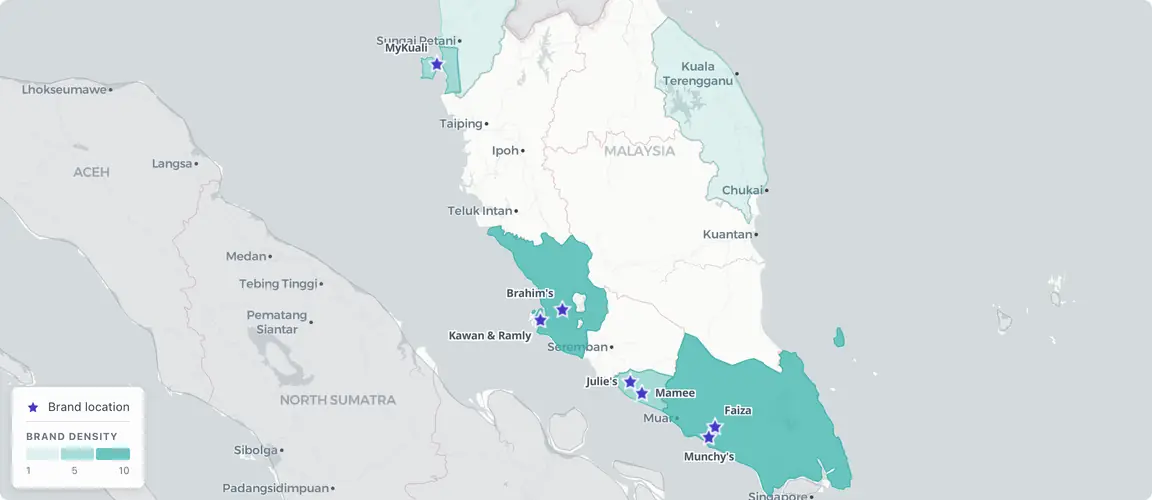
The certification that priced a generation's exit
A family in Jeddah can serve Brahim’s rice-and-rendang from a foil pouch, a convenience store in Tokyo can stock Mamee’s potato crisps, and a São Paulo importer can shelve Julie’s sandwich biscuits — without any of them registering that all three are founder-owned Malaysian companies, and almost none able to name one.
Then the market put a price on that invisibility. In November 2021 the Philippine-listed Universal Robina acquired Munchy Food Industries — a biscuit maker from Batu Pahat, in the southern state of Johor — for RM1.925 billion in cash (about US$454 million), the largest food founder-exit Southeast Asia had seen in a decade. The money was not really for the wafers. It was for what stands behind them: a halal-certification track record that turns a small-town Malaysian factory into a supplier the world’s importers will clear without asking twice.
From RM1,500 to a billion-ringgit exit
We told the equipment suppliers that they could take them back or they could let us use them, and when we had the money, we would pay them.
Malaysia’s packaged-food industry was built, almost entirely, by people who started with very little and never sold a share to a stranger. In 1958 four Kerk brothers pooled RM1,500 to make cream crackers in Batu Pahat under the brand Cap Ping Pong; Hup Seng (合成) is still run by the family that founded it. Pang Chin Hin started what became Mamee in Melaka in 1971; Gan Thiam Chai began delivering popiah (spring-roll) skins from a lorry in 1976, the seed of Kawan Food; the Tan family launched Munchy’s in 1991. A parallel set of founders built from the Muslim-Malay side of the economy: Syed Manshor started the spice brand Adabi in 1984, Ibrahim Ahmad Badawi left a university food-science faculty to commercialise sterilised halal ready-meals at Brahim’s in 1986, and a Cairo-born trader, Faiza Bawumi, turned a few ringgit of sewing capital into a rice business that by 1989 made her the first Muslim woman in Malaysia licensed to wholesale rice.
What turned this scatter of family firms into an industry was a stamp. JAKIM — the federal body that became Malaysia’s halal-certification authority, centralised in 1994 — gave every one of these companies, Chinese-Malaysian and Bumiputera alike, a common credential. It is the one thing a Hup Seng cracker and a Brahim’s curry pouch share, and the reason both sell without argument in markets neither founder ever visited.
Then came the test that decided who would last. When the Asian Financial Crisis broke in 1997, the ringgit fell from 2.50 to 4.80 against the US dollar, credit froze, and the imported machinery and inputs food makers relied on repriced overnight. Munchy’s was mid-expansion. Its managing director, Tan Chuan Kok, later described to The Star the decision that saved it: rather than default, he went to the suppliers of the machines he could no longer finance. He told them they could take the lines back, or let him keep running them and pay once recovery came. They let the lines run. Munchy’s revenue climbed from RM14 million in 1997 to RM58 million by 1999, every deferred debt settled once the economy turned. The brands that cleared 1997 emerged with distribution and certification track records their imitators could not buy — and a quarter-century later, those same founders are the ones now changing hands.
Where the certification base is built
The geography of Malaysian halal food is not spread evenly; it clusters, and the clustering shows where the certified production base was built. Two states do most of the work. Johor, in the south, is the Chinese-Malaysian snack heartland: Batu Pahat alone produced Hup Seng, Munchy’s and the prawn-cracker maker Snek Ku, with the soy-sauce house Habhal’s and the confectioner Apollo nearby. Its edge is part history, part logistics — a dense cluster of food-machinery workshops and a causeway to Singapore that has always been the export gateway. The Klang Valley and surrounding Selangor form the second pole, an industrial one: the Pulau Indah port and its halal park, the headquarters, the modern plants. Ramly, Adabi, Kawan and Brahim’s all run from here.
The smaller clusters each carry a character. Melaka is heritage Chinese-Malaysian processed food — Mamee in Ayer Keroh, Julie’s in Alor Gajah. Penang trades on culinary prestige: premium instant noodles, Nyonya pastes built for the diaspora. The northern padi belt of Kedah, Perlis and Terengganu supplies the rice and condiments the Malay-Muslim table is built on.
The most revealing detail sits in that last category. The sector’s flagship Bumiputera brand, Faiza, does not operate from the Malay padi heartland at all; its mill stands in Sri Gading, just outside Batu Pahat — inside the Chinese-Malaysian snack heartland of Johor, not beside it. Sort these companies by ethnicity and you would expect the Malay-Muslim rice business in the conservative north and the Chinese-Malaysian biscuit makers in the south. The map says otherwise: the two founder cultures are interleaved, building inside the same perimeter and often the same district. That concentration is also the argument. A sector spread thin is hard to consolidate; one whose value is packed into two states is exactly what an acquirer can map, price and roll up. Universal Robina did not have to search all of Malaysia to find Munchy’s — only one corner of one state.
What the databases cannot see
If these brands ship to a hundred countries and one just sold for nearly two billion ringgit, why can no analyst name them? Four barriers compound.
The first is language. The serious record of this sector lives in Bahasa Malaysia and Chinese, not English. The fullest account of Faiza Bawumi’s life is a 240-page biography written by her eldest daughter, in Malay. Datin Shala Siah’s role as equal co-founder of Ramly — she and her husband hand-cut the first patties together — is routine in the Malay press and almost absent from English coverage, which tends to credit her husband alone. An English-only researcher does not see a smaller version of this sector; they see a distorted one, with half its founders missing.
The second is structure. Most of these companies are private and family-held, obliged to publish nothing. Ramly, Adabi, Faiza and Habhal’s file no public accounts; their ownership and succession plans are visible only to whoever buys company-registry documents and can read them. The few that listed — Hup Seng, Kawan, Apollo — only show how opaque the rest remain.
The third is analytical. Global research houses organise the world by category and multinational. A founder-owned Malaysian biscuit maker is too small for a global snack report and too foreign for a Malaysian equities note. It falls into the gap between the two, documented nowhere precisely because it belongs to no one’s beat.
The fourth barrier is also the asset. JAKIM certification is the most under-priced export infrastructure in Southeast Asia, and almost nobody outside the trade understands how it works. The asymmetry is directional: Malaysia recognises 85 foreign halal bodies across 47 countries, while more than a hundred importing nations accept JAKIM-stamped product without renegotiation. Manufacture inside the JAKIM perimeter and the world’s Muslim-market shelves open at once. The proof is in the destinations: Malaysia’s three largest halal-export markets are China, Singapore and Japan — none Muslim-majority. A credential built for a domestic religious requirement turned out to be a passport into the secular markets that buy the most.
Together the four leave an information gap where an assembled record should be. The brands are real, the certification is real, and the RM1.925 billion exit proves the value is real. What is missing is the assembly — naming the founders, mapping the succession, reading the Malay and Chinese sources the databases skipped. That work has been done nowhere. It is the distance between what the sector is worth and what the world has bothered to learn about it.
The founders who refused to fold
What separates the brands that cleared the gate from the hundreds that did not is not luck but a set of decisions made when quitting would have been rational.
Brahim’s is the sharpest case. Ibrahim Ahmad Badawi was a founding member of a university food-science faculty before he left to build the company; in 1988 it rolled out the first halal retort-pouch sterilised meals in Southeast Asia and went on to supply halal field rations to United Nations peacekeepers. On the eve of the pandemic it produced 53,000 meals a day for 38 international airlines. COVID erased almost all of it — output fell to around 5,000 meals a day, and the company, already classified PN17 (Bursa Malaysia’s status for distressed listed firms), was delisted in June 2022. Ibrahim refused the exit: he increased his personal stake rather than walk away, held out against terms he judged unfair, and kept the retort-pouch capability intact. By February 2025 the company could report that more than half its pre-pandemic airline clients had returned.
Julie’s faced collapse not in demand but in trust. In October 2008 Hong Kong inspectors found melamine, an industrial chemical, in its crackers, traced to a contaminated leavening agent from a Chinese supplier; bans followed and founder Su Chin Hock put the loss at RM10–14 million. He could have quietly reformulated and waited. Instead he recalled and destroyed the affected stock, rebuilt supplier quality control, and — the decision that defined the brand — opened the Melaka factory to international distributors to inspect, and spoke about the failure on the record. Julie’s now sells in more than 80 countries.
Apollo Food shows the other end of the arc: not a crisis survived but a succession executed cleanly. In December 2023 the founding Liang family sold control to Scoop Capital, run by the Cheah family, for RM238 million (about US$51 million), the listing preserved and a plant upgrade begun under the new owners. One Teochew family handed a built business to another, with no fire sale — increasingly the template for how this generation will exit.
Mamee engineered its succession in advance. After Pang Chin Hin — who died in 2022 at 96, with five generations under one roof — the family left nothing to chance: the second generation took executive education at Harvard, the third, including group director Pierre Pang, a formal family-business programme at the National University of Singapore. Where most ownership structures are improvised, Mamee built an institution.
None of this could be written from a press release, which is the point. A trade database can tell you Munchy’s ships to fifty countries and Julie’s to eighty. It cannot tell you that Tan Chuan Kok kept his factory by inviting his creditors to repossess it, or that Su Chin Hock rebuilt trust by opening his plant to the people who had banned his product. That documentation does not live in the databases — which is also why the Bumiputera founders are the richest seam of all. Ramly Mokni and his wife Shala Siah built an empire of some 25,000 street stalls after a state lender rejected their RM7,000 loan on the reasoning that Malays did not eat burgers. Faiza Bawumi built a rice business large enough to need its own mill, having arrived in the country in 1964 with one child and almost no capital. Their stories are told in full only in languages the global databases never indexed.
Two cultures, one shelf
Malaysia’s halal-food sector is one of the few consumer ecosystems anywhere built by two founder cultures at once, inside the same rules. The Chinese-Malaysian families — Pang, Su, Kerk, Gan, Liang, the Tans — came from trading and hawking backgrounds, bootstrapped through family capital, and listed in batches between 1992 and 2005. The Bumiputera founders — Syed Manshor, Ramly Mokni and Shala Siah, Faiza Bawumi, Ibrahim Ahmad Badawi — built through the halal-first lens, and without the early bank credit their counterparts could draw on.
That credit gap shaped which founders had to be resourceful. When MARA turned down Ramly’s loan, Bank Pembangunan stepped in; Faiza built sale by sale until she could finance a mill. The Bumiputera brands that exist today are disproportionately the ones whose founders found a way around the institutions meant to help them.
What binds the two cultures is the stamp and the shelf. A Hup Seng cracker and an Adabi curry paste compete for the same trolley, certified by the same authority, sold through the same hypermarkets, exported through the same trade agency. The sector’s identity is not Chinese or Malay but Malaysian — the product of a country that made halal certification shared national infrastructure rather than a sectarian boundary. For the founders, that stamp became the most transferable asset on the balance sheet, frequently worth more than the factory that earned it.
Two facts arriving together
The first: the founding generation is handing over all at once. The brands that define the sector were started between the late 1950s and the early 1990s by founders now elderly or already gone — Pang Chin Hin died in 2022, Habhal’s patriarch Datuk Lambak in 2020 at 100. Across roughly two dozen founder-owned brands, control is changing hands inside one narrow window. Some transitions are engineered, like Mamee’s; some improvised; some, like Habhal’s, barely documented. All are happening now.
The second: institutional capital has already decided the sector is worth paying for. The RM1.925 billion Universal Robina paid for Munchy’s was no one-off; two years later Scoop Capital bought control of Apollo cleanly, preserving the listing. The pattern is set — a well-capitalised acquirer pays a fair price for a founder business with proven certification and export reach, and keeps it running. Two deals in three years mark the pattern so far, and the visible candidates for a third are already named: listed names on modest multiples, and unlisted founders like Brahim’s — founder still in control, retort-pouch capability intact, recovery documented but not yet priced.
The macro backdrop sits alongside both facts. Malaysia’s halal exports reached RM61.79 billion in 2024 — roughly US$13 billion — up 15% in a year, and the country has led the main global Islamic-economy ranking for over a decade. Global Muslim food spending already runs into the trillions. The shelf space these founders spent forty years securing carries that scale now, at the same moment they are stepping back.
The two facts overlap: a founding generation handing over control, and buyers who have already shown what they will pay for what that generation built. The certification track record each founder holds today sits inside a company they still run. Once a transition completes and that record is folded into an acquirer’s balance sheet, it stops being something a founder can sell — it becomes something someone else already owns.
The intelligence gap
For three kinds of reader, the same sector reads three ways. For an investor, it is a pipeline of founder businesses with proven export infrastructure, changing hands inside a two-year window, most of them not yet on any screen. For a trading company or importer — in Dubai, Hong Kong, São Paulo — it is a roster of certified suppliers who can clear product into a hundred markets, hiding behind brand names no buyer has been taught to recognise. For an operator or partner, it is a set of founders who solved the hardest problem in the business — trust at scale, across borders, under a credential the world accepts — and are now looking for who comes next.
What unites all three is that the intelligence required to act has never been assembled. It exists, but it is scattered: in Bahasa Malaysia biographies and Chinese-language trade profiles, in company-registry filings, in the memory of a founder who gave one radio interview a decade ago. No database holds it. No analyst covers it. The RM1.925 billion that Universal Robina paid for one Johor biscuit company was, in the end, the price of having looked when no one else had.
Faiza Bawumi arrived in Malaysia in 1964 with one child and almost no capital, and built a rice business large enough to need its own mill. She is handing it over now — as is Brahim’s founder, retort-pouch line still intact, and a dozen others, in months rather than years. What changes hands with them is the JAKIM credential they spent forty years earning: clearance onto a hundred Muslim-market shelves, from China to Japan, neither of them Muslim-majority. Once that passport is folded into an acquirer’s balance sheet, it is no longer for sale — it is inventory on someone else’s books.
Researched 41 sources in English, Malay.