 Skip to main content
Malaysia Fashion: Five Dynasties, One Charter
In 2018, four siblings of a Malaysian pewter dynasty transferred 49.92 million shares to a Labuan foundation named Yuhe — Mandarin for to heal. That family is one of five Chinese-Malaysian and Bumiputera anchor brands in active generational handover right now. No Western database aggregates them.
Malaysia Fashion-Accessories: Greater KL Concentration
Heritage houses reach the threshold
In 2018, four siblings of Royal Selangor’s third generation transferred 49.92 million shares of their family holding company, Kai Holdings, to a Labuan-registered foundation named Yuhe (愈合) — the Mandarin word for to heal. The naming was explicit. The foundation existed to heal the legacy of a second-generation feud that had once split the firm into three rival pewter entities — Tiger Pewter, Selangor Pewter, Lion Pewter — of which only one survived.
The transfer appears in a 2018 family-business retrospective in The Edge Malaysia and a Tatler Asia profile of fourth-generation managing director Yong Yoon Li. It does not appear in any institutional database that an investor outside Malaysia would consult. The Royal Selangor family charter that preceded it — codified in 2002 and revised more than thirty times since — is not catalogued by Bloomberg, PitchBook, or Crunchbase. The 1997 Asian Financial Crisis story of how Bonia’s founder sold nine properties at a loss and watched his share price fall from RM10-plus to about 50 sen is documented in WargaBiz, a Malay-language business retrospective. The fact that Jakel’s chief executive spent six months in 1997-98 convincing Japanese and South Korean manufacturers to bypass their Singapore agents is documented in The Star and Pubiperak, a Bahasa Malaysia trade portal. None of these stories speak to one another in any single intelligence platform.
This is the structure that hides a sector.
What the world isn’t reading
Malaysia has built a heritage fashion-accessories sector across five Chinese-Malaysian and Bumiputera anchor brands — four founding families, since Bonia and Carlo Rino are both Chiang-family — each founded between 1885 and 1990, each crisis-tested by the 1997 AFC, and each now in active generational handover between 2019 and 2024. Royal Selangor (1885) is the world’s largest pewter manufacturer, with 80+ global boutiques and 500+ department-store concessions including Harrods in London and John Lewis. Padini (1971) reported FY2024 revenue of RM1.92 billion across 140 Malaysian stores and franchises in seven countries. Bonia (1974) operates as a multi-brand luxury operator — its own label plus Braun Büffel, Renoma Paris, Valentino Rudy, and Santa Barbara Polo & Racquet Club — with FY2024 revenue of RM413.7 million. Jakel (1983) runs the world’s largest standalone textile mall, Cap Square in Kuala Lumpur, and reported RM1.45 billion in textile revenue in 2018. Carlo Rino (1990), the third Chiang family brand, transferred from the LEAP to the ACE Market of Bursa Malaysia on 18 December 2024 in an IPO that was oversubscribed 18.43 times.
The arc that produced this cohort is more concentrated than the brands themselves suggest. Royal Selangor’s founder, Yong Koon, arrived from Shantou in 1885 to make pewter for the tin-mining community then building colonial Kuala Lumpur. His workshop on Cross Street — today Jalan Silang — sat within walking distance of streets where the next century of Chinese-Malaysian commerce would compound. By the 1970s, the first wave of post-independence founders had begun: Yong Pang Chaun (Padini, 1971), Chiang Sang Sem (Bonia, 1974). By the 1980s the Bumiputera tier had begun in earnest: Mohamed Jakel (Jakel Trading, 1983) opened with RM30,000 capital in Muar, Johor, selling carpets and rubber mats. The royal warrant Sultan Salahuddin Abdul Aziz Shah conferred on Royal Selangor in 1979 — and the corporate renaming that followed in 1992 — set a template the rest of the sector would use, formally or informally, to convert local craft into export-grade credibility.
Then 1997 broke. The ringgit fell 45 percent. The Kuala Lumpur Composite Index fell 70 percent. Singapore-based suppliers stopped delivering. Banks began calling in covenants. The Malaysian heritage fashion sector that survives in 2026 is the sector that survived 1997-98 — and the brands that did so without selling out, going public on someone else’s terms, or collapsing into receivership are the brands that now have founders entering retirement age in the same five-year window.
Greater KL, not the heritage cities
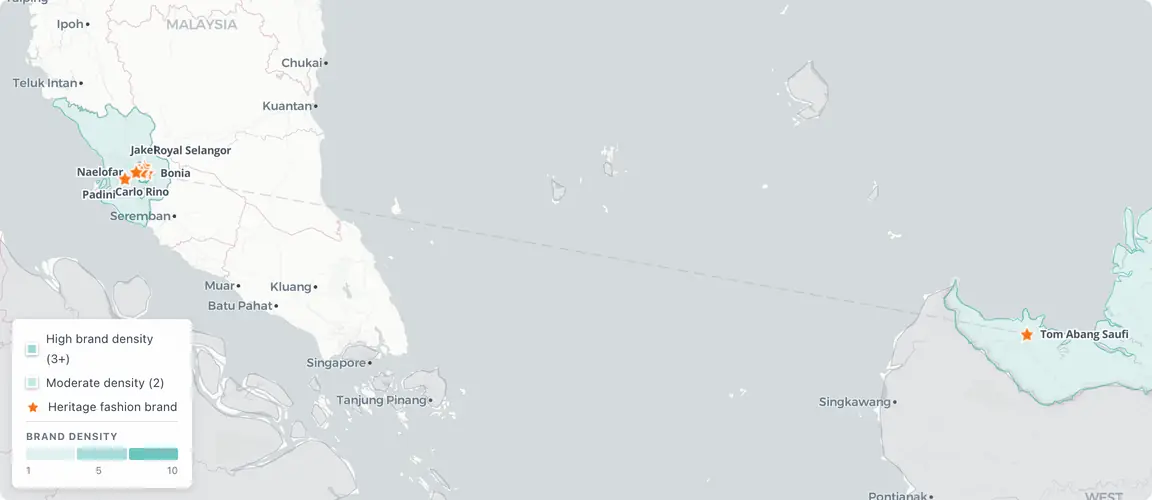
A reader’s first instinct, looking at a list of these brands, is to map them across Malaysia’s cultural-heritage cities — Penang, Malacca, Ipoh, the towns whose Peranakan and Baba-Nyonya histories are taught in tourism brochures. That instinct is wrong. Roughly 85 percent of Malaysia’s heritage fashion concentrates within 50 kilometres of central Kuala Lumpur. The Federal Territory itself holds six anchor headquarters: Bonia in central KL, Royal Selangor in Setapak, Jakel in Cap Square, Carlo Rino, Naelofar in TTDI, Rizman Ruzaini at the Shangri-La. The neighbouring Selangor state holds four more, including Padini’s Shah Alam headquarters and Siti Khadijah’s operations. Penang appears only as Bonia’s historical manufacturing site. Malacca and Ipoh appear not at all. The single national-distribution exception sits 800 kilometres east on the island of Borneo: Datuk Indera Tom Abang Saufi, working out of Kuching, Sarawak, is Malaysia’s sole heritage fashion house outside Greater KL. The exception is small enough to prove the rule. The dynasties don’t just share an era and a crisis. They share an address book.
That geography is not incidental to the succession story. The Chinese-Malaysian families that built this cohort intermarried, traded, and competed within walking distance of each other for three generations. When the 2002 family charter became a topic of conversation, it spread through a community small enough to discuss it informally — and dense enough to make the difference between governance models visible to neighbours.
Three press ecosystems, one sector
The structural reason this sector is invisible to institutional capital outside Malaysia is not that the documentation is missing. It is that the documentation lives in three press ecosystems that are read by separate audiences and aggregated by no one.
The Chinese-Malaysian press — Sin Chew Daily, Oriental Daily 东方日报, Nanyang Siang Pau 南洋商报 — is where the heritage-family arcs live. The Chiang family’s intergenerational logic, the Yong family’s century-long pewter inheritance, the Loh family’s textile heritage at Jakel: these stories appear in Chinese-language business retrospectives that Western analysts do not read. A Zhihu (知乎) long-form essay on Bonia’s 1997 reckoning, surfaced in our research, recounts founder details that English-language press never captured.
The Malay-language press — Berita Harian, mStar, Bernama, Pubiperak — is where the Bumiputera arcs live, alongside royal-patronage coverage. The pubiperak.com biography of Datuk Seri Faroz of Jakel documents the 1997 supplier pivot in granular operational detail. mStar’s January 2019 interview with Datuk Rizalman Ibrahim establishes the 15-year royal-tailor relationship with the Permaisuri Agong consort. These are not obscure outlets — they are major Bahasa Malaysia news sources with national reach. They are simply not in the corpus that international intelligence platforms ingest.
The English-language Malaysian business press — The Edge Malaysia, The Star, Malay Mail, Tatler Asia — sits closest to the international institutional reader, but it covers only one of the three story streams, and even there it covers the Bursa-listed end of the sector more reliably than the private-family end. The Edge’s family-charter feature on Royal Selangor — the single most important governance case in Malaysian family business — is excellent. But it is one article, in one ecosystem, on one company. A reader relying on English-language press alone sees Royal Selangor’s charter, misses Jakel’s 1997 pivot, misses Bonia’s nine-property reckoning, misses the Yuhe Foundation, and misses the Chinese-language commentary that makes the 2002 charter legible as a community decision rather than a private one.
This is the intelligence gap. Not a data gap. A synthesis gap.
Five tests, five answers
Royal Selangor is the only dynasty in the cohort that has documented its governance.
The 2002 family charter, codified by Yong Poh Kon and his siblings after the second-generation feud that nearly destroyed the firm, established a six-member family council, written succession rules, and an explicit deliberation process. Over the following two decades, the document went through more than thirty revisions. In 2018, the four third-generation siblings consolidated their entire equal shareholding in Kai Holdings into the Yuhe Foundation. In late 2019, fourth-generation Yong Yoon Li took the managing director chair, with cousin Chen Tien Yue running international operations. The firm now operates 80+ global boutiques and 500+ department-store concessions, including Harrods and John Lewis. “We’re still designing and making things in pewter like our great-grandfather was doing over 120 years ago,” Yong Yoon Li told Tatler. The continuity the line describes is partly craft. It is mostly governance.
Bonia’s succession is informal but observable. Founder Chiang Sang Sem retains 41 percent through Bonia Holdings and Freeway Team and serves as Group Executive Chairman. His son Daniel Chiang Fong Seng was redesignated Group CEO on 1 April 2023 and Executive Vice Chairman in October 2024. The handover playbook is the post-1997 playbook: Daniel led the 2012 acquisition of Braun Büffel Southeast Asia from Christiane Brunk, great-granddaughter of the German leather house’s founder, and now manages a multi-brand portfolio that generates 31 percent of revenue from Singapore. The crisis-tested instinct that built the firm — sell nine properties at a loss rather than default — has been transmitted by example, not by charter. (Bonia’s transformation arc is profiled separately on the Bonia brand profile.)
Padini’s succession runs through the board. Founder Yong Pang Chaun remains managing director; his wife Chong Chin Lin and three sons — Andrew, Benjamin, Christopher — sit as executive directors. The family controls 43.74 percent through Yong Pang Chaun Holdings. The succession pattern is plural inheritance rather than primogeniture, made workable by a Bursa-listed structure that provides governance scaffolding the family did not have to invent. The counter-cyclical 5 March 1998 IPO that funded the company’s expansion at the AFC trough is the strategic genealogy: take the institutional discipline of the public market when private discipline is insufficient.
Jakel’s succession was forced by death. When Mohamed Jakel bin Ahmad died in 2009, Datuk Seri Mohamed Faroz inherited operational control after the family had already been running together for years. The pivot that became the firm’s structural advantage had been built in 1997: Faroz spent six months convincing Japanese and South Korean textile manufacturers to bypass Singapore intermediaries and supply Jakel directly, converting the firm from re-wholesaler to direct importer. By 2012, Jakel acquired Cap Square Towers for more than RM300 million, opening the world’s largest standalone textile mall. By 2023, a 27.33 percent stake in Cypark Resources had extended the group into renewable energy. The pubiperak.com biography catalogues the trajectory in detail; no English-language equivalent exists.
Carlo Rino’s succession plays out through the capital markets. Chiang Fong Yee — Dato’ Sri, eldest son of Bonia’s founder — runs the third Chiang family brand as managing director. The LEAP-to-ACE Market transfer on 18 December 2024, with an IPO oversubscribed 18.43 times at 27 sen, made Bursa governance the inherited succession template for a Chiang family brand that had been informally family-managed since 1990. The –17.4 percent debut suggests the institutional investor base did not entirely buy the family-narrative premium; the question of whether full-year FY2025 performance vindicates the listing remains open.
The modest-fashion cohort — Neelofa’s Naelofar (2014, 30+ markets, 700+ distributors), Hajah Padzilah Enda Sulaiman’s Siti Khadijah (2009, IPO-track), Rizman Nordin and Ruzaini Jamil’s Rizman Ruzaini (2005, Naomi Campbell at Dubai Fashion Week SS24, V&A inclusion 2024) — is on a different succession clock. Its founders are in their thirties and forties, not their sixties and seventies. But the operational disciplines they have built (Naelofar’s distributor network, Siti Khadijah’s Srikandi Skills College, Rizman Ruzaini’s atelier inside the Shangri-La with roughly 100 staff) are the infrastructure that will determine whether the next generation has anything to inherit.
The reflex and the template
Family-business reflexes built this sector. Documented family governance is what will carry it forward. The two are not the same thing.
Reflexes are tacit. They are the instinct to sell nine properties rather than default. The instinct to list on the Bursa Second Board when the index is down 70 percent. The instinct to fly to Japan and Korea in 1997 and explain, in person, why your firm is worth supplying directly. Reflexes pass between generations through observation, apprenticeship, and crisis exposure — but they do not pass cleanly. They lose fidelity. By the third generation, the founder’s reasoning has compressed into rules of thumb. By the fourth, the rules of thumb have become brand mythology.
Templates are explicit. The Royal Selangor charter, with its six-member family council and its thirty revisions, is a document that survives the founder’s death. It can be read by an heir who never met her grandfather. It can be amended by a council that reasons together rather than by an individual who reasoned alone. The Yuhe Foundation, by consolidating the four third-generation siblings’ equal shareholdings, removes the equity fragmentation that drives most family-business break-ups. What the rest of the cohort calls “trust between brothers” Royal Selangor has translated into structure.
The convergence question — whether the four other dynasties codify, or continue to run on reflex — is a question this article documents rather than resolves. The record so far shows one dynasty with a written charter and four operating on inherited instinct.
What is converging
Three things are happening at once. The 1997-cohort founders are entering the late-sixties-to-mid-seventies band. The 2024 FashionValet criminal-breach-of-trust charges against Vivy Yusof and Datuk Fadzarudin Shah Anuar — RM8 million from a Khazanah Nasional and PNB investment, trial scheduled for July 2026 — have cleared the over-financialised celebrity-influencer tier of the modest-fashion market without contaminating the operators. Datuk Jovian Mandagie’s RM5.28 million bankruptcy in July 2025 removed another celebrity-tier brand from the field. The trial is scheduled through 2027 and continues to generate Malaysian fashion press coverage. The structural effect — fewer competitors for the genuinely operating modest brands — is already visible.
Meanwhile the global modest-fashion market reached USD 327 billion in 2023, per DinarStandard’s State of the Global Islamic Economy Report 2024/25, with the report’s own projection citing USD 433 billion by 2028. Malaysia retains the overall number-one position on the Global Islamic Economy Indicator for the eleventh consecutive year. In the modest-fashion sub-category specifically, Indonesia ranks first and Malaysia second — a status the Indonesian government has reinforced with the IN2MF 2024 trade show, which set a MURI world record in November 2024 with 1,550 attires from 208 Indonesian brands plus international designers. Malaysia does not yet have a modest fashion week of equivalent scale. The institutional infrastructure that exists — MIHAS 2025 in September at MITEC, the Islamic Fashion Festival running since 2006, the Kuala Lumpur Fashion Week now in its thirteenth edition — operates closer to the trade-show register than the international showcase register.
The heritage cohort’s founders’ tacit knowledge — why nine properties were sold in 1997, why a Bursa listing was attempted at the trough, why the family charter was worth thirty revisions — is documented only where it has been written down. The Royal Selangor template is readable because it was codified. The other four dynasties’ reflexes exist only in the founders’ own accounts and family memory.
What the record already shows
The brands in this sector have been here all along. The Yuhe Foundation has existed since 2018. The Royal Selangor family charter has existed since 2002. The Padini IPO has existed since 1998. The pewter workshop on Jalan Silang has existed since 1885. None of this is new information. It is simply information that lives in three press ecosystems, that requires reading across three languages, and that has not been synthesised by any database an institutional investor would consult. The intelligence exists. It has not been assembled.
Researched 30 sources in English, Malay, Chinese.