 Skip to main content
Malaysia Beauty: Two Tracks, One Country
Dr Mohd Hannan's Muslimah medispa runs 120-plus Malaysian branches plus Brunei (Sdn Bhd RC30000438) and an Indonesia partnership with The Face Klub Jakarta. 1,500 staff. Own GMP cosmetics factory. UMK Adjunct Professorship. The chain doesn't appear in any English-language deal-sourcing literature — it lives in Malay press, an academic journal, and the SSM register.
Malaysia Beauty Services: Two Cohorts, One Country
Two tracks, one reckoning
The chain that doesn’t exist in English
Dr Mohd Hannan Mohd Yusof runs 120-plus medispa branches across Malaysia. He runs more under a Brunei-registered Sdn Bhd (RC30000438). He runs more again in Indonesia under a licensed-area partnership with The Face Klub Jakarta. He employs roughly 1,500 staff. He owns the GMP-certified cosmetics factory in Muar that supplies his clinics. The Universiti Malaysia Kelantan named him an Adjunct Professor in July 2024.
His chain is the largest single beauty-services operator in Malaysia. It does not appear in any English-language deal-sourcing literature. The intelligence exists — in Malay newspapers, in the SSM corporate registry, in one academic case study published in 2024 — but no aggregator reads all three sources.
And Hannan is only half the story.
Two origin stories
You must always be willing to cut your losses. I'm willing to let go when things aren't what I expect.
In 1979, Winnie Loo and her husband Dato’ Richard Teo opened a 428-square-foot salon in Kuala Lumpur named A Cut Above. The training pedigree was Vidal Sassoon London — the same pedigree that would credential most of the heritage cohort that followed: Miko Au at Miko Galère (1994), Aaron Yap at Hair Atelier (1989), Shawn Loong at Shawn Cutler (2007). Penang heritage chains like Baptain Hair Salon (1988) grew on parallel local craft routes. By the mid-2000s, Klang Valley and Penang had a recognisable founder generation — Chinese-Malaysian, premium-positioned, trained in Britain or apprenticed under another Malaysian master, and operating in a register the English-language press could parse.
The second cohort did not exist yet. In 2012, Dr Hannan opened the first Hannan Medispa in Pasir Puteh, Kelantan — the East Coast Malay-belt city where most Western readers cannot place a beauty brand. His route was different. He had read medicine at Russia State Medical University Moscow before returning to Malaysia. He had tried ten businesses; only Hannan worked. By 2018 a parallel founding wave had begun: Noor Akmal Fadzila Ibrahim — University of Sunderland Master of Engineering, ex-IT — left telecoms to open the first shariah-compliant Muslimah aesthetic spa in Kuala Lumpur. By 2022, IR Healthcare Group (1482464-H) had incorporated Sofea Medispa Sdn Bhd (202201017577) and was on a path to 41 cawangan in four years.
These two cohorts share the same regulatory framework, the same Malaysian halal-economy policy, and the same beauty-services definition in the Department of Statistics Malaysia code. They do not share founders, training pipelines, branches, customers, or — in nearly every case — press coverage.
Klang Valley and Kelantan
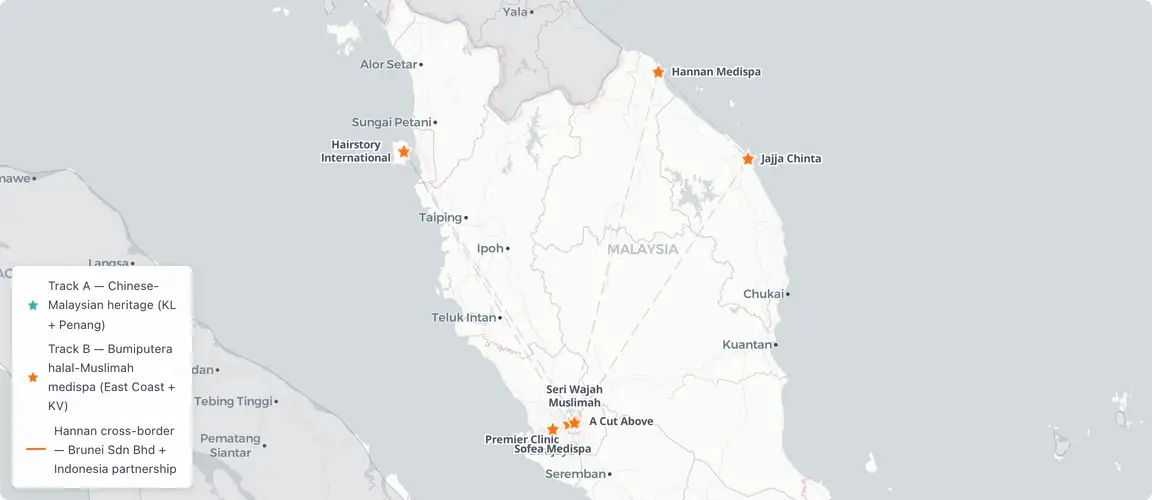
A map of Track A clusters sharply in Greater Kuala Lumpur — Pavilion, Bangsar, TTDI, Mont Kiara, Telawi 2 — with a Penang second cluster around the heritage neighbourhoods of George Town. Hairstory International (founded 2004 in Bandar Baru Ayer Itam as Hydro Hair Salon; 17 outlets today under Derick Ooi Tze Wei and Leon Lee) is the strongest Penang anchor. Joe’s Barbershop’s hipster-barbershop format went national from a Subang Jaya flagship opened by rapper Joe Flizzow (Johan Ishak) and Ardy Damis in December 2012 — 23 outlets under a chair-rental sub-operator model. Premier Clinic (Dr Chen Tai Ho, 2014) and the A-Saloon Group (50-plus outlets under co-founders known publicly only as Ken and Eddie) consolidate the Klang Valley map.
A map of Track B shifts the centre of gravity east. Hannan’s first wave runs through Kelantan and Terengganu. Jajja Chinta — founded 2013 by Siti Hajar Elyana binti Muda in Kuala Terengganu with RM600 borrowed from her husband, RM9.5 million in serum-brand revenue by 2021 — is east-coast on the route map and Bumiputera-Muslimah on the customer map. Seri Wajah Muslimah’s 15 outlets cluster around KL but extend through Johor and beyond into East Malaysia. Hannan’s Brunei outlets under Sdn Bhd RC30000438 and his Indonesia presence under the Hannan Medispa × The Face Klub Jakarta partnership are the visible cross-border edge of the second cohort.
The two cohorts are not segmenting against each other on price. They are segmenting against each other on demographics. Track A serves Chinese-Malaysian and broadly multicultural urban professionals. Track B serves the Bumiputera-Muslim majority for whom a women-only halal-compliant treatment room is a category requirement, not a premium upcharge.
Where the databases stop
The structural reason no Western deal-sourcing platform aggregates this sector is not a single barrier but four overlapping ones.
Language. Hannan’s primary press lives in Nona.my, Berita Harian, Sinar Harian, and Astro Awani — Malay-language outlets that Western aggregators do not crawl. The Universiti Malaysia Kelantan International Journal of Entrepreneurship and Commerce Studies (IJECS) published a 2024 case study citing “over 100 branches and 1,500 staff.” It is freely accessible and indexed nowhere a Bain analyst would look.
Format. Track B brands report branch counts on Instagram and Facebook biographies. Sofea Medispa’s 41 cawangan are tabulated in promotional Instagram posts; SSM records the entity but not the outlet count. Hannan’s 120-plus Malaysian branches are corroborated by the UMK Adjunct Professor announcement (which cites 113) and the IJECS case study, but no third party audits them. This is self-reported intelligence — verifiable in aggregate, unverifiable for any single quarter.
Geopolitics. Western press follows English-language Asian luxury through Singapore and Hong Kong. The Singapore beauty-services press carries Joe’s Barbershop and Premier Clinic. It carries Hannan as occasional regional colour. It does not aggregate Hannan against A Cut Above against Sofea against Seri Wajah, because the editorial frame is “Asian luxury hospitality,” not “Malaysian halal-economy verticals.”
Frame. Even the Malaysian English business press tends to cover the two cohorts in separate beats. The Star and Malay Mail cover Track A under lifestyle and entrepreneurship. Nona.my and Sinar Harian cover Track B under perniagaan wanita (women’s business) and halal industry. No Malaysian outlet reads both ecosystems and writes the consolidated sector view.
The result is that a serious institutional analyst — Hong Kong family office, Dubai sovereign-wealth vehicle, São Paulo importer evaluating a halal-cosmetics partnership — receives a sector view that is structurally one-sided. They see Track A and miss Track B, or they see Track B and assume Track A doesn’t exist.
Who held on
The strongest single arc in the sector belongs to Dr Hannan. He opened the first Hannan Medispa in Pasir Puteh in 2012, ten failed businesses behind him. The decision he made and stuck to, against the standard medical-aesthetic playbook, was to stay strictly halal-Muslimah: women-only treatment rooms, female practitioners, halal-certified products from his own Aestech Pro Enterprise factory in Muar (GMP-certified, founded 2017). His competitors broadened to capture mixed-gender clinics; he narrowed. In January 2022, a defamation suit threatened the brand’s reputation. He pressed it to verdict — RM1 million awarded — and donated the proceeds to orphanages and mosques. By 2022 he had a hundred Malaysian branches. By 2024 he had 113 cited in the UMK Adjunct Professor announcement and 1,500 staff. By the time IJECS published its case study he held 120-plus Malaysian outlets plus Brunei and the Indonesia partnership.
Winnie Loo’s crisis is the only one publicly named by a Track A founder in a recorded interview. In 2013 she and Dato’ Richard Teo launched X-Cut — an 8-outlet quick-cut chain in mall lower-ground locations, priced for traffic. By 2015 it was clear the format was wrong. “We opened around eight of them, if I recall,” she told the WIEF In Focus podcast. “But they weren’t churning enough revenue to be sustainable. The thing is, you must always be willing to cut your losses.” She closed all eight. The heritage brand kept running. In June 2024, on A Cut Above’s 45th anniversary, she announced her son Marcus Teo’s elevation to Business Development Director with authority over what the press release called “company matters” — the first publicly documented succession in Track A. In January 2026, industry leaders and friends gathered to mark her 70th birthday.
Noor Akmal Fadzila Ibrahim founded Seri Wajah Muslimah Aesthetic in 2018 after leaving IT and communications engineering. Beauty services in Malaysia, she told Nona.my, were “sektor pertama yang diarahkan tutup dan sektor terakhir yang dibenarkan beroperasi semula” — the first sector ordered closed under MCO in March 2020 and the last allowed to reopen, roughly two years later. She and her husband self-funded approximately 100 staff salaries through the closure period. Fifteen outlets are active today.
Kim May Chee opened COCOdry — Malaysia’s first dedicated blow-dry bar — in Bangsar on 7 December 2019. By the time MCO closed beauty services in March 2020, she was less than four months into operations. “With MCO in place and no physical operations were possible, there was literally RM0 income coupled with high operating costs such as rental and wages,” she told Vulcan Post. She and co-founder Shan pivoted to e-commerce inside ninety days. They broke even in year one. In August 2022 BURO 24/7 ran her on its cover. She is also, separately, the daughter of Penang heritage hairstylist Simon Kim, whose 10-outlet salon she saved through marketing repositioning — a Track A inheritance arc beside the Track A founding arc.
Words that name the second track
The vocabulary of Track B sits at the intersection of Malay, Arabic, and Islamic-finance terms. Four are load-bearing for any outsider reading the sector for the first time.
These are not exotic terms inside Malaysia. They appear daily in Nona.my, Sinar Harian, and the Halal Industry Master Plan documents. The Department of Statistics Malaysia uses them in official tabulation. Their absence from English-language deal-sourcing literature is not a translation problem; it is an aggregation problem. The lexicon is fully documented in Malay-language sources. Nobody has consolidated it across languages.
January, and what comes after
Two clocks are running simultaneously, and they converge in the second half of this decade.
The first is the heritage cohort’s succession clock. A Cut Above has named its successor (Marcus Teo, BD Director, June 2024). Miko Galère’s founder is approaching retirement with no documented public plan. Hair Atelier and Shawn Cutler have not signalled. Energy Wellness Group’s industry-builder founder Dato’ Ramona Suleiman built AMSPA from zero starting 2003 and now sits as an Advisor to the National Spa Council. Most of Track A’s founder generation opened their first salons between 1979 and 2014. They are now reaching the stage where transition is the planning question.
The second clock is policy. The Halal Industry Master Plan 2030, launched by MITI on 23 March 2023, names cosmetics and personal care among its three core halal sectors. The plan projects Malaysia’s halal market at RM523.53 billion MYR (~$113B USD) by 2030. Halal exports already reached RM59.46 billion MYR (~$13B USD) in 2022, per MATRADE. The DinarStandard State of the Global Islamic Economy Report 2024/25 sized the global Muslim cosmetics spend at USD 87 billion in 2023, growing to USD 118 billion by 2028. Malaysia has held the top spot on the Global Islamic Economy Indicator for eleven consecutive years. The Halal Development Corporation lists more than 100 halal-certified cosmetics and personal-care firms in Malaysia.
Currency note: RM = Malaysian Ringgit. Approximate exchange rate: RM4.62 ≈ $1 USD (May 2026). Revenue figures are for relative comparison; verify current rates for financial decisions.
The five-year overlap — heritage cohort succession underway at the same time as the HIMP 2030 policy horizon — is the period in which both structural shifts are documented and active simultaneously. Both clocks run loudest between now and 2030.
What the two tracks add up to
A reader who finishes this article knows three things a reader of the aggregate market-size figure alone does not.
The first is that the two cohorts are parallel founder-owned economies rather than a single sector. Track A and Track B are not segments of the same market. They are different markets that share a country and a regulatory framework.
The second is what sits past the brand list. The 120-plus-branch Hannan empire is the visible apex, but the depth of the cohort is the engineer-pivot founders, the RM600 startup founders, the post-MCO franchise scalers, the medical-doctor-turned-aesthetic-founder operators — documented across Malay-language press, SSM filings, and one academic case study that no aggregator has combined.
The third is the calendar already on the public record. The heritage cohort’s succession events are documented: Marcus Teo’s 2024 elevation at A Cut Above, Winnie Loo’s January 2026 70th birthday, Miko Galère’s undocumented plan. HIMP 2030’s five-year horizon is a matter of government policy record, not projection.
The intelligence exists. It lives in Nona.my and Sinar Harian, in the SSM corporate registry, in the IJECS case study, in the MATRADE export tables, in the HDC halal-certification register, and in the DinarStandard sector report. No platform writes the consolidated sector view. These brands have been here all along — 23 founder-confirmed brands, 130-plus outlets at the largest single chain alone, two parallel founder-owned economies sharing one country.
Researched 27 sources in English, Malay.