 Skip to main content
Kyrgyzstan Food: The Bazaar Stalls That Became Brands
In 1992 a Bishkek family sold two flasks of fermented grain drink at Dordoi Bazaar — over the mother's shame that for Kyrgyz, trading was a disgrace. The 80-litre batch sold out in two hours. Today that drink holds a third of the national soft-drinks market, and the company appears in no global food database.
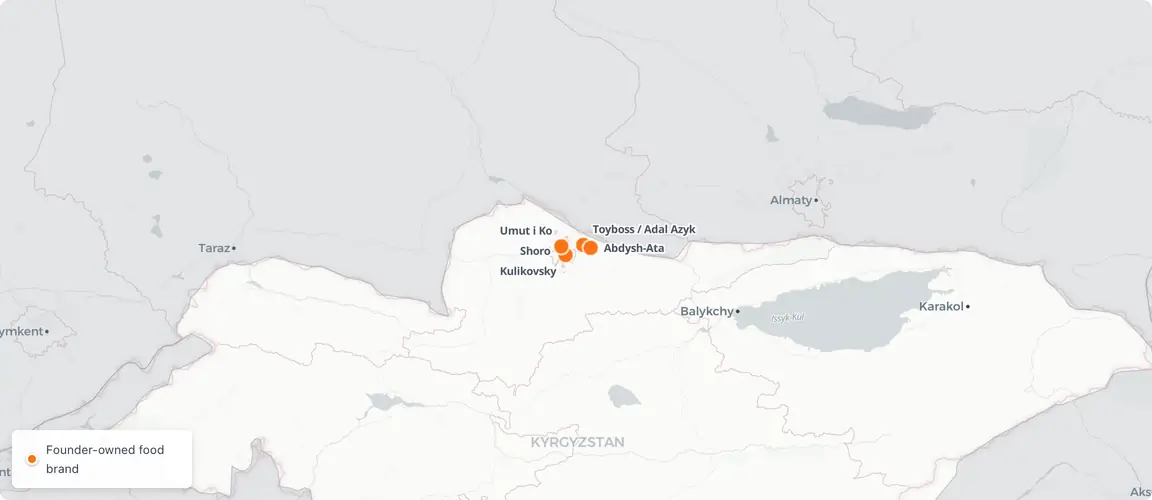
Kyrgyzstan's food brands: a single-valley cluster
Survival was the easy part
Jumadyl Egemberdiev did not do market research in any sense an analyst would recognise. He had simply noticed that guests at his mother’s home always reached for maksym — a tart, barley-based drink ladled from a kazan — over beshbarmak or vodka. So in the spring of 1992 he carried a batch to Dordoi Bazaar in Bishkek and started pouring. His mother had resisted the whole idea. For Kyrgyz, she told him, uyat bolot — it was a shame to trade, something other people’s families did. The first eighty litres were gone in two hours.
The drink she was ashamed to sell had grown to roughly a third of Kyrgyzstan’s soft-drinks market by 2019. The company her son built, Shoro, employs hundreds and exports to its neighbours. And it appears in no global food database, ranked by no analyst, covered by no institutional desk. The same is true of nearly every brand in this story.
What the country looks like from the outside
I fear my relatives. The moment a family member runs your business, you can no longer fire him — so I keep them out of management.
To an outside investor, Kyrgyzstan is a re-export bazaar — a place where Chinese goods are landed at Dordoi and waved on toward Kazakhstan and Russia, not a place that makes anything anyone would buy by name. The macro numbers say otherwise, and loudly. The country’s food, beverage and tobacco output reached 89.5 billion som in 2024, roughly 49% above its 2019 level, and food production grew 49% year-on-year in the first seven months of 2025. Food is now the largest manufacturing sub-sector by firm count — about one in five of the country’s roughly three thousand manufacturers.
Inside that mass sits a much smaller, sharply defined set: barely more than a dozen brands that are genuinely branded and genuinely founder-owned. Most were started between 1991 and 1997 by people now in their sixties and seventies. They are the subject here, because they are the only part of the sector an investor can actually buy into — and the only part with a story worth telling.
The sector these founders inherited was not empty. The Soviet Union had left behind an industrial skeleton: the Kant sugar plant from 1929, state dairy combines, ice-cream hladokombinats, confectionery lines across Frunze and the Chuy Valley. When the system collapsed in 1991 that skeleton collapsed with it, and for a few years the country’s food economy ran almost entirely through the bazaars. What separates the survivors of this story from the thousands of traders who came and went is that they did not stay in the bazaar. They used it as a starting line. The home recipe, the apartment kitchen, the flask sold by hand — each was a way to generate the first cash, and the test of a real founder was whether that cash bought a factory before the next crisis arrived.
The valley that pretends to be a country
Look at where these brands are, and the word “national” starts to wobble. Shoro, Kulikovsky, Umut i Ko and Riha are headquartered in or beside Bishkek. Toyboss sits twenty minutes east at Novopokrovka; Abdysh-Ata rose from a bankrupt sugar plant in Kant. Every one of them is in the Bishkek–Chuy corridor, a strip of land along the Kazakh border no more than 120 kilometres across. The 2024 registry makes the concentration explicit: Bishkek and Chuy hold 282 of the country’s 415 registered food firms between them. The southern oblasts — Jalal-Abad, Osh, Batken, home to nearly half the population — show a thin, mostly unbranded tail of dairy and commodity producers.
This is not an accident of where the good soil is. It is the geography of the bazaar and the border. Dordoi created the first demand: dollar-changers, traders from Kazakhstan and Uzbekistan, thirsty crowds. The Kazakh frontier became the export gate the moment Kyrgyzstan joined the Eurasian Economic Union in 2015. The brands clustered where the customers first appeared and where the exits would later open. A map of Kyrgyz food brands is not a map of Kyrgyzstan; it is a map of one valley, and the rest of the country is mostly empty space.
What the databases miss
So why has none of this surfaced? Why does a sector growing at 49% a year, with documented national champions and an IFC deal on the table, register nowhere in the intelligence that institutional capital actually reads?
The answer is a stack of overlapping opacities, each individually mundane, collectively impenetrable. The first is language: almost everything worth knowing about these companies exists only in Russian — in Economist.kg interviews, Kloop deep-dives, Kaktus.media tax filings, Azattyk court reports. The founders gave their best interviews to outlets no Western analyst monitors. The second is the registry: ownership and succession structures live in osoo.kg and the Minjust filings, in Cyrillic, behind no English summary. Whether the Egemberdiev family still holds absolute voting control of Shoro after a 2014–15 round of share sales is genuinely unclear from the public record — and that ambiguity is typical, not exceptional.
The third opacity is reputational. Kyrgyzstan carries the re-export-bazaar label, and the label does its own filtering: if a country is assumed to make nothing, no one looks for what it makes. Euromonitor can tell you the soft-drinks market grew. It cannot tell you that the man who built the leading brand keeps his own relatives out of management on principle — “the moment a family member runs your business, you can no longer fire him” — because that fact was given to a Bishkek business site in Russian, and reading it requires having looked. The gap between what is knowable and what has been assembled is the whole story here. The intelligence is sitting in plain Russian; almost no one has bothered to read it.
The survivors
What the assembled record does show, once you read it, is a cohort that has been tested the way few business cohorts anywhere have.
Shoro is the foundational case. Jumadyl Egemberdiev and his late brother Tabyldy carried the company through three revolutions — the Tulip Revolution of 2005, the April Revolution and Osh violence of 2010, and the upheaval of 2020 — and through the 2014 ruble shock that gutted the region’s purchasing power. Jumadyl’s governing principle is a kind of inverted nepotism: he keeps family out of management precisely because he cannot bring himself to fire them. When Tabyldy died in May 2015, the handover to Tabyldy’s son Kairat was orderly — a clean second-generation succession in a region where founder transitions routinely end in litigation. In 2024 the antimonopoly service reviewed Shoro’s maksym and chalap pricing as the dominant player; no penalty was recorded. The outcome an analyst can verify: about 30% of the national soft-drinks market by 2019, a national-identity category nobody can authentically copy, and a succession already proven.
Toyboss, the halal sausage maker run by Myrzabek Orumbaev, faced a different kind of attack. On a Saturday in April 2023, Russia’s Rosselkhoznadzor announced that samples of its halal sausage, seized in Barnaul, allegedly contained pork DNA — a potentially fatal accusation for a halal brand. Orumbaev did not retreat. He held a Bishkek press conference, produced three halal certificates and German TÜV documentation, argued the contamination must have occurred in transit to a city he does not even ship to, and called the affair “unscrupulous competition within the EAEU.” Then he let the labs decide: 57 samples tested in Bishkek, Irkutsk and two accredited Kazakh laboratories all came back negative. The product stayed on shelves. Two years later the IFC signed a facility of up to $20 million with Toyboss’s parent, Adal Azyk — debt, not equity, with the Orumbaev family keeping 89% of the company. It is the clearest proof in the sector that a Kyrgyz founder can take institutional capital without surrendering the firm.
Umut i Ko shows the cost of the model’s downside. The dairy, ice-cream and Dyushes-lemonade producer is co-owned by the brothers Kairat and Zhurat Abdullaev. In August 2022 the state security service arrested Zhurat on weapons charges; the searches turned up an armoured vehicle with a mounted machine gun, an arsenal, and cash and valuables equivalent to some 822 million som. He was convicted and the assets forfeited. The company kept producing throughout — the security service made a point of saying operations were not impeded — but the episode is the sector’s starkest illustration of founder-concentration risk. When one person is the company, the company is one arrest away from a crisis.
Kulikovsky demonstrates the limits of the export dream. Oleg Kulikov’s apartment-kitchen cake business grew into the country’s largest confectioner, with roughly a hundred stores across three or four countries. But its push into Russia broke twice on the same rock. It wound down its Moscow operation in 2016 and exited Novosibirsk in 2022, both times under a collapsing ruble. The lesson the cohort took from Kulikovsky is that the EAEU corridor runs both ways: the same border that opens a 180-million-consumer market also transmits Russia’s shocks straight into a Kyrgyz balance sheet.
Behind these four stand others with the same DNA: Abdysh-Ata, which built a beer brand claiming some 90% of the domestic market on the ruins of the Kant sugar plant, and Riha, a processed-meats dynasty run by three founding families with HACCP and ISO 22000 certification and more than 250 SKUs. Each carries its own version of the arc — a founder, a near-death moment, a decision made when quitting was the rational choice, and a company still standing.
A drink you cannot import
It would be easy to read this as an ordinary emerging-market food story — cheap labour, rising incomes, a bit of export upside. It is not, and the reason is in the glass. Maksym, jarma and chalap are not products a multinational can parachute in. They are liquid identity: fermented grain and yogurt drinks made for centuries in the home kazan, woven into Nooruz and the rhythm of the Kyrgyz spring. The Shoro women who sell chilled maksym from street-corner kegs each spring are themselves a seasonal signal that the new year has arrived.
That cultural depth is a structural barrier no foreign entrant can replicate. Coca-Cola and PepsiCo both operate in Kyrgyzstan — PepsiCo owns the dairy producer Bishkeksut — but neither can manufacture authenticity in a national-drink category. The founder brands hold the part of the market that cannot be bought into from outside, only built into from within. It is the rare emerging-market sector where the local incumbent’s advantage is structural rather than temporary.
The same logic runs through halal meat. Toyboss did not simply make sausage; it built a vertically integrated chain — its own poultry farm, Agro Kush, its own slaughterhouse, an electronic traceability system feeding the certificates that opened EAEU-Muslim and Gulf markets. When Moscow questioned its halal integrity, the answer was infrastructure, not assertion. Authenticity in these categories is not a marketing claim a competitor can match with a budget; it is built into the supply chain and the family name on it, which is exactly why it survives a price war or a smear and a parachuted brand does not.
Why the clock is running
The window on all of this is defined by two converging facts, and both are time-stamped. The first is the corridor. Since 12 August 2015, Kyrgyzstan has had tariff-free access to the EAEU’s 180-million-consumer market, and by mid-2025 some 462 Kyrgyz processors had entered the export register. The access is real but not yet fully exploited — veterinary and halal non-tariff barriers still throttle meat and dairy at the Kazakh border, and most of these companies have only begun to scale into the opening. Toyboss tripled its first-quarter exports from 51 to roughly 144 tonnes in a single year; Shoro took a $2.5 million development-fund loan to expand capacity and target the Gulf. The runway exists and the planes are only now leaving the ground.
The second fact is the founders themselves. The generation that built these companies from bazaar stalls is handing over. Shoro has already made its transition; Kulikovsky has ceded operations to a hired chief executive; the Orumbaev family has taken formal governance advice as a condition of the IFC deal. Each handover is a moment of maximum value and maximum fragility — the brand is worth most precisely while the founder is still there to explain how it survived, and that explanation has a shelf life.
What the record shows
The IFC deal is a working template — debt rather than equity, family control preserved, governance professionalised — and it has been executed exactly once. The other founder-owned champions of the Bishkek–Chuy corridor share the same structural profile: a founding generation stepping back, an export corridor now open, and a documented record of how each company survived three revolutions that exists mostly in Russian-language sources few outside readers have read. There are perhaps six of these companies at national scale.
Toyboss has demonstrated that formalising succession and scaling through the corridor can happen without the family relinquishing control. The rest of the cohort stands where Shoro stood in 1992, when a mother thought selling a home drink was a disgrace: each company has already done the hard work of surviving, and each is now working out how to hand that work to the next generation.
Researched 21 sources in Russian, English.