 Skip to main content
Kyrgyzstan Natural Foods: Certified, Unseen
A 2,500-farmer cooperative in Jalal-Abad holds the certification stack a German retailer demands — EU Organic, Fairtrade, FSSC 22000, Naturland — for walnuts the world still buys as anonymous Central Asian bulk. No specialty-food database lists the brand, the farmers, or the proof.
Kyrgyzstan's natural foods: three terroirs, one model
Certified before the corridor
A cooperative of 2,500 farmers in the southern Kyrgyz town of Jalal-Abad holds a stack of certifications most European food importers treat as a hard requirement: EU Organic, Fairtrade, FSSC 22000, and the German Naturland standard. The product it certifies is walnuts — the same walnuts that, gathered a valley away in the thousand-year-old Arslanbob groves, leave the country as anonymous bulk priced at whatever the nearest commodity broker will pay.
That gap — between what these brands have proven and what the buyers who would pay for the proof can see — is the whole story of Kyrgyz natural foods. The sector is not undocumented. It is documented almost entirely in Russian, in trade press and a corporate registry no Western analyst reads, and so a cluster of certified, award-winning, crisis-tested exporters sits one language away from the institutional capital it has already earned the right to court.
What the Soviet collapse left behind
We export nuts to the largest markets in the world.
Beekeeping arrived in the Tien-Shan foothills with settler families from Russia and Ukraine at the end of the nineteenth century, and by the Soviet zenith the Kyrgyz republic was producing around 12,000 tonnes of honey a year — third in the union behind Russia and Ukraine itself. Then the apparatus that bought, graded, and exported that honey dissolved with the state that ran it. For most of the 1990s the sector was a memory and a set of idle hives.
What rebuilt it was not policy but founders. Between 2010 and 2017 the modern Kyrgyz natural-foods sector was assembled almost entirely by individuals starting companies: Emma Savitskaya’s Dary Tien-Shan and the Medovaya Artel house in 2010, Beknazar Asanov’s Sun Planet Organic in 2016, Kurbanbek Obozov’s Altyn-Aymak in 2017. None inherited a distribution network. Each had to build one from a standing start, in a landlocked country with no maritime port and two of its four borders prone to closing without notice.
The terroir, though, had survived intact. The walnut forest at Arslanbob — a core grove of roughly 11,000 hectares yielding around 1,500 tonnes a year — is among the oldest cultivated walnut stands on earth, harvested communally by families who have worked the same trees across generations. The high-altitude esparcet meadows around At-Bashi produce a white honey that crystallises pale and fine. The apricot orchards of Batken, on the southern frontier, grow a fruit so identified with the region that “Batken kuraga” functions as an origin label inside Central Asia the way a wine appellation does elsewhere. The raw material was never the problem. Turning it into something a foreign buyer could trust was.
Three terroirs, scattered corner to corner
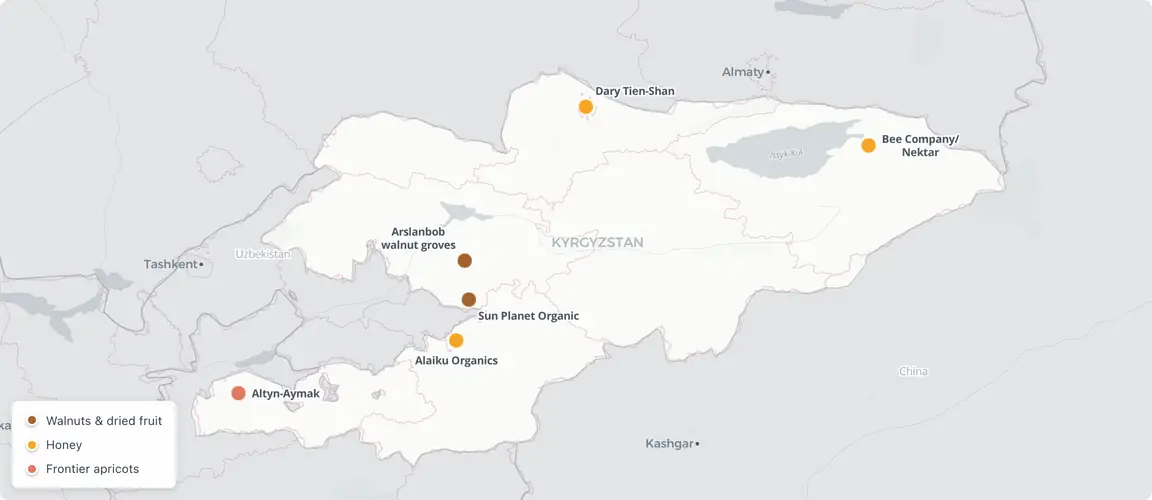
A map of Kyrgyz natural foods does not show a cluster. It shows three distinct zones pinned to opposite corners of a small mountainous country, each making a different product, sharing nothing but a certification model and a border problem.
The walnut south sits around Jalal-Abad and the Arslanbob groves, where Sun Planet Organic built its cooperative. This is the country’s specialty-export laboratory — the place where the full European certification stack was first assembled and where the cooperative model, pooling thousands of smallholders into a single auditable supply base, was proven.
The honey belt runs along the northern and eastern ranges, from Bishkek through the Issyk-Kul basin to Karakol. Here the brands are older and the families deeper: Dary Tien-Shan in the capital, Bee Company/Nektar near Karakol, Alaiku’s contracted beekeepers down toward Osh. The honey story is about reputation and reform — medals won, then a market nearly lost, then a market rebuilt. The Issyk-Kul basin, ringed by snowmelt rivers and high meadow, gives the honey its argument: an altitude and a flora that lowland apiaries cannot copy, and that the brands have learned to name on the label rather than leave implied.
The dried-fruit frontier is Batken, the southwestern salient that pushes into Tajikistan and Uzbekistan along a border that has never been fully drawn. Altyn-Aymak’s solar-drying plant sits in Kara-Bak, close enough to the disputed line that the sector’s hardest crisis arrived not as a market shock but as artillery. Before the solar plant opened, the region’s apricots largely left through Tajik intermediaries, who took both the margin and the credit; the plant let Batken keep its own name on its own fruit. Geography here is not a marketing note. It is the operating risk and, increasingly, the brand.
What the databases miss
To an analyst in London or Singapore, Kyrgyzstan registers, if at all, as a commodity origin — a line in a gold or a textile export table. The certified natural-foods sector is invisible, and the reasons are structural rather than accidental.
The first barrier is language. Of the eighteen primary sources behind this article, seventeen are in Russian — interviews in Economist.kg and VB.kg, export-agency listings, the osoo.kg corporate registry where a founder’s name and company registration can be confirmed. An English-only researcher reaches almost none of it. The brands are not hiding; they are simply on the far side of a wall most institutional research never crosses.
The second is the absence of public filings of the kind Western databases ingest. These are private companies and family operations. Their certifications are real and auditable, but they surface in audit bodies’ records and trade-fair listings, not in the financial-disclosure feeds that analysts scrape. A brand can hold Naturland certification and a thousand-farmer supply base and still leave no trace in any source a Euromonitor analyst would think to query.
The third is categorical. The sector is filed under “Central Asian agriculture,” a heading that connotes bulk and informality, when the reality at the top end is certified specialty food competing for the same German and Gulf shelves as producers anyone would take seriously. An analyst who never opens the file never tests the heading, and the heading is wrong. The mismatch between the file and the fact is the arbitrage. The intelligence to close it exists in full — the founder interviews, the registry entries, the audit certificates, the export-agency listings — it has simply never been assembled in a language the buyers read, by anyone with a reason to assemble it.
Who survived, and what it cost them
In September 2022, the Kyrgyz-Tajik border in Batken erupted. Human Rights Watch documented around 51 civilians killed, more than a hundred injured, and some 137,000 people evacuated. Kara-Bak — the village where Kurbanbek Obozov’s Altyn-Aymak runs its USAID-built solar-drying plant — was inside the fighting. The rational move for a processor whose entire operation sat on a contested frontier was to relocate or shut. Obozov kept the plant in Kara-Bak. Three years later, in 2025, Altyn-Aymak shipped 75 tonnes of dried fruit to the United States — a premium export breakthrough achieved from a production zone that had been a war zone. The decision to stay is the asset; the freight manifest is the proof.
Beknazar Asanov faced a slower, quieter crisis: irrelevance. Kyrgyz walnuts sold as bulk commodity earn a commodity price, and no amount of quality narrows that gap on its own. What narrows it is certification — the specific, expensive, multi-year ordeal of satisfying EU Organic, Fairtrade, FSSC 22000, and Naturland auditors across a supply base of thousands of smallholders. Asanov’s Sun Planet Organic — an Asanov-led team operating the cooperative — built the full stack, and with it the right to address EU and Gulf buyers directly. “We export nuts to the largest markets in the world,” he told Economist.kg in 2022. The sentence is unremarkable until you remember that the country has no port and the brand had no template to copy.
The honey sector’s crisis was collective. In 2015, Chinese inspectors at the Torugart crossing detected chloramphenicol — a banned antibiotic — in Kyrgyz honey, and rejected the consignments. China took roughly a third of Kyrgyz honey exports; the detection threatened to close the corridor entirely. The sector’s choice was reform or exit, and through the beekeepers’ union it chose reform: testing regimes, traceability, the slow rebuilding of buyer trust. The proof that it worked is in the numbers a decade on — exports recovered to 540 tonnes in 2025 from 439 the year before, with China restored as the lead market.
Around these survivors stand the brands that supply the texture. Dary Tien-Shan in Bishkek turned the 2013 Apimondia medals for At-Bashi white honey into a 43-award catalogue and a presence in more than thirty countries. Bee Company/Nektar near Karakol — Marat Galiev’s second-generation operation, built on the apiary his father raised — used a UNDP grant to pivot into cream-honey and reach five export markets. Alaiku Organics in Osh contracts 200 beekeepers. None of these stories — the decision to hold a frontier plant, the multi-year certification grind, the union-led reform after the antibiotic shock — is a thing an industry database could have told you. That is precisely why they are the structural advantage no database records.
Beyond the commodity label
To outsiders, Central Asian food reads as bulk and sameness — a region that exports raw material and imports brands. Inside Kyrgyzstan the relationship to these products is the opposite of anonymous. The walnut groves at Arslanbob are communal heritage, harvested by families who measure their claim to the trees in generations, not deeds. Honey is not a commodity but a craft with its own competitive culture, its medal-winners and its terroir arguments about which mountain meadow yields the finest white crystal.
That cultural density is why the sector produced founders rather than mere traders. A person who grows up understanding At-Bashi honey as a point of regional pride, or Batken apricots as an appellation worth defending, builds a brand differently from someone moving fungible tonnage. It also explains the second-generation pattern that recurs across the honey belt: businesses handed down rather than sold off, where the heir’s task is to modernise a craft rather than flip an asset. The certification stacks and the medal cabinets are the formal expression of something older — a conviction that these products are specific, that they come from somewhere, and that the somewhere is worth naming. Institutional buyers pay for exactly that specificity. The Kyrgyz founders have been living it for a century, which is why the documentation, when it finally arrives, will describe something real rather than manufacture it.
The clock the railway started
For most of this sector’s modern life, its central constraint has been logistics. A landlocked country with no port moves perishables expensively and slowly, and a brand that cannot guarantee a cold chain to a foreign buyer cannot command a premium no matter how good its certification. The European preference helps — Kyrgyzstan won GSP+ duty-free access in 2016, the first Central Asian state to do so, opening more than 6,600 tariff lines. But preference without throughput is a coupon you cannot redeem, and the trade ministry’s own warning, reported by 24.kg, is that GSP+ status can be forfeited if it goes unused.
What changes the arithmetic is the China-Kyrgyzstan-Uzbekistan railway. Ground was broken in Jalal-Abad in December 2024, and in December 2025 a $4.7bn financing agreement was signed in Bishkek, converting a decade-old promise into a funded project with a build schedule. A working corridor would collapse the cost of moving Kyrgyz perishables east into China and west toward Europe — exactly the bottleneck that has kept certified product crossing borders at commodity prices.
The timing logic cuts in a specific direction. A working corridor lowers freight costs for everyone, certified and uncertified alike — which means Kyrgyz origin becomes cheaper to ship and more commoditised the moment the railway opens, and the differentiation that certification provides today rests on a freight cost that is still high enough to keep the field thin.
What the record already shows
The value in this sector is not that Kyrgyzstan grows good walnuts. It is the gap between a sector that has already done the hard, unglamorous work — the certifications, the union-led reform, the decision to keep a plant running through a border war — and a record of that work that sits in the wrong language and the wrong file for most outside readers to find.
That record is specific and finite. There are perhaps four or five Kyrgyz natural-foods brands with a full certification stack, a documented crisis record, and installed export capacity — Sun Planet, Altyn-Aymak, Dary Tien-Shan, the Karakol apiaries. The founders who built them are the same founders who run them today, and the railway construction now underway is the clock against which their current freight-cost advantage is measured.
Researched 18 sources in Russian, English.