 Skip to main content
When Africa's Richest City Ruled the Gold Trade
In 1331, Ibn Battuta called Kilwa Kisiwani one of the finest cities on earth. An estimated 8.5 tonnes of gold flowed through its harbour annually. The sultan gave away his robes to beggars. Then on a single July morning in 1505, Portugal bypassed the chokepoint entirely. The city never recovered.
The monsoon chokepoint: how Kilwa ruled the Indian Ocean gold trade
Rich on a flow it didn't produce
In 1331, the Moroccan explorer Ibn Battuta (ابن بطوطة) sailed into Kilwa Kisiwani (كلوة كسواني) and declared it one of the finest cities on earth. The sultan gave away his royal garments to a beggar after Friday prayers. Chinese porcelain decorated the mosque walls. An estimated 8.5 tonnes of gold passed through the island’s harbour every year.
Today, roughly 1,150 people live among the ruins. Most Africans — let alone most investors, importers, or founders — have never heard of the place.
Kilwa’s erasure from global memory is not accidental. Eurocentric histories framed the Portuguese arrival as “discovery” rather than destruction, and the Swahili Coast’s commercial sophistication was written out of the narrative entirely. But the real lesson of Kilwa Kisiwani is not about colonialism. It is about what happens when a pure intermediary — an entity that controls the flow of value without producing any — meets a disruptor willing to go directly to the source.
The island that seized a continent’s gold
They went straight to the royal palace, and on the way only those Moors who did not fight were granted their lives.
Kilwa’s rise defies the intuitive logic that wealth flows to producers. The island had no gold mines, no arable hinterland, no military superpower behind it. What it had was position.
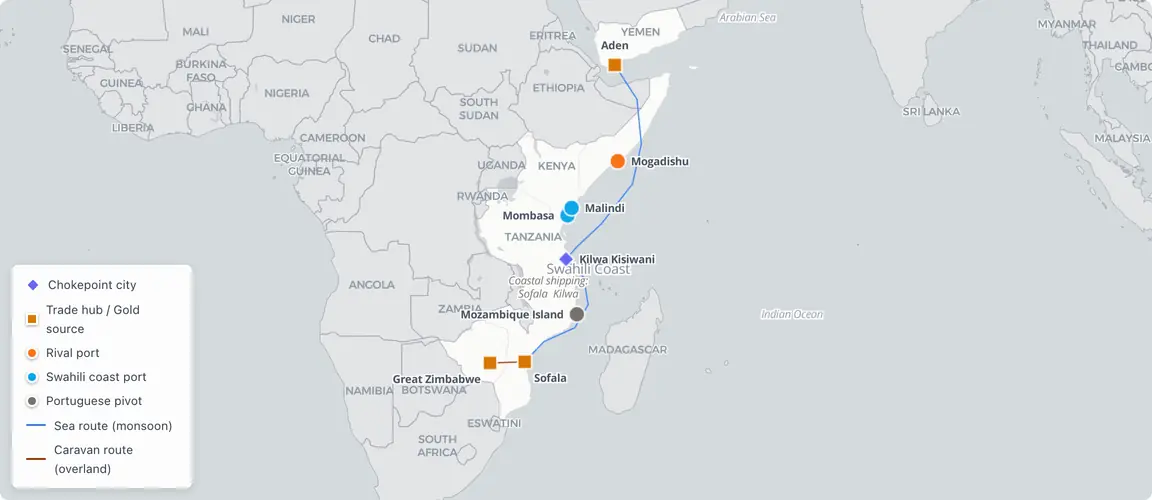
Located roughly two kilometres off Tanzania’s southern coast, Kilwa sat at the southernmost point in East Africa that a ship from Arabia or India could reach within a single monsoon season. The mechanism was simple and absolute: ships riding the northeast monsoon (December to March) from the Persian Gulf could sail to Kilwa but could not continue to Sofala — the actual gold outlet, 1,200 kilometres further south — and return before the winds reversed in June. Merchants who tried would be stranded for an entire year. This geographic constraint created a natural chokepoint, and Kilwa exploited it ruthlessly.
The pivotal move came in the late thirteenth century. Under Sultan Suleiman ibn al-Hassan (سليمان بن الحسن), Kilwa wrested control of Sofala from rival Mogadishu (مقديشو) and installed a governor who functioned less as a military commander than as a commercial consul — managing Swahili merchant residents, collecting customs on gold, and maintaining the pipeline to the interior. Sofala itself remained formally under the Kingdom of Mwenemutapa, with the Swahili community paying tribute for the right to trade. This was diplomatic and monetary control, not military occupation. And it proved extraordinarily durable.
The revenues transformed the island. Sultan al-Hasan ibn Sulaiman (الحسن بن سليمان) used gold wealth to build Husuni Kubwa (حصن كبوا) — a palace of over 100 rooms spanning two acres, with an octagonal swimming pool, indoor drainage, and carved coral decoration reminiscent of Abbasid Iraq. Encyclopaedia Britannica identifies it as the largest single building in all sub-Saharan Africa before colonialism. Simultaneously, al-Hasan expanded the Great Mosque to roughly four times its original size, adding the largest dome in East Africa — a distinction it held until the nineteenth century.
These were not provincial structures. They were statements of participation in a global civilisation stretching from Quanzhou to Córdoba.
Kilwa’s monetary innovation reinforced the point. The sultanate began minting coins from the eleventh century — making Kilwa the first urban centre in sub-Saharan Africa to issue coinage, and the only Swahili city-state to strike gold currency. The coins bore the sultan’s name paired with a Holy Name of Allah in rhyming Arabic couplets, merging political sovereignty with religious legitimacy. This was not mere symbolism. A standardised medium of exchange reduced transaction costs across Kilwa’s diverse merchant communities — Persian, Arab, Indian, Swahili — and created switching costs that reinforced the island’s centrality.
The Indian ocean’s most connected marketplace
Kilwa operated as what modern venture capitalists would recognise as a two-sided platform — and one of remarkable scale. On the supply side, gold, ivory, iron, copper, enslaved people, mangrove poles, ambergris, tortoise shell, and rock crystal arrived from Africa’s interior via Swahili intermediaries and Bantu trading communities. On the demand side, Chinese porcelain, Indian cotton textiles, Persian faience, glass beads, silk, and spices arrived from across the Indian Ocean — all timed to the monsoon calendar that dictated when ships could arrive and when they must depart.
The archaeological evidence is remarkable for its cosmopolitan density. More Chinese artefacts have been uncovered at Kilwa than at any other Swahili trade settlement, according to UNESCO’s Silk Roads programme. A fine Qingbai glazed bottle from the Yuan dynasty was found at Husuni Kubwa. Chinese porcelain fragments were embedded directly into the walls of the Great Mosque — a decorative practice that doubled as a display of global reach. In the opposite direction, a copper coin minted by a Kilwa sultan has been recovered at Great Zimbabwe (Dzimba dza mabwe), proving the commercial circuit extended deep into the continental interior.
Indian textiles dominated the import side by volume. Portuguese records from just after the conquest document staggering quantities: 83,000 cloths imported to Mozambique Island from India between 1507 and 1513. By the mid-seventeenth century, approximately 250 tonnes of Gujarati cloth entered Eastern Africa annually. A marble piece from Gujarat with Hindu decoration, later inscribed with Arabic writing, was found in a Kilwa mausoleum dated 1305–1345 — evidence of direct material exchange spanning civilisations.
Kilwa’s monetary innovation further enabled this cross-cultural commerce. The sultanate minted tri-metallic coinage — copper, silver, and gold — from the eleventh century onward. Kilwa was the first urban centre in sub-Saharan Africa to issue coins, and the only Swahili city-state to strike gold coinage. The coins bore the sultan’s name paired with a Holy Name of Allah in rhyming Arabic couplets, merging political sovereignty with religious legitimacy. Recent scholarship by Fleisher and Wynne-Jones argues these coins functioned primarily as instruments of local authority, yet their very existence created a standardised medium of trust that reduced transaction costs across Kilwa’s diverse merchant communities.
The broader Swahili Coast system comprised over 35 major ports from Mogadishu to Sofala, but Kilwa was distinct. It combined monopoly control of the gold pipeline, first-mover advantage in coinage, and the geographic constraint of monsoon-limited navigation into a competitive position that no rival city-state could replicate. At its zenith in the fifteenth century, the sultanate claimed authority over Mombasa, Zanzibar, Pemba, Mafia, the Comoros, Sofala, and trading posts on Madagascar — a maritime empire built not on naval power but on commercial indispensability.
The morning everything ended
By the late fifteenth century, Kilwa was already weakening from within. The Black Death had disrupted international demand in the mid-1300s. Great Zimbabwe itself was declining. Succession disputes had eroded sultanic authority — by the 1450s, viziers and emirs functioned as the real power, installing and deposing puppet sultans at will. Vassal cities like Malindi and Sofala had begun dealing independently with the Portuguese. The structural foundation of Kilwa’s dominance was fracturing before a single cannon was fired.
On 24 July 1505, Dom Francisco de Almeida arrived with eight ships and approximately 500 soldiers. His strategic objective was not Kilwa itself but India — Kilwa was a staging post to be neutralised en route. The emir, Ibrahim ibn Suleiman (إبراهيم بن سليمان), refused to submit. At dawn, the Portuguese landed in two columns.
Hans Mayr, a German clerk aboard the São Rafael, recorded the eyewitness account: “They went straight to the royal palace, and on the way only those Moors who did not fight were granted their lives.” Defenders attacked from rooftops with arrows and stones; the Portuguese fought through the narrow streets with crossbows, muskets, and cannon. Ibrahim escaped through a hidden door in the palace. “Then everyone started to plunder the town of all its merchandise and provisions,” Mayr wrote.
The next day — the feast of St. James — the Portuguese began constructing Fort Santiago, the first Portuguese stone fortification on the East African coast.
The economic collapse was immediate and devastating. Portuguese mercantilist laws prohibited non-Portuguese ships from carrying trade to principal coastal towns, effectively putting leading Kilwan merchants out of business. The puppet sultan, Muhammad Arcone, was assassinated within a year. Hans Mayr recorded that streams of residents fled the city, leaving it practically deserted. By 1512, the Portuguese themselves evacuated, having found the Island of Mozambique a more convenient harbour and the gold trade less profitable than anticipated.
No buildings were constructed in Kilwa throughout the Portuguese period or into the seventeenth century — an archaeological silence that speaks to total economic death. In 1587, migrating Zimba warriors attacked the remnant population, reportedly killing 3,000 of the remaining inhabitants. The city that Ibn Battuta had praised as one of the world’s finest was finished — not in a single dramatic collapse, but in a cascade of abandonment that followed the removal of the one thing that had made the island valuable: its position as the unavoidable middleman.
The economics of a pure intermediary
Kilwa’s arc names a structural pattern in intermediary businesses: the value of a chokepoint is inversely proportional to its permanence. The more valuable the intermediary position, the greater the incentive for a disruptor to bypass it entirely.
Kilwa controlled nothing except the passage of goods between producers and consumers. This made it extraordinarily capital-efficient — what modern venture parlance might describe as a “nothing business” with high margins. But it also meant that when the Portuguese developed caravel technology capable of sailing directly to Sofala, Kilwa’s entire value proposition evaporated in a single season. No fallback. No manufacturing capability. No unique resource. No diversified revenue stream.
The modern parallel is precise. Singapore — the closest structural analogue — followed a different path. In the 1960s, re-exports represented roughly 90% of Singapore’s total exports. Facing the same vulnerability of pure intermediation, Singapore systematically diversified into manufacturing, financial services, and human capital development; re-exports now represent approximately 35% of total exports. Dubai followed a similar trajectory, investing petroleum revenues into logistics infrastructure, tourism, and finance to escape single-commodity dependency.
Platform businesses face the identical dynamic. Amazon, Alibaba, and Uber are digital Kilwas — aggregating supply and demand without producing the underlying goods. Harvard Business School research on disintermediation documents that every successful platform creates its own vulnerability: the more efficiently it connects users, the more likely those users are to transact directly. The Portuguese did not need to destroy Kilwa’s physical infrastructure. They simply connected directly with Sofala, and the intermediary became irrelevant.
Kilwa’s own record shows what did and did not blunt that dynamic over three centuries. Its coinage system built genuine switching costs among its merchant communities — real, but not enough to survive a direct route to the source. It never added proprietary logistics, financing, or quality assurance beyond matching supply to demand. And it faced, without warning, a shift in distribution technology — the caravel — that collapsed the distance between supplier and buyer.
Kilwa had three centuries to diversify beyond intermediation. It never did. The island that controlled everything and produced nothing discovered, on a single July morning, that controlling everything was not enough.
What survives on the island today
Kilwa Kisiwani was inscribed as a UNESCO World Heritage Site in 1981 and placed on the Danger List in 2004 due to structural collapse, beach erosion, and vegetation overgrowth. Following international conservation efforts funded by Norway, France, Japan, and the World Monuments Fund — totalling over $2.3 million — the site was removed from the Danger List in 2014. CyArk completed LiDAR documentation in 2018 to create permanent digital baselines.
The Great Mosque’s coral pillars and domed bays still stand — the oldest surviving mosque on the East African coast. Husuni Kubwa’s eastern section is progressively disappearing into the sea from cliff erosion, though its octagonal pool and carved coral panels remain visible. A fourteenth-century well dug by enslaved labourers still supplies fresh water to the island’s residents. A riprap sea wall now protects the Gereza — a later Omani fort — from tidal erosion, and CyArk’s LiDAR scans have created a permanent digital record of structures that the Indian Ocean is slowly reclaiming.
Access is by a twenty-minute motorised boat from Kilwa Masoko, a quiet district town five to six hours south of Dar es Salaam. A mandatory guide costs approximately $40 including permits and transport. Visitor numbers remain very low — this is emphatically not a mass tourism destination, which makes it both fragile and genuinely compelling for those willing to make the journey.
Kilwa’s arc — from obscure island to continental commercial capital to abandoned ruin — is not a tragedy of colonial violence alone. It is a structural lesson about the economics of intermediation. The Portuguese did not destroy a resilient system; they bypassed a brittle one. Kilwa’s brilliance was in recognising that controlling the flow of value is more profitable than producing it. Kilwa’s failure was in assuming the flow could never be rerouted.
Trade convergence points recur in every era — logistics corridors, fintech rails, commodity aggregation, digital marketplaces — and each one carries the same structural exposure Kilwa never resolved: a position built on being unavoidable, with no plan for the day it becomes avoidable.
Researched 15 sources in English, Arabic, Portuguese.