 Skip to main content


Kashgar: The 2,000-Year Market, Audited
A Han history records market rows at Kashgar about two thousand years ago. The line names no market day. In the sources reached for this article, no Sunday market appears before the 20th century; the earliest they hold is the general bazaar, open only on Sundays until 1992. Today the livestock market trades on Thursdays and Sundays.
Where the record's roads meet
Trade under many masters, no Sunday in the early record
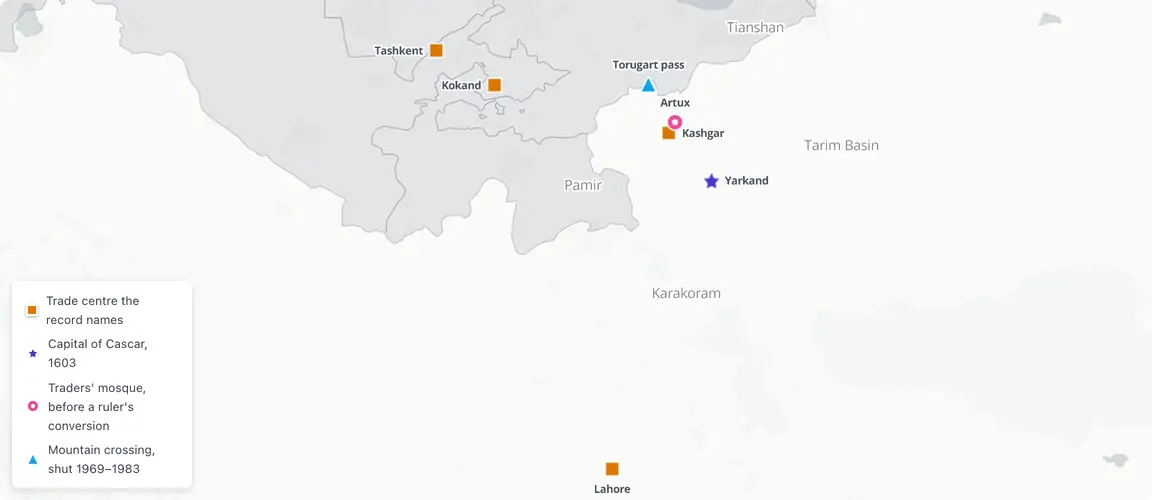
In November 1603 the annual merchant company from Lahore reached Yarkand (叶尔羌), the capital of the kingdom of Cascar. Benedict Goës, a Jesuit, recorded its size. In the account of his journey compiled by Ricci, the company “numbered in the present case about five hundred persons, with a great number of mules, camels, and carts”. It came every year. It reached Yarkand, not Kashgar (喀什) city.
The market and the day
live by trade and handicrafts... many merchants go forth about the world on trading journeys
The claim this article tests is that Kashgar has held its Sunday market for two thousand years. It has two parts, a market and a day, and the documents treat them differently.
The market comes first, in the Han shu (汉书). Its chronicle of the Western Regions describes Shule (疏勒), the kingdom on the site of Kashgar, as a place of 1,510 households, 18,647 people and 2,000 soldiers, 9,350 li from Chang’an (长安), with interpreters. Then comes the line the rest of this article leans on. Shule, it says, “has market rows, and lies on the road west to the Great Yuezhi, Dayuan [Ferghana] and Kangju” (有市列,西當大月氏、大宛、康居道也).
The entry is a set of counts: households, people, soldiers, distance. It also records interpreters, in a kingdom of fewer than 19,000 people. The counts describe the kingdom at some point in the Han period; the text does not pin the year. And it states that the kingdom traded.
That is a market, documented in a Han-period record. The day is another matter. In the sources this article’s research reached, no Sunday market appears before the 20th century. That is an absence in those sources, not proof that there was none. What follows takes the record forward from the Han shu, witness by witness.
The road the Han shu names was not the only one. The Han routes around the Tarim Basin (塔里木盆地), northern and southern, carried silk, grain, horses and jade from Chang’an and the Hexi Corridor (河西走廊), through the oases, to Ferghana, Kangju, Bactria and Parthia, from about 100 BCE to 200 CE. A second exchange came down from the mountains. Pastoralists of the Tianshan (天山) and the Pamir brought sheep, cattle, horses and camels to the oasis bazaars and took grain and cloth in return. That exchange runs, in the record, from about 100 BCE to the present.
Garrison, then faith
Shule submitted to the Tang in 632 and by 648 was one of the Four Garrisons of Anxi (安西四镇). The garrisons were lost to Tibet in 670, restored in 692 and overrun in 790. That is four changes of master between 632 and 790. Shule, the Han name, is the earliest name for the site in the record. Xuanzang’s (玄奘) 7th-century account calls the place Qiesha (佉沙). Its Uyghur name is Qäshqär; the Encyclopedia of China (中国大百科全书) traces the name to an Iranian form, Kasigiri, “heroes’ city”, used after the Uyghurs arrived.
The caravans kept coming through the changes of master. Between about 500 and 800, Sogdian and Persian merchants carried silk, silver, glass, horses and textiles between their homelands and Tang China by way of Kashgar. Between about 100 and 900 another route, from Gandhara, Kashmir and Gilgit, brought Buddhist texts, luxury goods and cloth across the Karakoram to Kashgar and the Tarim Basin.
Islam reached the ruling house through trade. Muslim traders were allowed a mosque at Artux (阿图什). After that, the Karakhanid ruler Satuq Bughra Khan converted under a Persian merchant, Nasr. The date given is about 932, and it is contested.
The order of events is the point. The traders had their mosque before the ruler had his faith.
The city that rose
In 1217 and 1218 the Mongols took Kashgar without sacking it. Encyclopedia summaries of the episode, which also cite Juvayni’s account, describe a local uprising. Kuchlug had burned harvests, billeted troops and persecuted Muslims. Kashgar rose against him and sided with the Mongols under Jebe, who proclaimed religious tolerance. The city was spared. The record shows a city that chose its side and went on trading, not one that was sacked.
Some fifty years later it was still trading. Marco Polo, in an account dated to about 1273, wrote that its people “live by trade and handicrafts… many merchants go forth about the world on trading journeys”. Between about 1250 and 1370 Kashgar’s cotton, textiles and handicrafts travelled across the Mongol Empire, to Persia and to Central Asia. In that trade the record has Kashgar as the place the goods came from, not only a place they passed through.
What Polo recorded is an occupation, not an appointment. He says what Kashgar’s people did for a living and that its merchants travelled far. Between those two clauses he mentions the city’s gardens and vineyards, and the cotton it grew.
The company from Lahore
Goës’s account reached English readers in the Yule-Cordier translation of 1916. The company he counted belonged to a wider trade. Between about 1500 and 1700, caravan companies from Lahore and Kabul carried cloth, spices, silver and jade to Kashgar, Yarkand and on toward Cathay. The overland road was still working in 1603, and it was still working on a schedule: once a year.
Goës also left a line about power. The command of a caravan, his account says, was sold by the king. That line belongs to a different caravan, the one that went on from Yarkand toward Cathay, not to the company from Lahore. It shows a ruler drawing income from the trade rather than stopping it.
What the 1603 passage establishes is the road. An annual overland company from Lahore was still reaching Yarkand, and its witness counted it in people and animals.
Who held the trade
In 1759 the Qing conquered Altishahr, and the conquest opened a trade with Kokand. From 1760 to 1864 a Kokandi aqsaqal acted in Kashgar as consul and commercial agent. Under that arrangement tea, rhubarb, silk, cotton cloth and livestock moved between Kokand, Ferghana and Kashgar, in what the record calls the Andijani trade.
The aqsaqal’s double title is the detail to keep. In Kashgar between 1760 and 1864, under a Qing conquest, the Kokand trade had a Kokandi who was both its consul and its commercial agent.
The arrangement predates the upheaval that followed it. It ended in 1864. The next year a Kokandi commander came to power in Kashgar.
Yaqub Beg ruled a state based on Kashgar from 1865 to 1877. M. A. Terentiev (М. А. Терентьев), a Russian officer writing in 1875, described its foreign trade as “a monopoly of Yaqub Beg” (составляла монополию Якуб-бека), something close to a privilege of government. Russian merchants, he wrote, were kept under guard. Their goods were valued at an arbitrary rate, significantly below market prices, and taken for Yaqub Beg himself.
Foreign trade was seized as a state monopoly.
In Terentiev’s account the state took the trade with visiting foreigners for itself, at its own prices. The Qing army re-entered Kashgar on 18 December 1877, and Yaqub Beg’s rule ended. The monopoly lasted twelve years; the aqsaqal’s office before it had lasted more than a century. Terentiev’s account was read in the original Russian for this article. It describes guards and valuations.
Russia opened a consulate in Kashgar in 1882, according to the Russian-language encyclopedia entry on it. Nikolai Petrovsky (Николай Петровский) took up permanent duty there in December 1883, and the post became a consulate-general in 1895. He also collected manuscripts for the Asiatic Museum (Азиатский музей) in St Petersburg, among them texts in Tocharian, a language then unknown.
Britain’s man, George Macartney, arrived in 1890 as interpreter to Francis Younghusband’s mission and stayed at Chini Bagh until 1918, a 28-year posting. His wife, Lady Catherine Macartney, joined him in 1898 and published her own memoir in 1931. By the encyclopedia account of Petrovsky’s career, the two consuls did not speak to each other from 1899 to June 1902.
Between 1872 and 1918 cotton goods, raw silk, silkworm eggs and manufactures moved between Tashkent and Russian Turkestan on one side and Kashgar, Khotan (和田), Tibet and Dzungaria (准噶尔) on the other. Each consulate tracked trade and influence.
Three arrangements follow one another in this part of the record. A Kokandi agent under the Qing, from 1760 to 1864. A state monopoly under Yaqub Beg, from 1865 to 1877. Rival Russian and British consulates, from 1882 and 1890. Each changed who held the foreign trade.
Twenty years shut
In 1962 the border began to shut. That year, in what encyclopedia accounts call the Yi-Ta incident (伊塔事件), at least 60,000 people left Xinjiang for Soviet Kazakhstan. The exodus was followed by the closure of the Soviet consulates and businesses in Xinjiang. The Torugart pass (吐尔尕特山口) closed in 1969. The dating of the closure rests on an IIAS newsletter article and a research blog on Kyrgyzstan’s Naryn (Нарын) region.
It reopened in 1983. Cross-border exchange resumed after about two decades, with a gift trade in the mid-1980s. The border had been effectively closed from about 1962 to 1983. From 1983 consumer goods, textiles, dried fruit and livestock moved again from Kashgar to Kyrgyzstan, Kazakhstan, Pakistan and the rest of Central Asia.
Until 1992, according to an IIAS newsletter article on China’s western borders, Kashgar’s general bazaar opened only on Sundays.
The Old City and the Grand Bazaar
The city’s buildings have their own record, from 2009. Its sources differ in kind, and each is named below by what it is.
In 2009 the Old City came under the Dangerous House Reform. The Congressional-Executive Commission on China, a US congressional body, published a page headed 7 April 2009 saying the programme would reach roughly 50,000 households, more than 200,000 people, over five years, at a budget of 3 billion yuan (US$439 million, in the Commission’s conversion). OpenDemocracy later projected 65,000 households. The Commission’s page also cited a New York Times report that put the share of the Old City to be demolished at 85 percent. The Kashi prefectural culture and tourism bureau records that the Old City became a national 5A scenic area on 20 July 2015.
Xinjiang Daily, the Party’s regional newspaper, reported in 2023 that by the end of 2020 the Old City renovation had cost a cumulative 7.049 billion yuan and had renovated 49,083 households and 5.07 million square metres of housing.
The Grand Bazaar followed. China Radio International, a Chinese state broadcaster, reported in 2021 that it held more than 4,000 stalls selling more than 9,000 kinds of goods, with up to 100,000 visitors on a peak day; it did not date that peak. Radio Free Asia, using Planet Labs satellite imagery, dated the bazaar’s demolition to the month between 4 April and 4 May 2022.
The figures above rest on different bases. The Commission’s are a five-year programme as described in 2009; the Xinjiang Daily figures are a cumulative total to the end of 2020; the broadcaster’s are counts for an undated peak. They are given side by side and not reconciled.
What the record shows
The witnesses are spread across the centuries: the Han shu’s Han-period count, Xuanzang in the 7th century, Polo around 1273, Goës in 1603, Terentiev in 1875, Macartney from 1890, the IIAS article on the years to 1992, and Xinhua (新华社) in 2022 and 2023.
Each witness recorded something different. The Han shu counted households and named market rows. Polo recorded an occupation. Goës counted a caravan. Terentiev described a valuation. The consulates tracked trade and influence. Not one of these records, in the passages this article quotes, names a market day. The Han shu line was checked against the Chinese Wikisource text, and Polo’s and Goës’s lines against published English translations.
Set the documents side by side and the audit is short. Market rows by name appear at the two ends of the record: in the Han shu, and in the named markets of the past four decades. Between them the witnesses record trade, at intervals: the Sogdian and Persian merchants of the Tang centuries, the Persian merchant under whom a Karakhanid ruler converted, Polo’s travelling merchants, Goës’s company at Yarkand, Yaqub Beg’s monopoly on foreign trade as Terentiev described it, and the Russian and British consulates. They record trade, not a market by name. The sources this research reached hold no Sunday market before the 20th century; the earliest they hold is the general bazaar that opened only on Sundays until 1992.
The present record holds more than one day. Xinhua, in a 2023 report carried by the State Council Information Office (国务院新闻办公室), put the relocated livestock market, the Ulagh Bazaar (牛羊巴扎), at Thursdays and Sundays, with nearly 10,000 people on a 13-hectare site. In Shule county, Xinhua reported in 2022, a Tuesday cattle bazaar sold about 4,000 cattle a day, with a daily turnover above 80 million yuan. A Tuesday in Shule county, Thursdays and Sundays at the livestock market: that is three days, in two places.
The city around these markets is large. Kashgar had 782,662 residents in its county-level city and 400,225 in its urban area at the 2020 census. On China’s Silk Road tentative lists for UNESCO, of 2008 and 2016, the Mehmud Qeshqeri (麻赫穆德·喀什噶里) Tomb in Kashgar is a component; on the 2016 list it is component 22, “City of Kashgar”.
The latest figure in the record is a parcel count. Kashgar prefecture delivered 20,399,700 parcels in 2024, up 95.32% on the year before, according to the prefectural government. The Han shu counted market rows; the prefecture now counts parcels.
A note on sources: 25 of the 55 sources behind this article are in Chinese, Russian or Turkish, and the rest are in English. The research reached no Uyghur-language source, and that is a limit on everything above.
Researched 55 sources in English, Chinese, Russian, Turkish.