 Skip to main content
India Spirits: 97 Points, Nobody Was Watching
In October 2009, Jim Murray declared an Indian single malt the third-finest whisky on Earth — ahead of every Scottish distillery with centuries of head start. Amrut had been distilling for five years. Global databases still classify it as 'Indian whisky.' The investors who noticed are still finding value. The ones who didn't are still waiting.
Five Climate Zones, No Single Capital
World-class, and nobody looked
Jim Murray had spent thirty years tasting whisky before he decided, in October 2009, that an Indian single malt was the third-finest in the world. The review ran in his Whisky Bible 2010, a publication that Scotch producers had long treated as the industry’s closest equivalent to a final verdict. That year’s verdict: Amrut Fusion, 97 out of 100. “It is one of those which command a big mouthful, a chair with a headrest… and silence.” The distillery in Bangalore had been making single malt for five years.
The review ran in specialist whisky publications. The financial press largely missed it. Nothing in institutional databases changed.
The category no database could see
It is one of those which command a big mouthful, a chair with a headrest… and silence.
India consumes roughly half of all whisky sold on Earth — approximately 260 million cases in 2024, a volume four times the entire United States market. The number is routinely cited. What it obscures is almost never mentioned.
“Indian whisky” as a global export category covers grain-spirit blends made primarily from molasses, a byproduct of sugar production. Cheap, large-volume, and efficiently manufactured, these blends account for the overwhelming majority of Indian whisky output by bottle count. They are also what global analytics platforms have indexed as the Indian spirits market for decades. When their databases return results for “Indian whisky,” this is the product they describe.
They are not describing Amrut Fusion. They are not describing the Paul John Nirvana or Brilliance, both distributed in 44 countries. They are not describing Rampur Indian Single Malt, in 80+ markets. These brands exist in the databases — aggregated under the same category heading as the products they outperform across every quality dimension. The analytical category has not caught up to the commercial reality.
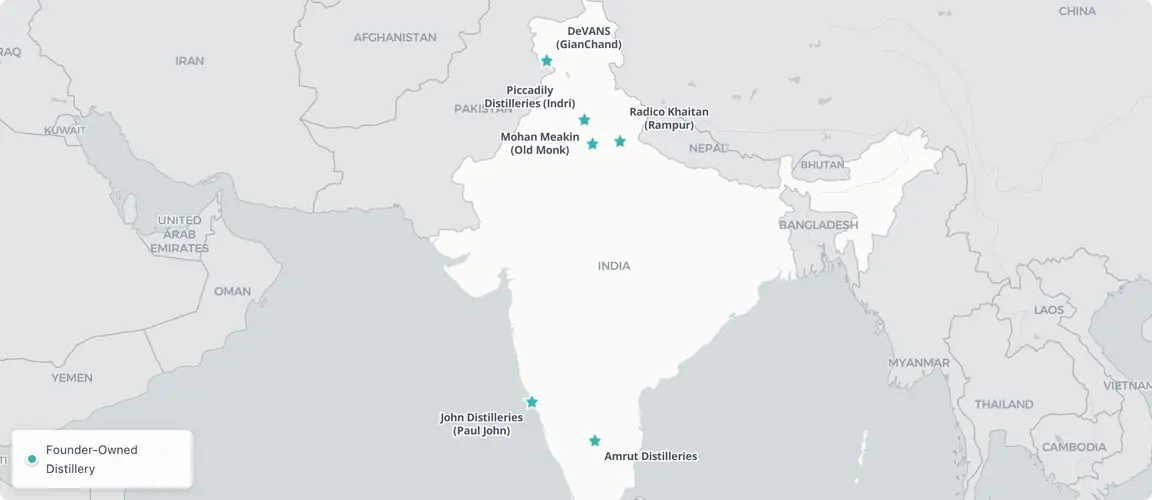
The scale of the mismatch is measurable. India’s total spirits market is estimated at ~$52.5 billion (2024). Indian single malts have crossed a threshold that matters for anyone following quality signals: they now hold 53% of India’s domestic premium malt market, ahead of Scottish imports for the first time. The five distinct climate zones where founder-owned distilleries built this category — from Karnataka’s tropical plateau at 920 metres to the Himalayan foothills of Jammu, from Goa’s coastal licensing environment to the extreme temperature variation of the Haryana plains — do not appear as a cluster on any standard market map. They appear as “India.”
That mismatch has persisted through fifteen years of unmistakable evidence. In those fifteen years, Sazerac entered India through John Distilleries. Diageo acquired Nao Spirits. Allied Blenders and Distillers bought the Fullarton portfolio. In December 2025, Tilaknagar Industries completed the largest acquisition in Indian beverage alcohol history, purchasing Pernod Ricard India’s Imperial Blue brand for $485 million. Each transaction made the same implicit claim: that Indian spirits built by founders who survived real crises are worth acquiring at premium valuations.
The UK-India Free Trade Agreement, signed July 24, 2025, adds a structural dimension. Spirits tariffs that had stood at 150% since independence will fall to 75% immediately and reach 40% over ten years. The export thesis that Amrut proved expensively at 150% tariffs is about to be validated cheaply.
The intelligence gap is not primarily about information access. The research exists — primarily in English-language Indian business press and publicly available corporate filings. The gap is in how the data is categorised, and who bears the cost of re-categorising it. That cost has historically fallen on the brands themselves — founder-owned companies spending export budgets to explain to buyers why their product doesn’t belong in the category that appears on the invoice.
What surplus malt looked like in 2001
In 2001, Amrut Distilleries had a problem. The Bangalore company had been producing whisky since 1948, founded by JN Radhakrishna Rao Jagdale in the year India gained independence. Its products were sold domestically, unremarkably. In 2001, the company found itself with surplus malted barley — quality grain with no ready buyer.
The second-generation chairman Neelakanta Jagdale made a decision that looked commercially irrational. He would turn the surplus into single malt whisky — the premium Scotch-style category that Scotland had spent three centuries perfecting. He would do it in Bangalore, at 920 metres elevation, in a climate where the angel’s share — the portion lost to evaporation during cask maturation — runs at 10 to 12% annually, compared to 2% in Scotland.
On paper, this made no sense. The conventional wisdom held that Indian heat would destroy the slow chemistry of cask aging. What Neelakanta understood — or was willing to bet on — was the inverse: India’s heat compresses the timeline without diminishing the process. The cask interaction that takes fifteen to twenty Scottish years happens in five Indian ones. A 10-year Indian single malt is not an accelerated product. It is a different kind of product: the same transformation, at a different intensity and pace. The Bangalore plateau, at 920 metres, moderates the heat enough to prevent over-extraction while altitude-adjusted temperature variation creates the breathing cycle that good whisky requires. The surplus stock nobody wanted was sitting in exactly the right place.
On August 24, 2004, Amrut Single Malt debuted in public at Café India in Glasgow. The choice of Scotland as the debut market was not incidental — it was a statement about where the credibility threshold for single malt actually lived. Sales were near zero. The Scotch whisky industry watched with polite scepticism.
Three years later, Neelakanta Jagdale was sitting on a bench in London’s Tavistock Gardens. He had been travelling the UK — meeting buyers, distributors, bar owners — and almost none were interested. Amrut had invested heavily in export development and had almost nothing to show for it. By his own account, documented by MYB International, Amrut’s UK distributor at the time, he was on the verge of abandoning the international expansion entirely.
He did not. He went back to Scotland. He kept investing. He persisted in a market that had not yet decided to take him seriously.
In October 2009, Jim Murray’s verdict appeared. The review changed what it was possible to say about Indian single malt — not by creating a fact that hadn’t existed, but by forcing the global whisky industry to reckon with one it had been ignoring.
Neelakanta Jagdale died on May 9, 2019. Two weeks later, Amrut won World Whisky Producer of the Year — the industry’s highest recognition. His son Rakshit became managing director. The company, now in its third generation under the Jagdale family, exports to 67 countries and reports net revenue of ~₹550 crore.
Bangalore was never on a Scotch map. It didn’t need to be.
Three founders who refused comfortable explanations
Amrut was not the only company that arrived at an impossible position and chose to stay.
Paul P. John did not begin in whisky. His first venture was biscuit manufacturing. It failed. He entered spirits in 1992, registering John Distilleries in Goa in a regulatory environment where state-by-state excise rules fragmented what looked from the outside like a single national market into dozens of separate permission regimes. Premium positioning in that environment was an act of sustained faith. John’s solution was not to start premium. He built Original Choice first — a mass-market brand that eventually reached 11 million cases annually. Not a product designed for prestige, but infrastructure: distribution reach, institutional relationships, and operational capability established before the Paul John single malt brand launched into those same channels.
Paul John is now in 44 countries. In 2017, US spirits giant Sazerac acquired a 28% stake from PE investor Gaja Capital, which exited at a reported 5× return. By 2024, Sazerac held 60%. The buyer did not acquire an aspiring brand. It acquired a distribution network built from a failed biscuit factory through twenty years of regulatory navigation.
The logic is structural. Original Choice gave John Distilleries shelf presence in state-level distribution networks across India that premium launches cannot acquire independently. When Paul John single malt needed export access, the institutional relationships were already built. Sazerac’s acquisition of a 44-country distribution relationship reflected this reality: the brand was the proof of concept; the infrastructure was what they were paying for.
In Ghaziabad, Brigadier Kapil Mohan ran Mohan Meakin with a conviction that most brand strategists would categorise as commercially suicidal. He was a teetotaler — a Padma Shri recipient who had dedicated his career to building one of India’s most beloved spirits brands without personally consuming any of its products. His view, maintained without compromise for decades: the best advertisement for a product is the product itself. Old Monk rum, launched in 1954 and aged seven years in oak barrels, had once held 15% of India’s domestic rum market. Under the no-advertising policy, with competitors spending aggressively on promotion, that share collapsed to 5%. Mohan did not change course. His conviction was not ignorance — it was a considered position that the brand’s equity was real enough to survive without manufactured awareness.
Brigadier Kapil Mohan died on January 6, 2018.
His nephews Hemant and Vinay Mohan inherited the brand. Old Monk now lives in a suspended state: genuine global cult recognition, a commercial trajectory bearing the marks of the no-advertising years, and a succession question the nephews are answering in real time through RTD launches and export growth. Whether the conviction that impaired the brand commercially also preserved the equity that makes revival possible — that is the live question.
In Rampur, Uttar Pradesh, G.N. Khaitan purchased a loss-making distillery in 1972 for ₹16 lakhs. His son Lalit Khaitan, who would build Radico Khaitan into a company with a $4.3 billion market capitalisation, tasted alcohol for the first time at age 28. The company he inherited navigated the competitive shock of post-1991 liberalisation — when multinational entry changed the pricing reference for quality spirits in India overnight — by executing a premium pivot that most heritage Indian distillers couldn’t pull off. Rampur Indian Single Malt launched into 80+ markets. Jaisalmer Indian Craft Gin followed. Both carry the same underlying wager: that Indian founder-built spirits, made by people who know the regulatory terrain intimately, can compete internationally on quality terms. The ₹16-lakh entry price in 1972 makes Radico’s current $4.3 billion market capitalisation difficult to describe without context: the company navigated post-1991 liberalisation when multinationals arrived with pricing advantages that should have compelled every domestic incumbent toward commodity positions. The premium pivot ran against that logic — and held.
When the state became the threat
On April 1, 2016, Bihar enacted total prohibition. In a single day, 5,467 liquor shops closed and the state forfeited ₹3,142 crore in annual excise revenue. The Patna High Court struck down the law on September 30. Within 48 hours, a replacement was enacted. Courts challenge; legislators respond; the environment shifts again. For brands building national distribution, the lesson recurred: India’s spirits market is not one market. It is twenty-eight licensing systems with twenty-eight risk profiles and twenty-eight moments of political exposure.
In November 2021, Delhi took the opposite approach: privatising its liquor retail system entirely. The results were briefly a windfall for premiumisation — Piccadily Distilleries launched Indri single malt during this window, capturing 30% of India’s domestic single malt market within two years. The experiment collapsed in 2022. CBI and ED investigations followed. The policy was withdrawn. A CAG report later documented ₹2,027 crore in revenue loss. The regulatory tide that had helped Indri scale receded. The brand continued to grow.
For smaller operations, the state’s unpredictability carried existential weight. India’s craft gin and rum ecosystem emerged almost entirely from Goa — a state whose liberal licensing, tourism-driven test market, and feni distilling tradition normalised artisanal production at a scale that other states made impossible. Nao Spirits built Greater Than into India’s first craft London Dry gin before Diageo acquired 97% of the company in 2025.
The pattern holds across the sector. Crisis in Indian spirits is not primarily a market crisis. It is a regulatory crisis — sudden, non-negotiable, and indifferent to the commercial logic of the brand it disrupts. The founders who navigated it built something that could not have been built in stable environments. The instability produced the resilience that premium buyers are now acquiring.
The acquisition wave and what remains
The five years since 2020 constitute the best period on record for verifying that Indian single malt is a mature category — and among the last years for uncrowded positioning within it.
The deal sequence is explicit. Sazerac moved from 28% of John Distilleries (2017) to 60% (2024). Allied Blenders and Distillers acquired the Fullarton brand portfolio in February 2025. Diageo reached 97% of Nao Spirits in June 2025 at ₹130 crore. In December 2025, Tilaknagar Industries acquired Pernod Ricard India’s Imperial Blue brand for $485 million — the largest transaction in Indian beverage alcohol history, making Tilaknagar the second-largest spirits company in India.
None of these acquirers were experimenting. Each transaction was a specific bet on a specific founder-built distribution network, brand equity, or production capability. The valuations embedded in these deals do not describe regional curiosities. They describe credible competitors in a global premium spirits market.
What remains in founder or family hands matters as much as what was acquired.
Amrut Distilleries is still family-owned, third-generation, under Rakshit Jagdale. Radico Khaitan is publicly listed but founder-influenced, with Rampur and Jaisalmer as its premium export vehicles. Mohan Meakin remains with the Mohan family. DeVANS is still family-operated in Jammu — its GianChand single malt won International Whisky of the Year in 2025.
Piccadily Distilleries, whose Indri brand holds 30% of India’s domestic single malt market and has grown faster by volume than any other single malt globally, reports revenue of ₹797 crore (FY2025). Its promoter, Siddharth Sharma — known publicly as Manu Sharma — was convicted in 2006 for the 1999 Jessica Lal murder and released in 2016. Investors and distributors considering commercial relationships with Indri should conduct appropriate due diligence. Brandmine covers the brand on its commercial merits; the promoter background is disclosed as a material fact that international partners require.
The UK-India FTA changes the arithmetic for every brand that survives to benefit from it. Export economics that required extraordinary conviction at 150% tariffs become manageable calculation at 40%. Distribution networks that Amrut, Paul John, and Radico built while absorbing full tariff headwinds now operate at structurally improved margins. What they proved expensively is about to become demonstrably viable for brands that haven’t yet had the resources to prove it.
Paul John’s chairman stated the dynamic plainly: “Once more brands come into the market, there will be more awareness created for single malts. You’re going to see a lot of people upgrading.” The FTA is both external validation and accelerant for a process that founder-owned brands started twenty years ago.
Stranger & Sons in Goa are still building craft gin without institutional backing — creating a category in a market with no established premium gin reference, navigating state-by-state distribution without a multinational’s logistics infrastructure. The craft gin category that barely existed in India when they launched is now a recognised export segment. The same pattern: conviction before credibility, built in the hardest possible conditions.
Hiding in plain sight
The analytical problem with Indian single malt is not access. It is categorisation. A database search for “Indian whisky” returns Amrut, Paul John, and Indri alongside the grain-spirit blends that represent the overwhelming majority of Indian whisky output by volume. The averages suppress the signal. An investor who filters past “Indian whisky” because the category profile doesn’t match their quality parameters makes a rational decision with the wrong data.
India has been producing half the world’s whisky for decades. The fraction of that production that matters for quality-focused capital allocation — the single malts from Bangalore, Goa, Rampur, Haryana, Jammu — has now cleared every threshold institutional legitimacy requires. Jim Murray established it in 2009. The acquisition wave confirmed it in 2024 and 2025. The UK-India FTA is about to make it legible to distribution partners who previously couldn’t model the tariff risk.
The FTA’s tariff milestones are staged through 2035 — each phase reduces the cost gap that has separated founder-owned Indian single malt from Scotch, and each of the acquisitions documented above happened before the full reduction was in place.
The brands that will define the next decade of global premium spirits are still largely family-owned. Amrut is exporting to 67 countries under the third generation of the Jagdale family — the family whose patriarch sat on a London park bench in 2007 and chose not to leave. Radico’s Rampur is in 80+ markets, still founder-influenced. The Goa cluster, where Paul John built a 44-country network from a failed biscuit factory, remains a verified production geography for spirits that attract serious international attention.
Jim Murray noticed in 2009. The databases are still updating their categories.
Rakshit Jagdale now runs the distillery his grandfather built from surplus malt nobody wanted; the next founder who makes that same bet does it at a 40% tariff instead of 150%, with buyers already circling. The premium belongs to whoever proved the category first, not whoever notices it now.