 Skip to main content
Hyderabad Cuisine: Invisible Until the Raid
Roughly 50 Income Tax teams searched 20-30 premises tied to Pista House, Shah Ghouse and Mehfil on 18-19 November 2025, physically counting out about ₹6 crore in cash. It is the first institutional-grade financial signal this sector has ever produced — and it took a raid, not an analyst, to produce it.
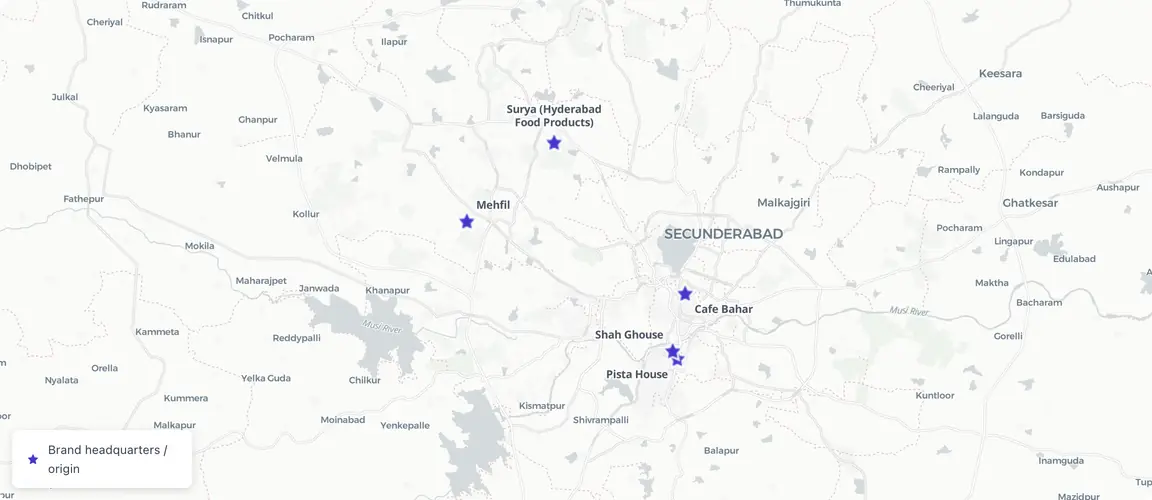
Hyderabad's haleem economy is not citywide
Crisis survival as the only public record
A ₹1,000-crore economy no institutional database has ever recorded
In the run-up to Ramzan 2025, Hyderabad’s haleem trade — one slow-cooked wheat-and-meat dish, sold for a few weeks a year from thousands of stalls, dhabas and franchise counters across the city — moved an estimated ~₹1,000 crore (~$105M USD), according to Deccan Chronicle’s trade-press reporting, up from ~₹800 crore the year before per Awaz The Voice. On Swiggy alone, one Ramzan season produced 1 million biryani orders and 400,000 haleem-plate orders, a 20% year-over-year jump. None of this appears in PitchBook, Bloomberg or Crunchbase. No institutional analyst covers it. The businesses that generate it — Pista House, Shah Ghouse, Mehfil, Cafe Bahar, and a wider cohort of first-generation, founder-controlled chains — have never raised a rupee of venture or private-equity capital, and most of their trade runs in cash.
That invisibility is not one gap; it is three, compounding. These founders never sought institutional capital, so there is no cap-table trail to find them by. The trade itself is cash-intensive, so there is no formal financial-data trail either. And the sector’s own documentation — crisis coverage, founder interviews, succession signals — lives overwhelmingly in Telugu and Urdu press, languages English-language institutional research does not read. As the Urdu-language outlet Siasat Daily put it in its own reporting on the trade: “Haleem is no longer merely a dish but has become a major industry of Hyderabad” — a framing that has circulated for years in local-language coverage without ever crossing into an English-language trade publication, let alone an institutional research note. Each gap alone would leave a partial record. Together, they make this sector functionally undocumented outside a live law-enforcement action.
The scale itself is not in doubt, only its visibility. During Ramzan season, the city hosts an estimated 6,000 haleem outlets — dedicated stalls, dhabas, and franchise counters that mostly don’t exist the rest of the year, springing up specifically to serve a few weeks of concentrated demand. That is not a niche seasonal treat; it is a parallel food-service economy that appears, generates real revenue at real scale, and disappears again, largely outside any register that would count it as economic activity in the way a permanent restaurant chain gets counted.
Which is exactly what happened. On 18-19 November 2025, roughly 50 Income Tax teams searched 20-30 premises tied to three of the cohort’s best-known chains — Pista House, Shah Ghouse, Mehfil — under India’s coordinated tax-enforcement authority. Investigators physically counted about ₹6 crore in cash on the spot, per reporting from The Hans India, and — according to Times of India-sourced coverage that must be read as investigators’ preliminary claims, not adjudicated findings — flagged an estimated ₹600 crore in potentially suppressed income across the searched premises. A single 48-hour tax operation surfaced more institutional-grade financial signal about this sector than a decade of English-language trade press had produced. The investigation remains open and unadjudicated; nothing here should be read as a settled finding of wrongdoing.
Survival, not paperwork, is the record that exists
The journey of Pista House was not easy until it was awarded the GI status in 2010; it came after putting in a lot of efforts to maintain the standard quality.
If a sector has no cap-table trail and no formal financial-data trail, what does survive as evidence of which businesses in it are actually durable? In Hyderabad’s case: the record of what each founder did when the business was directly threatened — because that record was public, contested, and specific enough that it couldn’t be erased the way a private balance sheet can be withheld.
Shah Ghouse, founded either in 1989 (per founder Mohammed Rabbani’s own account to The News Minute) or in 1973 under the name Mohammed Ghouse Pasha (per corporate and wire records surfacing during the 2025 tax coverage — both dates are recorded here, unreconciled), nearly lost its entire customer base in December 2016 to a fabricated WhatsApp rumour claiming the chain served dog meat, amplified by television coverage before anyone could contain it. Rabbani’s response wasn’t a denial campaign. It was cooperation with a GHMC health inspection and an independent lab test at the National Research Centre on Meat, which confirmed the meat in question was “sheep (Ovis aries) only.” A 22-year-old MBA student was later arrested for originating the hoax. “It took me years to get this goodwill,” Rabbani told The News Minute afterward. “I worked day and night for this.” The chain is still operating.
Gokul Chat’s founding family faced a different order of threat entirely, and it is the starkest illustration in this cohort of what “the only public record” actually means. In August 2007, an IED exploded at the chain’s Koti counter, part of a coordinated pair of Hyderabad bombings that killed dozens of people that day. No precise casualty count specific to the Gokul Chat site has been independently confirmed in the sources available for this article. What is documented — because it produced no filing, no press release, no annual report line, and survives only as public memory — is the outcome the Vijayvargiya family chose afterward: install security, reopen at the exact same site rather than relocate or close. It is, today, the only public evidence that the family chose continuity at the site itself over the safer, more anonymous option of starting over somewhere else. Gokul Chat remains a central-Hyderabad institution at that same location.
Karachi Bakery’s test has repeated on a cycle — not a single violent event but a recurring, identity-based campaign that has now hit the business twice in six years. Founded in 1953 by Khanchand Ramnani and now run by his grandsons Rajesh and Harish Ramnani, the bakery has faced recurring mob pressure to drop its name — first after the 2019 Pulwama attack, in Bengaluru, and again in May 2025 across Shamshabad and Vizag locations. Both times, the family’s response was public: reassert Indian identity, appeal to the Telangana state government, and keep the name. “Our grandfather Khanchand Ramnani established” the business on that name, the brothers told Deccan Herald in 2025 — and the 72-year operating history they cite as justification is, again, a claim made in the family’s own public statement, not something any institutional filing or registry record independently confirms. What is verifiable is the outcome: the name has held both times, across two separate rounds of organised pressure six years apart.
Surya — formally Hyderabad Food Products, founded by Ravindra Modi in 1984 on an SBI loan — offers the cohort’s clearest example of a founding-era crisis rather than a later one. The packaged-spice market Modi entered was full of adulterated, undercut-priced competitors. His decision was to compete on documented product quality rather than price-match the adulteration: “if we produce a good quality product, the consumers will accept it very well,” he told Deccan Chronicle in 2014. The company now supplies more than 20 states with an international B2B export arm, and Modi’s son Varun is now a registered company director — a clean, registry-confirmed succession signal that has nothing to do with the November raid and everything to do with a business built the slow way.
A single square mile, and why it matters
The concentration behind this sector is sharper than the raid headlines suggest. Roughly 70% of the city’s Ramzan haleem stalls sit inside one historic district — the Old City, anchored around Shalibanda and the lanes surrounding Charminar — a legacy of the Chaush and Hadhrami communities who settled there generations ago and whose culinary traditions became, over time, Hyderabad’s own. Pista House and Shah Ghouse both trace their origins to streets within walking distance of each other in this district. It is not a coincidence that the sector’s largest players cluster here rather than spreading evenly across the city: the Old City is where the trade’s institutional memory, supplier relationships and skilled labour pool for haleem-making — a genuinely labour- and technique-intensive process — are concentrated, and that concentration is itself part of why outsiders can look at “Hyderabadi cuisine” and see a citywide phenomenon rather than the specific, geographically anchored trade it actually is.
The remaining four zones researchers mapped for this sector tell a different, secondary story. The Cyberabad IT corridor — Gachibowli, HITEC City, Kondapur, Madhapur — is where marquee chains like Mehfil open seasonal counters to catch high-income delivery and takeaway demand, an estimated quarter of the sector’s total production despite having none of the Old City’s historic trade infrastructure. Secunderabad and the central Koti-Abids belt hold the city’s older institutional sites — Paradise (1953) and Gokul Chat (1973) both sit here, legacy brands from the cinema-era and post-Partition period rather than the haleem-specific Old City tradition. Kukatpally and the northern suburbs are where packaged-goods manufacturing happens — Surya’s spice production, Almond House’s sweets factories — an entirely different economic layer from either the Old City’s dine-in trade or Cyberabad’s delivery economy. And Shamshabad, near the airport, is where the export layer lives: Pista House’s international shipments and Karachi Bakery’s diaspora-facing packaged goods both route through here. Four different economic logics, one sector, and only one of them — the Old City’s — is what most outside observers picture when they hear “Hyderabadi biryani.”
What a tax raid revealed that a decade of trade press did not
Pista House sits at the center of the cohort’s scale story, even though this article treats its own founding narrative as out of scope — that account belongs to a separate, already-researched and locked profile, still unpublished. What is safe to state here is Pista House’s current-state footprint: 44 outlets across five countries, ISO 9001:2015-certified GI-tagged haleem exported to markets including the US, UAE, Oman and Kuwait, and standing as India’s largest haleem producer. Founder Mohammad Abdul Majeed’s own account of the road to that scale is instructive on its own terms: “The journey of Pista House was not easy until it was awarded the GI status in 2010,” he told Deccan Chronicle in 2018; “it came after putting in a lot of efforts to maintain the standard quality.” Haleem’s 2010 Geographical Indication tag — the first ever granted to a non-vegetarian product in India, renewed through 2029 and named the country’s “Most Popular GI” food in 2022 — is the closest thing this sector has to an institutional credential. It is a regulatory fact, not a financial one, and it says nothing about revenue, ownership structure, or who controls what. That gap is precisely what the November 2025 raid forced into partial view.
Mehfil, the third named chain in the raid, illustrates the same gap from a different angle: roughly 15 outlets plus a UAE branch, built on a growth trajectory that outside observers had no independent way to check against declared financials — until investigators showed up with exactly that mandate. Cafe Bahar, the cohort’s other Old City fixture, has faced no comparable financial scrutiny; its story is one of quieter continuity, an Irani-cafe-to-biryani-landmark conversion now in its second generation under the Bolooki family, still operating from the same Basheerbagh site near the city’s older cinema district.
None of these four brands appears in a venture database, a PE portfolio list, or an equity-research note. As of November 2025, three of the four appear in an Income Tax case file instead — the sector’s first involuntary financial disclosure, forced rather than volunteered, unadjudicated rather than audited.
Almond House is the cohort’s one clean counter-example, and it makes the invisibility argument by contrast rather than by pattern. Founded in 1989 and now generating an estimated ₹186 crore in FY24 (per Tracxn/MCA filings) under second-generation leadership, the mithai and dry-fruit sweets house had already completed a founder-to-son succession — Nagarjuna Muppala to Chaitanya Muppala — before any of this cohort’s crises made the news. When COVID hit traditional mithai retail, Chaitanya’s response wasn’t defensive; it was to spin off Manam, a craft-chocolate brand, as a new venture in 2023. Three years later, Manam closed a $9M Series A in June 2026 — the only venture-funded raise anywhere in this sector’s recorded history. The distinction that matters here: Almond House’s own numbers came from a registry filing, not from a tax raid or a founder’s own account to the press. It is the one brand in this cohort an institutional investor could have found without waiting for law enforcement to force the disclosure — proof that the invisibility problem is a function of how these founders have chosen to finance growth, not an inherent property of the sector itself.
The window this article can name — and the one it can’t
Two genuinely different signals point at this cohort right now, and they are worth keeping separate rather than blurring into one generic “act now” argument. The first is regulatory and time-bound: the November 2025 investigation is active and unresolved, which means the window during which this sector’s financial and ownership reality is under unusual, external, documentable scrutiny is open now and will close — either when the case resolves, or simply when the news cycle moves past it and the cash economy retreats back out of view. The second signal has nothing to do with the raid at all: Surya’s succession is already handled, cleanly, on the public record, with Varun Modi’s 2023 director appointment standing as exactly the kind of structural handover signal institutional research usually has to dig for. One signal is a closing window forced by an outside actor; the other is a founder-controlled business that simply got ahead of the question before anyone was asking it.
Both point at the same underlying fact about this sector: crisis-survival and quiet succession are not different kinds of evidence. They are the only two kinds of evidence a data-poor, cash-intensive, first-generation-founder sector produces on its own — one forced, one voluntary — and an investor who wants to find the businesses in it worth finding will need to read both.
Researched 27 sources in English, TE, Urdu.