 Skip to main content
Hyderabad: Trade That Outlived the Kingdom
In 1591, Muhammad Quli Qutb Shah built Hyderabad at the crossing of the Golconda diamond road and the Masulipatnam trade route. Conquest, princely collapse and a new city built 17 km away later, the Old City's food still travels the world while the quarter that made it stays poor — as a refugee's bakery, still fighting over its name, shows.
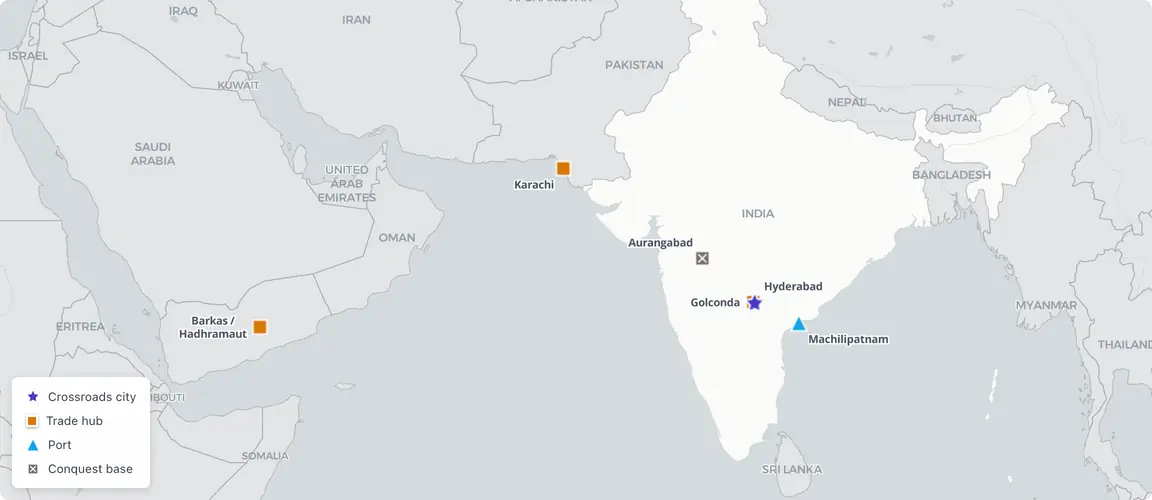
Hyderabad: Where the Diamond Road Met the Gulf Corridor
Trade timeline
Khanchand Ramnani had nothing when he crossed the new border in 1947 — no capital, no contacts, no city he recognized. He was a Sindhi Hindu fleeing Karachi as Partition tore the subcontinent in two, and he landed in Hyderabad, a Muslim-majority former princely state whose own accession to India was still a year away from being forced at gunpoint. Six years later, in 1953, he opened a bakery at Moazzam Jahi Market, in a quarter of the city that pearl merchants had built and diamond fortunes had once financed. He named it after the city he’d lost. Seventy-two years on, his grandchildren are still explaining why.
The city built for a crossing
Karachi Bakery is 100 per cent Indian brand, founded in Hyderabad, India in 1953. Our name is a part of our history, not our nationality.
Hyderabad was not founded where it is by accident. In 1591, Muhammad Quli Qutb Shah laid out a planned grid city on the Musi river’s east bank and built Charminar — the four-minaret monument that still anchors the Old City today — at the exact point where two trade routes crossed: the road carrying Golconda’s diamonds toward the coast, and the route that fed those diamonds, along with Coromandel textiles, out through the Bay of Bengal port of Masulipatnam. The English East India Company thought the crossing important enough to establish a settlement there in 1611, twenty years after the city’s founding. For the better part of a century, the diamonds that passed through Hyderabad’s markets weren’t merely valuable — they were, for a stretch of history, nearly the only game in town. Golconda’s mines supplied virtually the entire world’s diamond trade until Brazilian deposits were discovered in the 1720s, and the stones that carry the Golconda name today — the Koh-i-Noor, the Hope Diamond — trace their provenance to exactly this crossing.
The trade this crossing carried was not incidental to the city — it was the city’s founding logic. Sultan Quli Qutb-ul-Mulk had broken from the Bahmani Sultanate to establish the Qutb Shahi dynasty at Golconda in 1518, seventy-three years before Hyderabad itself existed; Muhammad Quli Qutb Shah’s 1591 decision to build a new capital was, in effect, a decision to build permanent civic infrastructure around a trade route his dynasty had already been running for three generations. Through the 1620s and 1630s, the arrangement peaked: Coromandel textiles and Golconda diamonds moved together through Masulipatnam toward Persia, Arabia and Europe in volumes that made both the port and the inland capital indispensable to a trade network spanning three continents.
That kind of geography does not stay lucky forever. In 1687, a Mughal army under Aurangzeb ended a long siege of Golconda fort and, with it, 169 years of Qutb Shahi independence. The diamond trade did not vanish overnight, but the Masulipatnam route grew unsafe, and the singular advantage of controlling a crossing where a fortune in stones moved through began to erode. Hyderabad’s first great trading empire, built in a century, took most of the next one to unwind.
What replaced the diamonds
The city did not stay quiet for long. In 1724, Nizam-ul-Mulk established the independent princely state of Hyderabad, and a second peak of patronage-driven trade and craft began — one built less on a single extractable resource and more on the accumulated skill of merchants and artisans who had learned to work a crossing for two centuries. Pearls from the Arabian Gulf flowed through Pathergatti, the red-granite arcade the Nizams built in 1911 specifically to house pearl and jewellery merchants; the quarter earned Hyderabad the epithet “City of Pearls,” and Pathergatti’s stalls are, remarkably, still active today. Bidriware — the distinctive zinc-alloy metalcraft inlaid with silver, a Persian import the Asaf Jahi courts patronized for two centuries — became another export the Deccan alone could claim.
The most consequential new arrival came from further away. Beginning in the late nineteenth century, the Nizams recruited Hadhrami Arab soldiers from Yemen to garrison the city, and those recruits settled the barracks that became Barkas, a neighborhood that still carries a distinct Yemeni-Hyderabadi identity today. This was not a passing military arrangement — it was a sustained, multi-generational migration that transplanted an entire community’s foodways, language inflections and kinship networks into the Old City’s fabric, in much the same way earlier Persian metalworkers had transplanted the techniques behind Bidriware into the Asaf Jahi courts a century before. The Chaush community, as the Hadhrami descendants came to be known locally, brought harees with them — a wheat-and-meat porridge that, transplanted into Hyderabad’s kitchens and reworked over generations with local spice and technique, became haleem, the dish that would eventually put the Old City on a global culinary map in a way none of its trade routes ever quite managed. A crossing that had built its first fortune moving diamonds out was, without anyone planning it, assembling the ingredients for a second export nobody in 1880 could have predicted.
Two crises in one lifetime
The patronage economy that sustained all of this — the pearl merchants, the metalcraft workshops, the courtly commissions that kept Bidriware alive — depended on a political structure that could not survive India’s independence. Operation Polo, the Indian Army’s action against the princely state under Major General J.N. Chaudhuri, began at dawn on 13 September 1948; the Nizam announced a ceasefire four days later. What happened in between and immediately after remains contested in a way most of Hyderabad’s earlier history is not. A committee headed by Pandit Sunderlal toured nine of the state’s sixteen districts that November and December and concluded, in its own words, that “at a very conservative estimate… at least 27,000 to 40,000 people lost their lives during and after the Police Action.” The report was suppressed for sixty-five years, declassified only in 2013 after a petition from Cambridge historian Sunil Purushotham. A contested higher figure — cited by scholars including W.C. Smith and William Dalrymple — runs as high as 200,000. Both numbers deserve to be stated in any honest account, and neither should be treated as fully settled.
The following year compounded the damage in a quieter, less-noticed register. The 1949 Hyderabad Jagirdar Abolition and Regulation Act dismantled the noble-patronage economy in a single legislative stroke — the same system that had funded Pathergatti’s pearl arcade and kept Bidriware’s workshops in commissions for two centuries. Artisans and merchants who had built entire livelihoods on courtly demand alone lost their customer base within a single generation. It was into this exact, specific moment of dismantlement — a city that had just lost its political sovereignty and was now losing its economic patronage structure too — that Khanchand Ramnani arrived from Karachi and, in 1953, opened his bakery.
The bakery that outlasted the empire that built its market
Karachi Bakery did not inherit a diamond fortune or a pearl-trading network. What it inherited was a location — Moazzam Jahi Market, inside a quarter whose commercial infrastructure long predated the crisis that had just gutted its patronage economy — and a founder’s willingness to rebuild from almost nothing in a city that was, in its own way, also rebuilding from almost nothing. The bakery and Paradise, the biryani restaurant founded the same year, both took root in 1953, within the same five-year window as Operation Polo and the jagir abolition. Neither food brand had any obvious reason to survive the collapse of everything around it. Both did.
The through-line from diamonds to pearls to bakeries is not a metaphor — it is the same crossing, continuously re-routing what passed through it as each prior trade exhausted itself. What stayed constant across four centuries and three separate economic collapses was not any single commodity. It was the accumulated density of people who knew how to trade, in a place built specifically for trading, who kept finding the next thing worth moving through it.
The city that moved north
By the late twentieth century, the crossing itself was under threat in a different way. In November 1998, Cyberabad — HITEC City — opened roughly seventeen kilometres northwest of Charminar, inaugurated by then-Prime Minister Atal Bihari Vajpayee. It was not a military conquest or a legislative abolition. It was simpler and, in its way, more permanent: Hyderabad’s commercial gravity itself relocated. The IT corridor that grew up around HITEC City became the address investors and multinational employers meant when they said “Hyderabad.” The Old City — the quarter that had anchored every version of the city’s trade identity since 1591 — became something closer to a heritage backdrop for a metropolis whose economic center of mass now sat somewhere else entirely.
And yet the thing the Old City had spent four centuries building — a population dense with trading and craft knowledge, occupying one of the most concentrated urban quarters in India at roughly three times citywide density — did not disappear when the money moved north. It found, again, a new commodity to move. This time it was food.
What the world actually buys from Hyderabad
Haleem, the Yemeni-origin dish Barkas had quietly incubated for a century, won India’s first non-vegetarian Geographical Indication tag in August 2010, administered by an association representing more than 6,000 haleem makers. During a single Ramzan season, Hyderabad’s haleem trade is now estimated at roughly ₹1,000 crore — up from an estimated ₹800 crore the year before, according to Urdu-language press reporting. On the online delivery platform Swiggy alone, one recent Ramzan season saw close to a million biryani orders and 530,000 haleem orders from Hyderabad. Biryani and haleem, dishes that trace directly to the Old City’s four-century habit of absorbing and reworking whatever migration or trade brought through its gates, now travel to the Gulf, the UK, the US, Canada and Australia as an established restaurant category, not a regional curiosity.
This is where the crossing’s oldest problem resurfaced in a new form. A neighborhood can export a cuisine without capturing much of the value that cuisine generates once it leaves. Karachi Bakery discovered this the hard way, twice. In 2019, in the wake of the Pulwama attack, and again in 2025, after the Pahalgam attack — including an incident of vandalism by BJP activists in Shamshabad and protests in Visakhapatnam — the bakery faced organized pressure to drop “Karachi” from its name, on the grounds that the word itself was now politically unacceptable, regardless of what the bakery actually was or who had founded it. A Mumbai outlet in Bandra had already closed in March 2021, amid both the pandemic and separate protests from a Maharashtra regional party. The bakery’s own name — the one thing tying its origin story to a specific founder’s specific act of rebuilding after loss — became, repeatedly, a target.
“Karachi Bakery is 100 per cent Indian brand, founded in Hyderabad, India in 1953,” the co-owners, Rajesh and Harish Ramnani, said in a statement carried by the news agency PTI in May 2025. “Our name is a part of our history, not our nationality.” It is a precise answer to an imprecise accusation, and it captures something the Old City’s entire trade history keeps demonstrating in different forms: producing something the world loves is not the same as owning the story of how it got made. Golconda’s diamonds carried the Golconda name into museum vitrines and royal treasuries centuries after the mines themselves stopped mattering commercially. Haleem now carries “Hyderabadi” as a permanent adjective on menus from Dubai to Toronto. Karachi Bakery carries a place name that, in 1953, meant only “where the founder came from” — and that, seven decades later, someone else decided should mean something else entirely.
The reckoning that’s only just begun
Two recent, modest institutional moves suggest the Old City’s long imbalance — enormous cultural export, comparatively little reinvestment — has at least been noticed. In September 2010, the same month haleem secured its GI tag, Golconda Fort, the Qutb Shahi Tombs and Charminar were jointly submitted to UNESCO’s Tentative List, the formal first step toward a heritage designation the quarter has never actually received; the nomination remains tentative, not inscribed, fifteen years later. In 2021, the Quli Qutb Shah Urban Development Authority — dormant for years — was reactivated specifically to take up heritage and tourism works in the Old City, work that had gone essentially unfunded since the jagir system that once paid for it was abolished seven decades earlier. Neither move is a transformation, and neither comes close to matching the scale of what HITEC City drew away in a single decade. Both are, nonetheless, the first coordinated institutional acknowledgment in decades that a quarter which has repeatedly rebuilt the city’s export economy, from diamonds to pearls to bread to biryani, might be owed something more than benign neglect.
What the Old City proves, across four centuries and at least three distinct economic collapses, is that a crossing survives by continuously finding the next thing worth moving through it — and that the people who keep finding it rarely capture the value of what they’ve found. Diamonds, pearls, Bidriware, haleem, biryani: each generation of the Old City’s traders and cooks inherited a crossing, not a fortune, and had to work out on their own what the next thing worth moving through it would be. Khanchand Ramnani understood this instinctively in 1953, rebuilding a livelihood from nothing in a city that was itself losing everything. His grandchildren, defending the same bakery’s name in 2025, are still working out what it costs to be right about that and still have to keep proving it.
Researched 36 sources in English, TE, Urdu.