 Skip to main content
Court winemaking: Russia's elite estates
In July 2015, Vladimir Putin and Dmitry Medvedev toured a €30–40 million Crimean winery the Kremlin never recorded. The estate's wines win medals; its ownership is a riddle traced through offshore shells. This is court winemaking — capital deployment dressed as a passion project, where quality is loud and the owner is silent.
Geographic Context: Elite Wine Estates of Crimea
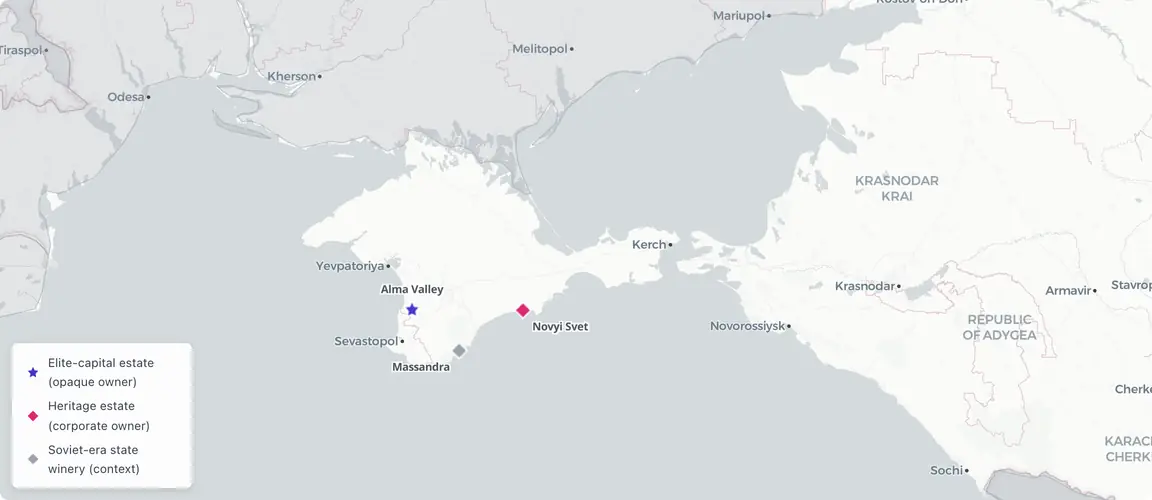
In July 2015, sixteen months after Russia annexed Crimea, Vladimir Putin and Dmitry Medvedev walked through a Swiss-designed winery in the Alma river valley. Their visit produced no Kremlin record — no photographs in the kremlin.ru archive, no press release, no acknowledgment that the president had endorsed a €30–40 million private investment. The general director confirmed the visit to the Russian business daily RBC, then declined to discuss it, calling it “private.” The silence was the message.
When quality is loud and ownership is silent
A winery's success sometimes depends less on terroir than on whose table pours your wine.
The estate they toured, Alma Valley, is not a hobby vineyard. It is a gravity-flow facility — the only one of its kind in Crimea, among a handful in all of Russia — producing more than ninety award-winning wines across thirty-five labels and seven product lines. Its winemakers brought in techniques almost unknown in Russian production: ice wine harvested below −8°C, German botrytis methods, Italian appassimento grape-drying. Its Riesling Ice Wine Reserve took an “Outstanding” silver at the 2018 International Wine & Spirit Competition in London — the first Crimean wine to win international acclaim there in half a century, according to Russian trade coverage. The terroir is real: limestone and marl soils on the 45th parallel, the same band that runs through Bordeaux and Piedmont, with a French chief winemaker and a German oenologist who set the production philosophy from the start. The infrastructure is real. The medals are real.
The owner is a riddle.
The timing of that 2015 visit was not casual. The winery’s first commercial wines had reached the market only that summer; Medvedev had just declared Crimea “fully integrated into Russia”; and within two weeks the Ministry for Crimean Affairs would be abolished, the federal government’s signal that the peninsula no longer needed special handling. The choice of a brand-new private estate over Soviet-era institutions like Massandra or Inkerman was itself deliberate — this was a showcase of new Russian investment succeeding under sanctions, not nostalgia for old cellars. Two months later Putin would tour Massandra with Silvio Berlusconi in a blaze of international coverage and Ukrainian criminal charges. The Alma Valley visit, by contrast, stayed below the Western radar entirely. Consolidation without confrontation; endorsement without a paper trail.
This is the pattern Brandmine calls court winemaking — придворное виноделие. It describes prestige estates owned, directly or through proxies, by a country’s political-financial elite, where wine functions as status currency, diplomatic gift, and networking venue rather than as a profit centre. A reader judging Russian wine by quality alone — a Hong Kong investor, a Dubai trader, a São Paulo importer — cannot tell from the awards that they are looking at capital deployment, not a founder’s story. The classification matters, because the two behave nothing alike.
The playbook
Court winemaking follows a recognisable sequence, visible across more than one Russian estate. Elite or state-adjacent capital acquires or builds the property. International winemakers and consultants — French, German, Swiss — are brought in to guarantee genuine quality. World-class infrastructure follows: gravity-flow cellars, imported oak, decades-long ageing programmes. Then comes the part that distinguishes the pattern from a normal premium business. The estate operates at persistent, often indefinite, loss; it tolerates that loss because the return is not measured in margin. And the beneficial owner is obscured — held through offshore structures, nominee directors, and companies with no public owner of record.
The economics only make sense if you stop thinking of the wine as the product. The product is proximity. A medal-winning estate in a contested region is a place to host, to gift, to signal endorsement, and to hold capital in an asset whose ownership is hard to trace. Run that way, a vineyard can lose money for a decade and still be the best investment its owner ever made.
Three features mark the pattern out from an ordinary luxury indulgence. First, the implicit state endorsement is load-bearing, not decorative: when a politically connected owner’s estate receives an unrecorded presidential visit, the visit signals to other elites that the asset is protected, and signals to the market that buying it is patriotic rather than risky. Second, the international expertise is non-negotiable — the owners want genuine quality, because a status asset that produces bad wine signals carelessness, not power. And third, the opacity is engineered, not incidental. A founder builds a brand to be known; a court winery is built so that its quality is known and its owner is not. The whole structure inverts the logic of a normal consumer brand, where the founder’s name is the asset. Here the name is the liability, and the medals do the talking instead.
Two estates, two ownership shapes
Brandmine classifies these brands already, and the two grounded cases show that “court winemaking” is not one label but a spectrum.
Alma Valley carries the designation elite-capital-project with ownership opacity flagged as deliberately-obscured — and vc-backed as its formal ownership type, the closest canonical fit for capital deployed without a founder. Investigations by RBC (2015), Forbes Russia (2014), and the OCCRP’s Pandora Papers (2022) traced its ownership through offshore structures to interests the reporting placed “close to” VTB Bank chairman Andrey Kostin. The most authoritative reference is the European Union’s own sanctions documentation, which stated that Kostin “owns a winery and luxury hotel in Crimea.” None of this is Brandmine’s claim; every link belongs to its named source, the reporting itself stops short of proof, and Kostin and VTB have denied commercial activity at the site. What is not in dispute is the structure: an estate of this scale whose ownership can only be described, even by investigative reporters, through proxies and qualifiers.
Then, on 14 March 2022 — eighteen days after the full-scale invasion of Ukraine — ownership transferred from Vargas Properties to a Russian company “whose owner remains secret,” in the OCCRP’s phrase. The operating entity lists no beneficial owner. The current director is unidentified in public sources. The transfer coincided with the period in which Western asset-tracing intensified; OCCRP characterised the restructuring as a move from traceable offshore structures to opaque domestic ones. Whatever the intent, the effect is a brand whose quality is documented and whose owner is not.
In Russia’s political economy the line between state and private capital is, in any case, porous: VTB is majority state-owned, Crimean projects of this scale receive government protection regardless of nominal ownership, and “Russian private investors” — the phrase Alma Valley’s management now offers — can mean a state banker, a connected oligarch, or a holding company that bundles all three. The operational reality is identical either way: a state-adjacent premium producer with political cover that purely private competitors cannot buy.
Novyi Svet sits at the other end. Brandmine classifies it plainly as corporate, and its arc is a state asset passing into inner-circle hands rather than offshore obfuscation. Founded in 1878 by Prince Lev Golitsyn (Лев Голицын) — whose “Koronatsionnoye” sparkling wine was served at Nicholas II’s 1896 coronation, earning him the right to display the imperial coat of arms — the estate carved seven kilometres of ageing tunnels into Crimean cliffs, maintained at 8–12°C year-round without mechanical cooling, where it still makes the only exclusively méthode traditionnelle sparkling wine in Russia. It remained state-owned through the entire Soviet and Ukrainian periods, 1920 to 2017; Golitsyn was, as one history puts it, “the first and last private owner” until the recent sale.
That ended on 22 December 2017, when a company called Yuzhny Proekt, created weeks before the auction and 99.9% owned by Bank Rossiya, bought the winery for 1.55 billion rubles (~$26M USD) — the first privatisation of a nationalised Crimean asset. Bank Rossiya is controlled by Yuri Kovalchuk (Юрий Ковальчук), often called “Putin’s banker” and under US sanctions since 2014; the same structure went on to acquire the historic Massandra winery in 2020, consolidating Crimea’s premium wine heritage under a single owner. Where Alma Valley’s ownership vanishes into the British Virgin Islands, Novyi Svet’s is a matter of public auction record — which is exactly why the corporate classification, not deliberately-obscured, is the honest one.
The contrast is the point. Alma Valley is capital arriving from nowhere and erasing its trail. Novyi Svet is the state handing a 146-year-old crown jewel to a politically connected bank in a documented transaction. One hides; one consolidates. Neither is a founder-owned brand, and conflating the two would flatten exactly the distinction that explains how each will behave.
Why the market rewards it
Court winemaking is rational because the surrounding market makes it rational — and this is where the ownership lens, not the now well-documented “Russian wine is invisible” story, does the work. The conditions are unusually favourable to producers who answer to capital rather than customers.
Domestic brands now hold roughly 60% of the Russian wine market, up from about 25% a decade ago, as sanctions thinned foreign competition and import-substitution policy pushed buyers toward “Made in Russia.” In August 2024 the duty on foreign wine doubled, from 12.5% to 25%; excise taxes climbed in parallel; and wine has been overtaking vodka in consumption. Novyi Svet’s 2024 results illustrate the upside: ₽1.0B RUB ($11M USD) in revenue, with net profit of ₽403M, a 110% year-on-year jump.
For an estate run as a status asset, this environment is close to ideal. A protected market with 140 million domestic consumers removes the need to chase exports — convenient, since Crimean-origin wine cannot reach Western markets under sanctions anyway, and Russia’s total wine exports fell by half between 2022 and 2023. Western wine critics will not cover sanctioned regions, and international competitions have stopped accepting Crimean entries; Alma Valley’s 2018 IWSC medals are now seven years old and unlikely to be refreshed. None of that matters to the business model. The awards already did their work as a domestic quality signal, and the only buyers who count are the ones inside the tariff wall.
The state’s policy goals and the elite owner’s interests align almost perfectly: import substitution wants visible domestic success stories, and a presidentially-blessed, medal-winning estate is exactly that. State media promote the wins as “Russian achievement”; the duty wall keeps foreign competition out; and the losses an owner tolerates are subsidised, in effect, by a market the state has tilted in their favour. A founder-owned brand has to earn its margin from customers who could buy something else. A court winery earns its return from a market designed so that, increasingly, they cannot.
How Brandmine reads it — illuminate, don’t judge
Brandmine’s job is not to allege; it is to classify so that a reader can see what quality signals hide. The discipline is to attribute every ownership and sanctions claim to its source — RBC, Forbes Russia, OCCRP, the EU and US sanctions lists, the SPARK-EGRUL corporate registry — and never to launder reporting into Brandmine fact. Within that discipline, the field values tell the story: elite-capital-project and deliberately-obscured on Alma Valley; corporate on Novyi Svet. Those are not insults. They are predictions.
What do they predict? Resilience and succession. A founder-owned brand has an identifiable person whose departure, death, or sale is the central risk and the central story — the transformation arc Brandmine reserves for founder-owned companies. A court winery has none of that. Its continuity depends on the owner’s standing, not a successor’s competence; its risk is political, not generational; its accounts answer to a balance sheet that was never meant to balance. Ask who inherits Alma Valley and the honest answer is that no one knows who owns it now. That is a different kind of company, and pretending otherwise would mislead exactly the investor the classification is meant to protect.
The two estates make the prediction concrete. Novyi Svet, classified corporate, behaves like an institution: a named owner, a public director, audited results, a 2023 reconstruction project targeting five million bottles. Its risk is that Bank Rossiya’s priorities shift or that sanctions tighten — corporate risk, legible from the outside. Alma Valley, classified elite-capital-project and deliberately-obscured, behaves like a held position: production volumes unconfirmed since 2022, current management unnamed, ownership reset to a blank. Its risk is that its protector falls from favour — and there is no public record to tell you when that risk crystallises. The classifications are not moral verdicts. They are a reader’s early-warning system, telling you which questions to ask before you mistake a status asset for a going concern.
Quality you can buy, transparency you can’t
Court winemaking is a reminder that excellence and integrity are not the same signal. Capital can buy Swiss consultants, limestone slopes, and a wall of medals; it cannot buy a transparent owner, because transparency is precisely what the model is built to avoid. The wines are good. The question the awards cannot answer is whose table they were always meant to pour at.
The pattern is extreme in Russia, but it is not unique to it. Across emerging markets, elite agriculture — vineyards, estates, prestige farms — often serves as the respectable face of capital that prefers not to be named. Russia simply runs the playbook with unusual clarity, in a region where the politics make the silence impossible to miss. For anyone reading a brand by its quality alone, that is the lesson worth carrying: a medal tells you what is in the bottle, never who is behind it.
Researched 47 sources in English, Russian.