 Skip to main content
China Restaurant Groups: Too Big to Consolidate
China's restaurant market hit ¥5.5 trillion in 2024 — bigger than the economies of most countries — yet only 5% of its stores belong to a chain of any kind. The founders who built the exceptions are now in their 60s, and almost none of them has a plan for what happens next.
China's restaurant chains never had one center
Scale without a center, control without a plan
A man who spent four decades building a chicken-soup chain across Anhui province stood on a comedy-competition stage in early 2025 and answered the question nobody had asked him directly: why is a man in his 60s still doing this? “Because I’m still alive,” Shu Congxuan (束从轩) told the audience. Two years earlier, he had already handed the company’s chairmanship to his son. He was not performing reluctance. He was performing what almost none of his peers have managed — a founder who let go of a company worth billions before a crisis forced him to.
China’s restaurant sector reached ¥5.5 trillion in 2024, more than 9 million outlets, the second-largest food market on earth after the United States. And by store count, only about 5% of it belongs to a chain of any kind — a fraction so far below the roughly 54–60% chain penetration of the US and Japan that the gap reads less like an emerging market catching up and more like a market that never organized itself in the first place. That gap is the story. A vast population of regional, founder-built chains has grown for three decades without ever consolidating around a handful of national winners, and the generation that built it — the xiahai (下海) founders who left state jobs and stable careers for the sea of private commerce in the 1990s — is now between 53 and 65, largely without a formal plan for what comes after them.
Five kitchens, no capital
Almost all pre-made, and so expensive — really disgusting.
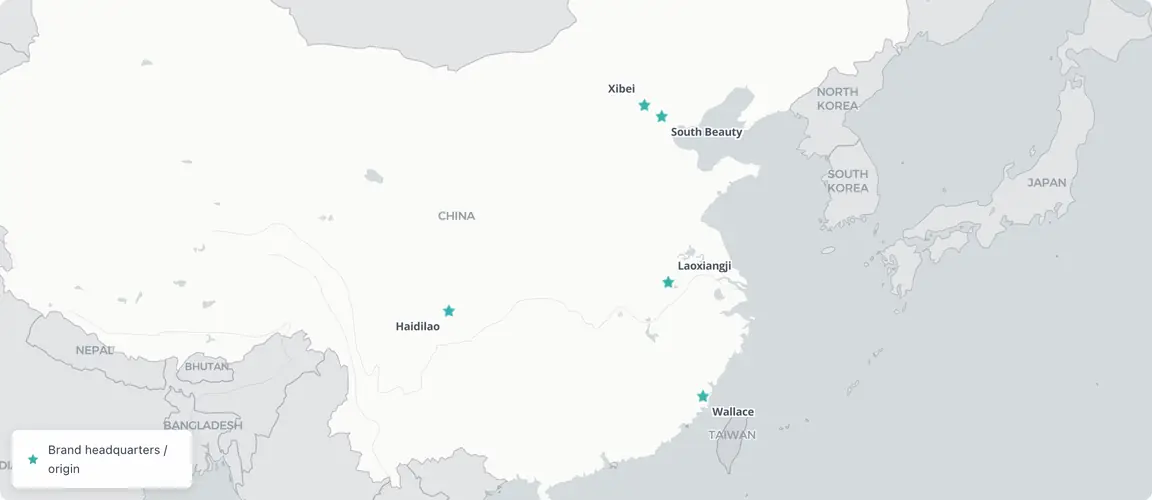
China’s chain restaurants did not grow outward from one city the way American fast food radiated from a handful of postwar hubs. They grew up independently, in five places at once, each inventing a format suited to what was locally available and what a founder happened to know how to cook.
This is a market of thousands of regional operators — the five chains that anchor this article are the ones whose ownership, crisis history, and succession status could be verified against public record, not a census of the sector. They are read here as evidence for a structural pattern, not as its full population.
Sichuan and Chongqing produced the sector’s spiciest, most standardizable formats — hotpot, malatang, pickled-fish fast food — flavor profiles that travel and franchise well because their intensity survives a central kitchen and a delivery truck without losing what made them distinctive in the first place. Haidilao (海底捞) started here in 1994, four tables and roughly ¥8,000 in pooled capital; Yonny (鱼你在一起) and its suan cai yu format and Country Style Cooking (乡村基) and its fast food both trace to the same regional flavor logic, decades and several founders apart. This is the sector’s culinary “source code” — a starting grammar that later chains in other regions borrowed and adapted rather than inventing fresh.
East China, anchored in Shanghai and the surrounding Anhui-Jiangsu-Zhejiang corridor, became something structurally different: a corporate fast-food incubator. Cold-chain density and capital access gave rise to chains like Laoxiangji (老乡鸡), whose farm-to-table vertical integration — its own farms, its own central kitchens, its own cold-chain centers — few competitors anywhere in the sector have matched. Anhui in particular functions less as a culinary source and more as an operational one, producing founders who compete on supply-chain discipline rather than flavor novelty.
Fujian, and Fuzhou specifically, invented something neither of the first two regions did: the Fuzhou model (福州模式), an employee-partnership franchise system built around treating franchisees as future owners rather than fee-paying operators. That structure let a value-fast-food brand called Wallace (华莱士) scale to more than 20,000 stores without ever taking outside venture capital — and it later produced Tastien (塔斯汀), founded by a former Wallace franchisee who took the same partnership logic and applied it to a hand-rolled “Chinese burger” format, out-scaling the very system that trained him.
The Northeast, centered on Harbin, took Sichuan’s malatang and reinvented it into something calmer: a milder, drinkable-broth format built for a colder climate and a more conservative palate, which became — counterintuitively — the version that traveled best nationally. And Beijing, the country’s capital-market and brand-building center, became home less to a culinary invention than to two very different bets on national visibility: Xibei (西贝莜面村) and its northwest cuisine, and South Beauty (俏江南) and its short, spectacular run at redefining what upscale Chinese dining could be.
Five regions, five formats, five completely separate lineages of founder and franchise logic. None of them absorbed the others. None of them needed to — and that is precisely what a database built to track “the restaurant industry” as a single entity cannot see.
The perception gap
The single biggest thing outsiders get wrong about this sector is assuming a founder’s name on the door means a founder’s hand on the controls. Under the standard Brandmine applies — founder-owned means the founder retains both equity and capital control, not just a chairman’s title — some of China’s most recognizable chains fail the test, and some of its least visible ones pass it decisively.
Jiumaojiu (九毛九), the public multi-brand platform behind the pickled-fish chain Tai Er (太二), is founder-led but not founder-controlled: Guan Yihong (管毅宏) entered its 2020 IPO holding 61.4% and has sold down to roughly 37% through subsequent block trades. Haidilao sits in a genuine hybrid category — publicly listed on the Hong Kong exchange since 2018, yet Zhang Yong (张勇) and Shu Ping (舒萍) still hold roughly 60% through offshore trusts, control preserved through structure rather than through staying private. Meanwhile the operators that are genuinely founder-controlled by Brandmine’s stricter test — Wallace, Xibei, Banu (巴奴), Yang Guofu (杨国福), Tastien — are almost entirely unlisted or stuck mid-IPO-queue, invisible to any database that only tracks public filings.
This is not a market that lacks intelligence about itself. It is a market where the intelligence that exists — trade press, corporate registries, regulatory filings — has never been assembled into a single, ownership-verified picture. A researcher pulling store counts from a public aggregator gets a directory. A researcher checking who actually controls each of those chains gets something closer to the truth, and it does not match the directory.
Who’s still standing
Four founders, four different answers to the same underlying pressure: what do you do when the thing you spent decades building starts slipping out of your hands.
Zhang Lan (张兰) built South Beauty from 2000 into a luxury Sichuan chain she publicly described as her attempt to build “the Louis Vuitton of Chinese cuisine.” She took CDH investment in 2008 under an IPO deadline, watched two listing attempts fail, and was pulled into a drag-along sale that handed CVC Capital Partners roughly 82.7% of the company in 2013–14. Within a year the relationship broke. A Hong Kong court froze her personal assets in March 2015. She was off the board by mid-year. A 2019 CIETAC arbitration found fraudulent misrepresentation and ordered her to pay CVC US$142 million plus interest — and in 2022 a Singapore court pierced her offshore trust, placing roughly US$55 million under receivership. She holds zero equity in the company she founded. It is the sector’s clearest founder-investor rupture, and it is the reason Brandmine treats a “founder-chairman” title as a claim to verify, not a fact to trust.
Jia Guolong (贾国龙) chose the opposite response to a different threat. When tech personality Luo Yonghao (罗永浩) accused Xibei on Weibo in September 2025 of serving “almost all pre-made” food and being “so expensive, really disgusting,” Jia did not quietly settle. He opened more than 370 kitchens to press inspection, vowed publicly to sue, and held the position through a 125-day national controversy that media kitchen-visits complicated by finding long-shelf-life frozen ingredients behind the brand’s “fresh, made-to-order” image. By January 2026 he confirmed closing 102 stores — about 30% of the chain — and told a financial newspaper the episode had cost Xibei more than ¥600 million. The same month, Xibei accepted its first outside capital in the company’s history. Jia did not lose control. He spent enormously — in money, in stores, in public trust — to keep it, and the crisis changed the terms on which he holds it.
Zhang Yong took a third path: engineer the structure so a crisis never threatens control at all. Haidilao’s 2021 loss of ¥4.161 billion, driven by pandemic-era over-expansion, was real and severe — the company launched a store-closure and turnaround plan rather than keep expanding through it. But Zhang Yong and Shu Ping’s roughly 60% stake, held through offshore trusts since before the 2018 IPO, never moved. Haidilao is publicly listed and still functionally founder-controlled, a structure built years in advance of the crisis that tested it.
And Shu Congxuan chose to hand over control before any external force made him. Twenty years of building Laoxiangji into Anhui’s dominant fast-food chain, holding decisive authority without ever taking direct equity himself, came to a head not through crisis but through timing: an approaching Hong Kong IPO filing that made the succession question unavoidable. In November 2023 he ceded the chairmanship to his son, Shu Xiaolong (束小龙). The IPO filed in 2025 and remains pending. The family retains more than 91% control. It is the sector’s cleanest handover — and it stands out precisely because almost none of Shu Congxuan’s peers have managed the same thing on their own timeline rather than a crisis’s.
More than a business, less than a nation
Chinese dining culture prizes the theatre of the wok, the freshness of what lands on the table, and the social ritual of the shared meal — values that sit uneasily against the industrial logic every chain eventually needs to scale. That tension is not abstract; it is exactly what exploded in the Xibei affair, where consumers felt betrayed less by the mere existence of central kitchens, which are ubiquitous across the industry, than by the collision between “xinxian xianzuo (新鲜现做)” (“fresh, made-to-order”) branding and the frozen-ingredient reality behind it. Yuzhicai (预制菜) — pre-made dish — stopped being a supply-chain term and became a moral accusation almost overnight.
Running beneath that tension is a xiahai mythology nearly every founder in this sector shares: the decision to leave a stable state job or a modest stall and jump into the sea of private commerce. Yang Guofu started with a skewer cart in Harbin. Shu Congxuan started on a chicken farm. Zhong Huaijun (钟怀军) quit teaching to inherit his family’s braised-duck shop. And a related pattern has emerged alongside it — the founder as public personality, inseparable from the brand in ways that cut both directions. Shu Congxuan performs stand-up comedy and carried an Olympic torch. Zhang Lan livestreams selling instant noodles years after losing her company. Jia Guolong aired his grievances on WeChat during the pre-made-food crisis. When the founder’s face is the brand, a crisis in the founder’s judgment becomes a crisis in the brand overnight — an asset in ordinary times, a liability the moment things go wrong.
Three forces converging on Wave-2 founders
Three forces are converging on this sector at the same moment, and none of them is waiting for the others.
The succession math is stark on its own: Wave-2 founders — the generation that entered business between 1992 and 2001 — are now 53 to 65, and research into Chinese family firms puts the share holding a documented, formal succession plan at somewhere near single digits. Laoxiangji and Ziyan (紫燕百味鸡) both resolved their handovers in 2023, in two structurally different ways — a direct son, a son-in-law chosen ahead of a bloodline heir — and both are the exception, not the emerging norm.
Capital markets are compounding the pressure. A queue of chains — Laoxiangji, Banu, Country Style Cooking, Yang Guofu — has spent years grinding through repeated Hong Kong IPO filings, while Wallace quietly delisted its supply-chain subsidiary from the New Third Board in February 2026, retreating from public disclosure at the same moment its own store growth slowed for the first time. And crisis has stopped being an occasional event and become a structural feature: Xibei’s 125-day pre-made-food war forced the company’s first outside capital in its history; Zhang Lan’s rupture with CVC remains the sector’s cautionary archetype a decade later.
Export is adding a third, quieter pressure: the sector’s best-performing chains are no longer purely domestic questions. Yang Guofu now operates in more than 20 countries; Yonny runs stores across the US, Canada, and Southeast Asia from a Malaysian overseas headquarters; Haidilao spun off its international arm as a separate, dual-listed company on the Hong Kong exchange and Nasdaq. Overseas franchise-store growth reportedly ran above 80% in 2025 alone. A founder weighing succession or a sale is no longer weighing only what a domestic buyer will pay — they are weighing what an export-capable chain is worth to a buyer who wants a beachhead outside China entirely, and that number moves independently of anything happening inside the country.
None of these three forces resolves on its own timeline. A founder deciding whether to sell, whether to list, or whether to hand over control to a son or a son-in-law is making that decision inside a market where the acquisition price, the IPO window, and the crisis exposure are all shifting at once — and where waiting does not hold any of them still.
Not for much longer
A market this large, staying this unconsolidated, is not a sign that nothing is happening. It is a sign that nobody outside the sector has been watching closely enough to see what is. The intelligence that would tell an investor which founder-controlled chains still exist, which have already lost control to private equity, and which are mid-handover to a second generation does not live in a single database — it lives in the trade press, the regulatory filings, and the founders themselves, most of whom are now old enough that their own account of what happened is running out of time to be recorded.
Shu Congxuan handed his company to his son before an IPO deadline forced the question. Jia Guolong spent ¥600 million rather than let a public accusation take his company from him. Zhang Lan lost hers to arbitration and a pierced trust, and still livestreams to sell noodles under a name that once meant something larger. Three different endings to the same structural test, and the founders who can still explain, in their own words, which choice they made and why are not a resource this sector gets to keep indefinitely. The next round of Wave-2 founders reaching that same decision will not have Shu Congxuan’s decade of runway to make it on their own terms.
Researched 25 sources in English, Chinese.