 Skip to main content
Ceuta: The Port That Won Every War and Lost Every Peace
For seven centuries Sabta was the Strait of Gibraltar's mandatory gateway — a Genoese trading colony, a Maliki seat of learning, a launch point for conquering Iberia. Portugal took the city in a day in 1415, and the merchants who made it rich left. The strait never moved. The trade did — and six centuries later, Ceuta still hasn't gotten it back.
Geographic Context: Ceuta and the Strait of Gibraltar
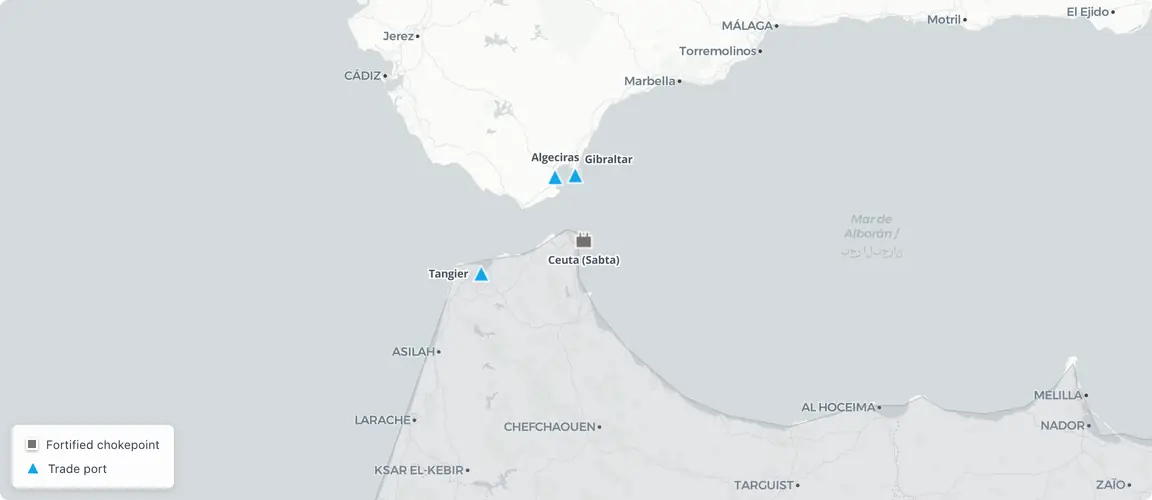
The city that kept the rock and lost the trade
Juan Vivas had a number for what closed borders do to a city built on movement. In August 2020, Morocco shut the commercial crossing into Ceuta, and the enclave’s economy contracted 40% within months. Vivas, the city’s governor, wasn’t describing a natural disaster. He was describing what happens, again, when the only thing propping up a chokepoint’s economy is the ability to move goods and people across a line — and someone on the other side decides to draw it shut.
Six hundred years earlier, the same city had lost something bigger than a border crossing. It lost the merchants.
The gateway before the rock had an owner
Long before it was Ceuta, it was Sabta (سبتة) — a name Berber and Arab geographers used for a city whose value had nothing to do with the strait it sits on. Founded on a small peninsula commanding the southern approach to the eight-kilometre gap between the Mediterranean and the Atlantic, Sabta prospered through a sequence of Islamic dynasties: the Umayyads took it in 931 and rebuilt its walls to block a rival power’s crossing into al-Andalus; the Almoravids and Almohads held it in turn; by 1256 the autonomous Azafid dynasty ran it as a commercially self-governing city-state, dominating navigation through the strait on its own account rather than as anyone’s provincial outpost.
What made Sabta rich wasn’t the geography alone — every power that held the rock had the same coastline. What made it rich was who chose to trade there. Genoese, Catalan, and Marseille merchant colonies operated their own trading houses in the city, part of a wider network: across the wider Maghreb of this period, historians estimate that as much as 98% of Genoese trading capital and operations concentrated in just three port cities — Ceuta among them, alongside Bejaia and Tunis. Trans-Saharan caravans terminated here, converting West African gold, ivory, and coral into Mediterranean commerce. The city’s port fees, its warehousing, its role as a clearing point for three continents’ worth of goods — none of that was guaranteed by controlling the rock. It was earned by being the place merchants kept choosing, decade after decade, dynasty after dynasty.
Sabta’s other export was intellectual. Qadi Iyad, born in the city in 1083, became the Islamic world’s pre-eminent Maliki jurist and the author of Ash-Shifa, a work still studied across the Maghreb today; he later served as the city’s own qadi, its senior religious judge. A generation later, around 1100, the city produced al-Idrisi, the geographer whose Tabula Rogeriana — commissioned by the Norman king of Sicily — mapped the known world with a precision that would not be surpassed in Europe for centuries. A port city that could produce both a jurist whose rulings still carry weight and a cartographer whose maps outlasted the empire that commissioned them was not merely a trading post. It was a place people came to for reasons beyond commerce, which is precisely what made the commerce durable.
None of this ran on a single community’s effort. Muslim and Berber caravan operators worked the desert legs of the trade under commercial-partnership contracts enforceable through religious law rather than any single sovereign’s courts — a structure that let a merchant in Sabta trust a counterpart hundreds of kilometres away without either party ever appearing before the same judge. Genoese and Catalan trading houses ran parallel books alongside them, converting the caravan trade’s raw goods into Mediterranean-denominated commerce the moment it reached the coast. And Jewish merchant families, part of the same trans-Mediterranean networks documented elsewhere in the period’s surviving correspondence, added a third layer of credit and connection that linked Sabta to trading communities as far away as Almería and Fez. Three overlapping trust systems, three religions, one city — and none of the three functioned without the others. That layered structure, more than any single dynasty’s patronage, is what let Sabta punch so far above the size its walls would suggest.
Dynasty after dynasty — Umayyad, Almoravid, Almohad, Azafid, Marinid — the prize at stake was always this same layered trading city, never the bare rock alone. That distinction is what the next conqueror would fail to understand.
The day the network chose to leave
On 21–22 August 1415, a Portuguese armada — chronicled at roughly 200 ships and several tens of thousands of men, though the precise figure has never been pinned to a source that survives scrutiny — assembled off the coast and struck the city. King John I of Portugal and his son, the young Prince Henry who would later be remembered as “the Navigator,” led the assault. The city fell fast: Zurara’s near-contemporary chronicle records an assault phase of more than five hours before Sabta’s defenses gave way, the whole operation concluded within a single day. It was the first European territorial conquest in Africa — a moment historians have since used to mark the opening of the Age of Exploration, the campaign that would eventually put Portuguese ships at the Cape of Good Hope and then in the Indian Ocean.
What happened next mattered more than the conquest itself. Portugal had captured the rock intact — the walls the Umayyads had rebuilt seven centuries earlier still stood, the harbor was still the same harbor, the strait had not moved an inch. What Portugal could not capture was the reason the merchants had been there. The city’s long-distance-trade engine — the Genoese and Catalan trading houses, the Muslim and Jewish merchant networks that had made Sabta’s commerce run for centuries — read the conquest correctly as a change of regime they had no reason to trust, and left. Some historians estimate the city’s inhabited urban area contracted to as little as 14% of its former extent in the years that followed, as the population that had filled it simply did not return.
They did not go far. Tangier, forty kilometres west along the same Atlantic-facing coast, absorbed the networks that Ceuta lost — a pattern that would repeat itself over centuries, as Tangier later became an international free zone in the twentieth century and, more recently, the site of Tanger Med, now one of the busiest container ports in the Mediterranean. The strait’s commercial centre of gravity simply relocated to a city forty kilometres away, and it never came back.
Portugal understood, at least partially, what it had lost, and tried to fix it structurally rather than commercially: in 1437 it mounted an assault on Tangier itself, attempting to complete the conquest of the strait’s northern Moroccan coast. The campaign failed catastrophically. Prince Fernando, John I’s youngest son, was taken hostage as security for the withdrawal terms and died in captivity in Fez a few years later — a reminder, if Lisbon needed one, that holding one rock does not confer control of the country around it.
The garrison that outlasted the merchants
For the next two and a half centuries, Ceuta survived as something categorically different from what Sabta had been: not a trading city that happened to be fortified, but a fortress that happened to contain a city. Historians studying the period describe post-conquest Ceuta bluntly, if not always in words anyone can attribute to a single author — the phrase that recurs is that the enclave became “a financial black hole,” a garrison Portugal, and later Spain, subsidized rather than a port that generated its own commerce. When the Iberian Union merged the Spanish and Portuguese crowns in 1580, Ceuta passed into Spain’s orbit; the arrangement was formalized in the 1668 Treaty of Lisbon, in which Portugal recognized Spanish sovereignty over the city outright — a transfer of ownership that changed nothing about the underlying economics. The city had a flag. It still didn’t have its merchants.
The clearest proof of what Ceuta had become came in 1694, when the Alaouite Sultan Moulay Ismail laid siege to the city. The siege lasted 33 years — until his death in 1727 — the longest siege in recorded military history. A fortress that matters commercially gets relieved, resupplied, and reinforced because someone has an economic stake in keeping it open. Ceuta got none of that in any meaningful commercial sense; it got a garrison that held on for a third of a century because holding on, not trading, was now the entire point of the place. The population that endured the siege collapsed to a fraction of what it had been before — the city that once hosted Genoese trading houses and a scholarly community producing jurists and cartographers had become, in its own defenders’ eyes, simply a position to be defended.
Three centuries later, the position finally got a formal name to match what it had functionally been all along. In 1995, Ceuta became a Spanish autonomous city — a governance structure that acknowledged the enclave’s genuinely anomalous status, neither a normal Spanish province nor a colony, but something built to be held rather than to grow.
What the strait never gave back
Ceuta today has 83,229 residents (2024) and holds the highest unemployment rate of any of the European Union’s 242 statistical regions — 28.4%, with youth unemployment at 42.4%, both figures confirmed against Eurostat’s own regional data. Its GDP per capita, at roughly €23,070, sits well below Spain’s national average of about €38,000. None of this is the profile of a city that regained what it lost in 1415. It is the profile of a city still subsidized for its geography, the way it has been, in one form or another, since the Portuguese first held the walls intact and discovered the merchants were gone.
What filled part of the gap, unofficially, was comercio atípico — the informal cross-border trade carried for decades by porteadoras, cargo-carrying women who moved goods across the land border with Morocco by hand, outside any formal customs regime. At its peak the trade is estimated to have moved on the order of €1 billion or more a year through Ceuta and the wider Spanish-Moroccan border economy — an entire improvised commercial system built in the gap the formal trade networks had left in 1415 and never refilled. When Morocco shut the commercial border crossing in August 2020, Vivas’s 40% contraction figure was this informal economy’s collapse made visible in one number: the closest thing Ceuta had to a modern trade network, gone in a season, the way the original one had gone in a day six centuries earlier.
Ceuta’s newest identity has nothing to do with trade at all. In May 2021, more than 8,000 migrants crossed into the enclave in the span of two days — a scale of movement that made international headlines and hardened Ceuta’s status as a European Union external border, not a trading post. Five years later, in July 2026, the pattern repeated at a scale the city had not seen before: close to 50,000 crossing attempts and at least 67 confirmed deaths in a single surge, according to reporting at the time. Ceuta’s geography — the same eight-kilometre chokepoint that made Sabta rich in the twelfth century — is the story again. This time the thing moving across the strait isn’t gold, coral, or ivory. It’s people, and the city holding the chokepoint has no more control over that flow than it has had, in any real commercial sense, since 1415.
The lesson the rock cannot teach on its own
Ceuta’s arc resists the place-swap test that would apply it to any nearby Strait-of-Gibraltar location, and that resistance is the point. Tangier absorbed Ceuta’s rerouted trade in the fifteenth century and reinvented itself twice more since — as an international zone in the twentieth century, and now as the site of a major container port that Ceuta, forty kilometres away, never built an equivalent to. Gibraltar, across the strait on the European side, built a completely different model from either of them: a British entrepôt economy based on services and re-export, ceded to Britain in 1704 and never dependent on a caravan terminus in the first place — a different starting position that produced a different, and considerably more prosperous, outcome. Melilla, Spain’s other North African enclave 380 kilometres to the east, is a parallel case but a genuinely distinct one, with its own conquest history and its own economics; it is not simply Ceuta’s twin with a different postcode. None of these three comparators proves the same thing Ceuta proves, because none of them kept the same geography while permanently losing the same centrality that geography once bought. Each took a different path away from — or around — the fifteenth century’s rupture; only Ceuta’s path led back to the same chokepoint it started with, still holding the rock, still without the trade.
That is the specific and transferable lesson in Sabta’s fall and Ceuta’s six centuries since: a chokepoint is a piece of terrain, and terrain can be conquered, held, besieged, and defended indefinitely. A trading network is a set of decisions made independently, over and over, by merchants who could just as easily make a different decision — and once they do, no army that captured the terrain can march out and recapture the choice. Portugal took the rock in a matter of hours in 1415. It never got the trade back, and neither, in any full sense, has anyone who has held Ceuta since. Six hundred years on, the garrison built to hold the terrain is still there, subsidized and defended; the merchants who made the terrain worth holding never came back to see it.
Researched 15 sources in English.