 Skip to main content


Balkh: The Monastery Managers Who Ran an Empire
In 725 the Arab governor Asad ibn Abd Allah rebuilt Balkh, and the agent he chose for the work was Barmak, holder of the hereditary title of the custodians of a Buddhist monastery the Arabs had destroyed six decades before. Barmak's son Khalid went on to run the army and land-tax office of the first Abbasid caliph.
The north end of the crossing
Rebuilt many times, replaced once
In 41 AH, the year 661 or 662 of the Christian calendar, an Arab commander named Qays ibn al-Haytham took Balkh (بلخ) for the governor Abd Allah ibn Amir. Then he destroyed the Nawbahar (نوبهار), the great Buddhist monastery outside the city. The family that had run it for generations was left with a hereditary title and no institution to run.
The house of the Barmakids
The capital is more than twenty li in circuit; everyone calls it Little Rajagriha. Though the city is strong, its inhabitants are very few.
The monastery had been the richest thing in Balkh. When the Chinese pilgrim Xuanzang (玄奘) passed through, in the year conventionally given as 630, he counted more than 100 monasteries in the kingdom’s capital and more than 3,000 monks. Several English-language retellings say 30,000. The Chinese text says 3,000.
South-west of the city stood the Nava, “New”, monastery. Xuanzang wrote that a former king of the country had built it. “Its Buddha images shine with famous gems and its halls are adorned with rare treasures,” he recorded, “so that the rulers of many countries covet it and raid it.”
The wealth had come along the same roads as the traders. A Buddhist network ran from India, Kashmir and Khotan through Balkh to the Tarim Basin and China, carrying relics, texts, endowments and pilgrims. Xuanzang was one of the pilgrims. The Nawbahar’s treasure was capital that had arrived as piety, and it sat in one place.
The city around it was another matter. Xuanzang called the capital more than twenty li in circuit, and said everyone called it Little Rajagriha. The walls were strong. The people were few. Balkh’s religious wealth and its population did not coincide.
The custodians of the Nawbahar carried a title: barmak (برمک). Most of the sources, the Great Islamic Encyclopaedia notes, take the word to be the general title of the monastery’s custodians. The oldest Arabic accounts make the family its keepers and stewards. The office passed down the family.
Later Muslim writers argued about what the Nawbahar had been. Some called it a fire temple. The encyclopaedia finds the reports so contradictory that a judgement is hard, and suggests the Zoroastrian attributions were made in the Barmakids’ own time of power. Xuanzang, who saw it, called it a sangharama: a Buddhist monastery.
The historian al-Mas’udi had a name for it that said more about its managers than its faith. He called the Nawbahar the house of the Barmakids, as the Great Islamic Encyclopaedia records his phrase. The building had become shorthand for the family that ran it.
A crossing and a granary
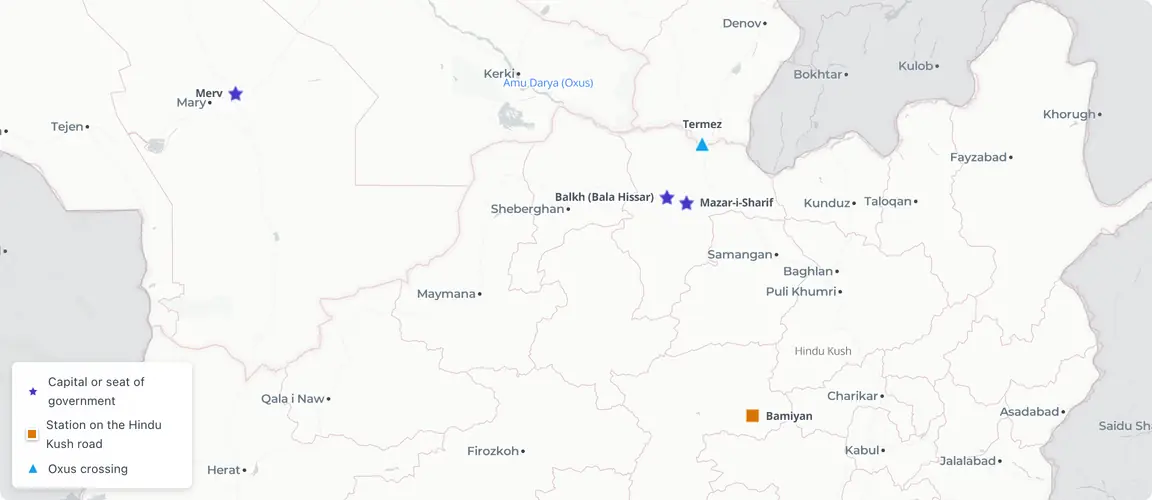
The monastery was rich because Balkh stood where it did. The city sits on the plain north of the Hindu Kush, at the head of the shortest western crossing of the range. The road ran south over the passes to Bamiyan and Kabul and on to India. North lay the Oxus crossings to Termez, Samarkand and Bukhara. West ran the road to Merv.
Each road carried its own trade. Over the Hindu Kush came Indian goods: textiles, spices, horses, and Buddhist texts and relics. Down the Oxus routes from Transoxiana, Khwarazm and the steppe came grain, camels, slaves, furs and textiles. West towards Merv went the oasis’s citrons, oranges and grapes, with manufactured goods and coin.
The French archaeological mission in Afghanistan, DAFA, has traced the fortress that guarded the southern road. Some 25 km south of Balkh, the fortified site of Chashm-e Shafa controlled the early route to India from the Achaemenid period until it was abandoned after the Mongol conquest.
The city also fed itself and its visitors. DAFA describes the oasis as covering about 16,000 km², irrigated by 18 canals drawn from the Balkhab river. A caravan city that is also a granary can supply the traffic it taxes. Balkh was both.
The site is old. DAFA’s excavations place the first occupation of the Bala Hissar, the citadel mound, in the Iron Age. Greek writers knew the city as Bactra. Polybius records that in 208 BCE its king, Euthydemus I, held it for two years against the Seleucid Antiochus III and was recognised as king of Bactria.
The Han envoy Zhang Qian came after the Greek kingdom had fallen to the Yuezhi. Sima Qian’s Shiji gives his report: “Its capital is called the city of Lanshi; it has a market where all kinds of goods are bought and sold.” The state had collapsed. The market had not.
Zhang Qian saw something else in it. Bactrian merchants were selling cloth from Shu, in Sichuan, and bamboo canes from Qiong, which they said they had bought in India. Goods from south-west China were reaching Balkh by way of the Indian markets.
That pattern would repeat for a thousand years. Whoever held the crossing could tax it, garrison it or burn it. What could not be moved, the walls, the canals, the monastery and its treasure, was what each new power broke. Xuanzang’s line about raiding rulers describes a habit, not an event.
A family without a monastery
The Arab conquest reached Balkh in the middle of the seventh century. The sources on the Barmak of that generation do not agree on when he turned to the new faith.
One account has him converting under the caliph Uthman, who ruled from 644 to 656. The Great Islamic Encyclopaedia records that he went to Medina, became a Muslim there and was given the name Abd Allah by Uthman. Another account places his conversion under Abd al-Malik, who ruled from 685 to 705.
The encyclopaedia records what followed in the first account. When the Barmak came home, his own people revolted against him. They set another member of the family in his place.
Then, in 41 AH, came Qays ibn al-Haytham. After taking Balkh he destroyed the Nawbahar. The Great Islamic Encyclopaedia’s article on Balkh records the event, citing the historians al-Baladhuri and Ibn al-Athir.
In the first account the order of events is stark. A Barmak accepted the conquerors’ faith. His own people turned him out. Then the conquerors destroyed the institution his family had kept. Under the second account the conversion came after the destruction, not before it.
The question the sources answer is not one of belief but of office: who would hold it, and what it would be worth once the building it served was gone.
Consider the position of the family at that point. Its standing rested on an office, and the office rested on a building. The building was gone. The religion it served was no longer the religion of the city’s rulers.
The city did not fare better. Balkh was taken and destroyed around 709. Xuanzang had found it thinly peopled within strong walls. By the early eighth century even the walls were down.
What the family still had could not be pulled down. It had generations of practice in running a large endowed institution: its land, its revenues, its buildings, its people and its visitors. That competence had been learned in a monastery. Nothing about it was specific to one.
A steward’s craft is a set of habits: knowing what an estate yields, who owes what, which repairs cannot wait and how many people a store must feed. None of it depends on what the estate is for.
The Barmaks had lost an asset.
They had kept a skill.
The rebuilding of 725
In 107 AH, the year 725, the Umayyad governor of Khorasan, Asad ibn Abd Allah al-Qasri, ordered Balkh rebuilt on its old site. The man he charged with the work was a Barmak, the father of Khalid. The Great Islamic Encyclopaedia records the appointment, citing Ibn al-Athir.
Asad needed a city that would function: walls, markets, water, revenue. He chose as his agent a member of the family that had managed the richest institution in the oasis. The conqueror did not need the monastery. He needed the people who had known how to run it.
The rebuilding worked. Within a few years Balkh had replaced Merv as the capital of Khorasan, according to Encyclopaedia Iranica. The city that had been a ruin in 709 was a provincial capital within a generation of its destruction.
Into the caliph’s service
The family did not stay a provincial one. In 750 the Abbasids overthrew the Umayyads. When the first Abbasid caliph, al-Saffah, came to the throne, he gave Khalid, son of the Barmak of 725, the headship of the office of the army and the land tax.
The Great Islamic Encyclopaedia, citing Ibn al-Athir and al-Jahshiyari, records the appointment. Under the next caliph, al-Mansur, Khalid kept his office, and he was called al-Mansur’s vizier, for little more than a year. A monastery steward’s son was running the finances of a new empire’s army.
His son Yahya rose further. When Harun became caliph, the encyclopaedia records, he chose Yahya as his vizier. The Barmakids, in its words, became the most prominent family of vizierate and bureaucracy throughout the Abbasid caliphate.
The skill had moved, and had kept compounding. Land, revenue, record and personnel: the matters that had occupied the custodians of an endowed monastery in Balkh were the matters that occupied the chancery of the caliphs. The scale changed. The work did not.
Balkh, meanwhile, prospered on its own terms. The tenth-century Persian geography known as the Hudud al-‘Alam called Balkh the entrepôt of India. The geographers, as Encyclopaedia Iranica summarises them, name gates of its suburb for the Hindus and for the Jews, the city’s colonies of merchants.
The geographer al-Ya’qubi, as the Great Islamic Encyclopaedia cites him, gave the inner city four gates and the wall of its suburb twelve. The two counts may describe different periods. Either way, the thinly peopled city that Xuanzang saw had become one whose suburb alone needed twelve gates.
The road west ran from Balkh to Merv, Nishapur and on to Baghdad. Al-Mas’udi’s phrase for the Nawbahar, the house of the Barmakids, had made the monastery a memorial to the family. The family was elsewhere, running the state.
One sack, two chronicles
The city’s next catastrophe came from the steppe. In the summer of 617 AH, 1220, the Mongols reached Balkh for the first time, and the city submitted. In the spring of 618 AH, 1221, Chinggis Khan arrived, and Balkh was savagely sacked, probably after a revolt by its people.
The chroniclers do not agree on what happened to them. Ibn al-Athir records that the city surrendered and was spared. Juvayni, who wrote around 1260 in the service of the Mongols themselves, gives a different account.
“He ordered the people of Balkh, small and great, few and many, men and women, to be driven out onto the plain,” Juvayni writes, “and, as was their custom, they were divided into hundreds and thousands and put to the sword, and nothing was left, wet or dry.”
No reliable death toll survives. The chronicles agree that Balkh fell. They disagree on whether its people died.
The Mongols came back. On their return in the autumn of 1222, by Juvayni’s account as J.A. Boyle reports it, the survivors were killed and the walls pulled down. When the party of Changchun passed in September of that year, the city had been sacked and razed.
A century later the ruin was still a ruin. Ibn Battuta, who came through around 1333, recorded that “the accursed Tankiz devastated this city and pulled down about a third of its mosque because of a treasure which he was told lay under one of its columns”. Tankiz was his name for Chinggis.
Xuanzang had found a strong city with few people. Ibn Battuta found a ruin. The pattern held again. What could not move was broken. The fortress at Chashm-e Shafa, which had guarded the road south since the Achaemenids, was abandoned after the conquest.
Replaced by a neighbour
Balkh came back once more. Timur took it in 1389. Shah Rukh rebuilt the citadel in 1407, and the shrine of Khwaja Abu Nasr Parsa followed in 1462–63. The city that had been rebuilt in 725 was rebuilt again.
What it did not survive was a neighbour. About 20 km to the south-east, Mazar-i-Sharif had grown up around a tomb attributed to Ali. The Encyclopaedia of the World of Islam names that tomb as one cause of Mazar’s rise.
It names a second cause in the same sentence: the irrigation network. No army was needed.
The oasis had been Balkh’s strength from the beginning, its 18 canals drawn from the Balkhab feeding the caravans and the garrisons. On the encyclopaedia’s account, the same water helped draw the region’s centre to Mazar.
In 1282 AH, the year 1865 or 1866, Balkh lost its place as the seat of government, and Mazar-i-Sharif took it. The same encyclopaedia notes that the exact date of the move is unclear, that it was probably temporary at first, and that it was complete by 1886.
Nomads, Arab armies, the Mongols and Timur had each taken Balkh, and each time the city was rebuilt on its site. A neighbour took its seat without a siege, and the seat did not come back. Afghanistan submitted the city to UNESCO’s Tentative List in 2004 under the name City of Balkh (antique Bactria).
What could be carried
The list of what Balkh lost is long: a Greek kingdom, a monastery and its treasure, its walls twice over, the sack of 1221, a third of its great mosque, the fortress on the southern road and, in the end, its seat of government. The list of what left Balkh and prospered is short. It begins with one family.
Every power that held the crossing at Balkh destroyed what could not move there: the Nawbahar in 41 AH, the city around 709, the town in 1221. What carried the city’s value forward was not a building but a family’s competence.
The custodians of a Buddhist monastery became the agents of the Arab governor who rebuilt their city, and then the administrators of the Abbasid state. Their monastery survived as a ruin and a phrase, the house of the Barmakids. Their city survived as a district town beside the neighbour that replaced it.
The skill moved. The city stayed.
Researched 62 sources in English, Persian, Russian, Chinese, PS.