 Skip to main content
The cosmopolitan city commerce could not save
For four centuries Ayutthaya was one of the richest cities on Earth — a river island ringed by Chinese junk traders, Japanese samurai, Persian nobles and European company men. In 1767 the Burmese burned it and marched its people away. The trading companies that had fought a century over its concessions did not fight for it. They sailed home.
Two destructions and a corrected capital
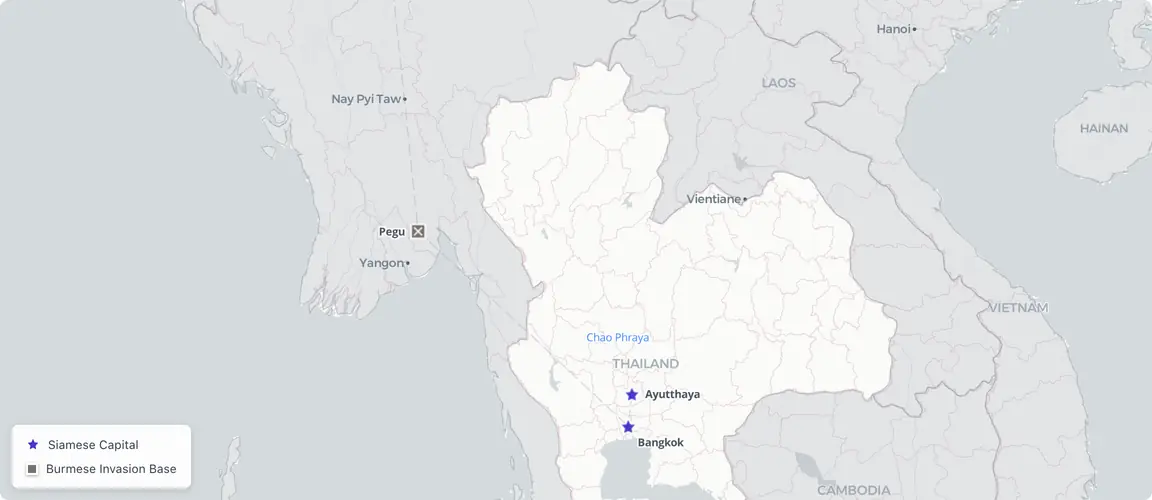
Survived once, erased once
When the Burmese tunnelled under the wall and fired its base on 7 April 1767, the men best equipped to defend Ayutthaya had already gone. The Dutch had built a new brigantine and abandoned their factory eighteen months earlier. The English country captain in the river, William Powney, had looked at the Siamese defences, judged them weak, and sailed off plundering junks. For a century the great trading companies had fought one another for royal concessions in this city. None of them fought for it.
The largest city you have never pictured
The kingdom fell even before the walls of Ayutthaya fell.
In 1700 Ayutthaya may have been the largest city on Earth. Perhaps a million people lived on and around a fortified river island 80 kilometres up the Chao Phraya from the sea — more than London, which had only just overtaken Paris as Europe’s largest city at around 575,000. The figure is an informed estimate rather than a census, drawn from European travellers and historical city-size data, but every account agrees on the texture: this was a place of astonishing density and astonishing variety.
The French Jesuit Guy Tachard, visiting in the 1680s, wrote that a single idol in the royal temple was “richer than all the Tabernacles of the Churches of Europe.” He was not exaggerating for effect. The Phra Si Sanphet Buddha stood sixteen metres tall on a bronze core of some sixty-four tonnes, sheathed in roughly 343 kilograms of gold.
Ring the island in your mind. The Portuguese, the largest European community at around 3,000 souls, kept three churches on the west bank. Across from them lay the Japanese quarter; nearby, the Dutch and English; the Chinese clustered around Wat Phanan Choeng; Persian, Cham, Makassarese, Mon and Vietnamese communities settled to the north and south. The historians Chris Baker and Pasuk Phongpaichit, in their Cambridge history of the city, make the argument that matters most here: Ayutthaya was not the peasant society later Thai nationalism imagined. It was a commercial society — built on trade, organised around trade, and ultimately undone by what trade could not provide.
How a river island ran the world
The crown ran its commerce through the Phrakhlang ministry, split into an eastern department handling China and Japan — staffed heavily by Chinese — and a western department for the Indian Ocean world, typically headed by a Persian or Indian Muslim. This was sophisticated machinery. It is the seventeenth-century equivalent of localised account management: each major trading bloc dealt with officials who spoke its language and understood its networks.
The reach was genuinely global. Persian and Indian Muslim merchants — the court called them “Moors” — held senior offices, ran the crown’s own junks, and traded horses and textiles from Golconda and the Coromandel coast; the family of Sheikh Ahmad of Qom planted a dynasty of officials that would outlast the city itself. Goods moved in every direction: deer and ray hides, sappanwood, tin, eaglewood and ivory outbound; Japanese silver, Indian cloth and Chinese luxuries inbound. Ayutthaya did not merely sit on the trade route between the China Sea and the Indian Ocean. It was the hinge on which the two oceans turned, and the crown took a cut of everything that passed.
The Dutch East India Company dominated the export of deer hides, sappanwood and tin to Japan. When King Narai imposed a royal trade monopoly in 1662 that stripped the Dutch of their hide monopoly, the VOC blockaded the Chao Phraya and forced the favourable Dutch-Siamese Treaty of 1664, extraterritoriality included. Narai answered the way a shrewd operator answers a supplier with too much leverage: he invited the English company back and cultivated the French, building a counterweight. The Greek adventurer Constantine Phaulkon, who had once worked for the English company, rose to become Narai’s foreign minister and steered Siam toward Versailles, encouraging the French embassies of the 1680s and the stationing of French troops at Bangkok and Mergui.
It was dazzling, and it was fragile. In 1688, as Narai lay dying, the noble Phetracha launched a coup, executed Phaulkon, and besieged the French garrison until it left. Resentment had been building from every direction — Buddhist clergy uneasy at a Catholic-leaning court, Siamese nobles passed over for a foreigner, and the rival Dutch, Persian and Portuguese factions Phaulkon had outmanoeuvred. A single overexposed counterparty had become the court’s strategy; when he fell, the strategy fell with him. The textbooks once called what followed a turn to isolation. The revisionist scholarship of Victor Lieberman and of Baker and Phongpaichit shows the opposite: the eighteenth century was arguably Ayutthaya’s most prosperous era, carried by a boom in junk trade with Qing China. The resident Chinese population may have tripled, toward 30,000, as southern China’s rice famines pulled Siamese grain across the sea. The Europeans had become a sideshow. The city was richer than ever.
The quarter that vanished overnight
One foreign community had already shown the court how quickly a settlement could disappear, and nobody read the warning. The Japanese quarter — the Nihonmachi — held perhaps 1,500 residents at its peak, including a corps of samurai mercenaries under the adventurer Yamada Nagamasa, who rose so high in Siamese service that he was made governor of a southern province. For a generation the red-seal ships from Nagasaki carried deer hides north and brought silver, swords, lacquer and paper south.
Then it ended, not by siege but by paperwork on two continents. Yamada died around 1630; King Prasat Thong, distrusting the Japanese as a political force, moved against the quarter and burned it. Almost simultaneously, the Tokugawa shogunate’s sakoku policy sealed Japan off from the outside world and cut the red-seal trade at the source. A community that had taken decades to build was gone in a few years, dissolved by decisions made in courts it did not control. The lesson sat in plain view on the riverbank for 137 years: a foreign quarter’s presence is a function of distant policy, not local loyalty. Ayutthaya kept building its prosperity on exactly that foundation.
Why 1569 survived and 1767 did not
Ayutthaya had been destroyed before. In 1569 the Burmese king Bayinnaung captured it after a long siege, deported the royal family to Pegu, enslaved thousands, and installed a vassal king. Yet within a generation the city was sovereign again. Bayinnaung’s son’s vassal, the prince Naresuan, declared independence in 1584 and had driven the Burmese out by 1600, his victory sealed in legend by an elephant duel against the Burmese crown prince.
The difference between the two catastrophes is the structural heart of the story. In 1569 the city was captured and occupied — but the institutional core survived. The dynasty lived, the population stayed, the records endured, the trading networks held. A functioning capital under occupation can regenerate, and it did.
In 1767 the aim had changed from subjugation to erasure. The Konbaung king Hsinbyushin sent two armies down from the Burmese northwest in 1765 — the western Tavoy column alone numbered more than 20,000 men. They besieged the island for roughly fourteen months. The Siamese trusted, as they always had, in their walls and in the monsoon floods that drowned every previous siege. This time the Burmese stayed through the floods and resumed the assault when the waters fell. On 7 April 1767 they broke the wall by tunnelling beneath it and firing its base, then turned to scorched earth over the weeks that followed.
The quantified stakes make the loss legible. The Phra Si Sanphet Buddha, the kingdom’s palladium, stood sixteen metres tall on a bronze core of some sixty-four tonnes, sheathed in roughly 343 kilograms of gold. The Royal Chronicles of Ayutthaya record that the Burmese “used fire to melt off the pure gold which encased that figure” and carried off the entire amount. They burned the libraries, melted the gold from thousands of lesser Buddha images, and deported the population — estimates of those marched to Ava range from 30,000 to 100,000, with perhaps hundreds of thousands more dead across the invasion. The chronicles of the kingdom, the Phongsawadan, burned with everything else; Thai history would have to be reconstructed afterward from Burmese, European and Chinese records, each carrying its own bias. A capital that had documented itself for four centuries lost even its own memory in a single spring.
Here is the cruel mechanism. The very prosperity that made eighteenth-century Ayutthaya a prize had hollowed out its defence. A century and a half of commercial wealth had let the old corvée manpower system — the obligation that put men on the walls — decay. The kingdom had stockpiled cannon. It no longer had the men to fire them. The historian Nidhi Eoseewong put it exactly: the kingdom fell before the walls of Ayutthaya fell.
The companies that sailed away
This is where the cosmopolitan paradox becomes a verifiable lesson rather than a poetic one, and the most careful evidence comes from the Thai historian Dhiravat na Pombejra’s reconstruction of the siege.
The foreign trading powers — the institutions, the companies — mounted no defence. The VOC had formally closed its Ayutthaya factory in 1765; its resident’s final letter is dated that November. The English captain Powney, asked by the king to help defend the city, declined when he saw how weak the Siamese position was. He was eventually forced to fight when the Burmese attacked his own ship, but abandoned the effort once the court could not supply him with cannon and powder, leaving while plundering Chinese and Siamese junks on his way out. He had an armed ship. He had an exit.
The distinction Dhiravat draws is the load-bearing one. The mobile commercial actors left; the rooted inhabitants did not. The resident Portuguese settlement and the French St Joseph seminary fought to the bitter end — Bishop Pierre Brigot surrendered only on 23 March 1767, after the Burmese falsely promised to spare the churches. The settled Chinese fought too: in the early stage of the attack, a Chinese officer holding the Siamese rank of Luang led three thousand men in a sortie, ineffective but real. “With their armed ships,” Dhiravat writes, “Powney and the Dutch had the means to escape, whereas the residents of Ayutthaya did not.”
That is the whole pattern in one sentence. The companies that could leave, left. The communities that could not leave, stayed and died. Commercial relationship and political obligation are not the same thing, and the city had confused the two for a hundred years.
What Rama I read in the ashes
The Burmese did not hold their prize. Facing a Chinese invasion of their own homeland, they abandoned the ruins entirely, leaving a power vacuum that the general Taksin filled, moving the capital downriver to Thonburi. In 1782 Rama I founded the Chakri capital that became Bangkok, on the more defensible east bank, screened by the river and a ring of new canals — an artificial island, in effect, built partly from bricks salvaged from Ayutthaya’s own ruins.
Bangkok is the lesson encoded in stone. It recreated Ayutthaya’s grandeur while correcting the strategic exposure that had twice carried the Burmese to the old capital’s gates. The survivors rebuilt by reading the map.
There is a quieter loss the tourist brochures never mention. UNESCO inscribed Ayutthaya in 1991 as “an excellent witness to the period of development of a true national Thai art” — an art-and-architecture framing that foregrounds the prangs and chedis and quietly erases what was actually destroyed. Visitors are sold ancient temple ruins. What burned in 1767 was not an art site. It was one of pre-modern Asia’s most sophisticated commercial capitals, and the framing that calls it a temple complex is itself a small second forgetting.
The founder lesson
The pattern translates directly to a modern company, and it is uncomfortable.
A business can build a formidable position on cosmopolitan talent, international capital and foreign partnerships — and under existential stress those relationships behaved, in Ayutthaya’s case, exactly as Dhiravat’s reconstruction shows. Investors, channel partners, outsourced suppliers and globally mobile star employees all retain an exit. Their interests overlapped with the city’s in good times and diverged at precisely the moment the city most needed them to hold. Commercial counterparties in Ayutthaya optimised for their own survival, not the kingdom’s, and the more mobile they were, the faster they reached for the door.
The city’s own record draws a clear line between relationships that generated value and relationships that carried obligation. The Portuguese settlement and the French seminary had nowhere else to go — their fate was bound to the city’s, and they fought to the end. The VOC and Powney’s ship had an exit, and they used it. What Ayutthaya never built was a defensible core of owned capability, committed capital and mission-bound people independent of counterparties whose loyalty was, in the end, contractual.
A second, subtler pattern sits underneath the first, and it cuts against instinct. The city was destroyed at the height of its prosperity, not in decline. The wealth itself was the corrosive agent: a century and a half of trade revenue had let the kingdom buy cannon instead of cultivating the manpower obligations that put defenders on the wall, until it owned the hardware of defence and had lost the muscle. Prosperity bred a quiet confidence that the old defences — the walls, the floods, the assumption that a partner present in good times would be present in bad — would hold one more time. They did not, because the conditions that had made them hold had been hollowed out underneath. The kingdom had stopped building the capability that money had made feel unnecessary, and the reckoning arrived once, at the worst possible moment.
Ayutthaya was open, rich and admired by the world, and none of that defended it. The companies that fought for a century over its concessions did not fight for the city. They sailed home. The residents who stayed had nowhere else to be — and that, not the city’s wealth or its foreign quarters, was what put anyone on the wall at all.
Researched 15 sources in English.