 Skip to main content
Aceh: The Tsunami That Ended a 29-Year War
For twenty-nine years, the Free Aceh Movement and Jakarta could not make peace. Ceasefires collapsed; a 2003 offensive killed thousands and settled nothing. Then on 26 December 2004, a wave killed roughly 170,000 Acehnese in twenty minutes. Two days later the rebels declared a ceasefire. The peace deal was signed 232 days after the water receded.
Geographic Context: Aceh and the Strait of Malacca
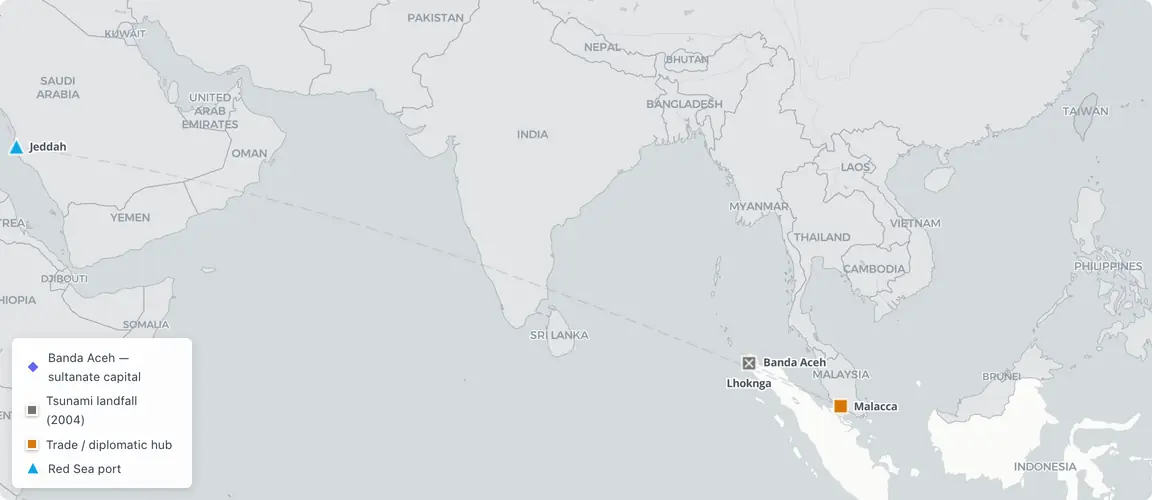
The catastrophe that broke the deadlock
For twenty-nine years, the Free Aceh Movement and the government in Jakarta had tried and failed to make peace. There had been ceasefires in 2000 and 2002, declarations, humanitarian pauses — all of them collapsed. A martial-law offensive in 2003 and 2004 displaced more than a hundred thousand people in seven months and killed thousands without yielding a settlement. Then, on the morning of 26 December 2004, a wave killed roughly 170,000 Acehnese in about twenty minutes. Two days later, the rebels declared a unilateral ceasefire. The peace agreement was signed 232 days after the water receded.
The veranda of Mecca
A face-saving opportunity for both sides.
To understand why the wave mattered, begin five centuries earlier, with the geography that made Aceh worth fighting over. The province occupies the northern tip of Sumatra, at the western mouth of the Strait of Malacca — the narrowest passage between the Indian Ocean and the South China Sea, and the single most important chokepoint in maritime Asia. Whoever controlled this point controlled the spice trade between the Maluku islands and the Red Sea.
For roughly a century, the Aceh Sultanate did. Founded around 1496 by Ali Mughayat Syah, who unified the northern Sumatran port polities at the site of modern Banda Aceh, the sultanate’s fortune was made by an event elsewhere. When Portugal captured Malacca in 1511, Muslim merchants refused to route their cargo through a Catholic-held port and diverted the spice trade up Sumatra’s west coast instead. Aceh’s harbour became the entrepôt for pepper, gold, benzoin and camphor moving toward Gujarat, the Red Sea and Mediterranean Europe.
The numbers were extraordinary. The historian Anthony Reid concludes that by the 1560s, “as much pepper was being shipped that way to Europe as was hauled by the Portuguese around the Cape to Lisbon” — roughly half of the continent’s supply, moving through the Muslim route that ran from Aceh to Jeddah, Cairo, and Venice. The trade pulled the wider Islamic world toward Sumatra. In 1564 Sultan Alauddin Riayat Syah al-Kahhar sent an embassy to Suleiman the Magnificent in Constantinople, addressing the Ottoman ruler as Khalifah and requesting artillery against the Portuguese. Most of the fleet Selim II authorised in 1567 was diverted to a revolt in Yemen, but enough cannoneers and gunsmiths reached Aceh to seed a local foundry — and by the reign of Sultan Iskandar Muda, Acehnese fortresses bristled with some 1,200 cannons.
Under Iskandar Muda, who ruled from 1607 to 1636, Aceh reached its zenith. His authority extended across much of Sumatra and over the Strait to Kedah, Perak, Johor and Pahang. He commanded a fleet of roughly a hundred ships, imposed a state monopoly that took fifteen per cent of all pepper and gold, and sponsored a court culture of Sufi mystics, jurists and architects — including the original Baiturrahman Grand Mosque, built in 1612 at the centre of his capital.
There was a third reason Aceh mattered, beyond pepper and cannon. It was the gateway to Islamic Southeast Asia — the Serambi Mekkah, the Veranda of Mecca, the staging point from which pilgrims across the archipelago embarked for the Hajj. Pilgrims from Java, Borneo and the Malay Peninsula often spent months studying in Banda Aceh before crossing the Indian Ocean. Eric Tagliacozzo’s history of the pilgrimage records that by the turn of the twentieth century, “fully half of all pilgrims making the journey in any given year could come from Southeast Asia.” Pepper was a commodity trade, vulnerable to price and war. The Hajj corridor was identity-based, and it endured.
Three centuries of survival
Aceh’s commercial primacy did not survive the seventeenth century. Iskandar Muda’s fleet was annihilated by a Portuguese-Johor-Patani alliance at the Battle of the Duyon River in 1629; when the Dutch took Malacca in 1641, the old Muslim-Venetian pepper route was broken and regional dominance passed to the Dutch East India Company. But the sultanate itself persisted, quasi-independent, into the nineteenth century. In the 1820s, under Tuanku Ibrahim, Aceh still produced more than half the world’s pepper.
What finally came for it was the Dutch state. The Anglo-Dutch Treaty of 1824 had nominally guaranteed Acehnese independence; the Sumatra Treaty of 1871 quietly traded it away, giving the Netherlands a free hand. In March 1873 a Dutch expedition of 3,000 men under Major-General Köhler landed at Banda Aceh — and was thrown back. Köhler himself was shot dead by a sniper at the Baiturrahman Mosque. It was the humiliating opening of what became the longest colonial war in Dutch history.
The Dutch returned in force, took the capital, and abolished the sultanate — and then discovered, as occupiers often do, that they had won a city rather than a country. The war moved to the jungle and lasted thirty years. Teuku Umar, an aristocratic commander, staged a celebrated double defection: he surrendered in 1893, accepted a Dutch commission and the title Johan Pahlawan, then deserted in 1896 with eight hundred weapons, twenty-five thousand rounds and a war chest of eighteen thousand dollars. After his death in an ambush in 1899, his widow Cut Nyak Dhien led the remaining fighters from the jungle — nearsighted, arthritic, refusing to mourn — until her capture in 1905 and exile to West Java, where she died in 1908. The Dutch broke the resistance only after the scholar Christiaan Snouck Hurgronje, who had entered Mecca in disguise and become the colonial government’s adviser, told them the truth their soldiers had missed: the war’s true engine was not the secular aristocracy but the religious ulama. Some fifty to sixty thousand Acehnese died.
Aceh did not survive that war politically — the sultanate was gone. It survived culturally. The memory of resistance, codified in the Hikayat Perang Sabil, the chronicle of holy war, became the substrate of every Acehnese movement that followed. Including the next one.
The war that would not end
When Indonesia became independent, Aceh joined it — but never comfortably. A 1953 rebellion forced Jakarta to grant the province “special region” status. Then, around 1971, the discovery of the Arun natural gas field turned Aceh into a major source of revenue for the central government while delivering very little benefit locally. The grievance was specific and material, and in December 1976 Hasan di Tiro — great-grandson of an ulama killed by the Dutch in 1891 — declared Acehnese independence at Pidie and founded the Free Aceh Movement, known by its Indonesian initials, GAM.
The insurgency that followed ran for twenty-nine years. It cycled through three phases and killed approximately fifteen thousand people. From 1989 the province was designated a Military Operations Zone; thousands of human-rights abuses during that period fuelled a second, fiercer phase of the war in the late 1990s. Ceasefires came and went. A negotiated pause in 2000 collapsed. A more ambitious agreement in 2002 collapsed. In 2003 the Indonesian military launched a martial-law offensive that displaced over a hundred thousand people in its first seven months and reduced GAM to perhaps half its fighting strength.
It did not produce peace. By late 2004 the war sat where it had sat for years: a weakened but unbroken insurgency, a government unwilling to grant independence, a province sealed off under martial law and closed to outside observers. Both sides had positions they could not abandon without losing face. GAM could not give up the demand for independence that defined it. Jakarta could not be seen to reward an armed separatist movement. Twenty-nine years of fighting and negotiation had produced an equilibrium that neither side could break alone.
Twenty minutes, then two hundred and thirty-two days
At 7:59 in the morning on 26 December 2004, the seabed off western Sumatra ruptured along thirteen hundred kilometres of the Sunda Trench in a magnitude 9.1–9.3 earthquake — one of the largest ever recorded. The tsunami it generated reached the Aceh coast in about twenty minutes. At Lhoknga, just west of the capital, the water ran up to fifty-one metres. Roughly eight hundred kilometres of coastline were destroyed; the wave penetrated as much as six kilometres inland in places. The agency that later coordinated reconstruction tabulated the loss in flat columns: 139,000 houses, 2,618 kilometres of road, 3,415 schools, 13,828 fishing boats. Approximately 170,000 Acehnese were killed and half a million displaced. Aceh was the single worst-affected place on Earth.
And it was the worst-affected place at the worst possible moment — mid-conflict, under martial law, closed. What happened next is the heart of the story, and it is worth stating precisely, because the temptation is to make it sentimental and the truth is more useful than that.
Three things converged in the weeks after the wave, and none of them was a change of heart. First, both sides now faced overwhelming and identical reconstruction need; the cost of sustaining the war had become absurd against the cost of rebuilding. GAM declared a unilateral ceasefire on 28 December — forty-eight hours after the disaster, before the scale of the death toll was even clear. Second, the government of Susilo Bambang Yudhoyono and Jusuf Kalla, elected only weeks earlier, was already committed to a negotiated settlement and now had the standing to pursue one. Third, and most consequential, the catastrophe forced Jakarta to open Aceh to foreign humanitarian workers for the first time since 2003 — ending the isolation that had insulated the conflict from any outside pressure. Patrick Barron, who led the World Bank’s support to the peace process from 2005, called the moment “a face-saving opportunity for both sides” — not a resolution of the dispute, but a way for each party to move without conceding.
Talks resumed in January 2005, mediated by the former Finnish president Martti Ahtisaari through his Crisis Management Initiative. The breakthrough came in February, when GAM did the thing that twenty-nine years of war had not made it do: it dropped the demand for independence and accepted “self-government” within Indonesia. Ahtisaari ran the negotiations on a single rule — “nothing is agreed until everything is agreed” — and over five rounds between January and July the two sides built a settlement. The Helsinki Memorandum of Understanding was signed on 15 August 2005, two hundred and thirty-two days after the water receded.
The reconstruction that followed was, at roughly seven billion US dollars, the largest of its era; a multi-donor fund alone pooled some 655 million dollars from fifteen countries. More than 140,000 homes were rebuilt within five years. The peace was operationalised through the Law on the Governing of Aceh in 2006, which created local political parties, granted special autonomy, and established a formal framework for sharia. In December of that year, a former GAM negotiator named Irwandi Yusuf was elected governor of the province he had fought to separate. Twenty years later, the peace still holds.
What the wave could do that politics could not
It would be obscene to call the tsunami fortunate. A hundred and seventy thousand people died. The lesson is not that catastrophe is good; it is something more uncomfortable and more useful: certain transformations are unavailable under normal operating conditions.
For twenty-nine years, peace in Aceh required something neither party could manufacture — a way to abandon a defining position without the abandonment being read as defeat. GAM could not surrender the demand for independence as a concession to Jakarta. Jakarta could not grant autonomy as a reward to GAM. The deadlock was not about the terms of a settlement; the terms were nearly the same in 2005 as they had been in 2002. The deadlock was about who would move first, and what moving would mean. Under normal conditions, moving first meant losing.
The tsunami did three things at once that no negotiator could engineer. It imposed undeniable physical reality on twenty-nine years of rhetoric — there was no political position from which a hundred and seventy thousand dead could be argued about. It forced the province open, ending an isolation that had let the war run unobserved. And it created a shared survival need that briefly overrode the shared grievance: for a season, both sides needed the same thing more than they needed to defeat each other.
There is an essential caveat, and the negotiators themselves insist on it. The tsunami did not create the readiness to settle — it activated a readiness that already existed. The 2003–04 offensive had weakened GAM; the Yudhoyono government was already disposed to negotiate; the broad shape of a deal was already visible. The wave was the catalyst that made an existing possibility operational, not a force that conjured peace from nothing. This is the part that travels. A rupture only produces transformation if the underlying conditions for change are already in place; on ground that is not ready, catastrophe produces only catastrophe.
Within that limit, Aceh offers a precise sequence. The rebels declared a ceasefire within forty-eight hours, before the dust had settled — they did not wait to calculate advantage. The government accepted outside mediation it had refused for years, mediation Jakarta had turned down through three prior ceasefire attempts. And the deal was signed in months, not years: GAM gave up its founding demand in February, the memorandum was signed in August. Twenty-nine years of war had not produced that sequence. Twenty minutes of water did.
The pattern documented in Aceh is specific to it: a shared catastrophe that struck a stalemated conflict, forced the isolation open, and gave both sides a face-saving reason to move at the same time. GAM’s ceasefire predates any accounting of the death toll; Jakarta’s acceptance of Ahtisaari’s mediation predates any donor pressure to accept it. Neither side calculated first. Both moved.
Banda Aceh in 2026 is a working provincial capital of a quarter of a million people, with ferries to the dive resorts on Pulau Weh and a tsunami museum, designed by the architect who later governed West Java, whose dark “Space of Sorrow” gives onto a chamber of victims’ names beneath an open oculus. The Baiturrahman Grand Mosque still stands at the centre of the city — the one the Dutch burned in 1873 and rebuilt as a concession, the one that survived the wave in 2004 with only cracks in its walls while the neighbourhoods around it were levelled. For five centuries the same exposed coast made Aceh a crossroads and a target. It is the rare place where the worst thing that ever happened was also the thing that ended the war.
Researched 48 sources in English.