 Skip to main content
† Zheng Yonggang
Founder & Chairman
Handed a bankrupt garment factory nobody else wanted, a cotton-mill turnaround manager borrowed money for an advertising medium no Chinese clothing company had used. He had no design training and no capital cushion — only an instinct the equipment was sound and only the brand was missing. Within a decade, Shanshan owned 37.4% of China's suit market.
Founder's Journey
Every pivot planned but the last one
Every business has a founding story. Most involve years of preparation. Zheng Yonggang’s began with a job nobody else wanted.
I am grooming my son [Zheng Ju] to succeed me... I'm very traditional, just a farmer; my philosophy is: a son born into my family should inherit it.
The truck driver who fixed things #
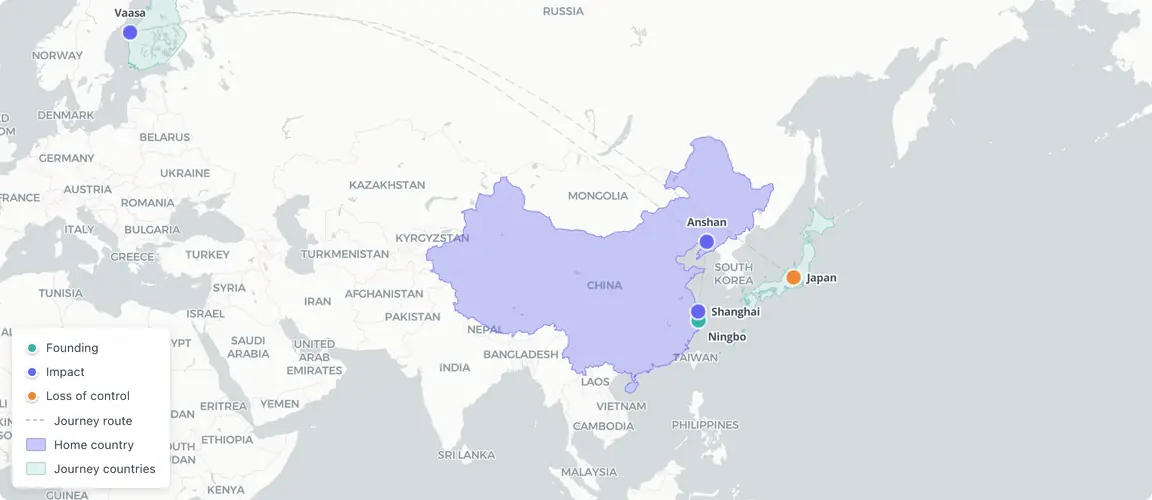
In 1985, Zheng — a former People’s Liberation Army truck driver with no textile training — was appointed to turn around the struggling Yinxian Cotton Mill outside Ningbo. He did it in three years. That credential, and nothing else in his background, put him in line for a harder assignment: in May 1989, local officials handed him the insolvent Ningbo Yonggang Garment Factory, a state enterprise more than RMB 10 million in debt that had burned through three managers in three years. It was the kind of assignment nobody with better options would have accepted — a factory three predecessors had already failed to fix, in an industry Zheng had never worked in. Where others saw a liability, Zheng saw a gap he could close. The machinery worked. The export contacts were intact. What the factory lacked was a brand, and a market that knew its name.
A bet on a medium nobody trusted #
He launched Shanshan — 杉杉 (“fir/cedar”) — that year, and immediately made a bet that had nothing to do with sewing. With no capital to spare, Zheng borrowed money to air “杉杉西服,不要太潇洒” (“Shanshan Suits — don’t be too dashing”), China’s first suit-brand television commercial. No clothing company in the country had used the medium before. It worked overnight: demand outran anything a state garment factory had prepared for, and Shanshan spent the next several years scaling to meet it.
The pattern that would define Zheng’s career was set in that first year: he was not, by his own account, a technician. He was a marketer and a reader of timing, willing to stake money on instruments he didn’t fully understand — first television, later a science. In 1992 the business was restructured into Ningbo Shanshan Co., Ltd., formalizing a joint-stock structure ahead of a public listing, and in January 1996 Shanshan Shares listed on the Shanghai Stock Exchange (600884) — China’s first listed apparel company. Two years later, in 1998, the brand’s comprehensive market share peaked at approximately 37.4%, making it the country’s No. 1 suit brand. A former truck driver with no design credentials had built, from a bankrupt factory, the most recognized menswear name in China.
Leaving while the money was good #
He did not wait for the business to plateau before betting again. “Every industry has cyclical laws,” Zheng said of the period, describing Shanshan’s apparel business as having already run its course even while it was still profitable. “When the industry was good, I was already preparing for the next cycle.” In 1999, with suits still generating strong revenue, he committed the company to a joint venture with the Anshan Thermal Energy Research Institute on mesophase carbon microspheres — an anode material for lithium batteries, a field with no relationship to garment manufacturing and no connection to anything in his own training. By 2001, Shanshan’s mass production of the material had ended a Japanese monopoly on lithium-battery anodes. By 2013, the battery-materials division had overtaken apparel in revenue. The pivot he made on instinct, a decade ahead of any visible decline in the core business, had become the company’s new center of gravity.
The last battle, past sixty #
A second major pivot followed past the age of 60. In 2020 and 2021, Shanshan acquired LG Chem’s LCD polarizer business for more than RMB5 billion (~$770 million), forming Shanjin Optoelectronics and becoming the world’s largest polarizer supplier. Zheng’s own account of the move, given to National Business Daily in April 2021, was more equivocal than the acquisition’s scale suggested: “This polarizer pivot wasn’t something I proactively chose — it was forced on me.” In a separate remark in the same period, he put it more plainly still: “This is my last battle. I will accomplish it, and I’m proud of that.” Months earlier, addressing a China Entrepreneur Leaders Annual Meeting, he had put the same instinct in plainer terms: “I’m not a scientist, I don’t understand the technology… everyone around me said I was crazy, but entrepreneurs aren’t ordinary people — entrepreneurs look at the future.” It was the same wager he had made with a TV ad and a battery joint venture three decades earlier, now made again with a global optics business, by a man in his sixties who had never claimed any expertise in the underlying science.
Shanshan’s financial peak came the same year: group revenue reached RMB 20.7 billion in 2021, up 152%, with the share price touching a high of RMB 43.47. By every operating measure, the company Zheng had rebuilt twice from an insolvent starting point was at its strongest point in 34 years.
The one instrument he never built #
He had one more decision left to make, and it was the one he had already described publicly years earlier — in October 2018, discussing his son Zheng Ju’s role at the company, Zheng told Zhejiang Entrepreneur: “I am grooming my son to succeed me… I’m very traditional, just a farmer; my philosophy is: a son born into my family should inherit it.” It was a plan stated in the plainest possible terms, from a man who had spent his career staking money on instruments and industries he didn’t fully understand but never hesitated to commit to. The one instrument he did not build was a legal one. On January 12, 2023, Zheng chaired the group’s annual economic work conference — his last public appearance, though no one knew it at the time. On February 10, 2023, he died suddenly of a heart attack in Japan, aged 65, without a will, a trust, or any formal succession instrument recording the intention he had stated in that 2018 interview.
What followed belongs to the business he left behind, not to the man who built it. But the shape of the outcome is worth naming here: the enterprise Zheng built from a bankrupt factory over 34 years, twice reinvented on his own reading of industrial cycles, outlived him under family control for barely three years. He had planned every pivot in the business years ahead of the moment it was needed — a TV ad borrowed against in 1989, an anode-materials bet placed in 1999 while apparel was still profitable, a polarizer acquisition closed past 60. Each of those decisions was made early, on instinct, against advice from people who thought he didn’t understand what he was doing. The one plan that would have determined who ran the company next, stated in his own words in that 2018 interview, he never put in writing.
Researched 26 sources in English, Chinese.