 Skip to main content
† Jaime Cardona Parra
Owner and CEO 2nd GEN
Jaime Cardona Parra took full control of his father's Cali store in 1983 and led it 32 unbroken years, greeting employees by name. He once told a reporter, "no hay nadie indispensable en este mundo." He was at his post the evening before, then died in the early hours of 25 November 2015 at 82 — no successor, no plan. Within six years, the company was gone.
Founder's Journey
Thirty-two years at the helm, then no one at all
Jaime Cardona Parra spent 32 unbroken years turning his father’s downtown variety store into the Valle del Cauca’s most beloved retailer. Employees called him “papá Jaime”; he greeted them by name. On 25 November 2015 a heart attack ended his tenure at 82 — and no one had been prepared to succeed him.
No hay nadie indispensable en este mundo… lo que he hecho es trabajar en equipo con toda la familia.
Born into a business still finding its shape #
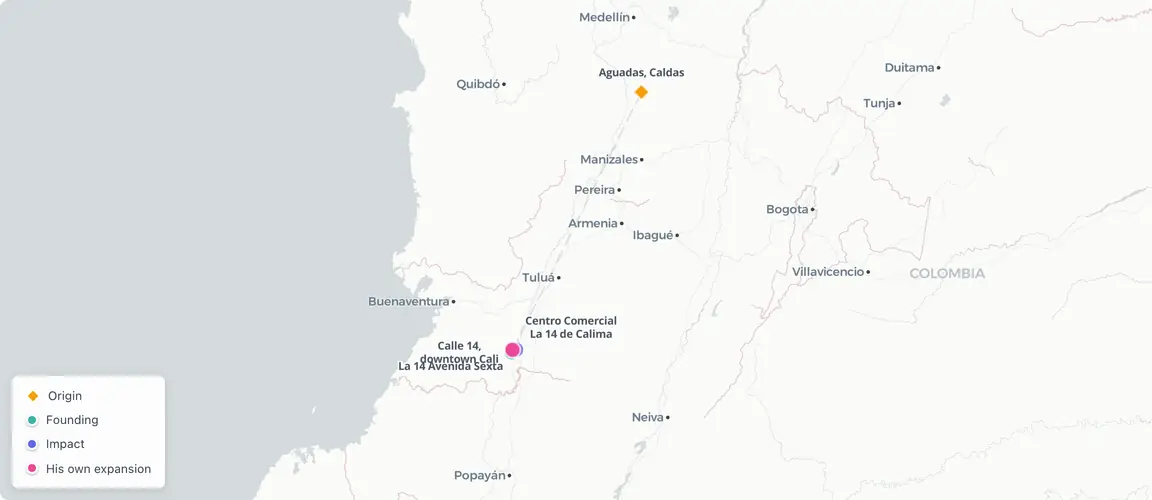
He was born into a business still finding its shape. His father, Abel Cardona Franco, had left Aguadas, a coffee town in Caldas, to settle in Cali around 1950, partnering with Antonio Villegas in a modest general-goods venture called La Gran Cacharrería. By 1963, Abel had bought out his partner, annexed a neighboring shop on Calle 14, and renamed the combined store Cacharrería La 14 — the direct predecessor of the company that would formally take the Almacenes La 14 name in 1964. Jaime grew up inside this expanding family enterprise, absorbing its retail instincts and its personal, relationship-driven way of doing business long before he had any formal authority over it.
The year the son took over #
That authority arrived in 1983, when Jaime took full leadership of the company from his father. What followed was not a gradual handover but a wholesale acceleration: he opened the Avenida Sexta store the same year and launched an expansion era that would carry La 14 from a Cali institution to the dominant retailer of an entire region. Four years later, in 1987, he opened what would become both the company’s largest store and its permanent headquarters — Centro Comercial Calima, built and financed through the family’s own real-estate company, Calima Desarrollos Inmobiliarios S.A. Under his leadership La 14 crossed into new departments and cities across the 1990s and 2000s — Manizales in 1992, then a widening footprint across Valle del Cauca, then as far afield as Popayán, Pereira, Armenia, and eventually Bogotá by 2011, the furthest and most consequential expansion of his tenure. He ran the company for 32 unbroken years, longer than most of his employees had been alive, and in that time built a genuine regional institution: a business commanding roughly 30 percent of Valle del Cauca’s retail demand, fourth-largest in the country by sales, known across the region for its Christmas jingle, its red logo, and the children’s amusement rides permanently installed at the Calima store.
His approach to leadership was inseparable from his approach to the people who worked for him. Colleagues and former employees who spoke to the press after his death described a management style built on direct, personal contact rather than institutional distance — a founder who moved through his own stores knowing names, not just titles. That personal register extended to his public identity as well: La 14’s own advertising and internal culture leaned into slogans like “¡Siempre te da más!” and “El mejor surtido a los mejores precios,” phrases that Cardona, by every account, treated as genuine commitments rather than marketing copy. The family’s ownership of Canal 14, a local Cali television channel created to give the company’s own suppliers an affordable advertising platform, was itself an expression of the same instinct — building infrastructure that served the wider community of people the business depended on, not just the company’s own balance sheet.
Papá Jaime #
What made Jaime distinctive was not just what he built but how personally he built it. Employees and colleagues who spoke to the press after his death consistently described a man who insisted on knowing his own people by name and title — “papá Jaime” was not a nickname invented for a retrospective; it was how people who worked for him actually referred to him while he was alive. In a 2004 interview with El País — the last extended interview he would give, later republished in the days after his death — he reflected on the company’s earliest days with striking candor: “¿Cuándo usted y sus hermanos crearon el almacén en la Calle Catorce imaginaron a dónde iba a llegar? No, nunca. Pero el optimismo que traíamos y el deseo de estar en Cali nos hizo seguir adelante a pesar de las adversidades del principio, porque empezar un negocio no es tarea fácil.” He spoke, too, about the private-label products the company had deliberately delayed introducing until it had something he considered genuinely high quality — a founder who trusted patience over speed, even in a business built on scale.
That same interview material, recalled by El País in its 2015 obituary coverage, captured a philosophy that would prove tragically ironic. Cardona described his management approach in terms of collective competence rather than personal indispensability: “No hay nadie indispensable en este mundo… lo que he hecho es trabajar en equipo con toda la familia y los colaboradores, conformando un grupo de profesionales que entiende la logística del negocio y la manera de administrarlo.” He spoke of a deliberate commitment to keeping La 14 a family-and-collaborator enterprise — “Con el tiempo uno entiende que es mejor caminar unidos. Nuestra filosofía es seguir operando como una empresa de familia, pero sin desvincularnos de los colaboradores que han impulsado este negocio” — a philosophy he held to when buyers came: in the same interview he said many offers had arrived and the answer had been no. After his death El País reported that one of the offers received over the years was from Walmart, and the family did not deny it.
The night of 24 November #
He worked, by every account, until the very end. A supplier who spoke with him the evening of 24 November 2015 was among the last to see him; he died in the predawn hours of 25 November of a sudden heart attack. He was 82. There was no announced successor, no transition plan the board could activate, no structure that had been built to survive his absence. The label people gave him — “papá Jaime” — was not a marketing invention or a posthumous flourish. It reflected a genuinely paternalistic labor culture at the company: employees who spoke to reporters after his death described being greeted by name on the shop floor, a level of direct familiarity unusual for a retailer of La 14’s scale. That same paternalism, which built decades of loyalty among his workforce, meant that authority at the company had never really been distributed — it had been personally embodied in one man, for 32 years, without a documented plan for what would happen when he was no longer there to embody it. In the immediate aftermath, the company’s own board insisted publicly that no “trauma” existed and that a corporate-governance structure had been in place for years — but the record of what followed suggests otherwise. The post was initially left unfilled. Outside managers were brought in starting in 2017, then family members rotated through operational roles in turn, and neither restored the direction the company had lost. Over the following six years, the company that Jaime Cardona had spent 32 years building entered financial collapse, judicial reorganization, and ultimately judicial liquidation — the family’s own equity in the business, built across nearly six decades since his father’s arrival in Cali, was largely destroyed in the process. His brother, Alberto Cardona Parra, who had also been part of the family’s later stewardship of the business, died in September 2021, the same year the liquidation was formally decreed — the dynasty’s two remaining links to the founding generation gone within the same collapse.
The mechanics of what happened after his death are, in their way, a portrait of the very culture he had built. A hands-on leader who personally knew his employees and greeted them by name had also built an organization where authority ran through him specifically, not through documented processes or a groomed deputy. When he was gone, the company did not lack capable people — it cycled through an outside manager, then family members rotating through operational roles — but it lacked a structure that told those people, collectively, what to do next. Each new leader inherited the company’s problems without inheriting Cardona’s standing to solve them the way he had: through personal relationships built over three decades, not through an institutional mandate anyone could simply assume. The overlap of his brother Alberto’s death that same year with the company’s own legal end was almost certainly coincidental, but it underscored how thoroughly the enterprise’s fate remained tied to the specific people who had built it, rather than to any institution capable of outliving them.
The man who said no one was indispensable #
There is a specific poignancy in how close Cardona came, in his own words, to naming the exact risk that would eventually destroy the company. His 2004 reflection on teamwork — “lo que he hecho es trabajar en equipo con toda la familia y los colaboradores” — described a genuine strength of his leadership style: La 14 was not a one-man operation in the sense of being narrow or brittle in its daily functioning. It employed thousands, ran dozens of stores, and had weathered real external pressure for decades under his direction. But “trabajar en equipo” is not the same as “institutionalized succession,” and the distinction is exactly where the company’s fate turned. A team built around a central figure who personally holds ultimate authority is not the same as an organization that has rehearsed operating without him. Cardona’s own confidence that no one is indispensable may have been true of any single day-to-day decision at La 14. It was not true of the decision that mattered most — who would lead when he no longer could.
Jaime Cardona Parra’s story is not a story of failure in the conventional sense. He did not lose the company to a smarter competitor, a hostile takeover, or a strategic miscalculation of his own making. He built something durable enough to survive decades of multinational retail expansion into Colombia, currency volatility, and generational change in Colombian shopping habits — the same forces that had already displaced or diminished many of his regional peers. What he did not build — what his own hands-on, deeply personal style of leadership may have made structurally difficult to build — was a mechanism for his own eventual absence. He told a reporter that no one is indispensable. His own company’s collapse, in the years immediately following his death, is the clearest evidence that in practice, for La 14, he was.
The lesson his story leaves behind is not that paternalistic, hands-on leadership is a mistake. It plainly was not, for Cardona — it produced 32 years of sustained growth, deep employee loyalty, and a regional institution that outlasted currency crises and multinational competition alike. The lesson is narrower and harder: the very qualities that make a founder irreplaceable in the daily life of a company are the same qualities that make his eventual absence catastrophic, unless he deliberately builds the structure that survives him. Jaime Cardona built almost everything else La 14 needed. The one thing he did not build was the version of the company that could exist without him.
Brandmine Founder Resilience Profiles document the full transformation arc, strategic decisions, and market context behind a founder's journey in emerging markets.
Each profile is researched and compiled to institutional standards, and delivered within approximately 3 business days.
Researched 25 sources in Spanish.